PharmExPrep

Free lesson

Public BCACP Blueprint Domains

The first lesson of BCACP Prep Course (BCACP), free to read.

Public BCACP Blueprint Domains

What you’ll learn:

  • Map the publicly available BCACP blueprint into practical study buckets for ambulatory care exam prep.
  • Identify which domain language signals medication optimization, monitoring, preventive care, transitions, and population health tasks.
  • Choose the most appropriate study emphasis when a question stem blends multiple domains.
  • Distinguish blueprint-tested ambulatory pharmacist actions from out-of-scope physician-level actions.
  • Use a domain-first approach to organize review, triage question stems, and reduce distractor error.

Blueprint mapping:

  • DOMAIN: Public BCACP framework interpretation → Objective: identify major competency areas → Subskill: translate broad blueprint language into teachable outpatient medication-management tasks
  • DOMAIN: Exam blueprint navigation → Objective: align study strategy with published domains → Subskill: recognize recurring ambulatory care themes across pharmacotherapy, monitoring, prevention, and systems work
  • DOMAIN: Ambulatory care decision-making → Objective: remain within pharmacist role → Subskill: frame answers as recommendations, follow-up plans, and escalation when authority is not explicit

Estimated time: 45–60 minutes

Prereqs: None yet; upcoming linked topics include Ambulatory Pharmacist Scope Boundaries and Outpatient Case Decision Framework

Key outputs: You should be able to classify stems by blueprint domain, choose the best study target for each domain, and reject answers that leave ambulatory pharmacist scope.

Why it matters

  • The BCACP exam tests broad ambulatory care competence, so the safest first step is recognizing what type of task the stem is asking before chasing details.
  • Many wrong answers look clinically reasonable but belong to a different setting, a different role, or a different blueprint domain.
  • A domain-first mental model improves time management: you identify the likely tested skill, then apply the correct guideline or monitoring rule.
  • Understanding the public blueprint prevents overstudying obscure content while underpreparing core longitudinal outpatient decisions.
Fig 1. BCACP blueprint to task map
Exam takeaway: Match the stem to a domain first, then choose the ambulatory pharmacist action that best fits.
flowchart TD
A[Read stem] --> B{What is being tested?}
B --> C[Medication optimization]
B --> D[Monitoring and follow-up]
B --> E[Preventive care or screening]
B --> F[Transitions or reconciliation]
B --> G[Population health or systems]
C --> H[Choose regimen, dose, safety checks]
D --> H
E --> H
F --> H
G --> H
H[Answer within ambulatory pharmacist scope]

Use this frame throughout the lesson. See Fig 1.

Key Terms & Must-Know Facts

Key terms

  • Blueprint domain: major tested competency area listed in the public BCACP framework
  • Subskill: a teachable outpatient task nested under broad blueprint language
  • Longitudinal care: ongoing outpatient follow-up rather than one-time acute stabilization
  • Medication optimization: initiating, adjusting, simplifying, or stopping therapy to improve outcomes
  • Monitoring plan: what to track, when to recheck, and what threshold triggers action
  • Transitions of care: medication reconciliation and follow-up after movement between care settings
  • Population health: panel-based gap closure, outreach, and quality metric improvement
  • Preventive care: immunizations, screening support, risk reduction, and early intervention
  • Escalation: referral or collaboration when symptoms, instability, or authority limits exceed pharmacist scope
  • Question task: the exact thing the item asks you to decide
  • Noise: nonessential details included to distract from the tested rule
  • Best next step: the highest-priority ambulatory action for that scenario

Must-know facts

  • The public blueprint gives broad tested areas; do not invent hidden domain weights or unsupported details.
  • BCACP prioritizes outpatient medication management, monitoring, prevention, follow-up, and system-aware decision-making.
  • Many stems combine domains; choose the answer based on the primary decision conflict.
  • If authority is not explicit, frame actions as recommendations, collaboration, education, follow-up, or escalation.
  • In ambulatory care questions, feasibility, adherence, access, safety, and follow-up are often the discriminating clues.
  • Outpatient red flags should trigger referral or urgent escalation rather than solo medication tweaking.
  • Quality and population health content commonly appears as care-gap closure, registry review, and panel prioritization.
  • Transitions content often tests discrepancy detection, omission, duplication, and unsafe continuation after discharge.
Blueprint language What it usually means on exam day Typical pharmacist task
Patient assessment Interpret meds, labs, vitals, risks, barriers Identify medication-related problems
Therapeutic decision-making Choose or modify drug therapy Recommend initiation, titration, de-escalation
Monitoring and safety Track efficacy, toxicity, interactions, follow-up Build monitoring plan and action thresholds
Preventive care Risk reduction and vaccinations Close preventive care gaps
Transitions of care Post-discharge or cross-setting medication review Reconcile, clarify, educate, follow up
Population health / quality Panel-level care improvement Prioritize outreach and metric-based intervention

Core content

1.1.1.1 Foundational blueprint architecture: what the public domains actually tell you

A. Explanation

The first decision conflict is broad framework versus overreading. Students often want a hidden list of exact test percentages or a secret hierarchy of topics. Reject that impulse. The public BCACP blueprint is designed to tell you the major competency categories, not to function as a minute-by-minute prediction tool. Your job is to convert broad labels into ambulatory care pharmacist subskills: medication selection, dose optimization, lab interpretation, preventive care, follow-up timing, reconciliation, adherence strategy, and escalation when the situation exceeds scope.

WHY THIS IS TESTED: exam items are written from broad competency statements, so candidates who can translate blueprint wording into practical outpatient tasks identify the tested rule faster than candidates who memorize isolated facts.

The choose-versus-reject rule here is simple: choose an interpretation anchored in real ambulatory medication-management tasks; reject any interpretation that assumes unpublished blueprint detail or non-ambulatory physician authority. See Fig 2 for a clean summary of how broad domains become study actions.

Concept flow: Converting a domain into a study target
Read domain phrase
Start with the public wording, not assumptions.

Translate to task
Ask what outpatient medication decision this wording implies.

Assign study bucket
Group into assessment, therapy, monitoring, prevention, or systems.

Prepare for stems
Expect mixed-domain cases and choose the primary task.

Fig 2. From domain label to exam subskill
Exam takeaway: Translate broad blueprint wording into a concrete ambulatory pharmacist task before choosing an answer.
flowchart LR
A[Public domain] --> B[Assessment]
A --> C[Therapy optimization]
A --> D[Monitoring]
A --> E[Prevention]
A --> F[Systems and population health]
B --> G[Extract labs vitals meds risks]
C --> H[Choose adjust stop simplify]
D --> I[Set follow-up and safety plan]
E --> J[Close care gaps]
F --> K[Prioritize panel-level action]
Memory anchor: Think A-T-M-P-S for blueprint translation: Assess, Treat, Monitor, Prevent, Systems. If you can place a stem into one of these buckets, you are already narrowing the best answer set.

B. Worked example

A 58-year-old man with type 2 diabetes, hypertension, and obesity comes for an ambulatory pharmacy visit after a health-system quality initiative flagged him for uncontrolled risk factors. Current medications are metformin 1000 mg by mouth twice daily, lisinopril 20 mg by mouth daily, and atorvastatin 20 mg by mouth nightly. His A1c is 8.6%, BP is 146/88 mm Hg, and he reports missing evening doses twice weekly because of shift work. A recent dental infection treated with amoxicillin is noted in the chart. The study question asks which blueprint domain is most directly being activated by this outreach encounter.

Reasoning chain: Identify task: this is not asking for a diagnosis; it asks what competency area the encounter represents. Extract key facts: quality initiative, risk-factor review, medication adherence issue, chronic disease gaps. Apply rule: panel-based outreach and gap closure point to population health/quality, even though disease management details are present. Eliminate distractors: acute infection management is noise; the dental antibiotic is not the tested issue. Verify: the ambulatory pharmacist action is systematic identification and optimization of care gaps at both patient and panel level.

C. Exam trap

Common wrong answer: “This is primarily infectious disease management.” WHY IT IS TEMPTING: the stem includes an antibiotic and a recent infection, so test-takers anchor on the freshest medication. The SINGLE CLUE that eliminates it: the visit was triggered by a quality initiative and focuses on chronic disease gaps, which maps to blueprint-level population health and longitudinal optimization.

D. Checkpoint

Question: A clinic registry identifies patients with ASCVD who are on moderate-intensity statins despite repeated LDL-C elevation. Which blueprint-oriented task is most directly being tested when the pharmacist reviews the list and recommends therapy intensification?

  1. A. Population health and medication optimization
  2. B. Acute stabilization of cardiovascular disease
  3. C. Independent diagnostic cardiology evaluation
  4. D. Inpatient formulary stewardship

Option A: tempting because it fits registry review and is correct because the task is panel-based gap closure with outpatient regimen optimization. Option B: tempting because ASCVD sounds high risk, but wrong because no acute instability is described. Option C: tempting because lipid management overlaps with diagnosis and risk assessment, but wrong because the pharmacist is not independently diagnosing cardiac disease. Option D: tempting because formulary and systems work sound operationally similar, but wrong because the scenario is ambulatory registry outreach, not inpatient medication-use policy.

If you missed this: Review 1.1.1.1 Foundational blueprint architecture: what the public domains actually tell you — focus on translating broad domain labels into concrete outpatient pharmacist tasks.
Pharmacist Action: NOTICE broad domain words that imply assessment, optimization, prevention, or systems work; SAY “This looks like a panel-management medication gap rather than an acute-care problem”; MONITOR whether the stem’s main task is patient-level or population-level; HOLD/CLARIFY/ESCALATE when the answer choice assumes hidden blueprint details or physician-only authority.

1.1.1.2 Foundational ambulatory scope signals within the blueprint

A. Explanation

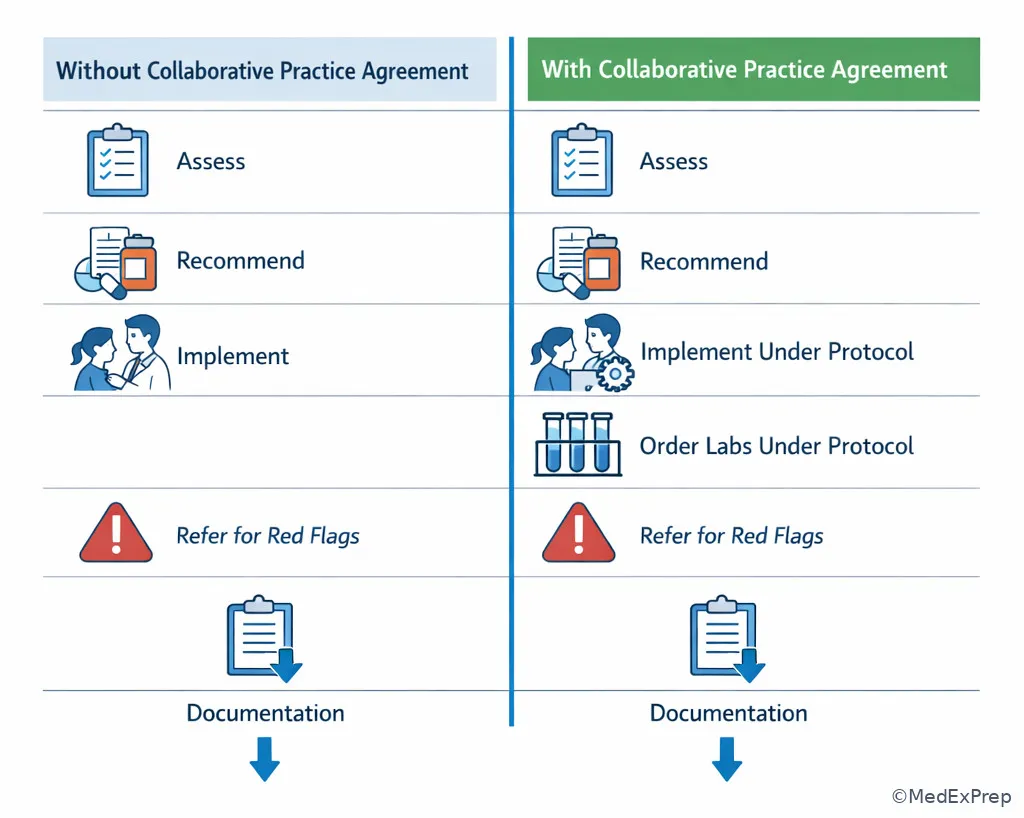
The second decision conflict is ambulatory pharmacist action versus out-of-role action. BCACP candidates are expected to make evidence-based medication recommendations, build monitoring plans, counsel, reconcile medications, and support prevention and quality improvement. They are not expected to act as unrestricted prescribers or attending physicians unless the stem explicitly grants protocol-based authority. This matters because many distractors are not clinically absurd; they are simply mismatched to candidate role.

WHY THIS IS TESTED: the exam wants safe, setting-appropriate decisions. In an outpatient case, the best answer often includes recommendation, collaboration, follow-up interval, documentation, adherence intervention, or escalation for red flags. See Fig 3.

Choose answers framed as medication-management actions within ambulatory workflow. Reject answers that imply independent diagnosis, hospital admission management, procedure ordering without protocol, or emergency attending-level control. Because this is the first lesson in the course, think of this as the prelude to the upcoming topic on Ambulatory Pharmacist Scope Boundaries, where the role lines will be sharpened further.

Concept flow: Scope check before answering
Spot the task
Therapy, monitoring, education, reconciliation, or referral?

Check authority
If protocol authority is not explicit, frame as recommendation or escalation.

Choose outpatient-safe action
Prefer follow-up, counseling, monitoring, and collaboration.

Fig 3. Ambulatory scope filter for answer choices
Exam takeaway: If the stem does not grant authority, select recommendation, monitoring, counseling, or escalation rather than independent prescribing or diagnosis.
flowchart TD
A[Answer choice] --> B{Within ambulatory pharmacist role?}
B -->|Yes| C[Recommend optimize monitor counsel reconcile]
B -->|No| D[Reject]
D --> E[Independent diagnosis]
D --> F[Admit or manage ICU]
D --> G[Order procedures without protocol]
D --> H[Ignore red-flag escalation]
Recall: This is the first topic in the course, so there is no prior lesson to build from. In the upcoming topic Ambulatory Pharmacist Scope Boundaries, you will formalize this same rule into a faster stem triage method.

B. Worked example

A 74-year-old woman with HFpEF, CKD stage 3a, and osteoarthritis calls the ambulatory care clinic two days after discharge. Her discharge list includes furosemide 40 mg by mouth daily, losartan 50 mg by mouth daily, apixaban 5 mg by mouth twice daily, and ibuprofen 600 mg by mouth three times daily as needed that she restarted from home. She reports lightheadedness and black stools. Her husband asks the pharmacist to “just change the blood thinner dose right now.” The stem asks for the most appropriate pharmacist action.

Reasoning chain: Identify task: safe outpatient action within scope. Extract key facts: anticoagulant use, possible GI bleeding, NSAID interaction, post-discharge setting, red-flag symptoms. Apply rule: urgent red flags exceed routine medication optimization; best action is escalation and collaboration, not independent dose change. Eliminate distractors: simply counseling to separate doses or switching to aspirin is unsafe and misses probable bleeding. Verify: ambulatory pharmacist should urgently refer/escalate and communicate the suspected medication-related harm to the care team.

C. Exam trap

Common wrong answer: “Reduce apixaban to 2.5 mg twice daily immediately.” WHY IT IS TEMPTING: dose reduction feels like medication management and seems safer than full-dose anticoagulation. The SINGLE CLUE that eliminates it: black stools plus lightheadedness indicate a red-flag bleeding scenario requiring urgent escalation, not routine ambulatory dose fine-tuning.

D. Checkpoint

Question: Which answer choice most clearly stays inside the BCACP ambulatory pharmacist role when protocol authority is not stated?

  1. A. Recommend adding a GLP-1 receptor agonist, document rationale, and arrange follow-up in 4 weeks
  2. B. Independently diagnose heart failure stage and write the new prescription
  3. C. Admit the patient directly for uncontrolled blood pressure
  4. D. Order abdominal CT imaging for unexplained weight loss without protocol authority

Option A: tempting and correct because it reflects recommendation, documentation, and follow-up planning within ambulatory medication management. Option B: tempting because treatment selection often requires staging context, but wrong because the action assumes unrestricted prescriber and diagnostic authority. Option C: tempting because severe disease can require escalation, but wrong because direct admission management exceeds the usual pharmacist candidate role unless explicit systems authority is given. Option D: tempting because weight loss may need workup, but wrong because ordering imaging without protocol authority is out of role.

If you missed this: Review 1.1.1.2 Foundational ambulatory scope signals within the blueprint — focus on choosing recommendation/collaboration/escalation over independent physician-level actions.
Quick Recall:

  • True or False: If protocol authority is not stated, “recommend and coordinate follow-up” is usually safer than “independently prescribe.”
  • The most common scope error in BCACP stems is confusing ambulatory medication management with acute physician-level management.
  • Name 3 in-scope action verbs: recommend, monitor, counsel.
High-Yield Connection: This concept is tested alongside Transitions Of Care Planning and Medication Reconciliation Strategy. Know both the role boundary and the post-discharge safety workflow for exam day — they are frequently paired in stems.
Pharmacist Action: NOTICE verbs such as diagnose, admit, intubate, order imaging, or independently prescribe; SAY “My role here is to recommend, monitor, reconcile, or escalate”; MONITOR for red flags that shift a routine question into urgent referral; HOLD/CLARIFY/ESCALATE when symptoms suggest instability or when authority is not explicit.

1.1.1.3 Applied domain recognition: how mixed stems hide the primary tested objective

A. Explanation

The next decision conflict is multiple true facts versus the primary tested objective. Real ambulatory cases mix adherence problems, lab interpretation, preventive care gaps, cost barriers, and disease-state management in one paragraph. Your job is not to solve every problem at once. Your job is to identify the stem’s main ask. If the question asks for the best monitoring plan, do not choose the most elegant treatment intensification. If it asks for the most appropriate next step after discharge, do not anchor on long-term population-health strategy.

WHY THIS IS TESTED: mixed-domain stems reward prioritization. Test writers add realistic noise so candidates must distinguish the dominant domain from secondary details. See Fig 4.

The resolving rule is: find the action verb in the stem, then match it to the blueprint bucket. “Most important to monitor” points to monitoring/safety. “Best next step after hospitalization” often points to transitions and reconciliation. “Best panel intervention” points to quality/population health. “Best regimen optimization” points to therapeutic decision-making. This is the bridge to the upcoming topic Outpatient Case Decision Framework.

Concept flow: Identifying the primary tested objective
Read the actual ask
Best next step, best monitoring, best outreach, or best regimen?

Ignore noise
Keep only facts that change that specific decision.

Map to domain
Assessment, therapy, monitoring, prevention, transition, or systems.

Answer narrowly
Pick the option that solves the asked problem first.

Fig 4. Mixed-stem objective finder
Exam takeaway: The action verb in the question stem determines which domain should drive your answer.
flowchart TD
A[Question stem] --> B{Action verb}
B --> C[Monitor]
B --> D[Optimize regimen]
B --> E[Reconcile after transition]
B --> F[Close preventive gap]
B --> G[Prioritize population action]
C --> H[Monitoring domain]
D --> I[Therapeutic domain]
E --> J[Transitions domain]
F --> K[Preventive care domain]
G --> L[Quality systems domain]
Recall: In the upcoming topic Outpatient Case Decision Framework, we will formalize the sequence identify task → extract key facts → apply rule → eliminate distractors → verify safety and follow-up. Here, we are building the first step: identify task by blueprint domain.

B. Worked example

A 63-year-old man with HFrEF, type 2 diabetes, and COPD presents for a pharmacist visit 10 days after hospitalization. Medications include carvedilol 12.5 mg by mouth twice daily, sacubitril/valsartan 49/51 mg by mouth twice daily, spironolactone 25 mg by mouth daily, empagliflozin 10 mg by mouth daily, tiotropium inhalation daily, and albuterol as needed. BP is 104/66 mm Hg, serum potassium is 5.3 mEq/L, and he says he has not received the updated discharge medication list from his outside cardiologist. He also asks whether he should get pneumococcal vaccination this year. The item asks for the most appropriate next step in the pharmacist’s post-discharge process.

Reasoning chain: Identify task: post-discharge process, not vaccination, not long-term HF optimization. Extract key facts: recent hospitalization, possible discrepancy, incomplete discharge list, high-risk regimen, potassium elevation. Apply rule: transitions of care domain dominates; medication reconciliation and clarification come first. Eliminate distractors: vaccine review is appropriate but secondary; immediate uptitration of HF therapy is premature until the discharge regimen is confirmed. Verify: the best ambulatory action is to obtain and reconcile discharge medications, clarify discrepancies, and coordinate timely follow-up/monitoring.

C. Exam trap

Common wrong answer: “Administer pneumococcal vaccine today because preventive care is important.” WHY IT IS TEMPTING: preventive care is absolutely within BCACP scope and often rewarded on exam items. The SINGLE CLUE that eliminates it: the stem specifically asks for the next step in the post-discharge process, making transitions and reconciliation the primary tested domain.

D. Checkpoint

Question: A stem asks for the “most important parameter to monitor 1–2 weeks after starting losartan 50 mg by mouth daily in a patient with CKD and hypertension.” Which domain should lead your answer?

  1. A. Monitoring and safety
  2. B. Preventive care
  3. C. Population health
  4. D. Diagnostic radiology coordination

Option A: tempting and correct because the action verb is monitor and the scenario centers on medication follow-up. Option B: tempting because CKD patients need preventive care too, but wrong because the asked task is short-interval lab monitoring after therapy initiation. Option C: tempting because CKD patients may be managed through panel registries, but wrong because this is an individual follow-up decision. Option D: tempting because CKD workup can involve diagnostics, but wrong because imaging is unrelated to the medication-monitoring ask.

If you missed this: Review 1.1.1.3 Applied domain recognition: how mixed stems hide the primary tested objective — focus on using the stem’s action verb to identify the tested domain.
Pharmacist Action: NOTICE the exact wording of the ask before reading all details; SAY “The primary task here is reconciliation/monitoring/prevention, not every issue in the chart”; MONITOR your own tendency to chase eye-catching but secondary details; HOLD/CLARIFY/ESCALATE only after the main asked task is satisfied.

1.1.1.4 Integration across domains: study strategy and question triage for BCACP

A. Explanation

The final foundational integration conflict is studying by disease state alone versus studying by blueprint function. Disease-state review is necessary, but BCACP rewards candidates who can also think functionally: assess, optimize, monitor, prevent, reconcile, and manage population care. The highest-yield study plan is dual-coded. For each major ambulatory disease state, ask: What are the common assessment findings? What optimization choices are most tested? What monitoring errors are common? What prevention gaps matter? What transitions issues appear? What population-health metric or care gap is paired with this condition?

WHY THIS IS TESTED: the exam is not just a pharmacology inventory. It tests how an ambulatory care pharmacist uses evidence over time in real outpatient systems. See Fig 5.

Choose a study plan that cross-links diseases to functions. Reject a plan that memorizes drug lists without follow-up strategy, access barriers, or system-level application. This is especially important in ambulatory care because the “best answer” frequently depends on what is feasible to monitor, affordable to obtain, and safe to implement in longitudinal follow-up.

Concept flow: Building a blueprint-based study plan
Pick a disease state
Example: diabetes, HF, asthma, CKD, or lipids.

Run A-T-M-P-S
Assess, Treat, Monitor, Prevent, Systems.

Add scope filter
Ask what the ambulatory pharmacist can recommend or escalate.

Practice mixed cases
Train on stems with realistic noise and competing priorities.

Fig 5. Ambulatory pharmacist blueprint study board
Exam takeaway: Organize each disease state by assessment, therapy, monitoring, prevention, and systems tasks to mirror how BCACP stems are built.
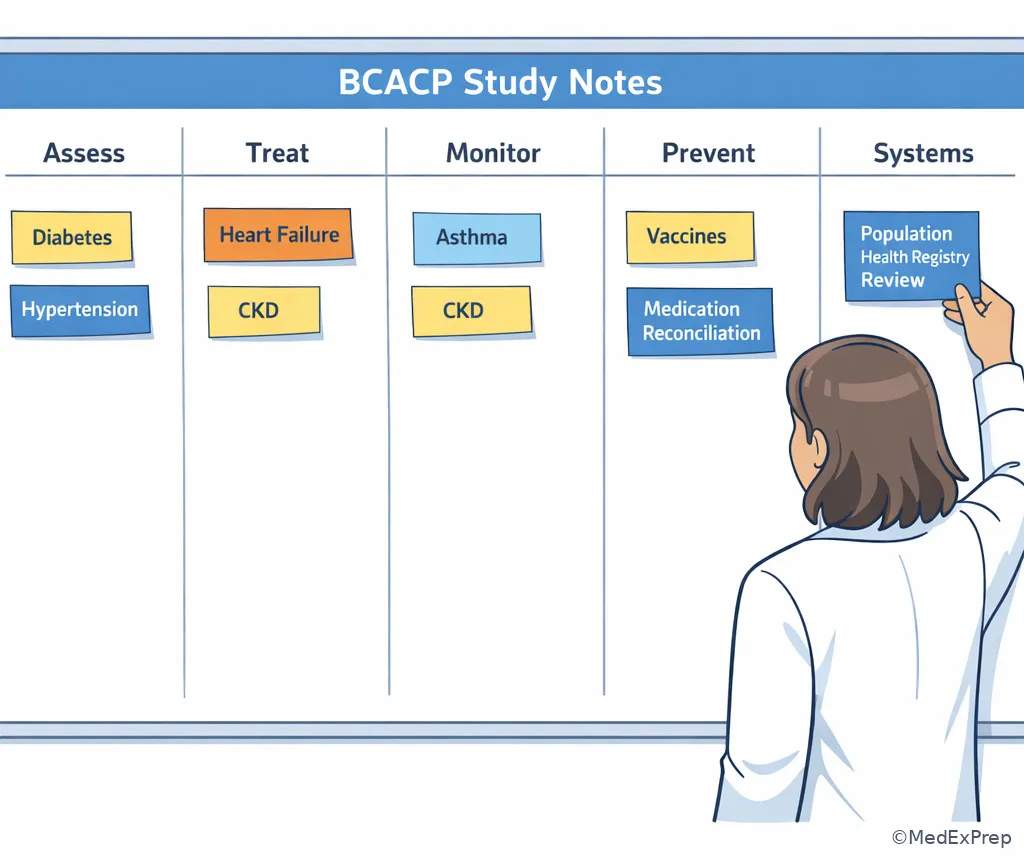
Fig 5. Ambulatory pharmacist blueprint study board
Outpatient panel management dashboard
Exam takeaway: Registry-driven care-gap review commonly tests quality improvement and population health skills in ambulatory practice.
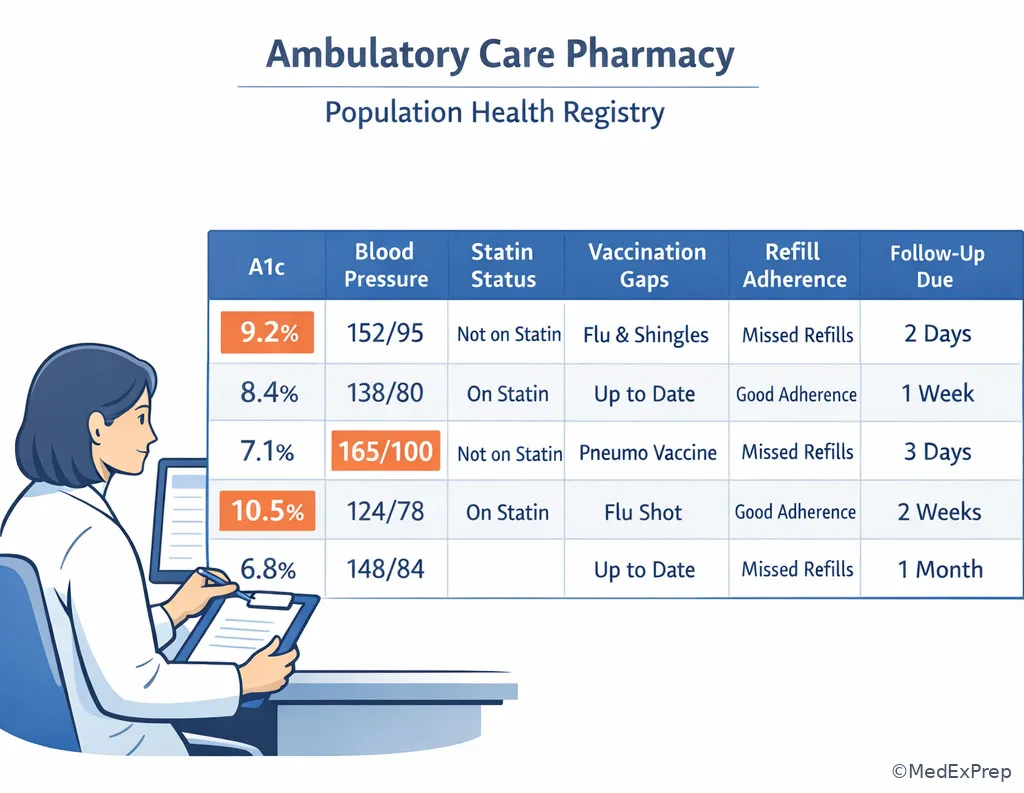
Outpatient panel management dashboard

B. Worked example

A PGY2 ambulatory care resident building a BCACP study schedule plans to spend three weeks memorizing antihyperglycemic drug mechanisms and one day on follow-up, preventive care, and medication reconciliation. Their preceptor asks for the most appropriate blueprint-aligned revision. The resident also mentions that they recently struggled with questions involving payer barriers and post-discharge discrepancies, despite knowing the drug classes well.

Reasoning chain: Identify task: choose the best study strategy based on public domains. Extract key facts: disease-state memorization is strong; systems, follow-up, and transitions are weak. Apply rule: the public blueprint spans more than pharmacology recall. Eliminate distractors: doubling down on memorization of mechanisms alone ignores the actual weakness pattern. Verify: the best revision is to pair each disease state with monitoring, preventive care, access/adherence, transitions, and quality-improvement tasks.

C. Exam trap

Common wrong answer: “Study only the highest-volume chronic diseases and skip systems content.” WHY IT IS TEMPTING: common diseases do dominate ambulatory care practice, and learners often feel more secure with concrete pharmacotherapy than process questions. The SINGLE CLUE that eliminates it: the blueprint explicitly includes prevention, transitions, monitoring, and population-health functions that frequently determine the best answer even within common disease states.

D. Checkpoint

Question: Which study plan best mirrors the public BCACP blueprint?

  1. A. Review each disease by assessment, regimen selection, monitoring, preventive care, and common ambulatory systems issues
  2. B. Memorize inpatient guideline algorithms first because they are more detailed
  3. C. Focus only on rare specialty diseases because they are harder
  4. D. Study pharmacology mechanisms without follow-up intervals or adherence barriers

Option A: tempting and correct because it reflects the functional structure of the blueprint and ambulatory practice. Option B: tempting because inpatient guidelines can feel more specific, but wrong because BCACP prioritizes outpatient longitudinal care. Option C: tempting because difficulty may feel high yield, but wrong because the public blueprint emphasizes broad ambulatory competencies, not rarity chasing. Option D: tempting because mechanisms are foundational, but wrong because stems often hinge on implementation, safety, and follow-up rather than mechanism alone.

If you missed this: Review 1.1.1.4 Integration across domains: study strategy and question triage for BCACP — focus on the A-T-M-P-S study framework and why disease-state review alone is insufficient.
Quick Recall:

  • Fill in the blank: A dual-coded BCACP study plan links each disease state to both content facts and functional ambulatory tasks.
  • True or False: If you know the drug class but not the follow-up plan, you are still fully prepared for BCACP mixed stems.
  • Name the 5 A-T-M-P-S study buckets.
High-Yield Connection: This concept overlaps with Titration And Follow-Up Intervals and Monitoring Parameter Design. Know both drug selection and what happens after the recommendation — they are frequently paired in BCACP stems.
Pharmacist Action: NOTICE when your study method overweights memorization and underweights implementation; SAY “For each disease, I need the regimen, monitoring, access plan, and follow-up interval”; MONITOR your weak domains using missed-question patterns; HOLD/CLARIFY/ESCALATE your study plan if it ignores transitions, prevention, or population health.

Exam Traps & Differentiators

Most common wrong answer and why: choosing a clinically true statement that does not answer the actual task. In BCACP stems, several options may be reasonable in general, but only one matches the primary domain, pharmacist scope, and outpatient priority.

Looks similar But the stem is really testing Single discriminator
Preventive care advice Transitions of care Recent discharge, med discrepancies, or pending reconciliation
Regimen intensification Monitoring and safety Question asks what to monitor or which lab matters next
Patient-level disease management Population health Registry, dashboard, outreach list, metric gap, or panel review
Independent prescribing Pharmacist recommendation/collaboration No explicit protocol authority in stem
Outpatient management Urgent escalation Red flags, instability, bleeding, severe symptoms, or acute deterioration
Interesting disease detail Main action verb “Best monitoring,” “best next step,” “requires clarification,” or “best outreach”

If the stem says...

  • “Registry,” “outreach,” “panel,” or “quality initiative” → think population health / systems.
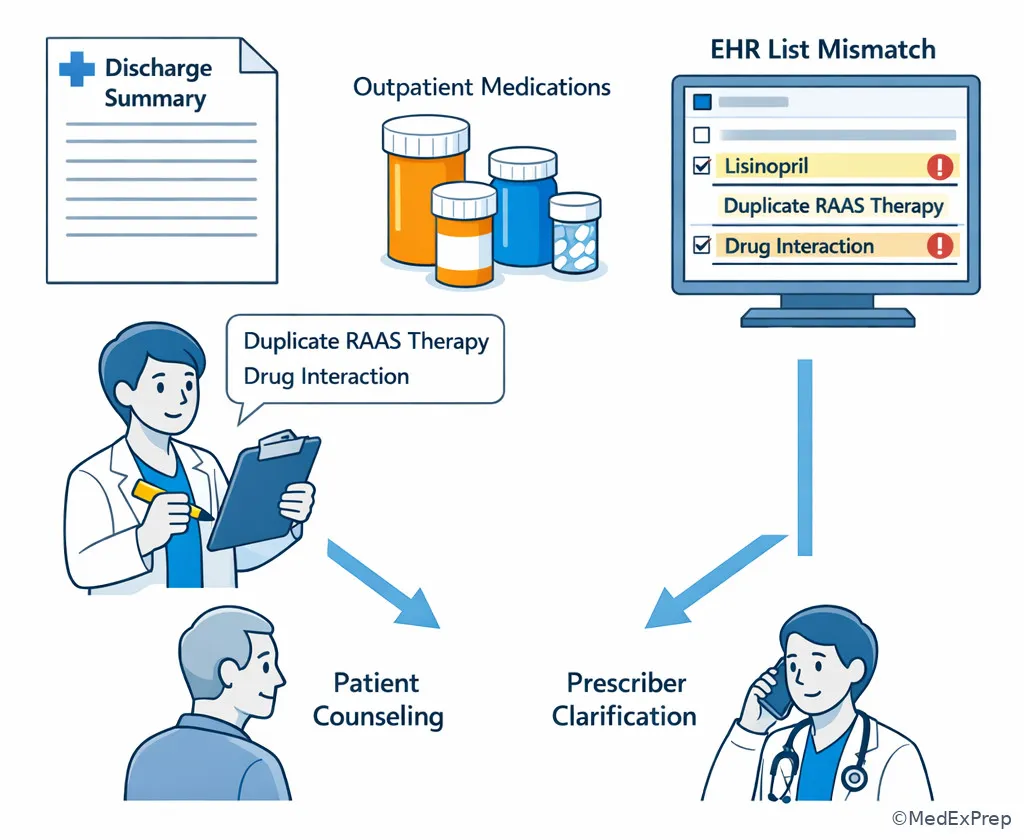
  • “After discharge,” “med list discrepancy,” or “hospital medication changes” → think transitions of care / reconciliation.
  • “Most important to monitor in 1–2 weeks” → think monitoring and safety.
  • “No protocol authority stated” → think recommend, collaborate, document, or escalate.
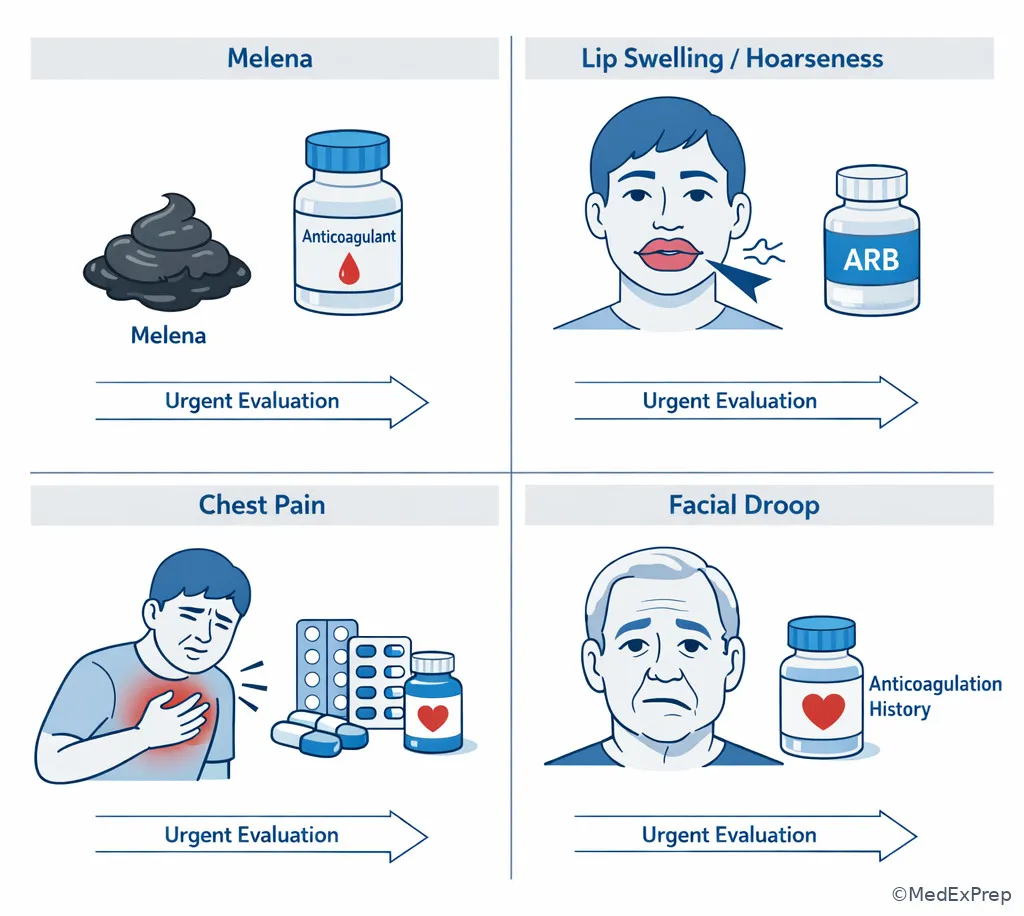
  • “Black stools,” “worsening dyspnea at rest,” “confusion,” or “severe symptomatic change” → think urgent escalation beyond routine ambulatory adjustment.
Ambulatory scope boundary cues
Exam takeaway: Red-flag symptoms and absent authority language should push you toward escalation or recommendation, not independent physician-level action.
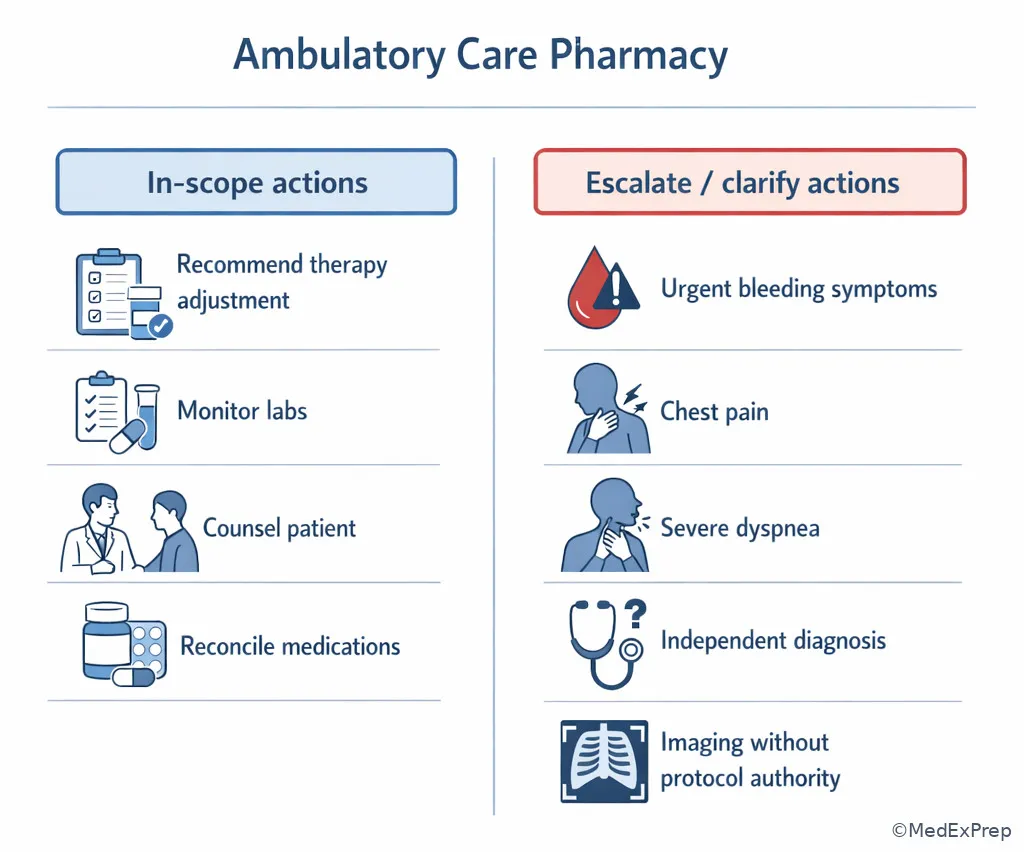
Ambulatory scope boundary cues
Transitions versus prevention comparison panel
Exam takeaway: When discharge discrepancies are present, reconciliation takes priority over routine preventive care tasks.
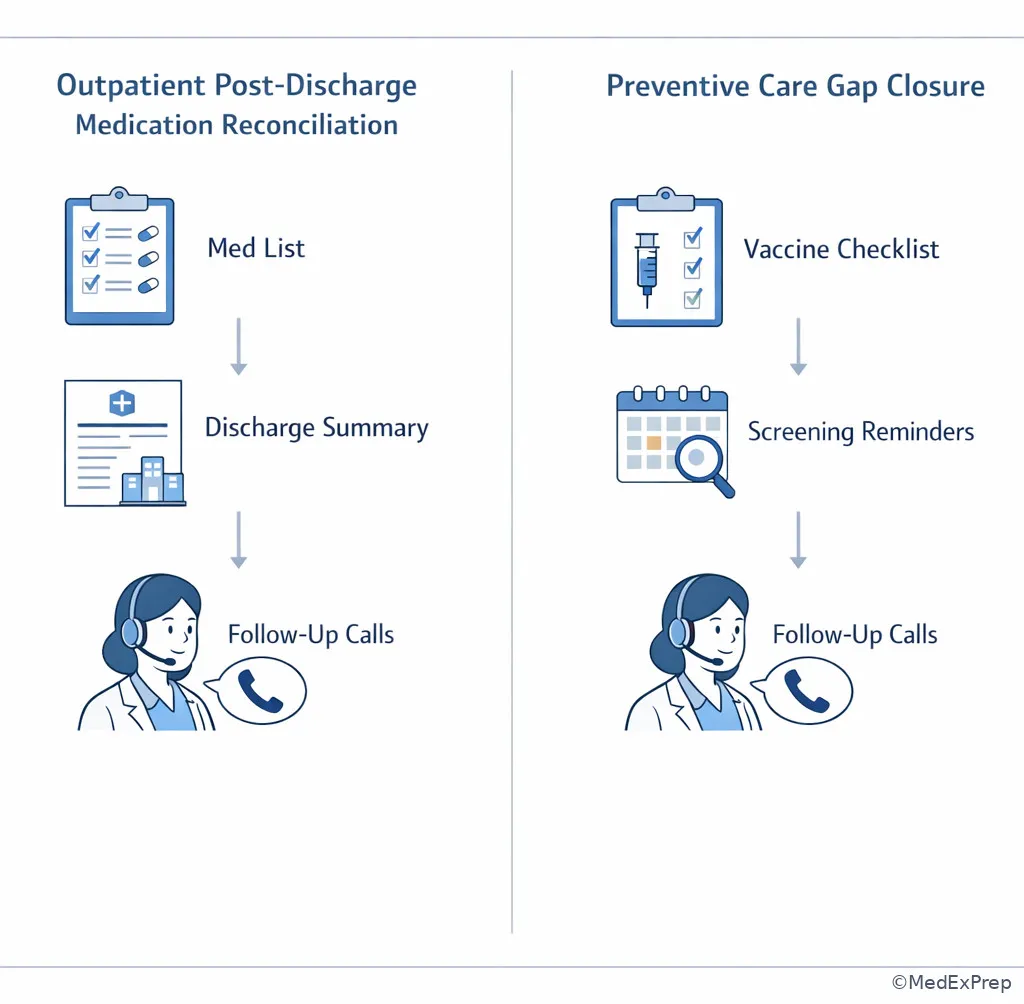
Transitions versus prevention comparison panel

Related future confusion to anticipate: the upcoming topic Ambulatory Pharmacist Scope Boundaries will make a frequent confusable pair with this lesson. Here you learn blueprint recognition; there you will sharpen role-based answer elimination.

Review connection: The traps above test blueprint-task matching and ambulatory role framing. If any felt unfamiliar, revisit 1.1.1.2 Foundational ambulatory scope signals within the blueprint and 1.1.1.3 Applied domain recognition: how mixed stems hide the primary tested objective before attempting the Self-check quiz.

Tables

Study bucket Questions it answers Common outputs
Assessment What matters in the profile? Medication-related problem list
Therapy optimization What should be started, adjusted, or stopped? Regimen recommendation
Monitoring What should be tracked and when? Lab/vital/follow-up plan
Preventive care What care gap should be closed? Vaccine or risk-reduction recommendation
Transitions What discrepancy or safety issue must be clarified? Reconciled med list and follow-up
Population health Which patients should be prioritized? Panel outreach plan
Common answer framing Usually acceptable Usually reject
Recommend therapy change to prescriber/team Yes Only reject if urgent escalation is required first
Independently diagnose and prescribe without stated authority No Reject as out of role
Build monitoring plan with follow-up interval Yes Reject only if wrong parameter or unsafe timing
Provide counseling and adherence support Yes Reject if it ignores a red flag
Urgently refer/escalate for instability Yes when red flags present Reject if stem is routine and stable
Manage inpatient ICU-style treatment No Reject as setting mismatch
Domain trigger in stem Primary domain Common distractor domain How to choose correctly
“Most appropriate outreach strategy” Population health Individual therapy change Choose panel prioritization logic
“Best next step after hospitalization” Transitions of care Routine prevention Reconcile and clarify before routine gap closure
“Most important lab to recheck” Monitoring/safety Treatment intensification Follow the monitoring ask, not the treatment urge
“Best regimen optimization” Therapeutic decision-making Monitoring only Choose the modification that best fits patient factors
“Which action is within scope?” Role/scope application Physician-level intervention Prefer recommendation, counseling, or escalation
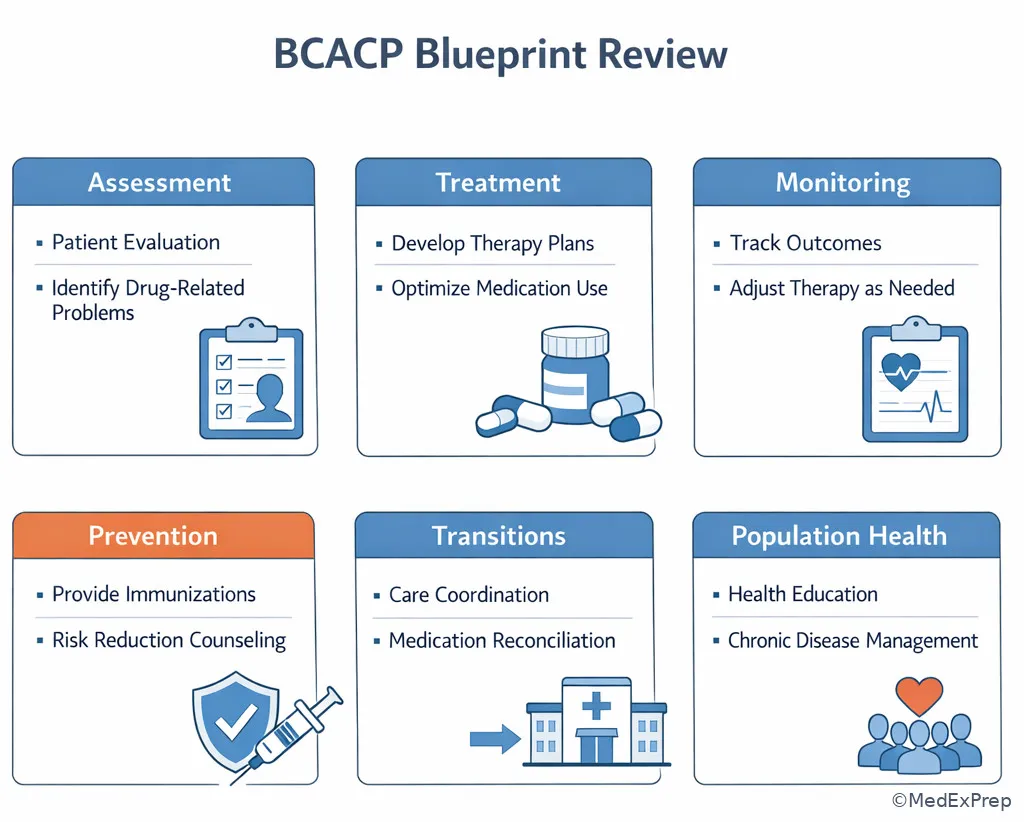
Blueprint domain flashcard set
Exam takeaway: Compact domain-to-task cards improve rapid stem triage during timed review.
Blueprint domain flashcard set

Algorithm / Approach

Fig 6. Blueprint-first question approach
Exam takeaway: Identify the task, match the domain, apply scope limits, then choose the safest ambulatory action.
Identify the task
Find the action verb: optimize, monitor, reconcile, prevent, prioritize, or escalate.

Match the domain
Place the stem into assessment, therapy, monitoring, prevention, transitions, or population health.

Apply scope filter
If authority is not explicit, choose recommendation, follow-up, counseling, reconciliation, or escalation.

Eliminate noise
Ignore details that do not change the asked decision.

Verify outpatient fit
Confirm safety, feasibility, and follow-up in longitudinal ambulatory practice.

See Fig 6 as your default first-pass method for early BCACP questions.

Rapid Review

  • Blueprint domain → broad competency bucket, not hidden exam secrets
  • Assessment task → extract meds, labs, vitals, barriers, and risks before answering
  • Therapy optimization → choose regimen change only if the stem actually asks for treatment
  • Monitoring question → best answer usually includes parameter plus timing
  • Transitions stem → recent discharge and med discrepancy outrank routine prevention
  • Population health trigger → registry, dashboard, outreach, or care-gap list
  • Scope boundary → absent authority language favors recommendation over independent prescribing
  • Urgent red flag → escalation beats routine ambulatory fine-tuning
  • Noise detail → tempting only if it changes the tested task
  • Mixed-domain stem → action verb identifies the primary domain
  • Study strategy → pair every disease with A-T-M-P-S, not drug facts alone
  • Best answer on BCACP → outpatient-safe, patient-specific, and feasible to follow longitudinally
Memory anchor: When stuck on a stem, ask “What is the pharmacist being asked to DO?” Then run A-T-M-P-S: Assess, Treat, Monitor, Prevent, Systems.

Self-check quiz

1. A 52-year-old man with hypertension and dyslipidemia is reviewed by an ambulatory care pharmacist after a clinic registry flags overdue follow-up. Current medications are amlodipine 10 mg by mouth daily and rosuvastatin 10 mg by mouth nightly. The question asks which public BCACP domain is most directly reflected by registry review and outreach prioritization. What is the most appropriate answer?

  1. A. Population health and quality improvement
  2. B. Emergency cardiovascular stabilization
  3. C. Independent diagnostic cardiology practice
  4. D. Inpatient antimicrobial stewardship

2. A 61-year-old woman with type 2 diabetes and CKD stage 3 takes metformin 1000 mg by mouth twice daily and losartan 50 mg by mouth daily. A study stem asks for the “most important parameter to monitor within 1–2 weeks after a medication change.” Which public blueprint bucket should drive the answer?

  1. A. Monitoring and safety
  2. B. Preventive care
  3. C. Population outreach design
  4. D. Hospital admission triage

3. A 68-year-old man with HFrEF, atrial fibrillation, and CKD stage 3 was discharged 5 days ago. Current medications are apixaban 5 mg by mouth twice daily, sacubitril/valsartan 49/51 mg by mouth twice daily, metoprolol succinate 100 mg by mouth daily, and furosemide 40 mg by mouth daily. He brings two conflicting medication lists and says he restarted ibuprofen 400 mg by mouth three times daily from home. The stem asks for the most appropriate next step in the pharmacist’s process. Which answer is best?

  1. A. Perform medication reconciliation and clarify discrepancies before routine optimization
  2. B. Intensify heart failure therapy immediately without reviewing the discharge record
  3. C. Focus on future vaccine recommendations first
  4. D. Independently reduce apixaban to 2.5 mg by mouth twice daily

4. A 47-year-old woman with obesity, hypertension, and migraine presents for an ambulatory pharmacy visit. Current medications are hydrochlorothiazide 25 mg by mouth daily and topiramate 50 mg by mouth twice daily. The question asks which study method best aligns with the public BCACP blueprint. Which option is most appropriate?

  1. A. Study each disease state by assessment, therapy, monitoring, prevention, and system barriers
  2. B. Memorize drug mechanisms only and defer follow-up plans until the last week
  3. C. Focus on inpatient order sets because they are more detailed
  4. D. Ignore transitions and population health because they are less pharmacologic

5. A 72-year-old woman with osteoarthritis, CKD stage 3a, and prior VTE takes rivaroxaban 20 mg by mouth daily, lisinopril 20 mg by mouth daily, and acetaminophen 650 mg by mouth every 8 hours as needed. She calls reporting melena and dizziness after self-starting naproxen 440 mg by mouth twice daily. The stem asks for the most appropriate pharmacist action when authority is not explicitly stated. Which answer is best?

  1. A. Urgently escalate/referral for possible bleeding and communicate the medication concern
  2. B. Recommend continuing rivaroxaban and adding a proton pump inhibitor without escalation
  3. C. Independently reduce rivaroxaban to 10 mg daily
  4. D. Schedule routine follow-up in 3 months and counsel on NSAID avoidance

6. A 59-year-old man with type 2 diabetes, ASCVD, and obesity takes metformin 1000 mg by mouth twice daily, empagliflozin 25 mg by mouth daily, semaglutide 1 mg subcutaneously weekly, lisinopril 20 mg by mouth daily, and atorvastatin 80 mg by mouth nightly. His clinic uses a dashboard showing overdue retinal exam, missing influenza vaccine, and LDL-C still above goal. The question asks which issue most clearly places the case in a population health domain rather than an individual therapy-only domain. Which option is best?

  1. A. Use of a dashboard to identify and prioritize care gaps across a panel
  2. B. Presence of multiple cardiovascular medications
  3. C. Need for LDL-C intensification in a single patient
  4. D. Need to counsel on semaglutide adverse effects

7. A 66-year-old woman with COPD, osteoporosis, and hypertension is seen after urgent care treatment for pneumonia. Current medications are tiotropium inhalation daily, albuterol inhalation as needed, prednisone 40 mg by mouth daily for 5 days, amoxicillin/clavulanate 875/125 mg by mouth twice daily for 7 days, and losartan 100 mg by mouth daily. She also asks whether she should receive pneumococcal vaccination now. The stem asks for the best next step after urgent care transition. Which answer is most appropriate?

  1. A. Reconcile urgent care medications and confirm intended duration before routine preventive interventions
  2. B. Administer all due vaccines immediately and defer medication review
  3. C. Independently discontinue losartan because infection is present
  4. D. Build a long-term osteoporosis treatment plan before reviewing antibiotics

8. A pharmacist candidate is practicing timed questions. One stem includes metformin 1000 mg by mouth twice daily, insulin glargine 30 units subcutaneously nightly, lisinopril 10 mg by mouth daily, A1c 9.1%, blood pressure 128/76 mm Hg, recent discharge after cellulitis, and a note that the discharge summary is missing. The actual question asks for the “most appropriate next step in the ambulatory pharmacist’s process.” Which approach best reflects blueprint-first reasoning?

  1. A. Identify the question as a transitions task and reconcile medications before intensifying diabetes therapy
  2. B. Increase insulin glargine immediately because the A1c is above goal
  3. C. Focus on blood pressure because hypertension is a common BCACP topic
  4. D. Order wound imaging because cellulitis was the reason for hospitalization

Answer key

1. Question 1

Correct answer: A. Population health and quality improvement. PK/PD is not the key issue here; the discriminator is task type. The clinic registry and outreach framing identify panel-based care-gap management, a common ambulatory systems function reflected in the BCACP blueprint. This is consistent with public BCACP competency themes emphasizing longitudinal outpatient quality and medication optimization. Sources: ACCP ambulatory care competencies; DiPiro; ASHP ambulatory care practice resources.

  • A: tempting because registry language is a direct clue; correct because dashboard or outreach-list work is classic population health and quality-improvement activity. Single clue: “registry flags overdue follow-up.”
  • B: tempting because cardiovascular disease can become urgent, but incorrect because no instability or emergency management is described. Single clue: routine outreach rather than acute symptoms.
  • C: tempting because dyslipidemia and hypertension involve risk assessment, but incorrect because the action is not independent diagnosis or specialty evaluation. Single clue: ambulatory pharmacist registry review.
  • D: tempting because stewardship is also system-based, but incorrect because the medications and setting do not involve inpatient antibiotics. Single clue: no antimicrobial context.
If you missed this: Review 1.1.1.1 Foundational blueprint architecture: what the public domains actually tell you — focus on recognizing panel-based registry language as population health.

2. Question 2

Correct answer: A. Monitoring and safety. The stem explicitly asks which parameter should be followed after a medication change; that wording makes monitoring the lead domain. Public BCACP framing commonly rewards the candidate who matches the action verb to the domain before interpreting details. Sources: ACCP guidance; DiPiro.

  • A: tempting because CKD and medication changes always imply follow-up; correct because the asked task is monitoring. Single clue: “most important parameter to monitor within 1–2 weeks.”
  • B: tempting because CKD patients need preventive interventions, but incorrect because prevention is not the immediate ask. Single clue: short-interval recheck language.
  • C: tempting because chronic disease can be tracked at panel level, but incorrect because this is one patient’s post-change follow-up. Single clue: individual monitoring window.
  • D: tempting because CKD can worsen and require higher-level care, but incorrect because no acute instability or admission decision is presented. Single clue: stable ambulatory follow-up framing.
If you missed this: Review 1.1.1.3 Applied domain recognition: how mixed stems hide the primary tested objective — focus on using the stem’s action verb to identify monitoring questions.

3. Question 3

Correct answer: A. Perform medication reconciliation and clarify discrepancies before routine optimization. Drug-mechanism knowledge is secondary here; the key is transitions of care. The patient has conflicting lists after discharge and a new NSAID interaction risk with apixaban. The safest ambulatory process is to reconcile medications, clarify intended regimens, and then optimize therapy. Sources: ASHP transitions of care guidance; ACCP ambulatory care resources; FDA labeling for apixaban interaction/bleeding risk.

  • A: tempting because it may feel slower than direct action; correct because conflicting lists after discharge make reconciliation the highest-priority process step. Single clue: “two conflicting medication lists.”
  • B: tempting because HFrEF optimization matters and guideline-directed therapy is high yield, but incorrect because regimen intensification before reconciling the discharge plan is unsafe. Single clue: missing clarity on what the patient should currently be taking.
  • C: tempting because vaccines are important in chronic cardiopulmonary disease, but incorrect because preventive care is secondary to transition-related safety risk. Single clue: recent discharge with discrepancies.
  • D: tempting because NSAID plus anticoagulant use raises bleeding concern and dose change feels proactive, but incorrect because independent dose reduction is out of role and may not address the true problem. Single clue: no stated protocol authority and need for reconciliation first.
If you missed this: Review 1.1.1.3 Applied domain recognition: how mixed stems hide the primary tested objective — focus on why post-discharge discrepancies outrank routine optimization.

4. Question 4

Correct answer: A. Study each disease state by assessment, therapy, monitoring, prevention, and system barriers. This mirrors the public blueprint and the A-T-M-P-S framework taught in the lesson. BCACP preparation is strongest when disease content is linked to ambulatory tasks and follow-up implementation. Sources: ACCP/ASHP ambulatory care competencies; DiPiro.

  • A: tempting because it is broader and more work; correct because it matches how mixed-domain ambulatory stems are written. Single clue: the public blueprint is functional, not mechanism-only.
  • B: tempting because mechanisms feel foundational, but incorrect because mechanism knowledge alone misses follow-up, access, safety, and systems tasks. Single clue: blueprint breadth beyond pharmacology recall.
  • C: tempting because inpatient algorithms are detailed, but incorrect because BCACP emphasizes longitudinal outpatient care. Single clue: ambulatory scope and setting.
  • D: tempting because transitions and population health may feel less “drug-focused,” but incorrect because they remain explicitly relevant ambulatory competencies. Single clue: post-discharge and care-gap processes are exam-relevant.
If you missed this: Review 1.1.1.4 Integration across domains: study strategy and question triage for BCACP — focus on the A-T-M-P-S blueprint study structure.

5. Question 5

Correct answer: A. Urgently escalate/referral for possible bleeding and communicate the medication concern. Pharmacologically, rivaroxaban plus naproxen increases bleeding risk; melena and dizziness are red flags that move the case out of routine ambulatory adjustment and into urgent escalation. Guideline-concordant pharmacist action is to recognize probable medication-related harm, instruct urgent evaluation, and communicate with the care team. Sources: FDA rivaroxaban labeling; Lexicomp; ASHP ambulatory care guidance.

  • A: tempting because escalation can feel less “pharmacy-specific,” but correct because it is the safest in-scope action in a suspected anticoagulant-related bleed. Single clue: melena and dizziness.
  • B: tempting because GI protection sounds helpful, but incorrect because adding a PPI without escalation delays evaluation of a potential active bleed. Single clue: red-flag symptoms already present.
  • C: tempting because lower anticoagulant dose seems safer, but incorrect because dose reduction is not the right response to suspected active bleeding and assumes authority not granted. Single clue: urgent safety issue, not maintenance dosing question.
  • D: tempting because NSAID counseling is appropriate, but incorrect because routine follow-up misses immediate harm. Single clue: symptomatic possible bleed requiring urgent action.
If you missed this: Review 1.1.1.2 Foundational ambulatory scope signals within the blueprint — focus on why red-flag symptoms convert a routine medication problem into urgent escalation.

6. Question 6

Correct answer: A. Use of a dashboard to identify and prioritize care gaps across a panel. The domain discriminator is not the medications themselves but the workflow structure. A dashboard or registry indicates population-health operations rather than a purely individual therapy question. Sources: ACCP ambulatory care framework; ASHP ambulatory care practice standards.

  • A: tempting because dashboards are a systems clue; correct because panel identification and prioritization are defining population-health functions. Single clue: “clinic uses a dashboard showing care gaps.”
  • B: tempting because multiple cardiometabolic drugs imply complex management, but incorrect because polytherapy alone does not define population health. Single clue: system-level dashboard language matters more.
  • C: tempting because LDL-C intensification is high yield, but incorrect because it describes an individual treatment task rather than the specific domain shift being asked. Single clue: panel-based prioritization.
  • D: tempting because counseling is pharmacist work, but incorrect because counseling is patient-level care, not the domain cue asked here. Single clue: registry workflow rather than encounter counseling.
If you missed this: Review 1.1.1.1 Foundational blueprint architecture: what the public domains actually tell you — focus on dashboard/registry language as a population-health trigger.

7. Question 7

Correct answer: A. Reconcile urgent care medications and confirm intended duration before routine preventive interventions. Pharmacologically, prednisone and amoxicillin/clavulanate are short-course transition medications where duration errors are common. The stem asks for the best next step after an urgent care transition, making reconciliation primary and vaccination secondary. Sources: ASHP transitions guidance; Lexicomp; DiPiro.

  • A: tempting because it delays prevention briefly; correct because transition safety takes priority when new short-course therapies and cross-setting communication are involved. Single clue: “after urgent care transition.”
  • B: tempting because COPD and older age increase vaccine importance, but incorrect because preventive care does not outrank unresolved transition medication issues. Single clue: current urgent care medication changes require confirmation first.
  • C: tempting because clinicians may think about holding certain chronic drugs during illness, but incorrect because independent discontinuation is out of role and not the primary task. Single clue: no authority stated and no losartan-specific emergency provided.
  • D: tempting because osteoporosis matters in a patient receiving steroids, but incorrect because long-term bone management is not the next step after urgent care treatment. Single clue: immediate transition process question.
If you missed this: Review 1.1.1.3 Applied domain recognition: how mixed stems hide the primary tested objective — focus on why transition wording outranks attractive preventive care actions.

8. Question 8

Correct answer: A. Identify the question as a transitions task and reconcile medications before intensifying diabetes therapy. The missing discharge summary is the pivotal clue. Although the A1c is above goal and insulin titration may eventually be needed, the blueprint-first approach prioritizes the explicit post-discharge process task. Sources: ASHP transitions of care guidance; ACCP ambulatory care competencies; DiPiro.

  • A: tempting because it may feel process-heavy, but correct because the stem asks for the most appropriate next step in ambulatory pharmacist workflow after discharge. Single clue: “recent discharge” plus “discharge summary is missing.”
  • B: tempting because A1c 9.1% suggests uncontrolled diabetes and insulin titration is a common pharmacist action, but incorrect because therapy intensification should wait until the transition record is clarified. Single clue: missing discharge information.
  • C: tempting because hypertension is common on BCACP and the blood pressure is provided, but incorrect because BP is already controlled and is not the task driver. Single clue: the BP value is distractor noise.
  • D: tempting because hospitalization for cellulitis may have involved ongoing infection concerns, but incorrect because imaging without protocol authority is out of role and not the main ambulatory process need. Single clue: pharmacist-scope next-step framing.
If you missed this: Review 1.1.1.3 Applied domain recognition: how mixed stems hide the primary tested objective — focus on letting the explicit task and transition clues override tempting chronic-disease intensification.

References

  • Board of Pharmacy Specialties. Board Certified Ambulatory Care Pharmacist (BCACP) Examination Content Outline. BPS.
  • American College of Clinical Pharmacy. Ambulatory Care Pharmacy Practice and Competency Resources. ACCP.
  • DiPiro, Joseph T., et al. Pharmacotherapy: A Pathophysiologic Approach. McGraw-Hill.
  • American Society of Health-System Pharmacists. ASHP Guidelines on Pharmacist-Conducted Patient Education and Counseling and ambulatory/transitions practice resources. ASHP.
  • Lexicomp Online. Wolters Kluwer Clinical Drug Information.

Last reviewed: March 13, 2026

Lesson 2

Ambulatory Pharmacist Scope Boundaries

Ambulatory Pharmacist Scope Boundaries

Topic: 1.1.2

Estimated time: 45–60 minutes

Prereqs: Public BCACP Blueprint Domains

Key outputs: You should be able to distinguish pharmacist-scope medication decisions from physician-only actions, choose when to recommend versus escalate, identify out-of-scope language in exam stems, and build ambulatory follow-up plans that stay within collaborative practice and local protocol boundaries.

What you'll learn

  • Map ambulatory pharmacist actions to public BCACP domains using a patient care and professional practice lens.
  • Recognize the boundary between medication management, triage, referral, and independent diagnosis.
  • Choose the most appropriate next step when a stem mixes chronic disease optimization with urgent red flags.
  • Differentiate recommending, clarifying, holding, and escalating in longitudinal outpatient settings.
  • Build board-style reasoning that accounts for collaborative practice limits, local protocols, payer/access issues, and follow-up feasibility.

Blueprint mapping

  • DOMAIN: Patient Care → Medication assessment and optimization → Identify medication-related problems and recommend evidence-based ambulatory interventions
  • DOMAIN: Patient Care → Monitoring and follow-up → Select appropriate monitoring and escalation thresholds in longitudinal outpatient care
  • DOMAIN: Professional Practice → Practice standards and regulations → Work within pharmacist scope, collaborative practice, and institutional protocol
  • DOMAIN: Professional Practice → Communication and care coordination → Refer, document, and collaborate appropriately when findings exceed pharmacist authority

Why it matters

  • BCACP items often hide the real task inside a clinically rich stem: the best answer depends less on disease trivia and more on whether the pharmacist should adjust therapy, recommend a change, or urgently escalate.
  • Scope errors create high-yield distractors: a clinically reasonable intervention becomes wrong if it assumes unrestricted prescriptive or diagnostic authority.
  • Ambulatory care is longitudinal, not acute inpatient rescue; the exam rewards safe follow-up planning, documentation, care coordination, and recognition of red flags.
  • When local authority varies, the safest exam approach is to frame actions as assessment plus recommendation unless explicit protocol authority is stated.

Key Terms & Must-Know Facts

Key terms

  • Collaborative practice agreement (CPA): Site- and state-specific authority for pharmacist medication management.
  • Medication-related problem: Indication, effectiveness, safety, adherence, access, or monitoring issue.
  • Triage: Identify urgency and route to appropriate clinician or level of care.
  • Escalation: Immediate communication/referral because the finding exceeds ambulatory medication-management scope or suggests instability.
  • Recommendation: Pharmacist-proposed therapy plan when independent authority is not explicit.
  • Monitoring plan: What to track, target, timing, and action thresholds.
  • Transitions of care: Medication reconciliation and risk reduction after care setting changes.
  • Red flag: Symptom, vital sign, lab, or history feature requiring urgent clarification or referral.
  • Population health: Panel-based identification of gaps in care.
  • Scope boundary: The line between pharmacist assessment/management and independent medical diagnosis/procedure.
  • Protocol authority: Specific delegated power to order, adjust, or discontinue therapy under defined rules.
  • Longitudinal follow-up: Ongoing outpatient reassessment over days to months.

Must-know facts

  • If prescriptive authority is not stated, assume recommendation/collaboration rather than unilateral prescribing.
  • Urgent instability beats routine chronic disease optimization every time.
  • Pharmacists can assess medication needs, interpret available patient-specific information, and recommend evidence-based plans within ambulatory care.
  • Independent diagnosis outside pharmacist assessment/triage functions is out of role.
  • Ordering imaging or managing emergencies as the attending is out of role unless explicit protocol authority exists.
  • The best BCACP answer often includes safety, feasibility, monitoring, and follow-up—not just the drug choice.
  • Local protocols, formulary limits, and payer restrictions vary; exam-safe phrasing acknowledges variability.
  • A plausible drug recommendation can still be wrong if the stem requires referral for red-flag symptoms first.
Fig 1. Scope boundary decision map
Exam takeaway: Sort the stem first into optimize, clarify, collaborate, or escalate before choosing any medication action.
flowchart TD
A[Read stem] --> B{Urgent red flag or instability?}
B -->|Yes| C[Escalate or refer now]
B -->|No| D{Authority explicitly stated?}
D -->|Yes| E[Act within protocol and document]
D -->|No| F[Assess and recommend to prescriber/team]
F --> G[Add monitoring, access, adherence, follow-up]
E --> G

See Fig 1 for the first-pass sorting rule that prevents many scope-based errors.

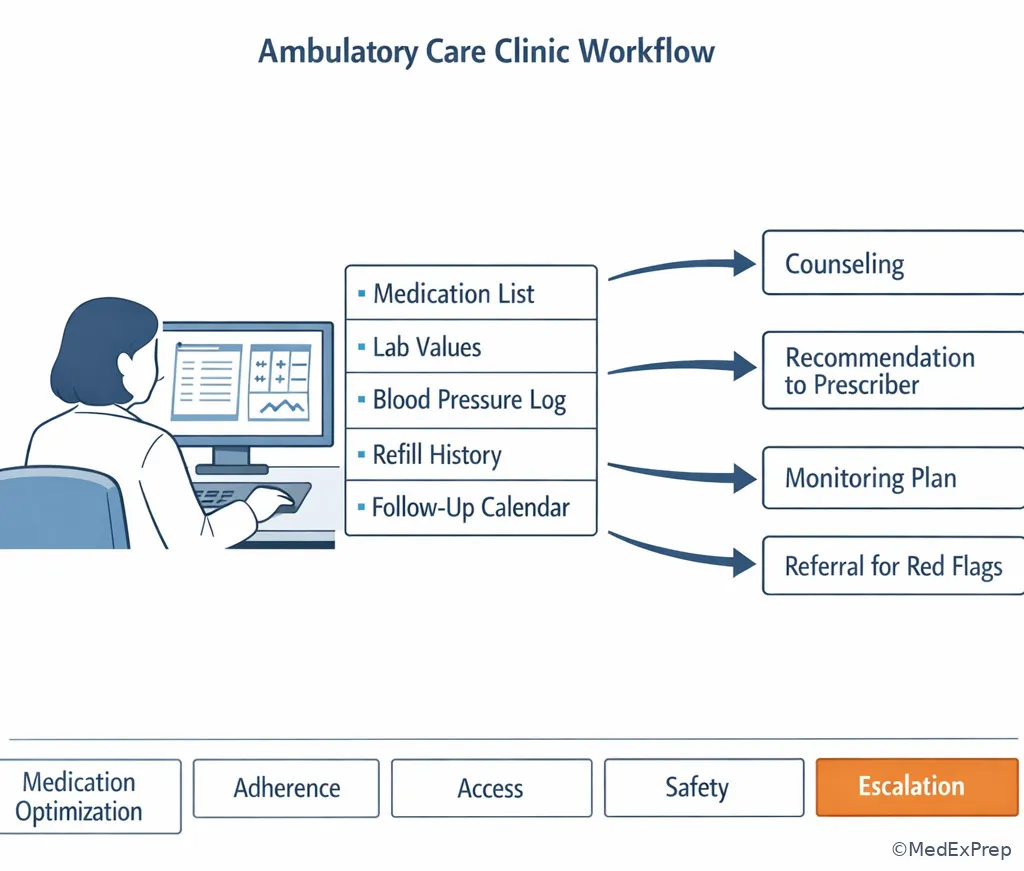
Ambulatory care clinic workflow illustration
Exam takeaway: The outpatient pharmacist's role centers on medication assessment, counseling, monitoring, and coordination rather than independent diagnosis or procedures.
Ambulatory care clinic workflow illustration
Collaborative practice boundary illustration
Exam takeaway: Protocol authority can expand what the pharmacist may implement, but only within predefined limits and documentation requirements.
Collaborative practice boundary illustration

Core content

Recall: In Public BCACP Blueprint Domains, we covered how Patient Care carries the major exam emphasis. Here, we build on that by asking what parts of patient care are medication-management decisions versus situations requiring collaboration or escalation.
High-Yield Connection: This concept is tested alongside Outpatient Case Decision Framework. Know both the scope boundary and the sequence identify task → extract key facts → choose action; many stems are missed because the task is misidentified before the pharmacotherapy is even considered.

1.1.2.1 Foundational boundary: what the ambulatory pharmacist is expected to do

A. Explanation

The central decision conflict is optimize medication therapy versus assume unrestricted prescriber or diagnostician authority. The single rule that resolves the conflict is this: if the action remains medication-focused, evidence-based, and within stated protocol or collaborative limits, it is generally in scope; if it requires independent diagnosis, unrestricted prescribing, invasive intervention, or management as the attending for an acute emergency, it is out of scope. WHY THIS IS TESTED: stems deliberately pair a valid drug idea with language that exceeds pharmacist authority.

Choose actions such as assessing adherence, interpreting available vitals/labs, identifying drug interactions, recommending initiation or optimization, designing monitoring parameters, reconciling medications after transitions of care, supporting preventive care, and coordinating with the care team. Reject answer choices that require independent diagnosis, direct hospital admission decisions as the attending, independent imaging orders without protocol, ICU-style management, or procedural interventions.

For BCACP, the safest default is: assess, recommend, monitor, document, and follow up. If the stem explicitly grants protocol authority, you may implement within that authority. If not, state the recommendation to the prescriber/team. See Fig 1 and Fig 2.

Concept flow: In-scope first pass
Identify task
Medication assessment, optimization, monitoring, counseling, reconciliation, or referral?

Authority check
If protocol authority is stated, implement within limits; otherwise recommend and collaborate.

Complete the plan
Add safety monitoring, adherence support, access plan, and follow-up interval.

Fig 2. In-scope versus out-of-scope comparison flow
Exam takeaway: The right action depends on whether the stem asks for medication management within protocol or a medical act beyond pharmacist authority.
flowchart LR
A[Medication issue found] --> B{Question type}
B -->|Dose, interaction, adherence, monitoring| C[Pharmacist scope]
B -->|Independent diagnosis or procedure| D[Out of scope]
C --> E[Recommend or implement if protocol says yes]
D --> F[Clarify, refer, or escalate]
E --> G[Document and follow-up]
F --> G

B. Worked example

A 63-year-old man with type 2 diabetes, CKD stage 3a, and hypertension presents to a primary care clinic pharmacy visit. Medications include metformin 1000 mg by mouth twice daily, empagliflozin 10 mg daily, lisinopril 20 mg daily, and ibuprofen 400 mg three times daily as needed, which he started on his own. BP is 148/86 mm Hg; serum creatinine rose from 1.1 to 1.4 mg/dL over 2 months; potassium is 5.2 mEq/L; he mentions “burning when I urinate” but no fever. A tempting wrong move is to diagnose a urinary tract infection and independently start antibiotic therapy.

Reasoning chain: Identify task: this is a medication review plus safety assessment, not unrestricted diagnosing. Extract key facts: CKD, ACE inhibitor, NSAID use, mild hyperkalemia, SGLT2 use, urinary symptom mention without acute instability. Apply rule: the pharmacist can identify likely medication contributors and recommend action, but should not independently diagnose and prescribe absent protocol authority. Eliminate distractors: empiric antibiotic initiation is tempting because of urinary symptoms, but the single clue is that diagnosis and treatment authority are not given; immediate ED transfer is not required because there is no instability. Verify: recommend stopping NSAID use, evaluate renal function trend, discuss potassium monitoring and hydration, and communicate urinary symptoms to the clinician for medical assessment if needed.

C. Exam trap

Common wrong answer: “Start an antibiotic for presumed UTI.” Why it is tempting: The stem inserts dysuria to pull you into a diagnosis-treatment reflex. The single clue that eliminates it: The task is ambulatory pharmacist medication management with no explicit authority to independently diagnose or prescribe; the safer pharmacist action is to flag the symptom, assess medication contributors, and collaborate.

D. Checkpoint

Question: A pharmacist in a primary care clinic reviews a patient taking warfarin 5 mg daily, amiodarone 200 mg daily, and trimethoprim-sulfamethoxazole just started yesterday by an outside urgent care clinic. The clinic note does not state pharmacist prescriptive authority. Which is the most appropriate next step?

  1. A. Independently discontinue warfarin and start apixaban because the interaction risk is high.
  2. B. Assess INR history and bleeding symptoms, urgently contact the prescribing clinician with a recommendation for warfarin management and closer INR monitoring.
  3. C. Reassure the patient that no action is needed because the warfarin dose is unchanged.
  4. D. Order a head CT scan because interaction-related bleeding is possible.

Correct answer: B.

  • A: Tempting because it tries to solve the interaction quickly; wrong because it assumes unilateral prescribing changes without stated authority and creates a new anticoagulation transition issue.
  • B: Tempting and correct because it stays squarely in pharmacist scope: assess risk, recommend evidence-based management, and arrange monitoring.
  • C: Tempting if the learner focuses only on current warfarin dose; wrong because amiodarone and TMP-SMX can both increase INR and bleeding risk.
  • D: Tempting because bleeding is serious; wrong because imaging without neurologic symptoms or protocol authority is outside the appropriate pharmacist next step.
If you missed this: Review 1.1.2.1 Foundational boundary: what the ambulatory pharmacist is expected to do — focus on the rule “recommend and collaborate unless implementation authority is explicitly stated.”
Pharmacist Action: NOTICE: medication-related problems, interactions, adherence gaps, unsafe OTC use. SAY: “I recommend this change/clarification to your clinician because of the safety concern.” MONITOR: efficacy and safety parameters at guideline-appropriate intervals. HOLD/CLARIFY/ESCALATE: escalate if symptoms or findings suggest acute instability or if the needed action exceeds protocol authority.

1.1.2.2 Boundary triggers: when to clarify, hold, or escalate instead of optimize

A. Explanation

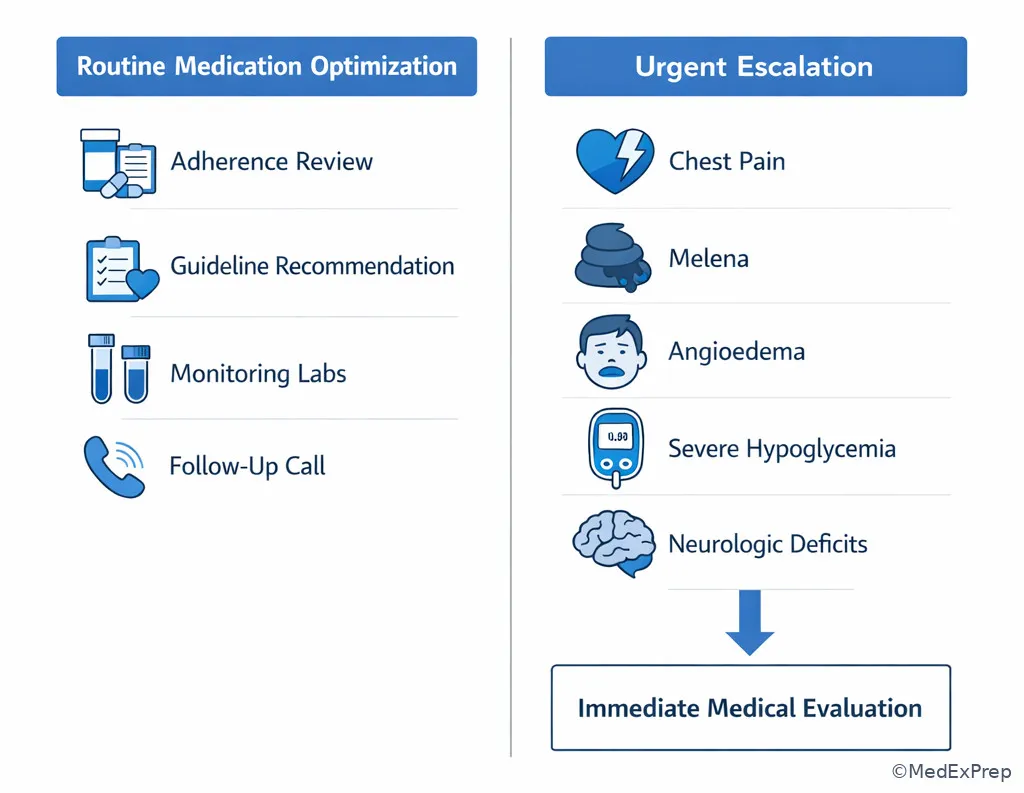
The decision conflict here is routine ambulatory optimization versus red-flag escalation. The single rule is: when the stem includes signs of acute deterioration, severe adverse effects, dangerous vitals/labs, or diagnostic uncertainty that could harm the patient if delayed, escalation comes before chronic medication fine-tuning. WHY THIS IS TESTED: many examinees correctly identify a long-term regimen issue but miss that the immediate problem is urgent triage.

Choose escalation when there is chest pain concerning for ACS, severe shortness of breath, syncope, marked hypotension, acute neurologic deficit, suicidal ideation, severe allergic reaction, severe hypoglycemia without recovery, significant bleeding, or a critical lab value requiring urgent medical evaluation. Choose clarification/hold when a medication order conflicts with renal function, duplicative therapy, a serious interaction, pregnancy/lactation safety issue, or missing key information. Reject answers that continue titration as though the patient were stable when the stem includes red flags.

In outpatient pharmacy practice, urgent findings do not make the pharmacist passive; they change the action from optimize to escalate. See Fig 3 for a clinical algorithm that compresses this decision.

Concept flow: Red-flag triage sequence
Spot the danger cue
Unstable symptoms, severe adverse effect, or critical value changes the task.

Decide urgency
If immediate harm risk is present, escalate now; if not, clarify and coordinate same-day or next-step care.

Then optimize later
Return to chronic regimen improvement only after safety is addressed.

Fig 3. Ambulatory red-flag escalation algorithm
Exam takeaway: A red flag converts the pharmacist's task from optimization to urgent triage and team coordination.
flowchart TD
A[Ambulatory follow-up visit] --> B{Red flag present?}
B -->|Yes| C[Assess severity and immediate safety]
C --> D[Refer same day or emergency care based on severity]
D --> E[Communicate to care team and document]
B -->|No| F[Proceed with medication optimization]
F --> G[Monitoring plus follow-up]

B. Worked example

A 71-year-old woman with heart failure, atrial fibrillation, and type 2 diabetes presents for medication synchronization. Her medications include furosemide 40 mg by mouth daily, metoprolol succinate 100 mg daily, apixaban 5 mg twice daily, and insulin glargine 22 units nightly. She reports increasing fatigue, “a little chest pressure,” and black stools for 2 days. BP is 96/58 mm Hg, HR 112 bpm. A distracting clue is that her fasting glucose today is 212 mg/dL, which might tempt you to focus on insulin adjustment.

Reasoning chain: Identify task: the most appropriate next step is triage, not diabetes optimization. Extract key facts: anticoagulant use, melena, hypotension, tachycardia, chest pressure. Apply rule: possible active GI bleeding with hemodynamic concern requires urgent escalation. Eliminate distractors: increasing insulin is wrong because hyperglycemia is not the immediate threat; recommending outpatient CBC “sometime this week” is too slow. Verify: urgent referral/emergency evaluation, communicate concern for bleeding, and document the escalation. Chronic therapy review can happen after stabilization.

C. Exam trap

Common wrong answer: “Adjust the chronic medication that looks most off-target today.” Why it is tempting: BCACP is heavy on chronic disease management, so learners may reflexively titrate a long-term drug. The single clue that eliminates it: Hemodynamic instability or major bleeding symptoms always outrank routine target optimization.

D. Checkpoint

Question: A patient with COPD, hypertension, and chronic kidney disease calls the ambulatory pharmacist. Current medications include tiotropium 2 inhalations daily, albuterol HFA 2 puffs every 4 hours as needed, losartan 50 mg daily, and spironolactone 25 mg daily. Today the patient reports progressive lip swelling and hoarseness after the morning dose of losartan. Which is the most appropriate pharmacist action?

  1. A. Recommend diphenhydramine at home and routine follow-up in 1 week.
  2. B. Escalate for urgent medical evaluation and advise holding the suspected agent pending clinician assessment.
  3. C. Increase albuterol because airway symptoms are usually from COPD.
  4. D. Switch losartan to valsartan immediately over the phone.

Correct answer: B.

  • A: Tempting because mild allergic reactions are often handled outpatient; wrong because hoarseness plus lip swelling raises airway risk.
  • B: Correct because possible angioedema requires urgent evaluation; the pharmacist should escalate and hold/clarify rather than manage as routine outpatient optimization.
  • C: Tempting because the patient has COPD; wrong because the single clue is lip swelling/hoarseness, not bronchospasm.
  • D: Tempting because ARBs are in the same therapeutic category; wrong because immediate substitution without evaluation misses a potentially serious reaction and assumes implementation authority.
If you missed this: Review 1.1.2.2 Boundary triggers: when to clarify, hold, or escalate instead of optimize — focus on the discriminator “red-flag instability overrides chronic disease titration.”
Quick Recall:

  • True or False: A plausible chronic therapy adjustment is still wrong if the patient has an urgent red flag. True.
  • The most common stem error here is choosing ___ before ___ . optimization before triage
  • Name 3 red-flag domains: hemodynamic instability, severe bleeding, airway/neurologic emergencies.
Memory anchor: SAFE first = Stability, Authority, Follow-up, Escalation threshold. Before picking a drug answer, ask whether the patient is stable, whether authority is given, what follow-up is needed, and what triggers escalation.
Pharmacist Action: NOTICE: airway symptoms, chest pain, syncope, severe bleeding, critical labs, or suicidal ideation. SAY: “This finding needs urgent medical evaluation now; I am contacting the care team.” MONITOR: immediate safety status and whether escalation occurred. HOLD/CLARIFY/ESCALATE: hold suspect medication when appropriate and escalate same day or emergently based on severity.

1.1.2.3 Authority and implementation: recommend versus directly act

A. Explanation

The decision conflict is “I know the right therapy” versus “am I authorized to implement it?” The single rule is that clinical correctness alone does not make an answer right; the action must match the authority granted in the stem. WHY THIS IS TESTED: exam writers use therapeutically correct but legally overreaching answer choices as distractors.

Choose direct implementation only when collaborative practice, protocol authority, standing order, or institutional policy is clearly stated. Choose recommendation/communication when the stem is silent on authority. This distinction applies to starting or stopping therapy, adjusting doses, ordering labs, and issuing refills. In both cases, the pharmacist should still perform the same cognitive work: assess indication, benefits, harms, interactions, adherence, affordability, and follow-up. What changes is who executes the order.

This section also prevents a second common error: assuming that because outpatient practice can be broad in real life, the exam will always treat pharmacists as independent prescribers. It will not. Local protocols vary; exam-safe reasoning stays within stated authority. See Fig 4.

Concept flow: Authority gate before action
Find best therapy
Apply guideline and patient-specific modifiers first.

Check authority
Protocol stated → implement; protocol absent → recommend and document.

Close the loop
Confirm communication, monitoring, and patient education.

Fig 4. Authority gate for pharmacist action
Exam takeaway: A therapeutically correct regimen may still be the wrong answer if the stem does not grant implementation authority.
flowchart LR
A[Best evidence-based regimen identified] --> B{CPA or protocol authority stated?}
B -->|Yes| C[Implement within protocol]
B -->|No| D[Recommend to prescriber/team]
C --> E[Order monitoring if allowed]
D --> F[Suggest monitoring plan]
E --> G[Document]
F --> G

B. Worked example

A 58-year-old woman with hypertension, albuminuric CKD, and obesity is seen in a pharmacist-led clinic. Medications are amlodipine 10 mg daily and hydrochlorothiazide 25 mg daily. BP is 154/92 mm Hg; UACR is elevated; potassium is 4.3 mEq/L; she cannot tolerate ACE inhibitors because of cough. The note states the pharmacist manages hypertension under CPA including initiation and titration of ARBs and ordering BMP in 2–4 weeks. A distracting detail is that her LDL-C is also above goal, which could pull attention toward statin therapy.

Reasoning chain: Identify task: hypertension optimization under explicit protocol. Extract key facts: uncontrolled BP, CKD with albuminuria, ACE cough, ARB authority given. Apply rule: because authority is explicit, the pharmacist may implement an ARB recommendation/order per protocol. Eliminate distractors: “send a suggestion and wait for routine physician review” is safe but not best because the CPA authorizes direct action; starting an ACE inhibitor ignores prior cough; focusing on statin intensification misses the stated task. Verify: initiate an appropriate ARB under protocol, arrange renal function and potassium monitoring, document, and follow up.

C. Exam trap

Common wrong answer: “Recommend the right drug to the physician” when protocol authority is already provided. Why it is tempting: Learners over-correct after hearing that pharmacists should not overstep. The single clue that eliminates it: The stem explicitly states CPA authority for initiation/titration; once authority is granted, the best answer is to act within that protocol.

D. Checkpoint

Question: In a pharmacist-run anticoagulation clinic, the CPA explicitly authorizes warfarin dose adjustment and INR ordering. A patient taking warfarin 5 mg nightly has an INR of 1.6 after increased kale intake and no bleeding. Which is the most appropriate next step?

  1. A. Adjust warfarin dose per protocol and arrange repeat INR according to clinic protocol.
  2. B. Send a message to the physician but make no change because pharmacists cannot alter anticoagulation therapy.
  3. C. Switch to rivaroxaban immediately without clinician discussion.
  4. D. Stop warfarin for 2 days to avoid bleeding because the INR is out of range.

Correct answer: A.

  • A: Correct because explicit CPA authority allows dose adjustment and INR management within protocol.
  • B: Tempting if the learner applies a blanket “recommend only” rule; wrong because authority is clearly granted.
  • C: Tempting because DOACs simplify monitoring; wrong because it assumes a therapy conversion not indicated by the stem and outside the stated protocol.
  • D: Tempting because out-of-range INR can trigger dose changes; wrong because subtherapeutic INR does not call for holding warfarin.
If you missed this: Review 1.1.2.3 Authority and implementation: recommend versus directly act — focus on the discriminator “match the action to explicit protocol authority.”
High-Yield Connection: This concept is often paired with Study Design And Bias in evidence questions: you may know the best evidence-supported intervention, but exam success still requires selecting an action that fits pharmacist authority and practice setting.
Pharmacist Action: NOTICE: exact wording of CPA, standing orders, refill protocols, and lab-ordering permissions. SAY: “Under our protocol, I can implement this change and schedule follow-up.” or “I recommend this change to your clinician.” MONITOR: outcome and safety labs at the interval specified by the protocol or guideline. HOLD/CLARIFY/ESCALATE: clarify when the desired action exceeds the protocol’s boundaries.

1.1.2.4 Ambulatory reasoning with noise: distinguish medication assessment from medical diagnosis

A. Explanation

The decision conflict is using patient findings to make medication recommendations versus crossing into definitive diagnosis beyond pharmacist role. The single rule: pharmacists may interpret patient-specific information to identify medication-related problems and likely contributors, but should avoid answer choices that frame the pharmacist as independently diagnosing/staging disease or directing nonpharmacologic specialty treatment beyond role. WHY THIS IS TESTED: stems often blur “recognize likely cause” with “independently diagnose and fully manage the disease.”

For example, a pharmacist can recognize that NSAID use is worsening blood pressure, that recurrent hypoglycemia may require insulin deintensification, that refill history suggests nonadherence, or that oral thrush may be related to inhaled corticosteroid technique. The pharmacist can recommend changes, counseling, and follow-up. But answer choices that require diagnosing COPD exacerbation severity, staging cancer, or ordering imaging as the attending go too far unless explicit authority exists. On exam day, look for verbs: assess, identify, recommend, monitor, counsel, reconcile, refer are usually in role; diagnose, admit, perform, intubate, independently prescribe without authority are red flags.

Concept flow: Interpreting findings without overreaching
Recognize pattern
Use history, labs, vitals, and refills to identify a medication problem.

Stay in role
Recommend, counsel, or refer; do not convert pattern recognition into unsupported independent diagnosis.

Set follow-up
Define what will be reassessed and when.

B. Worked example

A 47-year-old woman with asthma, obesity, and GERD uses fluticasone/salmeterol 250/50 mcg inhaled twice daily and albuterol as needed. She reports mouth pain and white patches after several weeks of poor spacer use and says she rarely rinses after inhalation. Oxygen saturation is normal and she is not in distress. A tempting wrong choice is to diagnose a fungal infection formally and prescribe treatment independently.

Reasoning chain: Identify task: evaluate medication use and adverse effects. Extract key facts: inhaled corticosteroid, poor inhaler technique, no acute instability, classic medication-related adverse-effect pattern. Apply rule: the pharmacist can identify likely ICS-associated thrush risk, counsel on rinse/spacer technique, assess need for clinician evaluation, and recommend therapy if indicated through the care team or protocol. Eliminate distractors: emergency referral is wrong because there is no airway compromise; diagnosing and fully treating independently is unsupported by the stem. Verify: correct device counseling, communicate recommendation as needed, and arrange follow-up on symptoms and technique.

C. Exam trap

Common wrong answer: “Make the diagnosis because the pattern is obvious.” Why it is tempting: Strong pattern recognition feels clinically satisfying. The single clue that eliminates it: The exam asks for pharmacist action in ambulatory care, which favors medication assessment, counseling, and referral/recommendation unless explicit diagnostic authority is given.

D. Checkpoint

Question: A patient taking insulin glargine 38 units nightly, glipizide 10 mg twice daily, and metformin 1000 mg twice daily reports three fasting glucose readings below 70 mg/dL this week and one near-syncope episode. The pharmacist has no explicit prescriptive authority in the stem. Which is the most appropriate action?

  1. A. Independently diagnose brittle diabetes and discontinue all oral agents.
  2. B. Identify likely overtreatment, counsel on hypoglycemia management, and urgently recommend regimen deintensification to the prescribing clinician.
  3. C. Increase insulin glargine because occasional hyperglycemia still occurs after dinner.
  4. D. Order pancreatic autoantibody tests to classify the diabetes type.

Correct answer: B.

  • A: Tempting because recurrent hypoglycemia clearly signals a problem; wrong because it oversteps into diagnosis and unilateral major therapy change.
  • B: Correct because it identifies a medication-related safety issue and routes action through collaboration while providing immediate patient counseling.
  • C: Tempting if the learner chases isolated postprandial elevations; wrong because repeated fasting hypoglycemia is the discriminating clue.
  • D: Tempting if the learner wants diagnostic certainty; wrong because diabetes classification testing is not the pharmacist’s best next step here.
If you missed this: Review 1.1.2.4 Ambulatory reasoning with noise: distinguish medication assessment from medical diagnosis — focus on the discriminator “recognize the medication problem without crossing into unsupported diagnosis.”
Quick Recall:

  • Fill in the blank: In-scope verbs include assess, recommend, monitor, counsel, reconcile, and ___ . refer/escalate
  • True or False: If a pattern strongly suggests a disease state, the pharmacist should independently stage it unless the answer mentions collaboration. False.
  • The single clue that pushes away from medication optimization toward referral is ___ . acute instability or need for medical evaluation beyond role
Pharmacist Action: NOTICE: when symptoms map to a likely drug-related problem. SAY: “This pattern suggests a medication-related issue that we should address with your clinician.” MONITOR: patient-reported symptoms, home readings, refill history, and relevant labs. HOLD/CLARIFY/ESCALATE: clarify missing information and escalate if symptoms become severe or unstable.

1.1.2.5 Documentation, follow-up, and system-based scope in ambulatory care

A. Explanation

The decision conflict is making the right recommendation versus making it actionable in ambulatory practice. The single rule is that the best pharmacist answer includes operational closure: documentation, communication, monitoring schedule, access/adherence plan, and follow-up. WHY THIS IS TESTED: BCACP questions often separate good pharmacology from good ambulatory care delivery.

In longitudinal outpatient settings, one-time advice without follow-up is usually incomplete. Choose answer choices that specify how the recommendation will be communicated, what safety and efficacy metrics will be monitored, how soon follow-up should occur, and how patient barriers will be addressed. Population health and panel management are also in scope: identifying overdue labs, missing statins, absent immunizations, refill nonadherence, or uncontrolled disease registries is core ambulatory practice. Reject answers that make a clinically sound suggestion but omit all feasible next steps in a scenario centered on ongoing care.

This also helps with transitions of care. After discharge, the pharmacist’s role includes reconciliation, duplication detection, interaction checks, education, and routing unresolved medical issues back to the care team—not acting as the inpatient discharging service. See Fig 5 for a comparison visual and Fig 6 for an outpatient workflow image.

Concept flow: Close the outpatient loop
Document
Record assessment, rationale, and action.

Communicate
Send clear recommendation or protocol-based update.

Monitor
Define parameter, target, and interval.

Follow up
Set timing and escalation threshold.

B. Worked example

A 69-year-old man was discharged 5 days ago after hospitalization for heart failure. His outpatient medications now include sacubitril/valsartan 24/26 mg twice daily, carvedilol 12.5 mg twice daily, furosemide 40 mg daily, and potassium chloride 20 mEq daily. He also resumed a home bottle of lisinopril 20 mg daily because “that’s what I used to take.” He has mild fatigue but no dyspnea at rest; BP is 118/72 mm Hg. The tempting wrong answer is to focus only on whether the ARNI dose should be increased.

Reasoning chain: Identify task: transition-of-care medication reconciliation with safety focus. Extract key facts: duplicate RAAS therapy with ACE inhibitor plus ARNI, recent discharge, outpatient setting, relative stability. Apply rule: ambulatory pharmacist scope clearly includes reconciliation, duplicate therapy detection, counseling, recommendation/implementation per protocol, and close follow-up. Eliminate distractors: simply increasing ARNI ignores the immediate medication safety issue; inpatient-style management is irrelevant. Verify: clarify and stop inappropriate duplication through protocol or prescriber communication, educate the patient, ensure follow-up labs and blood pressure monitoring, and document the reconciliation intervention.

C. Exam trap

Common wrong answer: “Choose the strongest disease-state optimization move and ignore the transition detail.” Why it is tempting: Guideline intensification feels high yield. The single clue that eliminates it: Recent discharge plus a conflicting medication list means reconciliation and safety correction come before titration.

D. Checkpoint

Question: After a hospital discharge, a patient’s ambulatory medication list shows both lisinopril 20 mg daily and sacubitril/valsartan 49/51 mg twice daily. The pharmacist has refill authorization only for maintenance renewals, not therapy initiation. Which is the most appropriate next step?

  1. A. Refill both agents because they were present in the electronic list.
  2. B. Clarify the regimen immediately with the discharging/prescribing team, counsel the patient not to take both together, and document the reconciliation issue.
  3. C. Double the sacubitril/valsartan dose because heart failure guideline therapy should be optimized aggressively.
  4. D. Independently discontinue all heart failure medications until the next office visit.

Correct answer: B.

  • A: Tempting because medication lists can be assumed accurate; wrong because ACE inhibitor plus ARNI duplication creates avoidable harm.
  • B: Correct because it fits pharmacist scope: reconcile, educate, clarify urgently, and prevent unsafe duplication.
  • C: Tempting because sacubitril/valsartan is guideline-directed; wrong because the immediate issue is duplicate therapy, not titration.
  • D: Tempting if the learner wants to eliminate risk quickly; wrong because it overreaches and may destabilize heart failure unnecessarily.
If you missed this: Review 1.1.2.5 Documentation, follow-up, and system-based scope in ambulatory care — focus on the discriminator “ambulatory pharmacists close the loop with reconciliation, communication, and follow-up.”
Forward reference: In Outpatient Case Decision Framework, you will turn these scope rules into a repeatable stem-solving sequence: identify task, filter noise, apply authority, then choose the safest medication action.
Pharmacist Action: NOTICE: transitions of care discrepancies, refill gaps, duplicate therapy, missing labs, affordability barriers. SAY: “I identified a medication safety issue that needs clarification before this regimen continues.” MONITOR: resolution of discrepancy, symptom status, targeted labs/vitals, and adherence within a defined interval. HOLD/CLARIFY/ESCALATE: clarify same day when duplication, contraindication, or high-risk interaction is found.

Exam Traps & Differentiators

Most common wrong answer and why: Choosing the “most pharmacologically sophisticated” intervention even when the stem really tests scope, urgency, or authority. Learners see a disease-state target problem and forget to ask whether the patient is stable and whether the pharmacist may directly implement the change.

Stem clue Think Reject Why
“Under collaborative practice, the pharmacist may initiate/titrate...” Implement within protocol Passive recommendation only Authority is explicitly granted.
No authority stated Assess and recommend Unilateral prescribing/action Default to collaboration when authority is silent.
Chest pain, melena, airway symptoms, neurologic deficit Escalate urgently Routine optimization Red flags override chronic management.
Recent discharge with conflicting med list Reconcile and clarify Titrate first Medication safety discrepancy comes first.
Classic medication adverse-effect pattern without instability Counsel, recommend, monitor Independent formal diagnosis Pattern recognition supports medication action, not overreach.
Fig 5. Recommendation versus escalation comparison illustration
Exam takeaway: Distinguish routine pharmacist medication management from symptoms that require urgent referral before any optimization.
Fig 5. Recommendation versus escalation comparison illustration

See Fig 5 when you need to separate “safe outpatient management” from “urgent escalation.”

Looks similar but isn't

Looks similar Actually different because... Best pharmacist move
Identifying probable drug-induced cough Medication adverse-effect recognition is not the same as independently diagnosing pulmonary disease Recommend medication adjustment and document assessment
Recognizing severe hypoglycemia risk Safety triage is different from independently reclassifying the diabetes type Counsel, recommend deintensification, escalate if unstable
Ordering labs under a CPA Protocol-based implementation differs from unrestricted diagnostic workup authority Order only what the protocol permits
Medication reconciliation after discharge Ambulatory follow-up differs from inpatient discharge management Clarify discrepancies, counsel, monitor, communicate
Reviewing evidence for the best regimen Evidence strength does not override legal/operational scope Choose the best action that fits the setting and authority

If the stem says..., think...

  • “The pharmacist manages under protocol/CPA” → think implementation within limits.
  • “No authority is stated” → think recommendation and collaboration.
  • “Chest pressure, black stools, hypotension” → think urgent escalation before any titration.
  • “Recent discharge with duplicate therapy” → think medication reconciliation first.
  • “The patient asks for a diagnosis” → think assess medication-related issues, counsel, and route to clinician evaluation as needed.
  • “Best next step” in a pharmacist-run clinic → think close the loop with monitoring and follow-up, not just a one-line drug choice.
Related trap from neighboring topics: In Outpatient Case Decision Framework, a major error is answering before identifying the task. Scope-boundary questions are an early version of that same mistake: learners solve the pharmacology but not the actual job being asked of the ambulatory pharmacist.
Review connection: The traps above test task identification under ambulatory scope. If any felt unfamiliar, revisit 1.1.2.2 Boundary triggers: when to clarify, hold, or escalate instead of optimize before attempting the Self-check quiz.

Tables

Action type Usually in scope? Conditions Exam phrasing cue
Assess medication-related problems Yes Use meds, labs, vitals, refill history, barriers “Review, assess, identify, prioritize”
Recommend therapy change Yes Especially when authority to implement is not stated “Recommend to prescriber/team”
Implement therapy change Variable Requires explicit protocol/CPA/standing order “Under protocol/CPA...”
Order monitoring labs Variable Allowed when protocol/policy permits “Authorized to order...”
Counsel and support adherence Yes Core ambulatory pharmacist role “Educate, counsel, self-management”
Medication reconciliation Yes Especially after transitions of care “Discharge, transfer, conflicting list”
Independent diagnosis/staging No Beyond pharmacist assessment/referral role unless explicit local authority is framed “Diagnose, stage, determine disease type”
Emergency attending actions/procedures No Escalate instead “Admit, intubate, manage ICU, perform procedure”
Comparison Recommend Implement Escalate
Authority needed No explicit implementation authority required Explicit protocol/CPA or standing order needed No prescriptive authority needed; safety triage role applies
Typical scenario Uncontrolled chronic disease in stable patient Protocolized anticoagulation, hypertension, diabetes titration Possible bleeding, angioedema, chest pain, severe hypoglycemia
Output Plan sent to clinician/team Order/change executed within protocol Urgent referral/care-team notification
Follow-up Track acceptance and outcomes Track protocol results and document Confirm patient reached urgent care pathway
Common distractor Too passive when authority exists Overreach when authority is absent Delayed because learner chases chronic targets
Differential stem type Single discriminator Best answer style
Stable patient, no authority stated Scope silent on implementation Assess and recommend with monitoring plan
Stable patient, protocol explicitly stated Authority granted Implement within protocol and document
Unstable symptoms/red flags Urgency exceeds routine clinic optimization Escalate/referral first
Recent transition with med list conflict Reconciliation issue creates immediate safety risk Clarify discrepancy before titration
Drug adverse-effect pattern without instability Medication problem recognized, but diagnosis authority not needed Counsel, recommend, monitor, coordinate care
Population health panel gap Registry/care-gap management task Outreach, recommend evidence-based therapy, arrange follow-up
Transitions-of-care reconciliation illustration
Exam takeaway: Recent discharge shifts the pharmacist's immediate task toward reconciliation, duplicate-therapy detection, and communication.
Transitions-of-care reconciliation illustration
Red-flag symptom triage illustration
Exam takeaway: Visual red flags such as melena, angioedema, chest pain, and neurologic deficit should trigger escalation rather than routine ambulatory titration.
Red-flag symptom triage illustration

Algorithm / Approach

Fig 6. Pharmacist scope approach flow
Exam takeaway: On BCACP stems, decide urgency first, authority second, and only then choose the medication action and follow-up plan.
Start with the task
Ask: Is this optimization, reconciliation, monitoring, counseling, or triage?

Check stability
If red flag or acute instability is present → escalate/referral. Otherwise continue outpatient plan.

Check authority
If protocol authority is explicit → implement within limits. If silent → recommend/collaborate.

Address medication realities
Review indication, effectiveness, safety, interactions, renal/hepatic issues, adherence, cost, and access.

Close the loop
Document, communicate, counsel, monitor, and define follow-up timing plus escalation thresholds.

See Fig 6 as the exam-day sequence. It prevents the two classic misses: optimizing an unstable patient and acting beyond granted authority.

Rapid Review

  • Silent authority → recommend; do not assume implementation.
  • Explicit CPA/protocol → act within limits, then document.
  • Melena on anticoagulation → escalation outranks chronic disease titration.
  • Recent discharge + list mismatch → reconciliation before optimization.
  • Medication adverse-effect pattern → identify and manage the drug problem without overreaching into unsupported diagnosis.
  • Population health gap → outreach and evidence-based recommendation are in scope.
  • Chest pain or neurologic deficit → urgent referral, not routine clinic adjustment.
  • Correct drug but wrong authority → wrong answer.
  • Correct authority but missed red flag → wrong answer.
  • Ambulatory setting → longitudinal follow-up and feasibility matter.
  • Outpatient pharmacist role → assess, recommend, monitor, counsel, reconcile, refer.
  • Out-of-role verbs → diagnose, admit, intubate, perform procedure, order imaging without authority.
Memory anchor: ARMOR for scope questions: Authority, Red flags, Medication problem, Outpatient follow-up, Recommend vs refer. If one letter is missing from your reasoning, your answer is probably incomplete.

Self-check quiz

1. A pharmacist in a primary care clinic reviews a patient taking amlodipine 10 mg by mouth daily, rosuvastatin 20 mg by mouth nightly, and metformin 1000 mg by mouth twice daily. BP remains 148/88 mm Hg, and the note does not mention a CPA or prescriptive protocol. Which action is most appropriate?

  1. A. Recommend adding losartan to the prescriber and propose BMP monitoring in 2–4 weeks
  2. B. Independently prescribe losartan 50 mg daily and send the prescription to the pharmacy
  3. C. Order renal ultrasound because hypertension is uncontrolled
  4. D. Delay any action until the patient develops end-organ damage

2. In an anticoagulation clinic, the CPA explicitly allows the pharmacist to order INR tests and adjust warfarin. A patient takes warfarin 2.5 mg by mouth nightly and has INR 1.7 after missing two doses during travel. Which is the most appropriate action?

  1. A. Adjust warfarin per protocol and schedule repeat INR
  2. B. Refuse to act and defer all dose management to the physician
  3. C. Convert immediately to dabigatran without clinician communication
  4. D. Stop warfarin because any out-of-range INR requires holding doses

3. A 66-year-old man with atrial fibrillation, osteoarthritis, and hypertension is seen after starting ibuprofen 600 mg by mouth three times daily on his own. Current medications are warfarin 5 mg nightly, amlodipine 5 mg daily, and omeprazole 20 mg daily. He reports dark stools today but says knee pain is better. The pharmacist has no explicit prescriptive authority in the stem. Which is the most appropriate next step?

  1. A. Recommend urgent medical evaluation and notify the care team
  2. B. Increase omeprazole to 40 mg daily and reassess in 1 month
  3. C. Switch warfarin to apixaban immediately
  4. D. Continue current therapy and order a routine INR next month

4. A 54-year-old woman with diabetes, obesity, and albuminuric CKD takes metformin 1000 mg by mouth twice daily, empagliflozin 10 mg by mouth daily, and amlodipine 10 mg by mouth daily. BP is 152/94 mm Hg, potassium is 4.4 mEq/L, and she previously developed cough with lisinopril. The note states the pharmacist may initiate ARBs under CPA and order BMP. Which is the most appropriate action?

  1. A. Initiate losartan under protocol and schedule BMP follow-up
  2. B. Send a recommendation only, because pharmacists cannot initiate antihypertensives
  3. C. Start lisinopril because it has the most kidney outcome data
  4. D. Double amlodipine to 20 mg daily

5. A 45-year-old woman with asthma and allergic rhinitis uses budesonide/formoterol 160/4.5 mcg 2 inhalations twice daily and albuterol HFA as needed. She reports white patches in her mouth and poor rinsing technique but has normal oxygen saturation and no dyspnea. No CPA is mentioned. Which is the most appropriate pharmacist action?

  1. A. Independently diagnose oral candidiasis and prescribe treatment
  2. B. Counsel on inhaler rinse/spacer technique, identify likely medication-related cause, and recommend clinician evaluation or treatment if needed
  3. C. Send the patient to the emergency department immediately
  4. D. Stop all inhaled therapy permanently

6. A 73-year-old man with HFrEF, CKD, and type 2 diabetes was discharged 4 days ago on sacubitril/valsartan 24/26 mg by mouth twice daily, carvedilol 6.25 mg by mouth twice daily, furosemide 40 mg by mouth daily, and dapagliflozin 10 mg daily. At the ambulatory follow-up, he also shows an old bottle of lisinopril 20 mg daily that he restarted yesterday. BP is 110/68 mm Hg, serum potassium is 5.0 mEq/L, and he has no severe dyspnea. The pharmacist has no therapy-initiation authority beyond refill renewals. Which is the most appropriate next step?

  1. A. Clarify the duplicate RAAS therapy immediately with the prescribing team, counsel the patient not to take lisinopril with sacubitril/valsartan, and document the reconciliation issue
  2. B. Increase sacubitril/valsartan to 49/51 mg twice daily because guideline-directed therapy should be up-titrated aggressively
  3. C. Discontinue all heart failure therapy until the cardiology visit
  4. D. Refill lisinopril because it was previously tolerated

7. A 62-year-old woman with COPD, hypertension, and chronic pain takes tiotropium 2 inhalations daily, albuterol HFA 2 puffs every 4 hours as needed, losartan 100 mg daily, and naproxen 500 mg by mouth twice daily. She calls the clinic reporting new lip swelling and hoarse voice after her morning medications, but she also mentions increased wheeze this week due to pollen. The pharmacist has a CPA for inhaler titration only. Which is the most appropriate action?

  1. A. Increase albuterol frequency and reassess tomorrow because COPD symptoms are present
  2. B. Urgently escalate for medical evaluation and advise holding the suspected causative agent until clarified
  3. C. Switch losartan to valsartan under the inhaler CPA
  4. D. Recommend diphenhydramine at home and routine follow-up next week

8. A 59-year-old man with type 2 diabetes, prior severe hypoglycemia, and stage 3 CKD takes insulin glargine 34 units by mouth? no, by subcutaneous injection nightly, glipizide 10 mg by mouth twice daily, and metformin 500 mg by mouth twice daily. He reports three fasting glucose readings of 58–64 mg/dL this week, one missed lunch due to work, and a bedtime reading of 220 mg/dL last night. The ambulatory pharmacist has no CPA. Which is the most appropriate action?

  1. A. Recommend urgent regimen deintensification to the prescriber, counsel on hypoglycemia treatment, and prioritize the recurrent fasting lows over the isolated bedtime elevation
  2. B. Increase insulin glargine by 2 units nightly because the bedtime glucose is above target
  3. C. Independently stop metformin and order pancreatic antibody testing
  4. D. Continue the regimen unchanged because the low readings likely reflect one missed meal only

Answer key

1. Correct answer: A.

  • A: Tempting because it is the evidence-based hypertension step and correct because no authority is stated, so the pharmacist should recommend—not independently prescribe—while adding a monitoring plan. The single stem clue is the absence of CPA/protocol language. Source support: ACC/AHA hypertension guidance for RAAS-based therapy selection and ambulatory medication management principles; DiPiro and ACCP ambulatory care standards support recommendation plus monitoring.
  • B: Tempting because losartan is clinically reasonable; incorrect because unilateral prescribing is not justified when authority is not specified. The discriminator is silent implementation authority. Source: ambulatory practice standards and collaborative practice principles.
  • C: Tempting because uncontrolled hypertension can prompt secondary workup; incorrect because imaging without authority is beyond the pharmacist’s best next step in this stable outpatient medication-management scenario. The discriminator is that this is a routine optimization case. Source: BCACP-aligned ambulatory role expectations; ACC/AHA guideline sequence emphasizes medication optimization first in common cases.
  • D: Tempting only if the learner underestimates ambulatory pharmacists’ clinical role; incorrect because acting on uncontrolled BP is in scope. The discriminator is that assessment and recommendation are core pharmacist functions. Source: ACCP ambulatory care competencies.
If you missed this: Review 1.1.2.1 Foundational boundary: what the ambulatory pharmacist is expected to do — focus on recommend versus independently prescribe when authority is silent.

2. Correct answer: A.

  • A: Tempting and correct because the CPA explicitly authorizes warfarin dose adjustment and INR ordering; missing doses explains the low INR and protocol-based management fits scope. The discriminator is explicit anticoagulation CPA language. Source: ACCP antithrombotic guidance, clinic protocol-based anticoagulation management, and Lexicomp warfarin monitoring principles.
  • B: Tempting if the learner applies an overly restrictive global scope rule; incorrect because the stem grants authority. The discriminator is the CPA statement. Source: collaborative practice standards.
  • C: Tempting because DOACs avoid INR checks; incorrect because conversion is not required by the scenario and exceeds the stated protocol task. The discriminator is subtherapeutic INR from missed doses, not warfarin failure. Source: anticoagulation guidance and FDA labeling.
  • D: Tempting because learners remember “hold warfarin” for abnormal INR; incorrect because holding is for supratherapeutic risk contexts, not low INR from missed doses. The discriminator is INR 1.7. Source: anticoagulation management references.
If you missed this: Review 1.1.2.3 Authority and implementation: recommend versus directly act — focus on matching your action to explicit CPA authority.

3. Correct answer: A.

  • A: Tempting and correct because dark stools in a patient on warfarin plus NSAID exposure suggests possible GI bleeding; urgent evaluation and care-team notification are the pharmacist’s safest next steps. The discriminator is melena-like symptoms. Source: Lexicomp interaction data for warfarin and NSAIDs; ACCP antithrombotic safety principles.
  • B: Tempting because GI protection might seem relevant; incorrect because increasing omeprazole delays necessary evaluation of possible active bleeding. The discriminator is current dark stools, not dyspepsia. Source: GI bleed risk management references.
  • C: Tempting because changing anticoagulants seems to reduce warfarin complexity; incorrect because immediate conversion without evaluation misses an active safety emergency and assumes implementation authority. The discriminator is urgent bleeding concern. Source: anticoagulation conversion guidance and scope boundaries.
  • D: Tempting because INR monitoring is reasonable in stable management; incorrect because waiting a month is unsafe. The discriminator is today’s red-flag symptom. Source: ambulatory triage principles and anticoagulation safety references.
If you missed this: Review 1.1.2.2 Boundary triggers: when to clarify, hold, or escalate instead of optimize — focus on red-flag symptoms overriding routine medication management.

4. Correct answer: A.

  • A: Tempting and correct because an ARB is appropriate in albuminuric CKD with prior ACE inhibitor cough, and the CPA explicitly permits initiation plus BMP monitoring. The discriminator is protocol authority combined with the ACE-cough history. Source: KDIGO and ACC/AHA-aligned BP management; Lexicomp ARB monitoring.
  • B: Tempting if the learner defaults to recommendation only; incorrect because the stem states the pharmacist may initiate ARBs under CPA. The discriminator is explicit authority. Source: collaborative practice standards.
  • C: Tempting because ACE inhibitors are strongly kidney-protective; incorrect because prior cough makes repeating lisinopril a poor choice when an ARB is available. The discriminator is ACE intolerance. Source: KDIGO and hypertension guidelines.
  • D: Tempting because dose intensification is a common outpatient move; incorrect because amlodipine 20 mg daily exceeds usual dosing limits and ignores the renal-protective ARB opportunity. The discriminator is maximum standard amlodipine dosing and albuminuria. Source: FDA labeling and guideline therapy selection.
If you missed this: Review 1.1.2.3 Authority and implementation: recommend versus directly act — focus on how explicit protocol authority changes the best answer.

5. Correct answer: B.

  • A: Tempting because the pattern strongly suggests ICS-associated thrush; incorrect because the stem does not grant diagnostic/prescriptive authority, and the patient is stable. The discriminator is no CPA plus no instability. Source: inhaled corticosteroid counseling standards; Lexicomp adverse-effect data.
  • B: Correct because it identifies a likely medication-related adverse effect, provides high-yield counseling, and routes any needed treatment through appropriate clinician evaluation. The discriminator is poor rinsing technique with ICS use and stable status. Source: GINA inhaler education principles and drug information references.
  • C: Tempting if oral symptoms are misread as airway compromise; incorrect because the patient has normal oxygen saturation and no dyspnea. The discriminator is stability. Source: ambulatory triage principles.
  • D: Tempting because the inhaler is the likely cause; incorrect because stopping all controller therapy permanently could worsen asthma control and is not the best next step. The discriminator is need to preserve chronic disease control while addressing technique and adverse effects. Source: GINA controller therapy guidance.
If you missed this: Review 1.1.2.4 Ambulatory reasoning with noise: distinguish medication assessment from medical diagnosis — focus on pattern recognition without unsupported independent prescribing.

6. Correct answer: A.

  • A: Correct because ACE inhibitor plus sacubitril/valsartan duplication is a high-risk transition-of-care problem requiring immediate clarification, patient counseling, and documentation. The discriminator is the restarted lisinopril after discharge. Source: FDA labeling for sacubitril/valsartan contraindication/transition precautions; heart failure guideline references; medication reconciliation standards.
  • B: Tempting because HFrEF therapy should be titrated toward target doses; incorrect because duplicate RAAS therapy creates the immediate safety issue and the pharmacist lacks initiation/titration authority in the stem. The discriminator is reconciliation before optimization. Source: heart failure guidelines and ambulatory scope principles.
  • C: Tempting because the learner wants to eliminate risk decisively; incorrect because stopping all GDMT is excessive and could destabilize the patient. The discriminator is that the unsafe piece is the duplicate ACE inhibitor, not the whole regimen. Source: HF outpatient management references.
  • D: Tempting because lisinopril was previously tolerated; incorrect because it should not be used concurrently with sacubitril/valsartan. The discriminator is concurrent ARNI therapy. Source: FDA labeling and Lexicomp.
If you missed this: Review 1.1.2.5 Documentation, follow-up, and system-based scope in ambulatory care — focus on transitions-of-care reconciliation before disease-state titration.

7. Correct answer: B.

  • A: Tempting because wheeze and COPD history make bronchodilator escalation seem reasonable; incorrect because lip swelling and hoarseness are the single clues pointing to possible angioedema and airway risk. Source: outpatient triage principles; Lexicomp adverse-effect information for RAAS agents.
  • B: Correct because urgent medical evaluation is required for possible angioedema, and the inhaler CPA does not authorize management of this non-inhaler safety event. The discriminator is airway symptom pattern, not wheeze alone. Source: drug safety labeling and ambulatory emergency escalation principles.
  • C: Tempting because switching within the ARB class feels pharmacologically tidy; incorrect because the CPA applies only to inhaler titration and immediate substitution misses the urgent safety issue. The discriminator is both limited CPA scope and possible angioedema. Source: collaborative practice principles and drug labeling.
  • D: Tempting because mild allergic symptoms are often managed outpatient; incorrect because hoarseness raises concern for airway involvement. The discriminator is hoarse voice. Source: urgent allergy/angioedema triage guidance.
If you missed this: Review 1.1.2.2 Boundary triggers: when to clarify, hold, or escalate instead of optimize — focus on airway-risk symptoms as a same-day escalation trigger.

8. Correct answer: A.

  • A: Correct because recurrent fasting hypoglycemia in a patient on basal insulin plus sulfonylurea suggests overtreatment; the pharmacist should counsel immediately and recommend deintensification through the prescriber because no CPA is given. The discriminator is repeated fasting lows, not one bedtime high. Source: ADA Standards of Care, Lexicomp hypoglycemia risk data for insulin and sulfonylureas.
  • B: Tempting because bedtime glucose 220 mg/dL looks above target; incorrect because the single stem clue is recurrent fasting hypoglycemia, which outweighs the isolated high bedtime reading. Source: ADA glycemic monitoring and deintensification principles.
  • C: Tempting because CKD can complicate agent selection and diagnosis may seem uncertain; incorrect because independent discontinuation and antibody testing overstep the pharmacist’s role and miss the immediate safety priority. The discriminator is no CPA and clear hypoglycemia pattern. Source: ADA standards and ambulatory scope boundaries.
  • D: Tempting because one missed lunch can cause a low; incorrect because multiple fasting lows indicate a persistent regimen problem. The discriminator is repeated low readings across the week. Source: ADA hypoglycemia management guidance.
If you missed this: Review 1.1.2.4 Ambulatory reasoning with noise: distinguish medication assessment from medical diagnosis — focus on prioritizing the medication-safety pattern over distracting glucose noise.

References

  • American College of Clinical Pharmacy. Comprehensive Medication Management in Team-Based Care. ACCP.
  • DiPiro, Joseph T., et al. Pharmacotherapy: A Pathophysiologic Approach. McGraw-Hill.
  • Lexicomp Online. Wolters Kluwer Clinical Drug Information.
  • Whelton, Paul K., et al. “2017 ACC/AHA Guideline for the Prevention, Detection, Evaluation, and Management of High Blood Pressure in Adults.” Hypertension.
  • American Diabetes Association. Standards of Care in Diabetes.
  • Heidenreich, Paul A., et al. “2022 AHA/ACC/HFSA Guideline for the Management of Heart Failure.” Circulation.

Last reviewed: March 13, 2026

Keep reading, free

Enter your email to read lesson 2 now.

Free. We may also email you about our programs. No spam, and you can ask us to remove your email at any time.

Liked it?

BCACP Prep Course (BCACP) has 72 lessons.

PharmExPrep
Programs
For organizations
ContactLog inGet a free guide