






PharmExPrep

Free lesson

BCIDP Domain Map

The first lesson of BCIDP Prep Course (BCIDP), free to read.

BCIDP Domain Map

Topic: 1.1.1

Course position: 1 of 73

Estimated time: 45–60 minutes

Prereqs: Course introduction concepts only; upcoming related topics: Pharmacist Scope Boundaries, Case Reasoning Framework

Key outputs: You should be able to map any BCIDP-style question to a tested domain, identify what the pharmacist is actually being asked to do, and predict whether the item is mainly about therapy selection, microbiology interpretation, PK/PD, stewardship, safety, monitoring, or prevention.

What you'll learn

  • DOMAIN: Infectious Diseases Pharmacotherapy -> Subskill: classify questions by syndrome-based therapy selection, targeted therapy optimization, and patient-specific regimen design
  • DOMAIN: Microbiology and Diagnostics -> Subskill: recognize when culture, susceptibility, rapid diagnostics, and biomarkers drive a medication recommendation
  • DOMAIN: PK/PD and Dose Individualization -> Subskill: identify items centered on dosing, route, organ dysfunction, dialysis, and exposure-response reasoning
  • DOMAIN: Stewardship and Safety -> Subskill: distinguish de-escalation, duplicate coverage, duration, adverse effects, interactions, and toxicity monitoring questions
  • DOMAIN: Prevention, Transitions, and Professional Practice -> Subskill: recognize prophylaxis, IV-to-PO, counseling, and pharmacist-scope framing in board-style stems

Blueprint mapping

  • DOMAIN: Infectious Diseases Pharmacotherapy -> select empiric and targeted antimicrobial therapy using syndrome, organism, susceptibility, and host factors
  • DOMAIN: Microbiology and Diagnostics -> interpret microbiology, diagnostic tests, and clinical data as they affect medication decisions
  • DOMAIN: PK/PD and Dose Design -> individualize dose, interval, route, and monitoring by renal/hepatic function and treatment target
  • DOMAIN: Stewardship and Medication Safety -> recommend de-escalation, duration optimization, adverse effect mitigation, and interaction management
  • DOMAIN: Prevention and Transitions of Care -> support prophylaxis, discharge regimen feasibility, adherence, and follow-up monitoring

Why it matters

  • The BCIDP exam does not reward isolated memorization of drug names; it rewards recognizing which decision framework the stem is testing.
  • A domain map lets you quickly sort stem details into useful buckets: bug, host, drug, source, susceptibility, safety, stewardship, and monitoring.
  • Many wrong answers are attractive because they fit the syndrome but miss the tested domain, such as choosing a broad agent when the item is really about de-escalation or picking the right drug but wrong renal adjustment.
  • If you know the map first, later lessons on scope boundaries and case reasoning become easier to apply under timed conditions.

Key Terms & Must-Know Facts

Key terms

  • Empiric therapy: initial regimen before full microbiology is available
  • Targeted therapy: narrowed regimen based on organism and susceptibility data
  • De-escalation: reducing spectrum or number of agents once data support it
  • PK/PD: relationship between drug exposure and antimicrobial effect
  • Breakpoint: susceptibility threshold used to interpret an MIC
  • Stewardship: optimizing therapy while minimizing unnecessary exposure and resistance pressure
  • Colonization: organism presence without evidence that treatment is indicated
  • Contamination: test result not representing true infection
  • IV-to-PO conversion: transition from intravenous to oral therapy when clinically appropriate
  • Therapeutic drug monitoring: measuring or estimating exposure to improve efficacy and reduce toxicity
  • Special population: patient group requiring tailored selection or dosing, such as dialysis, obesity, pregnancy, transplant, or immunocompromise
  • Pharmacist-scope framing: recommend, verify, clarify, monitor, educate, or escalate rather than independently diagnose or perform procedures

Must-know facts

  • BCIDP stems usually test a medication decision, not abstract microbiology trivia.
  • The same infection can generate different question types: empiric choice, targeted narrowing, dose adjustment, toxicity monitoring, or step-down planning.
  • If a stem provides cultures and susceptibilities, broad empiric reasoning is often no longer the best framework.
  • If renal function, dialysis, weight, or drug levels appear, suspect a PK/PD or dose-design question.
  • If multiple active agents are listed, duplicate coverage and stewardship become likely test targets.
  • If the patient is clinically improving and can take oral therapy, IV continuation may be the distractor.
  • Not every positive culture requires treatment; colonization versus infection is repeatedly tested.
  • On BCIDP-style questions, safety and feasibility can overrule theoretical spectrum advantages.
Fig 1. BCIDP domain map at a glance
Exam takeaway: First identify whether the stem is testing therapy, diagnostics, PK/PD, stewardship, or prevention before choosing an answer.
flowchart TD
A[Read the stem] --> B{What is the task?}
B --> C[Therapy selection]
B --> D[Microbiology / diagnostics]
B --> E[PK/PD / dose design]
B --> F[Stewardship / safety]
B --> G[Prevention / transition]
C --> C1[Empiric vs targeted]
C --> C2[Bug-host-drug fit]
D --> D1[Culture MIC breakpoint]
D --> D2[Colonization vs infection]
E --> E1[Renal hepatic dialysis]
E --> E2[Exposure target monitoring]
F --> F1[De-escalation duration]
F --> F2[Interaction toxicity duplicate coverage]
G --> G1[IV to PO prophylaxis counseling]
Blueprint buckets visual
Exam takeaway: Mentally sorting stem details into bug, host, drug, and stewardship buckets reduces distractor pull.
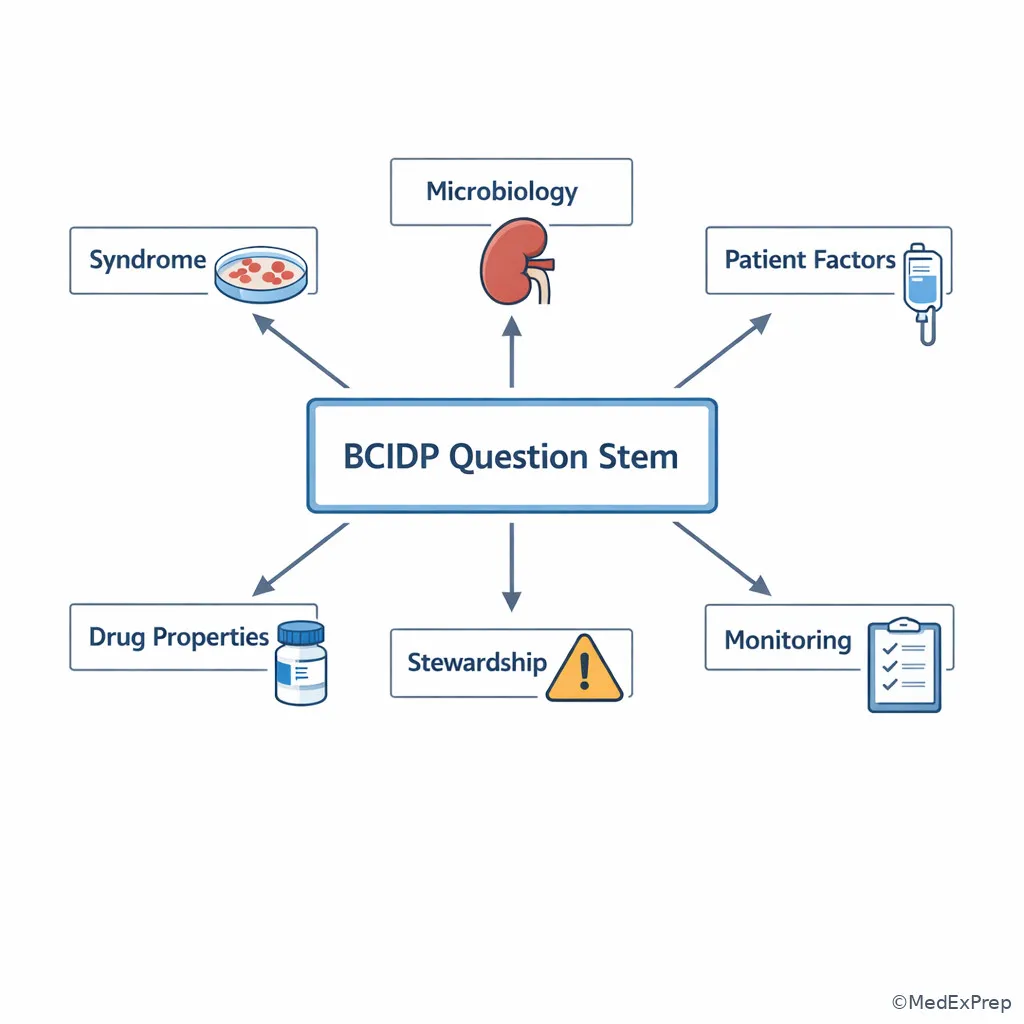
Blueprint buckets visual

Core content

1.1.1.1 Foundational map: what the BCIDP exam is really asking you to do

A. Explanation

The first decision conflict is simple but high yield: Is this a content question or a task question? Many learners read a stem and focus on the disease name. The exam often cares more about the action: choose empiric therapy, optimize targeted therapy, adjust dose, interpret susceptibility, recommend de-escalation, monitor toxicity, or clarify an unsafe plan. The single resolving rule is this: identify the pharmacist action verb before interpreting the details. If the stem asks for the most appropriate next step after culture results, reject answers that stay in empiric mode. If the stem gives a regimen with creatinine clearance and asks what to monitor, reject syndrome-focused answers that ignore drug exposure and toxicity. WHY THIS IS TESTED: candidates often know the infection but miss the tested competency.

For BCIDP, the highest-yield broad buckets are: infectious diseases pharmacotherapy, microbiology/diagnostics, PK/PD dose design, stewardship/safety, and prevention/transitions. This topic is foundational because every later lesson fits somewhere on this map. See Fig 1 for the organizing structure.

Recall: This is the opening topic of the course, so there is no prior detailed lesson to review yet. In the upcoming topic Pharmacist Scope Boundaries, we will narrow this map further by separating what you may recommend from what you must clarify or escalate.
Concept flow: Start every BCIDP question with task recognition
Read the ask
Find the requested pharmacist action before parsing every detail.

Sort the domain
Therapy, diagnostics, PK/PD, stewardship, or prevention.

Use only relevant facts
Promote clues that match the domain; demote unrelated noise.

Choose and verify
Confirm efficacy, safety, feasibility, and stewardship fit.

B. Worked example

A 68-year-old man with type 2 diabetes, stage 3 chronic kidney disease, and atrial fibrillation on apixaban is receiving piperacillin/tazobactam 4.5 g IV every 6 hours for hospital-acquired pneumonia. On day 3, he is afebrile, oxygen need is improving, and sputum culture grows Escherichia coli susceptible to ceftriaxone. Serum creatinine is 1.8 mg/dL, unchanged from baseline. A mild eosinophilia is noted, and the nurse reports the patient prefers to avoid extra IV lines. The question asks for the most appropriate pharmacist recommendation.

Reasoning chain: Identify task: this is not “name the pneumonia bug”; it is a therapy optimization question after microbiology returns. Extract key facts: clinical improvement, culture-directed susceptibility, broad empiric agent still running, stable renal function, no clue demanding antipseudomonal continuation. Apply rule: when culture data permit, move from broad empiric to narrower targeted therapy. Eliminate distractors: continuing piperacillin/tazobactam is tempting because it is active, but spectrum is broader than needed; switching to meropenem would be even broader and unjustified; changing apixaban would address a non-central detail. Verify: ceftriaxone is active, narrower, operationally simpler, and stewardship-concordant.

C. Exam trap

Common wrong answer: Continue the current broad-spectrum regimen because the patient is improving. WHY IT IS TEMPTING: learners overvalue “don’t change what is working” and confuse clinical response with justification for ongoing broad coverage. SINGLE CLUE: organism-specific susceptibility results are already back and support narrowing.

D. Checkpoint

Question: A pharmacist reviews cefepime 2 g IV every 8 hours started empirically for febrile neutropenia. Blood cultures remain negative, ANC is recovering, and the stem asks for the most appropriate monitoring focus. Which domain is most directly being tested?

  1. Infectious diseases pharmacotherapy — tempting because cefepime is an antimicrobial choice, but the ask is about what to monitor rather than which agent to select.
  2. Microbiology and diagnostics — tempting because cultures are mentioned, but the stem does not ask for interpretation of organism identity or susceptibility.
  3. PK/PD and dose individualization — tempting because cefepime dosing is specified, but no organ function or exposure target detail is offered.
  4. Stewardship and safety — correct because monitoring ongoing need and appropriate continuation after negative cultures and clinical change is a stewardship-centered pharmacist task.
If you missed this: Review 1.1.1.1 Foundational map: what the BCIDP exam is really asking you to do — focus on identifying the action verb before focusing on the infection name.
Pharmacist Action: NOTICE: the exact ask in the stem and whether culture, organ function, or regimen details dominate. SAY: “This item is primarily about targeted optimization / monitoring / stewardship,” before choosing. MONITOR: whether new data shift the domain, especially culture results, renal function, route feasibility, and drug levels. HOLD/CLARIFY/ESCALATE: if the requested action moves outside pharmacist scope, reframe it into a recommendation or escalation.

1.1.1.2 Foundational map: the major BCIDP domains and their signature clues

A. Explanation

The next decision conflict is which broad domain best matches the stem clues. You do not need unpublished blueprint percentages to prepare well; you need pattern recognition. Therapy questions usually feature a syndrome, likely pathogens, prior antibiotics, allergies, or susceptibility data. Diagnostics questions foreground specimen quality, culture interpretation, MICs, rapid tests, contamination versus true pathogen, or biomarker limits. PK/PD questions highlight drug, dose, route, infusion strategy, renal function, dialysis, obesity, hepatic dysfunction, or exposure targets. Stewardship questions feature broad-to-narrow choices, duplicate anaerobic coverage, unnecessary MRSA or Pseudomonas coverage, duration, oral step-down, or “do we need to keep treating?” Prevention and transitions questions emphasize prophylaxis, discharge planning, adherence, counseling, access, and follow-up.

The single resolving rule: look for the detail that would be unnecessary unless that domain were being tested. For example, an MIC without a dosing or breakpoint context suggests microbiology interpretation; creatinine clearance placed next to a fully named regimen strongly suggests dose design; a patient tolerating diet, improving, and ready for discharge points toward IV-to-PO or transition planning. See Fig 2 for a high-yield comparison of domain clues.

Fig 2. Signature clue-to-domain matching
Exam takeaway: Match the stem’s “extra detail” to the domain being tested, because that detail usually separates the correct answer from a look-alike option.
flowchart LR
A[Stem clues] --> B{Most distinctive clue}
B --> C[Culture MIC rapid test] --> C1[Diagnostics domain]
B --> D[CrCl dialysis weight level] --> D1[PK/PD domain]
B --> E[Broader than needed duplicate therapy duration] --> E1[Stewardship domain]
B --> F[Discharge oral option adherence] --> F1[Prevention transition domain]
B --> G[Syndrome likely pathogens allergy prior exposure] --> G1[Therapy selection domain]
Memory anchor: Use “Bug-Data-Dose-De-escalate-Discharge” to sort stems fast: Bug = therapy, Data = diagnostics, Dose = PK/PD, De-escalate = stewardship, Discharge = prevention/transitions.
Concept flow: Domain clue recognition
Scan for standout data
What detail feels too specific to be incidental?

Assign the domain
MIC, CrCl, duplicate therapy, or discharge feasibility point to different frameworks.

Use the matching rule
Only then compare answers within that domain.

B. Worked example

A 54-year-old woman with obesity, rheumatoid arthritis on prednisone, and chronic kidney disease receives vancomycin 1.25 g IV every 12 hours plus ceftriaxone 2 g IV daily for suspected meningitis. Her CSF culture later grows penicillin-susceptible Streptococcus pneumoniae. Serum creatinine has increased from 0.8 to 1.4 mg/dL. The stem includes a vancomycin concentration and asks for the best therapy adjustment. There is also an incidental note of chronic sinusitis.

Reasoning chain: Identify task: therapy adjustment after culture data with a safety signal. Extract key facts: definitive pathogen with narrower treatment option, vancomycin nephrotoxicity risk becoming relevant, susceptibility allows de-escalation. Apply rule: once susceptibility supports a narrower beta-lactam, vancomycin can often be discontinued. Eliminate distractors: changing vancomycin to a different dosing interval is tempting because the level is provided, but the culture result changes the entire need for vancomycin; escalating ceftriaxone dose without indication misses the targeted question. Verify: the tested domain overlaps therapy and stewardship, with safety reinforcing the narrow choice.

C. Exam trap

Common wrong answer: Adjust the vancomycin dose rather than discontinue it. WHY IT IS TEMPTING: levels and serum creatinine pull the learner into a PK/PD frame. SINGLE CLUE: culture already identifies a pathogen with a narrower susceptible option, so the higher-level decision is de-escalation, not fine-tuning unnecessary therapy.

D. Checkpoint

Question: Which stem detail most strongly signals that a BCIDP item is primarily testing a microbiology/diagnostics domain rather than therapy selection?

  1. Recent exposure to levofloxacin 750 mg PO daily for 5 days — tempting because prior exposure affects therapy choice, but it points more to empiric selection and resistance risk than diagnostics.
  2. A bronchoalveolar lavage culture with an MIC and breakpoint interpretation — correct because MIC and susceptibility interpretation are diagnostic data that directly frame the medication decision.
  3. Need for oral step-down at discharge tomorrow — tempting because it changes the regimen, but it is a transitions-of-care clue.
  4. Creatinine clearance of 24 mL/min while receiving cefepime 2 g IV every 8 hours — tempting because drug and dose are central, but that is a PK/PD dose-adjustment clue.
If you missed this: Review 1.1.1.2 Foundational map: the major BCIDP domains and their signature clues — focus on the “extra detail” rule that identifies the tested domain.
Quick Recall:

  • The most common signal for a PK/PD domain is the presence of renal function, dialysis, or exposure target.
  • True or False: A positive culture automatically means the item is testing microbiology rather than stewardship. False.
  • Name the 3 quick clue words for stewardship stems: broad, duplicate, duration.
High-Yield Connection: This concept is tested alongside Case Reasoning Framework. Know both the domain clue and the reasoning sequence used to act on it; on exam day they are frequently paired in the same vignette.
Pharmacist Action: NOTICE: whether the stem’s most specific detail is microbiologic, pharmacokinetic, stewardship-related, or discharge-focused. SAY: “This clue exists because the exam wants a certain framework.” MONITOR: for domain shifts after new culture or clinical data arrive. HOLD/CLARIFY/ESCALATE: if team members are solving the wrong problem, redirect the recommendation to the actual domain.

1.1.1.3 Application: how stems blend syndrome, bug, host, and drug information

A. Explanation

Once you identify the domain, the next conflict is which facts matter most within the stem. BCIDP questions often contain noise: age, comorbidities, old allergies, mild lab abnormalities, and operational details. The pharmacist must choose between every available fact and the decision-driving fact. A useful internal hierarchy is: task first, then syndrome/source, then microbiology, then host modifiers, then drug-specific safety and feasibility. If the question is targeted therapy, organism and susceptibility outrank remote epidemiology. If the question is dosing, organ function and modality outrank the syndrome name. If the question is oral step-down, bioavailability and source control feasibility outrank the fact that IV therapy “feels stronger.” WHY THIS IS TESTED: the exam is built to reward disciplined prioritization, not total data absorption.

Use a mental grid: syndrome tells you where the drug must work; bug tells you what it must cover; host tells you whether standard choices are safe and feasible; drug tells you whether the regimen can achieve exposure without undue harm. See Fig 3 for a comparison framework. This lesson is not asking you to master every syndrome yet; it is teaching where later syndrome lessons will plug into your reasoning map.

Fig 3. Stem triage using syndrome-bug-host-drug
Exam takeaway: Prioritize the fact that changes action, not the fact that merely sounds clinically interesting.
flowchart TD
A[Question asks for best regimen decision] --> B[Syndrome or source]
B --> C[Likely or confirmed bug]
C --> D[Host modifiers]
D --> E[Drug fit]
E --> F[Check stewardship and monitoring]
D --> D1[Renal function allergy immunocompromise route]
E --> E1[PK PD interactions toxicity penetration]
High-Yield Connection: This concept overlaps with future topics on Patient Assessment Inputs and Empiric Risk Stratification. Know both the syndrome source and the host modifier because many close-call answers differ by only one host factor, such as renal dysfunction or recent antibiotic exposure.
Pharmacist stem-sorting worksheet illustration
Exam takeaway: A structured stem-sorting approach helps you downgrade distracting details and elevate the one fact that changes therapy.
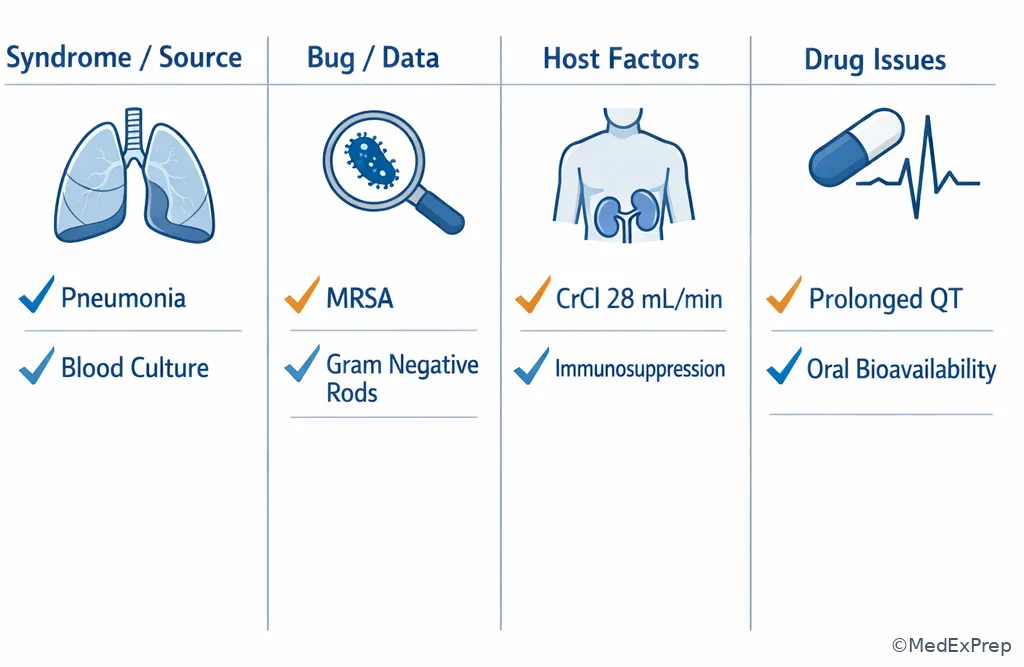
Pharmacist stem-sorting worksheet illustration
Concept flow: Prioritize data inside a noisy vignette
Find the task
Choice, adjustment, monitoring, de-escalation, or clarification.

Rank the facts
Syndrome and bug first, then host and drug constraints.

Reject the noise
Ignore details that do not change the requested action.

Verify the regimen
Check efficacy, toxicity, route, and stewardship.

B. Worked example

A 73-year-old woman with cirrhosis, chronic kidney disease, and a remote rash with amoxicillin is admitted with pyelonephritis. She was started on cefepime 2 g IV every 12 hours. Urine culture grows ESBL-producing E. coli. She has a QTc of 510 ms, mild thrombocytopenia, and nausea but is otherwise improving. The question asks for the best targeted regimen recommendation.

Reasoning chain: Identify task: targeted therapy recommendation. Extract key facts: pyelonephritis source, confirmed ESBL organism, current cefepime may be unreliable depending on susceptibility context and syndrome, QTc makes fluoroquinolone less appealing, renal function and liver disease affect dosing but do not change the central bug-drug fit. Apply rule: in serious ESBL infections, choose an agent with reliable activity and supportive evidence rather than being distracted by non-central details. Eliminate distractors: oral levofloxacin is tempting for convenience but QTc and resistance concerns matter; piperacillin/tazobactam is tempting if reported susceptible, but source and ESBL reliability are critical; ceftriaxone is too narrow for ESBL. Verify: a carbapenem-based targeted recommendation best fits the domain.

C. Exam trap

Common wrong answer: Pick the oral option because the patient is improving. WHY IT IS TEMPTING: improvement and nausea resolution encourage premature discharge thinking. SINGLE CLUE: the item asks for best targeted therapy for an ESBL organism, so bug-drug reliability outranks convenience.

D. Checkpoint

Question: A stem includes linezolid 600 mg IV every 12 hours, platelet count trend, serotonin-active home medications, and no culture data yet. What is the most likely primary domain being tested?

  1. Therapy selection — tempting because linezolid choice matters, but the supporting clues emphasize adverse effects and interactions rather than organism fit.
  2. Microbiology/diagnostics — tempting because cultures are not final, but there is no lab interpretation task.
  3. Stewardship and safety — correct because platelets and serotonergic co-medications direct attention to toxicity and interaction management.
  4. Prevention and transitions — tempting because linezolid has oral bioavailability, but discharge feasibility is not the stem’s central clue.
If you missed this: Review 1.1.1.3 Application: how stems blend syndrome, bug, host, and drug information — focus on ranking decision-driving facts above clinically interesting noise.
Pharmacist Action: NOTICE: which single fact changes the recommendation most. SAY: “The deciding factor here is the source-bug fit / host safety constraint / operational feasibility.” MONITOR: culture finalization, organ function, route tolerance, and drug-specific toxicity markers. HOLD/CLARIFY/ESCALATE: when a tempting alternative fails because of one high-risk host factor or interaction.

1.1.1.4 Application: pharmacist scope, task verbs, and answer-choice filtering

A. Explanation

BCIDP is a pharmacist board exam, so another major decision conflict is which answers remain inside pharmacist role. The exam wants consultant-level medication judgment, not unsupported independent diagnosis or procedure-level action. Accept verbs such as recommend, assess, clarify, verify, adjust, monitor, educate, de-escalate, convert to oral therapy, document a plan, and escalate safety concerns. Reject answers that require acting as an unrestricted prescriber or proceduralist unless the stem explicitly grants collaborative authority. The single resolving rule is: if the action is outside pharmacist scope, choose the answer that appropriately recommends, clarifies, or escalates instead. WHY THIS IS TESTED: high-performing clinicians can still miss exam items by picking an answer that is medically sensible but role-inappropriate.

This matters even when the drug choice itself is correct. For example, “write the order for line removal” is a trap if the pharmacist should instead recommend line evaluation or alert the primary team. Likewise, if no diagnosis has been established, the pharmacist’s role is often to interpret the available microbiology and medication implications, not independently make the final diagnosis. This domain map therefore includes scope framing as a cross-cutting filter over every other domain.

Fig 4. Pharmacist-scope answer filter
Exam takeaway: When multiple answers seem clinically reasonable, prefer the one framed as a pharmacist recommendation, clarification, monitoring step, or escalation.
flowchart TD
A[Answer choice] --> B{Within pharmacist role?}
B -->|Yes| C[Recommend optimize monitor educate]
B -->|No| D[Reject unless explicit authority given]
C --> E{Safe and stewardship aligned?}
E -->|Yes| F[Keep in consideration]
E -->|No| G[Reject]
D --> H[Prefer clarify or escalate option]
Key rule: On BCIDP, the best answer may be a pharmacist recommendation to clarify or escalate, not the independent medical act itself.
Pharmacist scope boundary visual
Exam takeaway: Distinguish medication-optimization actions from prescriber-only or procedural actions to avoid avoidable misses.
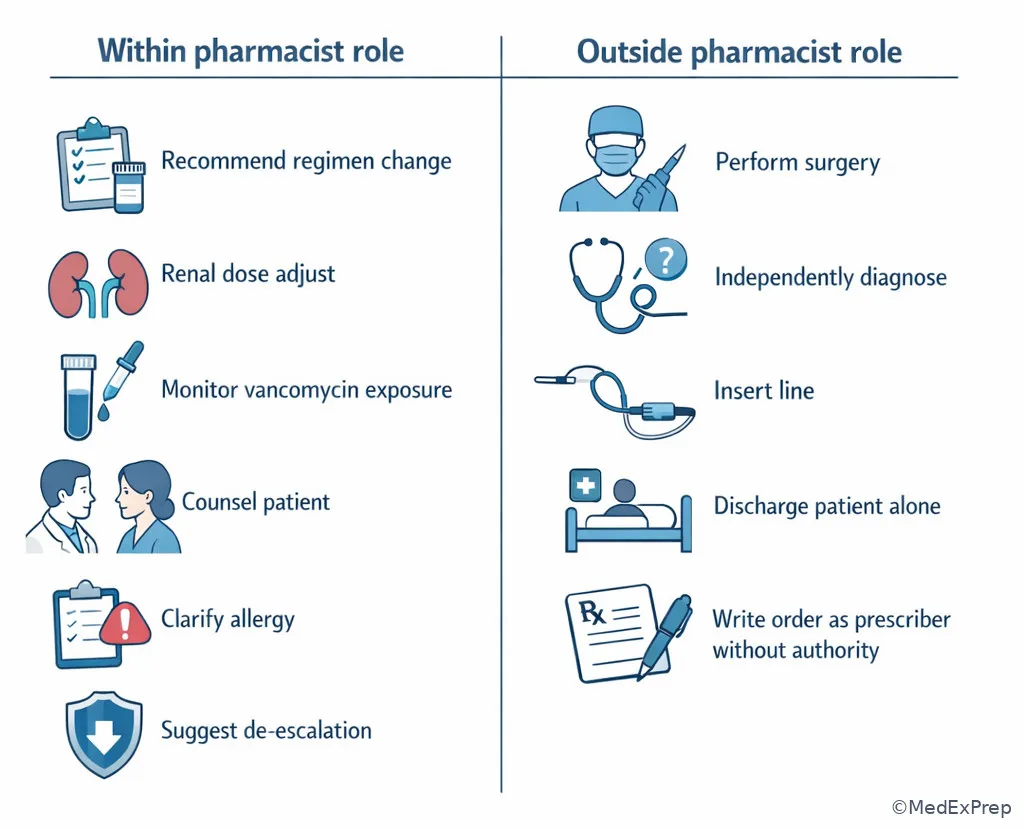
Pharmacist scope boundary visual
Concept flow: Filter answer choices through pharmacist scope
Read the action verb
Does the option ask you to recommend, monitor, or directly perform?

Check authority
If authority is not explicit, prefer collaborative wording.

Choose the pharmacist action
Recommend, clarify, verify, monitor, or escalate.

B. Worked example

A 60-year-old kidney transplant recipient on tacrolimus is admitted with candidemia and receives micafungin 100 mg IV daily. Repeat blood cultures are pending. He has a tunneled central line, hypertension, and mild diarrhea. The item asks what the pharmacist should do next. One option is “remove the line immediately”; another is “recommend urgent line evaluation and communicate persistent candidemia risk while optimizing antifungal therapy.”

Reasoning chain: Identify task: pharmacist next step. Extract key facts: candidemia requires medication optimization and urgent multidisciplinary follow-up; line management matters but is not a pharmacist-performed procedure. Apply rule: stay within role while still acting decisively. Eliminate distractors: “remove the line immediately” is medically adjacent but outside pharmacist action; “continue current therapy with no communication” ignores the seriousness; “switch to fluconazole now” is premature without stability and susceptibility context. Verify: the pharmacist should recommend appropriate therapy and escalate line/source concerns to the treating team.

C. Exam trap

Common wrong answer: Choose the procedural answer because it is clinically aggressive. WHY IT IS TEMPTING: urgency in infectious diseases can make the most interventionist option look strongest. SINGLE CLUE: the item asks what the pharmacist should do, not what the team as a whole may ultimately perform.

D. Checkpoint

Question: Which answer is most likely to be correct on a BCIDP item if no collaborative practice authority is specified?

  1. Write an order for meropenem 2 g IV every 8 hours by extended infusion — tempting because the regimen may be appropriate, but independent prescribing is not assumed.
  2. Perform incision and drainage, then narrow therapy — tempting because source control matters, but procedural management is outside pharmacist scope.
  3. Recommend meropenem 2 g IV every 8 hours by extended infusion and document renal-dose reassessment needs — correct because it stays within pharmacist medication-management role.
  4. Finalize the diagnosis of osteomyelitis before adjusting therapy — tempting because diagnosis matters, but the pharmacist generally acts on provided data and collaborates rather than independently establishing the diagnosis.
If you missed this: Review 1.1.1.4 Application: pharmacist scope, task verbs, and answer-choice filtering — focus on preferring recommend/clarify/escalate wording when authority is not explicit.
Quick Recall:

  • Fill in the blank: If the stem asks what the pharmacist should do, procedural answers are usually ______. outside scope
  • True or False: The most clinically aggressive answer is usually the best BCIDP answer. False.
  • Name 3 in-scope verbs: recommend, clarify, monitor.
Recall: In the upcoming topic Pharmacist Scope Boundaries, we will convert this broad filter into an exact exam-day checklist: recommend, clarify, verify, monitor, and escalate.
Pharmacist Action: NOTICE: whether the answer choice assumes prescriptive or procedural authority. SAY: “My role is to recommend and escalate the safest medication plan.” MONITOR: team follow-through on high-risk recommendations, especially candidemia, bacteremia, toxicity, and interaction concerns. HOLD/CLARIFY/ESCALATE: immediately when the safest next step requires another clinician’s direct action.

1.1.1.5 Integration: building an exam-day question triage system

A. Explanation

The final integration task is combining all prior sections into a rapid triage system. Under timed conditions, you need a repeatable algorithm: identify the ask, classify the domain, rank the stem facts, filter by pharmacist scope, then verify the choice for efficacy, safety, feasibility, and stewardship. The decision conflict here is speed versus thoroughness. Moving too fast leads to superficial pattern matching; moving too slowly wastes time on noise. The single resolving rule is: perform the same short sequence on every item, even if you think you already know the answer. WHY THIS IS TESTED: the exam is less about memorizing all facts at once and more about consistently applying a medication-decision workflow.

This triage system anticipates the next course topic, Case Reasoning Framework, where you will expand the method into a more formal bug-host-drug-source analysis. At this stage, your goal is not exhaustive management. Your goal is to quickly identify what kind of pharmacist judgment the question demands and prevent classic misses such as broader-than-needed therapy, wrong dose in renal dysfunction, unsafe interaction, or out-of-scope action. See Fig 5 for the exam-day algorithm.

Fig 5. Exam-day triage algorithm for BCIDP stems
Exam takeaway: Use the same five-step sequence on every item to convert complex vignettes into one pharmacist-level decision.
flowchart TD
A[Read stem] --> B[Identify pharmacist task]
B --> C[Assign domain]
C --> D[Rank key facts]
D --> E[Apply scope filter]
E --> F[Choose answer]
F --> G[Verify efficacy safety feasibility stewardship]
Exam-day workflow board illustration
Exam takeaway: A fixed workflow improves speed without sacrificing the single discriminating clue in complex vignettes.
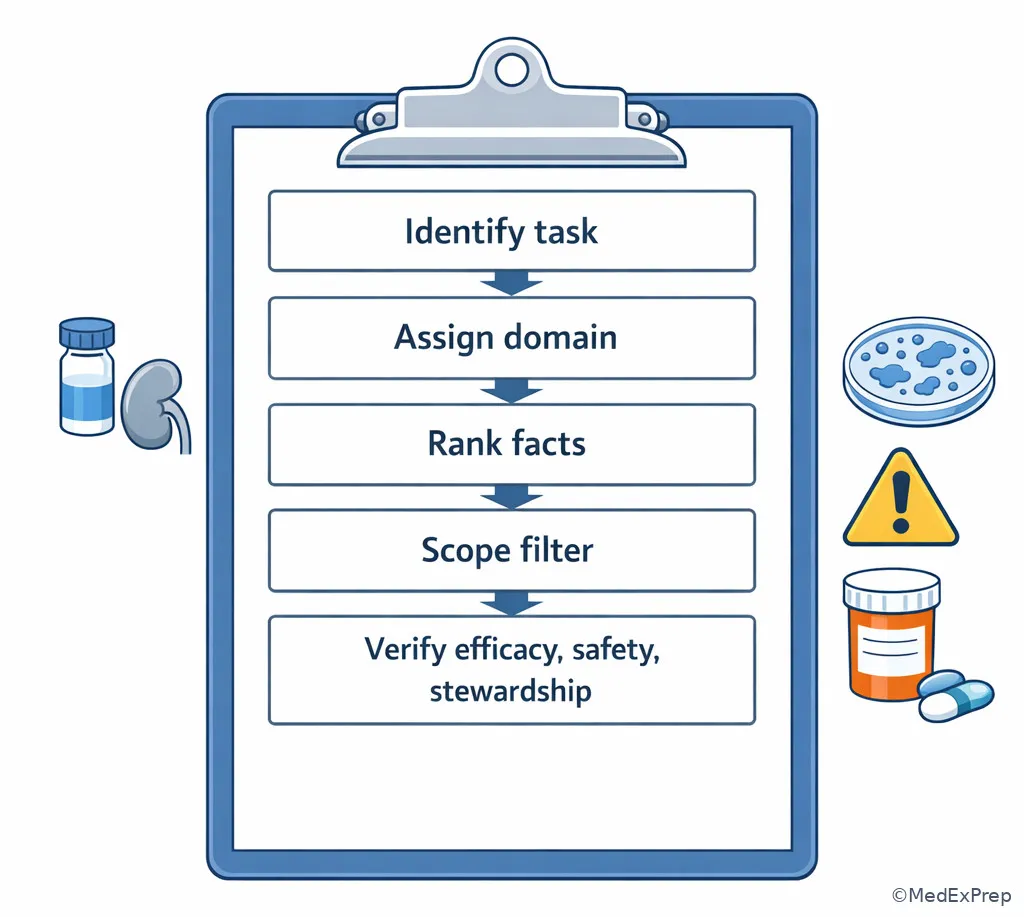
Exam-day workflow board illustration
Concept flow: Five-step exam triage
Task
What does the pharmacist need to do?

Domain
Therapy, diagnostics, PK/PD, stewardship, or transition?

Key facts
Promote only details that can change the decision.

Scope
Choose the in-role action.

Verify
Confirm efficacy, safety, feasibility, and stewardship.

B. Worked example

A 49-year-old man with obesity, uncontrolled diabetes, and hemodialysis dependence is receiving daptomycin 8 mg/kg IV after each dialysis session for MRSA bacteremia. His CK is mildly elevated, blood cultures have cleared, and he is eager for discharge. The stem includes home simvastatin use, a tunneled catheter, and a question asking for the most appropriate pharmacist follow-up recommendation.

Reasoning chain: Step 1 task: follow-up recommendation. Step 2 domain: safety and monitoring, with some transitions-of-care overlap. Step 3 key facts: daptomycin exposure in dialysis, CK elevation, statin interaction risk, bacteremia follow-up. The desire for discharge is noise unless it changes feasibility. Step 4 scope: pharmacist should recommend monitoring and therapy optimization, not independently discharge or remove hardware. Step 5 verify: CK and muscle toxicity monitoring, statin review, dialysis timing, and coordination with the team are most appropriate. The domain map prevents a common miss: choosing an early oral step-down concept that does not fit bacteremia.

C. Exam trap

Common wrong answer: Switch to oral therapy because the patient wants discharge. WHY IT IS TEMPTING: transition-of-care details often trigger oral-conversion reflexes. SINGLE CLUE: the infection is MRSA bacteremia, where monitoring and completion of an appropriate parenteral plan remain central.

D. Checkpoint

Question: Which verification step should always occur after you think you have the right answer to a BCIDP item?

  1. Confirm the answer is the broadest active regimen — tempting because severe infections often start broadly, but broadest is not the universal goal.
  2. Confirm the answer fits efficacy, safety, feasibility, and stewardship — correct because the final check protects against close-call distractors that fail on one of these dimensions.
  3. Confirm the answer uses an intravenous formulation whenever available — tempting because IV therapy feels stronger, but oral options may be preferred when appropriate.
  4. Confirm the answer solves every possible medical issue in the vignette — tempting because comprehensive thinking feels safe, but the exam usually targets one pharmacist decision.
If you missed this: Review 1.1.1.5 Integration: building an exam-day question triage system — focus on the final verification check of efficacy, safety, feasibility, and stewardship.
Memory anchor: Use T-D-K-S-V = Task, Domain, Key facts, Scope, Verify. If you freeze on a hard question, write these five letters and force the stem into that sequence.
Pharmacist Action: NOTICE: whether you are being pulled toward a familiar but wrong framework. SAY: “I have to verify this answer on four dimensions: efficacy, safety, feasibility, stewardship.” MONITOR: your own tendency to skip verification on easy-looking questions. HOLD/CLARIFY/ESCALATE: when the safest recommendation depends on another service’s urgent action, document and communicate that need.

Exam Traps & Differentiators

Most common wrong answer and why: choosing the clinically active regimen that does not match the tested domain. Example: keeping a broad empiric drug after susceptibilities return because it is active, when the item is actually about de-escalation.

Stem says... Think... Common distractor Single discriminator
Culture, MIC, breakpoint, rapid diagnostic Microbiology/diagnostics domain Answering as if still purely empiric The lab detail exists to change the medication decision
CrCl, dialysis, weight, level, infusion strategy PK/PD dose design Choosing the right drug with the wrong dose Organ function or exposure target is the tested variable
Improving, cultures finalized, spectrum broad Stewardship/de-escalation Continuing broad therapy “because it works” New data allow safe narrowing
Discharge, tolerating PO, insurance, adherence Transition/IV-to-PO Preferring IV because it feels stronger Feasibility and bioavailability now matter most
Question asks what the pharmacist should do Scope framing filter Picking a procedural or prescriber-only action Choose recommend/clarify/monitor/escalate wording
Looks similar But is not the same as How to tell
Positive culture result Question about microbiology domain If the ask is whether to narrow, stop, or monitor therapy, it may be stewardship instead
Detailed drug regimen in the stem PK/PD question If no organ function, level, or dosing constraint appears, the regimen may just be context for safety or therapy selection
Desire for discharge Automatic oral step-down Source, bacteremia status, absorption, and agent bioavailability still decide
Urgent infection Permission to act outside pharmacist role Urgency changes communication speed, not professional boundaries
  • If the stem says “susceptibilities returned” think targeted therapy or de-escalation.
  • If the stem says “creatinine clearance is 18 mL/min” think dose design before spectrum.
  • If the stem says “improving and tolerating oral intake” think transition feasibility, not reflexive IV continuation.
  • If the stem says “what should the pharmacist do next” think recommend, clarify, monitor, or escalate.
  • If the stem says “positive culture from a low-quality specimen” think contamination/colonization risk before treatment escalation.
Distractor comparison board
Exam takeaway: Most close-call wrong answers fail because they solve the wrong domain problem, not because they are obviously inactive.
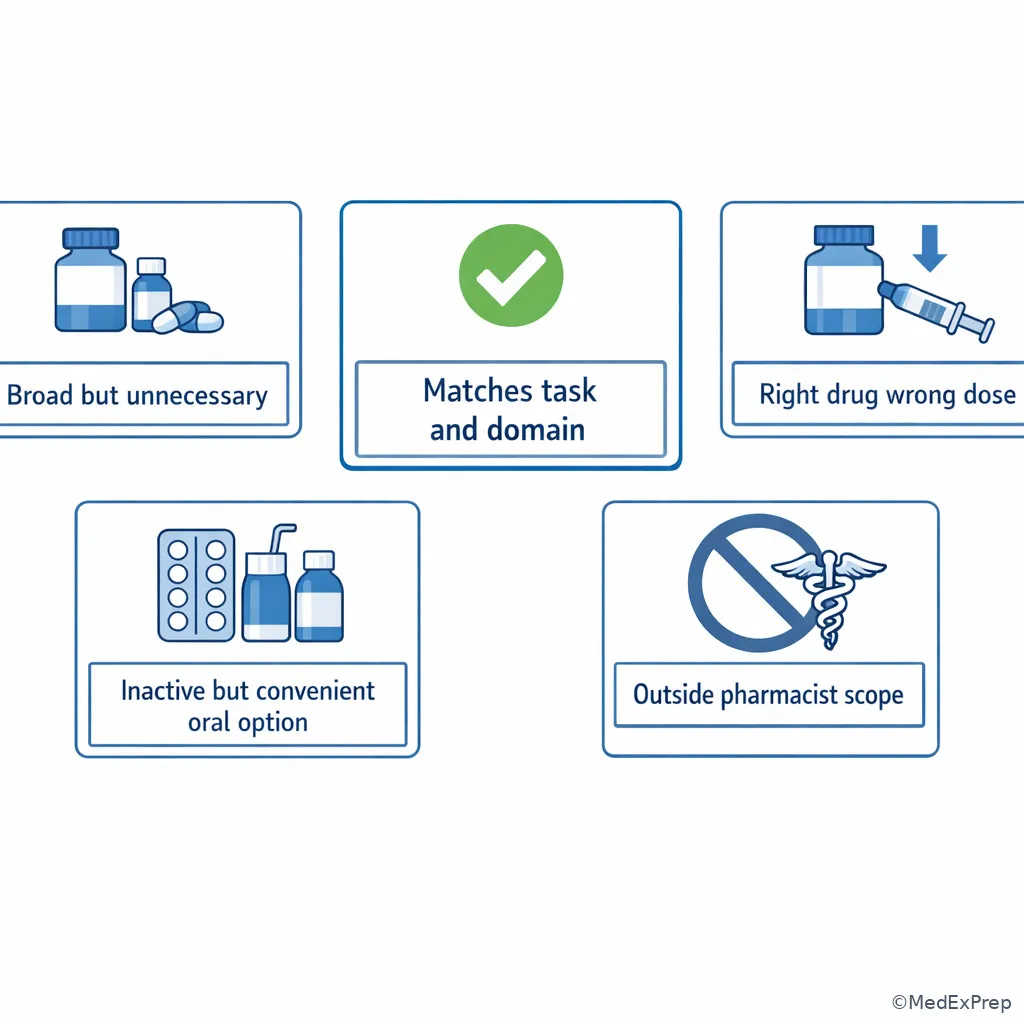
Distractor comparison board
Review connection: The traps above test domain recognition and pharmacist-role framing. If any felt unfamiliar, revisit 1.1.1.2 Foundational map: the major BCIDP domains and their signature clues and 1.1.1.4 Application: pharmacist scope, task verbs, and answer-choice filtering before attempting the Self-check quiz.

Tables

Domain What it usually tests Signature stem clues Typical pharmacist action
Infectious diseases pharmacotherapy Empiric or targeted agent selection Syndrome, organism, allergy, prior antibiotics, susceptibility Recommend the best regimen or narrowing strategy
Microbiology and diagnostics Interpretation of culture, rapid test, MIC, specimen quality Breakpoint, contaminant, colonization, rapid organism ID Explain how the result changes therapy
PK/PD and dose individualization Dose, interval, infusion, dialysis, monitoring target CrCl, RRT modality, obesity, level, AUC, infusion duration Adjust regimen and monitoring plan
Stewardship and safety De-escalation, duration, duplicate coverage, toxicity, interactions Improving patient, finalized cultures, broad therapy, adverse effect trend Recommend safer, narrower, shorter, or better-monitored therapy
Prevention and transitions Prophylaxis, IV-to-PO, discharge plan, adherence, counseling Tolerating oral intake, discharge tomorrow, prophylaxis indication, access issue Select feasible regimen and follow-up plan
Question type Choose this framework Reject this reflex
Empiric therapy Syndrome + likely pathogens + host risk Over-focusing on a nonfinal culture clue
Targeted therapy Confirmed organism + susceptibility + site Continuing the original broad regimen automatically
Dose adjustment Drug exposure + organ function + modality Keeping standard dose because the drug choice is correct
De-escalation Narrowest effective regimen “Don’t change what’s working”
IV-to-PO conversion Clinical improvement + oral option quality + source considerations Assuming IV is always superior
Safety/interaction Drug-specific toxicity risk + comedications Ignoring one red-flag lab or home medication
Differential category Primary cue Best next pharmacist mindset
Therapy selection vs stewardship Broad regimen still active after cultures return Ask whether narrower therapy is now justified
Diagnostics vs therapy MIC or rapid test included in stem Interpret what the test means before changing drugs
PK/PD vs safety Dose details plus organ dysfunction or level Decide whether the issue is exposure adequacy, toxicity, or both
Transition vs inpatient optimization Discharge planning language Confirm source, oral bioavailability, adherence, and monitoring feasibility
In-scope vs out-of-scope Answer options include procedures or independent orders Prefer collaborative pharmacist wording

Algorithm / Approach

Concept flow: Universal BCIDP item approach
Start with the ask
Define the requested pharmacist action: choose, adjust, monitor, de-escalate, convert, or clarify.

Assign the domain
If data center on culture/MIC → diagnostics; if on dose/CrCl/level → PK/PD; if on broadness/duration → stewardship.

Promote the deciding clue
Select the one fact that changes the recommendation and ignore decorative noise.

Apply the scope filter
Choose recommend/clarify/monitor/escalate unless explicit authority changes the framing.

Verify four checks
Confirm efficacy, safety, feasibility, and stewardship before finalizing.

Fig 6. Universal pharmacist decision checklist
Exam takeaway: The best BCIDP answers survive a final check for efficacy, safety, feasibility, and stewardship within pharmacist scope.
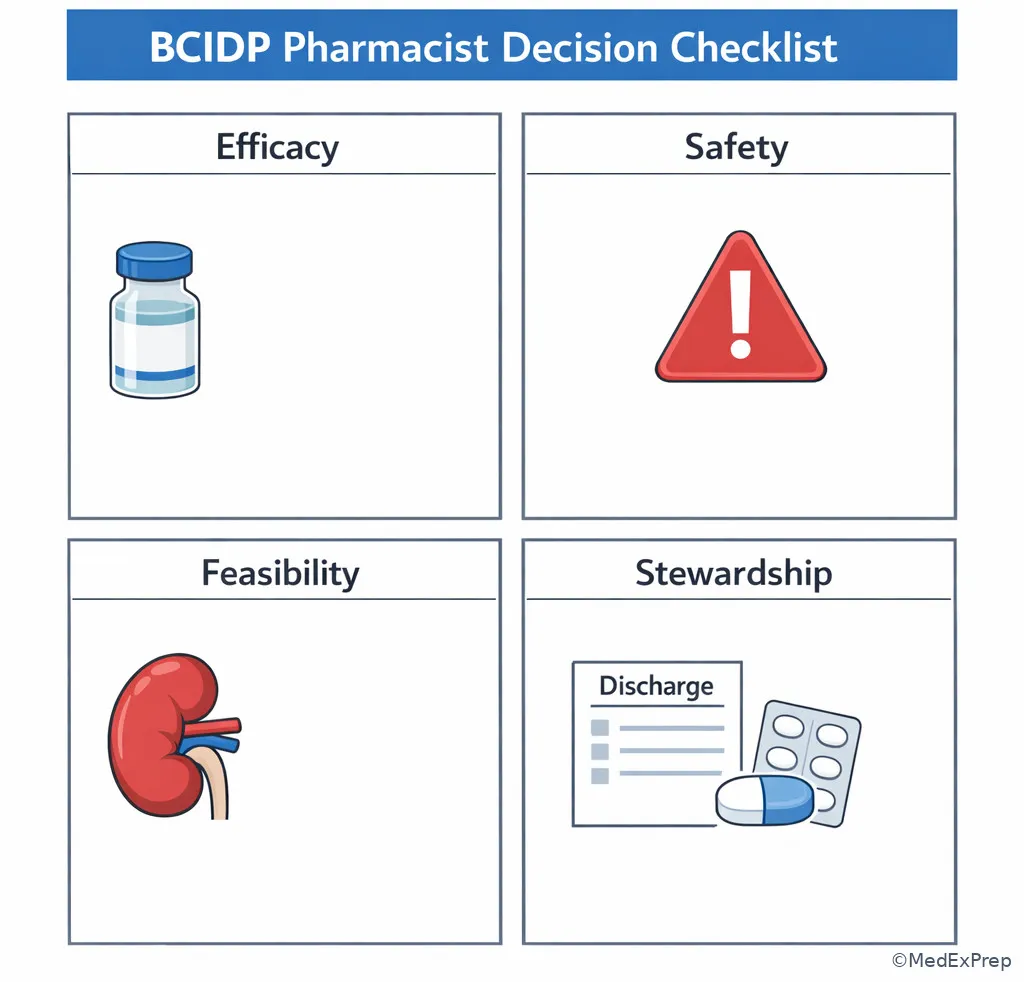
Fig 6. Universal pharmacist decision checklist

Use this algorithm when you feel uncertain. It is especially valuable early in the course because it prevents you from overcommitting to one content area before you understand the full exam structure. See Fig 5 and Fig 6 for the exam-day flow and final checklist.

Rapid Review

  • Task recognition → the verb matters more than the diagnosis label
  • Targeted therapy → finalized susceptibility data outrank empiric habit
  • PK/PD item → CrCl, dialysis, weight, or levels are the discriminator
  • Diagnostics item → MIC/breakpoint details exist to change medication meaning
  • Stewardship item → broad but active is often still wrong
  • Transition item → oral feasibility can beat unnecessary IV continuation
  • Scope filter → recommend/clarify/escalate beats procedural action
  • Noise in vignettes → prioritize the fact that changes action
  • Culture positive → does not automatically mean “treat more”
  • Correct drug, wrong dose → still wrong on BCIDP
  • Improving patient → asks for reassessment, not autopilot continuation
  • Answer verification → check efficacy, safety, feasibility, stewardship

Self-check quiz

1. A pharmacist reviews ceftriaxone 2 g IV every 24 hours for community-acquired pneumonia. The stem provides no renal function issue, no culture data, and asks which broad BCIDP domain is most likely being tested when the learner must choose the initial regimen. Which is the best answer?

  1. Infectious diseases pharmacotherapy
  2. Microbiology and diagnostics
  3. PK/PD and dose individualization
  4. Prevention and transitions of care

2. A pharmacist reviews cefepime 2 g IV every 8 hours in a patient with creatinine clearance 18 mL/min and asks which domain is most directly signaled by the presence of renal function in the stem. Which is the best answer?

  1. Stewardship and safety
  2. PK/PD and dose individualization
  3. Prevention and transitions of care
  4. Microbiology and diagnostics

3. A 65-year-old man with COPD and chronic kidney disease is receiving piperacillin/tazobactam 4.5 g IV every 6 hours for pneumonia. Sputum culture now shows Haemophilus influenzae susceptible to ceftriaxone; he is afebrile and improving. The pharmacist is asked for the most appropriate next step. Which framework should drive the answer?

  1. Continue broad empiric therapy because the patient improved on it
  2. Targeted therapy and stewardship de-escalation
  3. Primary prevention and prophylaxis planning
  4. Independent diagnostic confirmation of pneumonia etiology

4. A 58-year-old woman with obesity and diabetes is receiving vancomycin 1 g IV every 12 hours for MRSA skin infection. The stem includes an AUC estimate, serum creatinine trend, and no new culture issue. It asks for the most appropriate regimen adjustment. Which is the best primary domain?

  1. PK/PD and dose individualization
  2. Prevention and transitions
  3. Microbiology and diagnostics
  4. Diagnostic imaging escalation

5. A 72-year-old woman with atrial fibrillation on dofetilide and chronic sinusitis is prescribed levofloxacin 750 mg PO daily at discharge for a urinary infection. The stem asks what the pharmacist should address before finalizing the plan. Which framework is most appropriate?

  1. Stewardship and safety, especially interaction review
  2. Microbiology only, because urinary infections are culture-driven
  3. Prevention only, because discharge is mentioned
  4. Independent diagnosis of pyelonephritis severity

6. A 47-year-old liver transplant recipient on tacrolimus receives voriconazole 6 mg/kg IV every 12 hours for 2 doses then 4 mg/kg IV every 12 hours for probable invasive aspergillosis. The stem includes tacrolimus concentration, QTc 505 ms, mild visual changes, and a plan for discharge in several days. The pharmacist is asked for the most important recommendation now. Which answer best reflects correct domain recognition and pharmacist scope?

  1. Prioritize discharge conversion because oral therapy will simplify care
  2. Recommend urgent review of interaction and toxicity with dose/monitoring adjustment considerations
  3. Finalize the diagnosis of aspergillosis before commenting on therapy
  4. Write a standing order to hold tacrolimus indefinitely

7. A 70-year-old man on intermittent hemodialysis is receiving daptomycin 10 mg/kg IV after each dialysis session for VRE bacteremia. CK rises from 110 to 880 units/L, he reports new thigh pain, and his home rosuvastatin was resumed yesterday. Blood cultures are negative. The item asks for the best pharmacist recommendation. Which option shows the correct BCIDP reasoning structure?

  1. Continue daptomycin unchanged because blood cultures are now negative
  2. Recommend assessing daptomycin toxicity risk, reviewing statin coadministration, and escalating the CK concern to the team
  3. Switch automatically to oral linezolid because discharge may be possible this week
  4. Remove the dialysis catheter immediately

8. A 62-year-old woman with rheumatoid arthritis on prednisone and stage 4 CKD is receiving cefepime 2 g IV every 8 hours plus metronidazole 500 mg IV every 8 hours for intra-abdominal infection after source control. She is improving, cultures show susceptible E. coli and Bacteroides fragilis, and discharge to home OPAT is being discussed. The pharmacist is asked for the most appropriate next recommendation. Which option best applies the domain map?

  1. Keep both agents because improvement proves the current regimen is optimal
  2. Recommend reassessing dose for CKD and narrowing to the simplest effective regimen supported by culture data
  3. Focus only on discharge logistics because home therapy planning is mentioned
  4. Independently determine whether the surgery achieved adequate source control before changing therapy

Answer key

Question 1

Correct answer: A. Infectious diseases pharmacotherapy

  • A. Tempting because the stem centers on ceftriaxone selection for a syndrome; correct because choosing an initial regimen is classic therapy-selection framing. The single clue is the ask to choose the initial regimen. Source support: DiPiro and ACCP-style pharmacotherapy frameworks emphasize syndrome-, pathogen-, and host-based regimen selection.
  • B. Tempting because pneumonia often involves cultures, but incorrect because no diagnostic interpretation detail such as MIC, specimen quality, or rapid test is provided. The single clue eliminating it is the absence of microbiology interpretation data. Source support: Diagnostic domains hinge on test interpretation, not merely infection presence.
  • C. Tempting because ceftriaxone is a drug with dosing, but incorrect because renal function or exposure targets are not presented as decision drivers. The single clue eliminating it is lack of dose-design data. Source support: PK/PD questions require dose-relevant patient-specific variables.
  • D. Tempting because route and discharge can matter in therapy, but incorrect because nothing in the stem focuses on prophylaxis, transition, or oral conversion. The single clue eliminating it is that the choice is about initial treatment, not transition. Source support: Prevention/transition items require adherence, discharge, or prophylaxis framing.
If you missed this: Review 1.1.1.2 Foundational map: the major BCIDP domains and their signature clues — focus on recognizing therapy-selection stems by syndrome and initial-regimen language.

Question 2

Correct answer: B. PK/PD and dose individualization

  • A. Tempting because incorrect dosing can create toxicity, but incorrect because the stem’s most distinctive clue is creatinine clearance linked to a named cefepime regimen. The single discriminator is renal function data. Source support: Lexicomp and FDA labeling tie cefepime dose adjustment to renal function.
  • B. Correct because a specified regimen plus CrCl 18 mL/min directly signals dose individualization. The single clue is explicit renal impairment. Source support: AHFS, Lexicomp, and pharmacotherapy texts identify renal function as a core dosing determinant.
  • C. Tempting because route feasibility can matter later, but incorrect because there is no discharge or oral-conversion context. The single clue eliminating it is absent transition language.
  • D. Tempting because cultures may later matter, but incorrect because no MIC, susceptibility, or specimen issue is given. The single clue eliminating it is lack of microbiology interpretation data.
If you missed this: Review 1.1.1.2 Foundational map: the major BCIDP domains and their signature clues — focus on CrCl/dialysis/level as PK/PD trigger clues.

Question 3

Correct answer: B. Targeted therapy and stewardship de-escalation

  • A. Tempting because active empiric therapy led to clinical improvement; incorrect because culture data now support narrowing, and stewardship requires reassessment of broad coverage. The single clue is susceptible H. influenzae with patient improvement. Source support: IDSA stewardship principles favor narrowing once cultures support it.
  • B. Correct because the combination of finalized culture data and ongoing broad therapy makes targeted de-escalation the governing framework. The single clue is organism-specific susceptibility. Source support: stewardship guidelines and pharmacotherapy texts emphasize culture-directed narrowing.
  • C. Tempting because step-down planning often comes later, but incorrect because prophylaxis is not the issue. The single clue eliminating it is the active treatment question after cultures return.
  • D. Tempting because diagnosis matters conceptually, but incorrect because the pharmacist is not being asked to independently diagnose; the syndrome is already being treated and microbiology is available. The single clue eliminating it is pharmacist recommendation framing.
If you missed this: Review 1.1.1.1 Foundational map: what the BCIDP exam is really asking you to do — focus on switching from empiric to targeted reasoning when susceptibilities return.

Question 4

Correct answer: A. PK/PD and dose individualization

  • A. Correct because vancomycin AUC and serum creatinine are classic exposure-and-toxicity variables used to optimize dosing. The single clue is the AUC estimate paired with renal trend. Source support: vancomycin consensus guidance and Lexicomp dosing recommendations prioritize exposure-based adjustment.
  • B. Tempting because some vancomycin cases end with oral step-down discussion, but incorrect because no discharge or route-conversion issue is presented. The single clue eliminating it is the monitoring focus.
  • C. Tempting because MRSA is a microbiologic concept, but incorrect because no new organism interpretation or susceptibility challenge is present. The single clue eliminating it is that the stem asks for regimen adjustment using PK data.
  • D. Tempting because severe skin infection sometimes prompts imaging, but incorrect and outside the tested medication framework. The single clue eliminating it is that the item asks for a regimen adjustment, not a procedural/diagnostic escalation. Source support: pharmacist role is medication optimization.
If you missed this: Review 1.1.1.2 Foundational map: the major BCIDP domains and their signature clues — focus on level/AUC/SCr as exposure-management signals.

Question 5

Correct answer: A. Stewardship and safety, especially interaction review

  • A. Correct because dofetilide plus levofloxacin raises an interaction and QT-risk concern, making safety review the key pharmacist task before plan finalization. The single clue is the named interacting home medication. Source support: FDA labeling, Lexicomp interaction monographs, and Clinical Pharmacology support significant QT interaction concern.
  • B. Tempting because urinary infections are often culture-guided, but incorrect because the deciding clue is a drug interaction rather than culture interpretation. The single clue eliminating it is dofetilide use.
  • C. Tempting because discharge is mentioned, but incorrect because transition planning is not the immediate priority if the regimen may be unsafe. The single clue eliminating it is the high-risk interaction.
  • D. Tempting because disease severity can affect route and duration, but incorrect because independently diagnosing severity is not the pharmacist’s primary role in this framing. The single clue eliminating it is “before finalizing the plan,” which points to medication safety review.
If you missed this: Review 1.1.1.3 Application: how stems blend syndrome, bug, host, and drug information — focus on identifying the one drug-specific safety clue that outranks other details.

Question 6

Correct answer: B. Recommend urgent review of interaction and toxicity with dose/monitoring adjustment considerations

  • A. Tempting because voriconazole has an oral formulation and discharge is mentioned; incorrect because tacrolimus interaction, QTc prolongation, and visual adverse effects demand immediate safety-focused review first. The single clue is the cluster of toxicity/interaction data. Source support: voriconazole FDA labeling, Lexicomp, and Aspergillosis guidance emphasize interaction monitoring and toxicity management.
  • B. Correct because the question asks for the most important recommendation now, and the provided tacrolimus concentration and QTc specifically signal a pharmacist safety/PK-interaction action within scope. The single clue is tacrolimus plus voriconazole. Source support: FDA label, Clinical Pharmacology, and guideline-based antifungal management support close interaction/toxicity monitoring.
  • C. Tempting because certainty of diagnosis matters in invasive fungal disease, but incorrect because the stem already provides treatment context and asks for medication-focused action. The single clue eliminating it is the detailed drug-toxicity data already present.
  • D. Tempting because tacrolimus may need major adjustment, but incorrect because writing a standing order assumes prescriptive authority and the word “indefinitely” is unsupported. The single clue eliminating it is pharmacist-scope framing without explicit collaborative authority.
If you missed this: Review 1.1.1.4 Application: pharmacist scope, task verbs, and answer-choice filtering — focus on choosing the in-scope safety recommendation when interaction data dominate.

Question 7

Correct answer: B. Recommend assessing daptomycin toxicity risk, reviewing statin coadministration, and escalating the CK concern to the team

  • A. Tempting because culture clearance suggests efficacy; incorrect because the current problem is toxicity risk, not persistent infection. The single clue is CK 880 units/L with myalgias. Source support: daptomycin labeling and Lexicomp emphasize CK and muscle symptom monitoring.
  • B. Correct because the stem’s decisive clues are elevated CK, muscle pain, hemodialysis dosing context, and concurrent statin exposure; the pharmacist should recommend safety reassessment and escalation. The single clue is symptomatic CK elevation. Source support: FDA labeling, AHFS, and drug information references support addressing daptomycin-associated myopathy risk and interacting factors.
  • C. Tempting because linezolid is an oral VRE-active alternative and discharge is mentioned; incorrect because the stem asks for the best recommendation now, and toxicity evaluation comes before reflexive transition decisions. The single clue eliminating it is acute CK/myalgia concern.
  • D. Tempting because catheter management may matter in bacteremia, but incorrect because immediate catheter removal is a procedural/team action, not the pharmacist’s direct act. The single clue eliminating it is the role framing.
If you missed this: Review 1.1.1.5 Integration: building an exam-day question triage system — focus on using the task-domain-scope sequence before reacting to discharge or source-control details.

Question 8

Correct answer: B. Recommend reassessing dose for CKD and narrowing to the simplest effective regimen supported by culture data

  • A. Tempting because improvement on current therapy suggests adequacy; incorrect because the stem gives both CKD dosing relevance and culture data that support stewardship reassessment. The single clue is combined renal impairment plus finalized organisms. Source support: stewardship principles and renal dosing references require reevaluation of both dose and spectrum.
  • B. Correct because the domain map shows this is an integration item: PK/PD due to stage 4 CKD, plus stewardship due to culture-directed narrowing and simplification for ongoing care. The single clue is the combination of kidney function and finalized susceptible organisms. Source support: Lexicomp/AHFS renal dosing plus stewardship guidance support narrowing and dose reassessment.
  • C. Tempting because OPAT planning is mentioned; incorrect because discharge logistics are secondary if the inpatient regimen still needs optimization. The single clue eliminating it is culture data and CKD appearing before final transition decisions.
  • D. Tempting because source control adequacy affects duration and regimen decisions, but incorrect because the pharmacist should act on the provided statement “after source control” rather than independently determining procedural adequacy. The single clue eliminating it is the role boundary and existing source-control information.
If you missed this: Review 1.1.1.3 Application: how stems blend syndrome, bug, host, and drug information — focus on when multiple valid domains combine, with one host factor and one stewardship clue jointly driving the answer.

References

  • DiPiro, Joseph T., et al. Pharmacotherapy: A Pathophysiologic Approach. McGraw-Hill Education.
  • Lexicomp Online. Wolters Kluwer Clinical Drug Information.
  • AHFS Drug Information. American Society of Health-System Pharmacists.
  • Barlam, Tamar F., et al. “Implementing an Antibiotic Stewardship Program.” Clinical Infectious Diseases.
  • Rybak, Michael J., et al. “Therapeutic Monitoring of Vancomycin for Serious Methicillin-Resistant Staphylococcus aureus Infections.” American Journal of Health-System Pharmacy.
  • FDA Drug Labeling. U.S. Food and Drug Administration.

Last reviewed: March 15, 2026

Lesson 2

Pharmacist Scope Boundaries

Pharmacist scope boundaries

This foundational BCIDP lesson teaches how to answer infectious diseases exam cases from the correct professional role: an infectious diseases pharmacist who recommends, clarifies, verifies, monitors, de-escalates, educates, and escalates, but does not perform physician-only diagnosis, invasive procedures, laboratory authority functions, or unrestricted prescribing unless the vignette explicitly grants collaborative authority.

What you will learn

  • DOMAIN: bp.all - Objective -> Scope recognition: Distinguish pharmacist actions from out-of-role distractors in BCIDP-style cases.
  • DOMAIN: Therapeutics and Patient Management - Objective -> Regimen optimization: Choose recommendations that optimize antimicrobial selection, dose, route, duration, monitoring, and safety.
  • DOMAIN: Microbiology - Objective -> Data interpretation: Use culture, susceptibility, biomarker, and syndrome data to support medication decisions without claiming laboratory authority.
  • DOMAIN: Professional Practice - Objective -> Stewardship boundaries: Apply de-escalation, formulary, resistance, and quality principles while recognizing local protocol variability.
  • DOMAIN: Practice Management and Drug Information - Objective -> Escalation judgment: Identify when the best pharmacist action is to clarify, verify, consult, or escalate.

Blueprint mapping

  • bp.all Cross-domain pharmacist role boundary.
  • 2.1 Patient assessment and diagnostic/laboratory interpretation.
  • 2.2 Pharmacotherapy for infection.
  • 2.3 Implementation, outcomes, monitoring, de-escalation, transitions, and counseling.
  • 3.1-3.2 Stewardship, drug information, clinical informatics, and practice management.

Estimated time: 35-45 minutes

Prereqs: BCIDP Domain Map; basic infectious diseases pharmacist role awareness

Key output: You should be able to choose recommend, clarify, verify, monitor, or escalate over unsafe out-of-role actions.

Why it matters

  • BCIDP questions frequently test not only what therapy is correct, but what action is appropriate for a pharmacist candidate in the presented scenario.
  • Out-of-role answer choices can look decisive: write the order, remove the line, perform source control, finalize the diagnosis, or run the microbiology workup. On this exam, those choices are wrong unless authority is explicitly framed.
  • The safe answer usually preserves pharmacist expertise: assess the medication problem, recommend evidence-based therapy, verify feasibility, monitor response and toxicity, and escalate urgent issues.
  • Scope discipline prevents two common exam errors: undertreating because you avoid giving a recommendation, and overstepping by choosing a procedural or unrestricted prescriber action.
Fig 1. Pharmacist action boundary map
Exam takeaway: The BCIDP pharmacist acts through medication assessment, recommendation, monitoring, education, and escalation rather than independent procedural control.
flowchart LR
A[Patient and infection data]-->B[Pharmacist assessment]
B-->C[Recommend regimen or modification]
B-->D[Clarify missing information]
B-->E[Verify safety and feasibility]
B-->F[Monitor outcomes and toxicity]
B-->G[Escalate urgent non-pharmacy needs]
G-->H[Prescriber, proceduralist, lab, or care team]

Use Fig 1 as the mental boundary for the entire course: stay active, clinically useful, and safety-focused, but do not select answers that convert the pharmacist into another professional role.

Key Terms & Must-Know Facts

Key terms

Scope boundary
The line between pharmacist decision-support responsibilities and actions belonging to another clinician, laboratory, or institution.
Recommendation
A pharmacist-appropriate therapeutic proposal, such as narrowing therapy, changing dose, adding monitoring, switching route, or discontinuing unnecessary therapy.
Clarification
A request for missing or inconsistent information before verification or recommendation.
Verification
Medication-focused review for indication, regimen, patient factors, interactions, allergies, organ function, duplication, and monitoring needs.
Escalation
Promptly involving the prescriber, procedural service, microbiology laboratory, infection prevention, or emergency team when the issue exceeds pharmacist authority or requires urgent evaluation.
Collaborative authority
Explicitly stated practice authority that may permit protocolized ordering or modification; do not assume it exists unless the vignette says so.
Stewardship-concordant care
Therapy that balances adequate empiric coverage, targeted narrowing, safety, duration optimization, and resistance prevention.
Colonization
Organism presence without clinical infection; usually not a treatment target unless the case frames prophylaxis or a special indication.
Contamination
A specimen finding that may not represent the true pathogen; the pharmacist interprets significance but does not act as the final laboratory authority.
Out-of-role distractor
An answer choice that may be clinically important but asks the pharmacist to perform a non-pharmacist action.

Must-know facts

  • Choose recommend when the medication decision is clear and within pharmacist expertise.
  • Choose clarify when a key fact is missing, contradictory, or needed to prevent an unsafe regimen.
  • Choose verify when the task is medication safety, appropriateness, interaction, allergy, dose, or route review.
  • Choose monitor when therapy is reasonable but requires efficacy or toxicity follow-up.
  • Choose escalate when the case requires source control, invasive procedures, urgent clinical assessment, final diagnosis, or laboratory authority.
  • Do not treat colonization, contamination, or asymptomatic findings when the vignette points away from infection.
  • Local protocols may vary; exam-safe answers rely on durable pharmacist principles rather than hospital-specific rules.
  • When two answers are clinically reasonable, prefer the one that fits pharmacist authority and directly addresses the medication-related risk in the stem.
Pharmacist action Use when the stem asks for Exam-safe wording
Recommend Therapy selection, dose, route, duration, de-escalation, prophylaxis, or step-down Recommend changing from broad empiric therapy to targeted therapy based on culture and patient factors.
Clarify Missing allergy details, renal function, infection source, culture validity, route feasibility, or conflicting orders Clarify the beta-lactam reaction history before excluding preferred therapy.
Verify Order appropriateness, duplicate therapy, contraindications, interactions, monitoring, administration feasibility Verify indication, dose, interval, organ function, interactions, and monitoring plan.
Monitor Response, adverse effects, levels, organ function, adherence, follow-up, or transition plan Monitor clinical response, cultures, renal function, toxicity, and feasibility of oral step-down.
Escalate Need for source control, line removal, surgery, emergent evaluation, final lab interpretation, or non-pharmacy procedure Escalate to the appropriate clinician or service while recommending medication safeguards.

Core content

1. The pharmacist action set: recommend, clarify, verify, monitor, escalate

A. Explanation

Decision conflict: In BCIDP cases, the candidate must decide whether the most appropriate next step is a pharmacist action or a non-pharmacist action. The high-yield action set is recommend, clarify, verify, monitor, escalate. These are active clinical actions, not passive deferrals.

WHY THIS IS TESTED: The exam evaluates whether an infectious diseases pharmacist can make safe, evidence-based medication recommendations while respecting role boundaries. You may be expected to recommend therapy changes, but not to perform procedures, issue unrestricted orders, or claim final diagnostic authority without explicit framing.

Use the five-action ladder in Fig 2 when an answer choice seems clinically important but may exceed scope.

1. Identify task: Is the question asking for therapy, safety, interpretation, monitoring, or a procedural decision?
2. Match authority: Pharmacist actions include recommendation, clarification, verification, monitoring, education, and escalation.
3. Reject overstep: Do not choose invasive procedures, unrestricted prescribing, final diagnosis, or laboratory authority unless explicit.
4. Preserve urgency: If patient safety is threatened, escalate while addressing medication risks.
5. Verify stewardship: Ensure the recommendation avoids unnecessary spectrum, duplication, toxicity, and unsupported treatment.
Fig 2. Five-action pharmacist scope ladder
Exam takeaway: Most BCIDP role questions can be solved by mapping the stem to recommend, clarify, verify, monitor, or escalate.
graph TD
A[Case stem]-->B{Medication decision clear?}
B--Yes-->C[Recommend]
B--No-->D{Key fact missing?}
D--Yes-->E[Clarify]
D--No-->F{Order or regimen needs safety review?}
F--Yes-->G[Verify]
F--No-->H{Therapy acceptable but needs follow-up?}
H--Yes-->I[Monitor]
H--No-->J[Escalate]
Scope ladder visual
Exam takeaway: A ladder image reinforces that escalation is a pharmacist action when a problem exceeds medication decision authority.
{"prompt":"Professional medical education illustration of an infectious diseases pharmacist standing beside a five-rung ladder labeled Recommend, Clarify, Verify, Monitor, Escalate, with icons for antimicrobial vial, question mark, checklist, graph, and care team handoff; clean hospital consult room background; no patient identifiers; board exam study style","caption":"Scope ladder visual","size":"1024x1024"}

B. Worked example

A 67-year-old man with diabetes and chronic kidney disease is admitted with fever and hypotension. Blood cultures are pending. The team starts empiric vancomycin plus piperacillin-tazobactam. Serum creatinine has increased from 1.2 to 2.1 mg/dL. A nurse notes that the patient also has a chronic venous stasis ulcer, which is colonized with mixed flora. The question asks for the pharmacist's most appropriate next step.

  1. Identify task: The issue is antimicrobial safety and regimen review during acute kidney injury.
  2. Extract key facts: Broad empiric therapy may be justified early, but renal function changed and monitoring is needed. The chronic ulcer culture is distracting and does not by itself define the bloodstream source.
  3. Apply rule: Pharmacist scope supports verifying dose appropriateness, renal adjustment, nephrotoxicity risk, and monitoring plan while cultures clarify pathogen and source.
  4. Eliminate distractors: Do not independently diagnose the ulcer as the source; do not discontinue all therapy in a hypotensive patient; do not perform wound debridement.
  5. Verify: The best answer is to review renal dosing and toxicity risk, recommend any needed regimen adjustment, and monitor cultures, renal function, and response.

C. Exam trap

Common wrong answer: Perform the source-control procedure or remove an infected device yourself. Why it is tempting: Source control is clinically important in many infections. Single clue that eliminates it: The option asks the pharmacist to perform an invasive or procedural action rather than recommend or escalate to the procedural team.

D. Checkpoint MCQ

A BCIDP-style vignette asks for the most appropriate pharmacist response to a patient with persistent bacteremia and a suspected infected central line. Which action best fits pharmacist scope?

  1. Remove the central line immediately.
  2. Recommend evaluation for source control and optimize antimicrobial therapy while escalating to the care team.
  3. Report the final organism identification before the laboratory completes testing.
  4. Delay all antimicrobial recommendations until the attending physician writes a complete plan.

Correct answer: 2. Option 1 is tempting because line removal may be clinically important, but removal is procedural. Option 2 is correct because it combines pharmacist therapeutic responsibility with escalation. Option 3 is tempting when microbiology data are central, but the pharmacist does not act as the laboratory authority. Option 4 is tempting as a cautious boundary stance, but pharmacists are expected to make medication recommendations within scope.

If you missed this: Review 1. The pharmacist action set - focus on the difference between escalating a procedural need and performing the procedure yourself.

2. Authority framing: when collaborative practice changes the answer

A. Explanation

Decision conflict: Some cases explicitly state that the pharmacist practices under an approved collaborative protocol. Others do not. The candidate must not assume authority. If collaborative authority is stated, protocolized adjustment may be appropriate; if it is absent, the safer exam action is to recommend or clarify rather than independently write orders.

WHY THIS IS TESTED: BCIDP cases require professional judgment, not role inflation. The same clinical idea may be correct or incorrect depending on whether the answer says recommend versus write the order.

1. Read authority language: Look for approved protocol, collaborative practice agreement, stewardship authorization, or pharmacist-managed service.
2. If explicit: Choose protocol-consistent adjustment, documentation, and monitoring.
3. If absent: Frame the action as a recommendation, verification, or clarification.
4. If unsafe: Escalate urgently regardless of authority details.
5. If local: Remember that local protocols vary; the exam tests the principle, not one institution's policy.
Fig 3. Authority framing decision tree
Exam takeaway: A therapy action becomes scope-appropriate only when the stem frames pharmacist authority or when the answer is worded as a recommendation.
flowchart TD
A[Answer asks pharmacist to change therapy]-->B{Collaborative authority stated?}
B--Yes-->C[Protocolized adjustment may be appropriate]
B--No-->D{Is answer worded as recommendation?}
D--Yes-->E[Appropriate pharmacist recommendation]
D--No-->F[Out-of-role prescriber action]
C-->G[Document, monitor, and communicate]
E-->G
Collaborative authority checkpoint
Exam takeaway: Explicit protocol language is the clue that permits a pharmacist-managed adjustment rather than only a recommendation.
{"prompt":"Clean board-style illustration of an infectious diseases pharmacist reviewing a collaborative practice agreement on a tablet beside an antimicrobial dosing chart, with visual labels Protocol stated, Recommend if absent, Monitor after change; modern hospital pharmacy workroom; professional and non-cartoon","caption":"Collaborative authority checkpoint","size":"1024x1024"}

B. Worked example

A 42-year-old woman with obesity and HIV presents to an ambulatory clinic for cellulitis follow-up. She is clinically improved and can take oral medications. The clinic has an approved pharmacist-led antimicrobial step-down protocol. Cultures are negative, and the original empiric IV regimen was selected during admission. A distracting detail is a mild leukocytosis that is improving. The question asks for the best next step.

  1. Identify task: Transition from IV empiric therapy to an appropriate oral regimen under explicit protocol authority.
  2. Extract key facts: Oral route feasible; patient improved; protocol exists; cultures negative; leukocytosis is improving, not worsening.
  3. Apply rule: Explicit pharmacist-led protocol allows protocol-consistent step-down and monitoring rather than merely suggesting it.
  4. Eliminate alternatives: Continuing IV therapy only because WBC remains mildly elevated ignores trajectory and route feasibility. Performing a diagnostic procedure is out of role.
  5. Verify: The best action is protocol-based IV-to-PO conversion with documentation, counseling, and follow-up monitoring.

C. Exam trap

Common wrong answer: Assume every stewardship pharmacist can independently write or discontinue all antimicrobials. Why it is tempting: Stewardship pharmacists often influence therapy. Single clue that eliminates it: The stem does not state collaborative authority, protocol authority, or prescriber authorization.

D. Checkpoint MCQ

A case says the pharmacist is reviewing cefepime therapy for a patient with worsening renal function. No collaborative practice authority is mentioned. Which response is most appropriate?

  1. Write a new cefepime order at the adjusted dose.
  2. Recommend renal dose adjustment and monitoring for neurotoxicity.
  3. Remove cefepime from the formulary.
  4. Ask the microbiology laboratory to change the susceptibility report.

Correct answer: 2. Option 1 is tempting because the dose adjustment may be clinically correct, but the stem lacks authority to write the order. Option 2 is correct because it is a pharmacist recommendation with safety monitoring. Option 3 is tempting in stewardship language, but formulary management is not the immediate patient-level action. Option 4 is tempting when susceptibility data drive therapy, but the pharmacist does not alter final laboratory reporting.

If you missed this: Review 2. Authority framing - focus on explicit authority versus recommendation wording.
Quick Recall:

  • Fill in: Without explicit collaborative authority, convert 'write the order' into '_____ the change.' Answer: recommend.
  • True/false: Escalating a procedural need is within pharmacist scope. Answer: True.
  • One-liner: What clue permits protocolized adjustment? Answer: Explicit collaborative or pharmacist-managed protocol language.

3. Medication-centered interpretation of microbiology and clinical data

A. Explanation

Decision conflict: The pharmacist must interpret microbiology, susceptibility, biomarkers, allergies, renal function, and syndrome data enough to make medication recommendations, but must not act as the final diagnostic authority or laboratory director. The exam tests this middle zone heavily.

WHY THIS IS TESTED: BCIDP practice depends on translating data into antimicrobial decisions: empiric versus targeted therapy, narrowing, duration, monitoring, drug interaction management, and avoidance of treating colonization or contamination. See Fig 4.

1. Confirm syndrome: Is there clinical evidence of infection, or does the stem suggest colonization/contamination?
2. Read microbiology: Identify organism, source, susceptibilities, resistance clues, and specimen quality if provided.
3. Translate to therapy: Choose active, appropriately narrow, patient-specific therapy.
4. Check patient factors: Organ function, allergy, interactions, route feasibility, special population factors, and monitoring.
5. Define follow-up: Monitor response, toxicity, repeat cultures when clinically indicated by the scenario, and de-escalation opportunities.
Fig 4. Data-to-regimen translation pathway
Exam takeaway: The pharmacist interprets microbiology and clinical data to optimize therapy, not to replace the diagnostic or laboratory authority.
flowchart LR
A[Clinical syndrome]-->B[Specimen and culture data]
B-->C[Susceptibility or resistance clue]
C-->D[Active regimen options]
D-->E[Patient-specific safety screen]
E-->F[Stewardship-concordant recommendation]
F-->G[Monitoring and reassessment]
Microbiology interpretation workspace
Exam takeaway: Culture and susceptibility data are used by the pharmacist to support regimen optimization and de-escalation.
{"prompt":"Detailed educational illustration of a pharmacist reviewing a culture and susceptibility report beside a patient medication profile, with highlighted fields organism, source, susceptible agents, renal function, allergy, and oral route feasibility; infectious diseases consult desk; no brand names; professional exam prep style","caption":"Microbiology interpretation workspace","size":"1024x1024"}

B. Worked example

A 59-year-old man with cirrhosis and type 2 diabetes is receiving broad-spectrum antibiotics for a urinary source. Urine culture grows a gram-negative organism susceptible to ceftriaxone and resistant to ciprofloxacin. Blood cultures are negative. He is afebrile, improving, and able to take oral medications, but has a prolonged QT interval on another medication. A note mentions chronic asymptomatic bacteriuria in the past.

  1. Identify task: Interpret culture and patient factors for antimicrobial optimization.
  2. Extract key facts: Current symptomatic infection appears to be improving; ciprofloxacin resistance and QT risk make fluoroquinolone step-down inappropriate; ceftriaxone susceptibility supports narrowing from broader therapy.
  3. Apply rule: Pharmacist recommends active, narrower therapy and monitors response/toxicity; pharmacist does not make the final diagnosis of urinary infection independent of the clinical team.
  4. Eliminate alternatives: Treating prior asymptomatic bacteriuria is irrelevant; choosing ciprofloxacin ignores resistance and QT risk; continuing broad therapy ignores de-escalation.
  5. Verify: Best response is to recommend de-escalation to a narrower active regimen with duration and monitoring aligned to syndrome and response.

C. Exam trap

Common wrong answer: Treat every positive culture as infection. Why it is tempting: Positive microbiology feels actionable. Single clue that eliminates it: The stem lacks compatible symptoms or instead describes colonization, contamination, or asymptomatic findings.

D. Checkpoint MCQ

A patient has one of two blood culture bottles positive for a likely skin organism, no fever, no leukocytosis, and improving noninfectious symptoms. Which pharmacist action is most appropriate?

  1. Recommend broadening to cover all resistant gram-positive organisms.
  2. Interpret the result in clinical context and recommend against unnecessary therapy while clarifying contamination risk with the team.
  3. Finalize the laboratory report as contamination.
  4. Insert a new central line to repeat cultures.

Correct answer: 2. Option 1 is tempting because a positive blood culture can signal danger, but the clinical context suggests possible contamination. Option 2 is correct because it uses pharmacist interpretation to avoid unnecessary therapy while involving the team. Option 3 is tempting because contamination is suspected, but final lab reporting is not pharmacist authority. Option 4 is procedural and not a pharmacist action.

If you missed this: Review 3. Medication-centered interpretation - focus on translating data into therapy without claiming final diagnostic authority.

4. Safety, monitoring, and stewardship as scope anchors

A. Explanation

Decision conflict: When cases include multiple plausible therapy choices, the best BCIDP answer often turns on safety, monitoring, and stewardship rather than spectrum alone. A pharmacist should reject unnecessarily broad, duplicative, prolonged, or toxic therapy when a safer targeted plan is supported.

WHY THIS IS TESTED: The BCIDP role is not simply choosing an antimicrobial name. It includes dose individualization, toxicity prevention, interaction management, organ-function adjustment, therapeutic monitoring, adverse-effect prevention, de-escalation, and continuity planning. See Fig 5.

1. Efficacy: Does the regimen cover the likely or confirmed pathogen and syndrome?
2. Safety: Does the regimen fit renal/hepatic function, allergy, interactions, toxicity risk, and special populations?
3. Stewardship: Can therapy be narrowed, shortened, stopped, or converted to oral?
4. Feasibility: Is administration possible in the inpatient, outpatient, OPAT, COPAT, or transition setting?
5. Monitoring: What response and toxicity endpoints determine success or failure?
Fig 5. Efficacy-safety-stewardship triad
Exam takeaway: The most appropriate pharmacist recommendation must be active, safe for the patient, and stewardship-concordant.
graph TD
A[Candidate regimen]-->B{Efficacy}
A-->C{Safety}
A-->D{Stewardship}
B--Active for syndrome and pathogen-->E[Consider]
C--Fits patient factors-->E
D--Avoids excess spectrum or duration-->E
E-->F[Recommend with monitoring]
B--Mismatch-->G[Reject]
C--Unsafe-->G
D--Excessive-->G
Safety and stewardship balance
Exam takeaway: A narrow active regimen with a monitoring plan is usually superior to broad therapy continued without justification.
{"prompt":"Board exam teaching illustration showing a balance scale with efficacy, safety, and stewardship icons; on one side broad duplicate antimicrobial bottles labeled unnecessary spectrum and toxicity risk, on the other side a targeted regimen checklist with renal function, allergy, interactions, monitoring, and de-escalation; clean pharmacy consult aesthetic","caption":"Safety and stewardship balance","size":"1024x1024"}

B. Worked example

A 73-year-old woman with heart failure and chronic kidney disease is improving on empiric vancomycin plus cefepime for hospital-acquired pneumonia. Respiratory culture grows a susceptible gram-negative organism; MRSA nasal screening is negative. She has new confusion and worsening renal function. A distracting detail is a history of childhood rash with amoxicillin, but she tolerated cefazolin last year.

  1. Identify task: Reassess empiric therapy for de-escalation and safety.
  2. Extract key facts: Susceptible gram-negative pathogen, negative MRSA screen, worsening renal function, possible cefepime neurotoxicity risk, non-severe historical allergy with later cephalosporin tolerance.
  3. Apply rule: Pharmacist recommends narrowing and renal/safety adjustment rather than continuing broad duplicate empiric coverage.
  4. Eliminate alternatives: Continuing vancomycin solely due to severity ignores negative MRSA evidence and response. Avoiding all beta-lactams due to childhood rash ignores tolerance history.
  5. Verify: Best action is to recommend stopping unnecessary MRSA coverage, narrowing to an active safer regimen, adjusting for organ function, and monitoring mental status and renal function.

C. Exam trap

Common wrong answer: Keep broad empiric therapy until discharge because the patient was initially sick. Why it is tempting: Early severity makes broad coverage feel safer. Single clue that eliminates it: New microbiology and clinical improvement provide a de-escalation opportunity.

D. Checkpoint MCQ

A patient improves clinically after empiric broad therapy. Cultures identify a susceptible pathogen, and no evidence supports continued duplicate coverage. What is the best pharmacist-centered action?

  1. Recommend narrowing therapy and define monitoring endpoints.
  2. Continue all empiric agents to prevent resistance.
  3. Ask the pharmacist to make the final diagnosis of infection resolution.
  4. Stop all antimicrobials immediately regardless of syndrome and duration.

Correct answer: 1. Option 1 is correct because it integrates efficacy, safety, stewardship, and monitoring. Option 2 is tempting because broader therapy feels protective, but excess spectrum promotes toxicity and resistance pressure. Option 3 is tempting because pharmacists assess response, but final diagnosis is not the core pharmacist action. Option 4 is tempting when stewardship is emphasized, but duration and syndrome still matter.

If you missed this: Review 4. Safety, monitoring, and stewardship - focus on de-escalation when cultures and response support narrowing.
Quick Recall:

  • Fill in: The best regimen must satisfy efficacy, _____, and stewardship. Answer: safety.
  • True/false: De-escalation can be the most active pharmacist intervention. Answer: True.
  • One-liner: What defeats broad-therapy inertia? Answer: A culture-supported, clinically improving patient with no ongoing need for excess spectrum.

5. Escalation and interprofessional handoff when the problem exceeds pharmacy scope

A. Explanation

Decision conflict: Some vignettes include urgent issues that require action beyond medication management: sepsis deterioration, source control, line removal, drainage, intubation, surgery, or final lab adjudication. The pharmacist should not ignore these issues; the correct action is to escalate to the appropriate clinician or service while making medication recommendations within scope.

WHY THIS IS TESTED: Advanced ID pharmacists are expected to function within interprofessional care. The exam rewards recognizing urgent non-pharmacy needs and pairing escalation with safe pharmacotherapy.

1. Detect red flag: Hemodynamic instability, persistent bacteremia, abscess, device infection, organ dysfunction, severe toxicity, or treatment failure.
2. Separate roles: Medication optimization belongs to pharmacy; procedures and final diagnoses belong to the responsible team.
3. Escalate directly: Notify prescriber, procedural service, microbiology, infection prevention, or emergency response as appropriate.
4. Recommend concurrently: Address empiric coverage, dosing, toxicity, interactions, and monitoring.
5. Document handoff: State the concern, medication rationale, monitoring plan, and unresolved team action.
Fig 6. Escalation plus medication action model
Exam takeaway: Escalation is not avoidance; it is the pharmacist's correct response when source control, procedures, or urgent evaluation are required.
flowchart TD
A[Urgent or non-pharmacy need]-->B{Can pharmacist perform it?}
B--Yes, medication decision-->C[Recommend or adjust within authority]
B--No, procedure or diagnosis-->D[Escalate to responsible team]
D-->E[State concern clearly]
D-->F[Recommend antimicrobial safeguards]
D-->G[Define monitoring and follow-up]
C-->G
Interprofessional escalation handoff
Exam takeaway: The pharmacist communicates urgency and medication recommendations to the responsible interprofessional team rather than taking over procedural tasks.
{"prompt":"Professional hospital interprofessional handoff scene with infectious diseases pharmacist presenting a concise recommendation to physician, nurse, microbiology specialist, and procedural consultant on a whiteboard labeled Concern, Recommendation, Monitoring, Escalation; modern clinical education style; no logos or patient identifiers","caption":"Interprofessional escalation handoff","size":"1024x1024"}

B. Worked example

A 64-year-old patient with end-stage kidney disease on hemodialysis has persistent bloodstream infection despite active antimicrobial therapy. The dialysis catheter is suspected as the source. The patient is febrile and hypotensive. A distracting detail is that the current antimicrobial is susceptible on the report. The question asks for the most appropriate next pharmacist action.

  1. Identify task: Persistent bacteremia and suspected device source with instability.
  2. Extract key facts: Active therapy alone may fail without source control; the patient is unstable; catheter management is procedural.
  3. Apply rule: Pharmacist should escalate urgent source-control evaluation and optimize antimicrobial regimen, dose, and monitoring.
  4. Eliminate alternatives: Personally removing the catheter is out of role. Continuing the same plan because the organism is susceptible ignores treatment failure and suspected source.
  5. Verify: Best response is urgent team escalation plus antimicrobial assessment, dosing for dialysis, toxicity monitoring, and follow-up cultures as directed by the care plan.

C. Exam trap

Common wrong answer: Do nothing because the issue is procedural. Why it is tempting: The pharmacist cannot perform source control. Single clue that eliminates it: Persistent infection or instability requires escalation plus medication optimization, not silence.

D. Checkpoint MCQ

Which answer best reflects pharmacist scope when a patient has an abscess that likely requires drainage?

  1. Perform incision and drainage at bedside.
  2. Recommend antimicrobial therapy alone and avoid discussing source control.
  3. Escalate to the team for source-control evaluation and recommend antimicrobial therapy appropriate to the syndrome and patient factors.
  4. Finalize the diagnosis and discharge the patient independently.

Correct answer: 3. Option 1 is tempting because drainage may be definitive, but it is procedural. Option 2 is tempting because pharmacists manage antimicrobials, but it ignores a critical non-drug need. Option 3 is correct because it integrates escalation and pharmacist medication expertise. Option 4 is out of role because it combines independent diagnosis and discharge.

If you missed this: Review 5. Escalation and interprofessional handoff - focus on escalation as an active pharmacist action.

Exam Traps & Differentiators

Most common wrong answer: Choosing the most aggressive clinical action instead of the most appropriate pharmacist action. It is tempting because aggressive answers feel decisive, but the exam asks what the pharmacist should do within role and authority.
Looks similar But is different because Best exam discriminator
Recommend dose adjustment Within pharmacist role when based on organ function, PK/PD, or toxicity risk Answer says recommend, verify, or protocol-adjust with authority
Write a new order May be out of role unless collaborative authority is explicit Stem states approved protocol or pharmacist-managed service
Interpret culture significance Pharmacist uses data to guide therapy Focus is regimen choice, de-escalation, or monitoring
Finalize lab report Laboratory authority function Answer claims final organism or susceptibility reporting
Escalate source control Appropriate interprofessional action Answer notifies procedural/prescriber team
Perform source control Out-of-role procedural action Answer asks pharmacist to drain, remove, insert, or operate
If the stem says... Think... Avoid...
No symptoms but positive culture Colonization, contamination, or asymptomatic finding may not need treatment Automatic antimicrobial escalation
Explicit collaborative protocol Protocolized pharmacist adjustment may be appropriate Assuming no pharmacist action is allowed
No authority language Recommend rather than independently write orders Unrestricted prescriber wording
New culture identifies susceptible pathogen De-escalation and duration review Continuing broad empiric therapy by inertia
Persistent bacteremia or abscess Escalate source-control need plus optimize therapy Medication-only tunnel vision
Renal dysfunction, QT risk, allergy, or interaction Safety and monitoring may be the key discriminator Choosing only by antimicrobial spectrum
Choose versus avoid answer visual
Exam takeaway: Board-style scope questions often hinge on a single verb: recommend, clarify, verify, monitor, or escalate instead of perform, write, or finalize.
{"prompt":"Side-by-side educational decision visual for BCIDP exam answers: left panel green checklist labeled Choose with verbs Recommend, Clarify, Verify, Monitor, Escalate; right panel red caution list labeled Avoid with verbs Perform procedure, Write unrestricted order, Finalize diagnosis, Run lab, Ignore stewardship; clean professional medical infographic","caption":"Choose versus avoid answer visual","size":"1024x1024"}
Out-of-role distractor sorting cards
Exam takeaway: If an answer changes the pharmacist into a surgeon, unrestricted prescriber, lab director, or primary diagnostician, reject it unless the stem explicitly grants authority.
{"prompt":"Professional exam-prep illustration of sorting cards on a desk into Pharmacist scope and Out-of-role distractors, with cards labeled de-escalate therapy, monitor toxicity, clarify allergy, remove line, perform drainage, finalize lab report; infectious diseases pharmacist hands visible sorting cards; clean high-resolution educational style","caption":"Out-of-role distractor sorting cards","size":"1024x1024"}
Review connection: Return to 1. The pharmacist action set whenever an answer choice is clinically important but may not be a pharmacist action.

Algorithm / Approach

Use this compact approach for any BCIDP case that asks for the pharmacist's most appropriate next step.

Step 1 - Define the task: Therapy choice, safety review, microbiology interpretation, monitoring, stewardship, counseling, transition, or urgent escalation.
Step 2 - Screen authority: If the answer says write, perform, remove, drain, diagnose, or finalize, require explicit authority or reject it.
Step 3 - Apply pharmacist lens: Recommend, clarify, verify, monitor, educate, de-escalate, or escalate.
Step 4 - Check efficacy and safety: Confirm pathogen/syndrome fit, organ function, allergy, interactions, route feasibility, toxicity, and special population factors.
Step 5 - Check stewardship: Narrow, stop, shorten, convert, or avoid treating colonization when supported by the stem.
Step 6 - Communicate follow-up: State monitoring endpoints and handoff needs clearly.
Operational algorithm for pharmacist scope cases
Exam takeaway: The best answer must satisfy task fit, authority fit, patient safety, and stewardship fit.
flowchart TD
A[Most appropriate next step]-->B[Define task]
B-->C[Check authority wording]
C-->D[Choose pharmacist action]
D-->E[Verify efficacy and safety]
E-->F[Verify stewardship]
F-->G[State monitoring or escalation]
Decision weight model for scope questions
Exam takeaway: A high-scoring exam answer is both clinically useful and within pharmacist authority.
{"v":1,"type":"quadrant","xLabel":"Pharmacist authority fit","yLabel":"Clinical usefulness","points":[{"label":"Best answer","x":0.85,"y":0.9},{"label":"Passive deferral","x":0.9,"y":0.25},{"label":"Out-of-role action","x":0.15,"y":0.85},{"label":"Unsafe distractor","x":0.2,"y":0.2}]}

Self-check quiz

Question 1

A patient with suspected infective endocarditis has persistent bacteremia despite active therapy. The case asks for the pharmacist's most appropriate next step. Which answer best fits BCIDP scope?

  1. Perform valve surgery consultation independently and schedule the procedure.
  2. Recommend antimicrobial optimization and escalate persistent bacteremia to the treating team for source-control and specialty evaluation.
  3. Finalize the diagnosis before the prescriber evaluates the patient.
  4. Continue the current regimen without comment because the organism is susceptible.

Question 2

A stewardship note asks the pharmacist to evaluate whether broad empiric therapy can be narrowed after cultures return. The patient is improving and the organism is susceptible to a narrower option. What is the best action?

  1. Recommend de-escalation to active narrower therapy with monitoring.
  2. Continue broad therapy until discharge because it was appropriate empirically.
  3. Stop all therapy immediately because stewardship always means shorter therapy.
  4. Ask the microbiology lab to change the susceptibility interpretation.

Question 3

A stem does not mention collaborative practice authority. The antimicrobial dose is inappropriate for renal function. Which wording is most appropriate?

  1. Write a replacement order immediately.
  2. Recommend renal dose adjustment and monitoring for toxicity.
  3. Perform dialysis access evaluation.
  4. Make the final diagnosis of antimicrobial toxicity.

Question 4

A culture is positive, but the patient has no compatible symptoms and the stem suggests colonization. What is the most appropriate pharmacist-centered response?

  1. Recommend treatment for every positive culture.
  2. Recommend against unnecessary antimicrobial therapy and clarify clinical significance with the team.
  3. Finalize the culture as contamination in the laboratory system.
  4. Broaden empiric coverage to prevent resistance.

Question 5

Which option is the clearest out-of-role distractor for a BCIDP pharmacist when no collaborative authority is stated?

  1. Recommend oral step-down when route feasibility and susceptibility support it.
  2. Monitor renal function and antimicrobial toxicity.
  3. Perform incision and drainage of an abscess.
  4. Educate the patient about antimicrobial adherence and adverse effects.

Answer key & explanations

Question 1 answer: 2

Option 1: Tempting because source control and specialty evaluation may be important, but scheduling or performing procedural care is outside pharmacist scope. Option 2: Correct because it pairs medication optimization with escalation for persistent bacteremia. Option 3: Tempting because endocarditis requires diagnostic synthesis, but the pharmacist does not independently finalize diagnosis in the vignette. Option 4: Tempting because susceptibility supports activity, but persistent bacteremia is a treatment failure clue requiring escalation and reassessment.

If you missed this: Review 5. Escalation and interprofessional handoff - focus on persistent infection as an escalation trigger.

Question 2 answer: 1

Option 1: Correct because culture-supported narrowing in an improving patient is pharmacist-centered stewardship. Option 2: Tempting because empiric therapy was initially justified, but new data change the risk-benefit balance. Option 3: Tempting because stewardship includes duration optimization, but stopping must still fit syndrome and clinical course. Option 4: Tempting when susceptibilities drive the decision, but the pharmacist does not alter the lab report.

If you missed this: Review 4. Safety, monitoring, and stewardship - focus on narrowing when cultures and response support it.

Question 3 answer: 2

Option 1: Tempting because the dose is wrong, but no authority to write an order is provided. Option 2: Correct because recommending adjustment and monitoring is a pharmacist action. Option 3: Tempting if kidney failure is central, but dialysis access evaluation is not medication management. Option 4: Tempting if toxicity is suspected, but the pharmacist supports assessment and monitoring rather than final diagnosis.

If you missed this: Review 2. Authority framing - focus on recommendation wording when collaborative authority is absent.

Question 4 answer: 2

Option 1: Tempting because positive cultures feel actionable, but colonization does not automatically require therapy. Option 2: Correct because it avoids unnecessary antimicrobial exposure while clarifying significance. Option 3: Tempting if contamination is suspected, but final laboratory reporting is not pharmacist authority. Option 4: Tempting as a defensive answer, but unnecessary broadening increases toxicity and resistance pressure.

If you missed this: Review 3. Medication-centered interpretation - focus on clinical context before treating positive cultures.

Question 5 answer: 3

Option 1: Tempting and appropriate because oral step-down recommendations are pharmacist-centered when supported. Option 2: Appropriate because safety monitoring is a core pharmacist task. Option 3: Correct as the out-of-role distractor because incision and drainage is procedural. Option 4: Appropriate because education and counseling are within pharmacist practice.

If you missed this: Review 1. The pharmacist action set - focus on rejecting procedural verbs.

Rapid review / cheat-sheet

  • Recommend -> Use when the medication change is clinically supported and pharmacist wording is appropriate.
  • Clarify -> Use when allergy, indication, culture meaning, organ function, or route feasibility is missing or contradictory.
  • Verify -> Use for order appropriateness, dosing, interactions, duplication, contraindications, and monitoring.
  • Monitor -> Use when therapy is reasonable but response, toxicity, levels, renal function, or transition follow-up determine success.
  • Escalate -> Use when source control, instability, persistent infection, invasive procedures, or final diagnostic authority are needed.
  • Collaborative authority -> Explicit protocol language changes a recommendation into a possible protocolized adjustment.
  • Positive culture -> Treat only when the clinical syndrome supports infection or the stem frames a valid prophylaxis/prevention indication.
  • Broad empiric therapy -> Reassess once cultures, response, and safety data become available.
  • Out-of-role verb -> Reject perform, remove, insert, drain, intubate, finalize, or independently discharge unless explicitly authorized.
  • Best answer -> Clinically useful plus within pharmacist authority plus safe plus stewardship-concordant.
Rapid review scope checklist
Exam takeaway: Before selecting an answer, check the verb, authority, patient data, safety risk, and stewardship fit.
{"prompt":"Compact medical exam cheat-sheet illustration for BCIDP pharmacist scope with five checkboxes: Verb, Authority, Patient data, Safety, Stewardship; includes small icons for antimicrobial vial, clipboard, kidney, culture plate, and care team; clean premium education design","caption":"Rapid review scope checklist","size":"1024x1024"}

Blueprint anchor recap

This lesson maps to bp.all because scope boundaries apply across BCIDP clinical reasoning: pathophysiology and microbiology interpretation, patient assessment, antimicrobial pharmacotherapy, therapeutic implementation and monitoring, antimicrobial stewardship, and practice management/drug information. The direct subject anchor is practice-management-and-drug-information, with derived subskills in scope recognition, recommendation quality, safety verification, stewardship alignment, and escalation judgment.

See also: BCIDP Domain Map; Case Reasoning Framework; Drug Information Resources.

References / further study

  • Board of Pharmacy Specialties. Board Certified Infectious Diseases Pharmacist Content Outline. Board of Pharmacy Specialties.
  • Board of Pharmacy Specialties. Candidate Guide and Certification Information for Specialty Pharmacy Certification. Board of Pharmacy Specialties.
  • Course source pack. BCIDP Prep Course: Blueprint Foundations, Pharmacist Scope Boundaries. MedExPrep, course 8465.

Keep reading, free

Enter your email to read lesson 2 now.

Free. We may also email you about our programs. No spam, and you can ask us to remove your email at any time.

Liked it?

BCIDP Prep Course (BCIDP) has 73 lessons.

PharmExPrep
Programs
For organizations
ContactLog inGet a free guide