






PharmExPrep

Free lesson

Radionuclide Production Methods

The first lesson of BCNP Prep Course (BCNP), free to read.

1.1.1 Radionuclide Production Methods

What you'll learn:

  • Radiopharmaceutical science: Production and physical properties -> Production-source recognition by distinguishing reactor, cyclotron, generator, and accelerator-based production pathways.
  • Preparation/dispensing judgment -> Procurement and release implications by linking production method to radionuclidic impurities, availability, and timing constraints.
  • Quality control interpretation -> Source-related QC risk by identifying what source-specific impurities or checks are most relevant before product release.
  • Calculations and timing -> Calibration logic awareness by recognizing how production route affects practical scheduling, delivery windows, and elution/use timing.
  • Regulations/compliance -> Scope-aware pharmacist action by choosing when to hold, clarify, document, or escalate source-related concerns.

Blueprint mapping:

  • Radiopharmaceutical science → Production and physical properties → Radionuclide source categories
  • Preparation and dispensing → Product suitability assessment → Source-driven feasibility and timing
  • Quality control → Radionuclidic identity/breakthrough awareness → Source-specific release concerns
  • Calculations → Calibration and scheduling logic → Production-to-dispense timing
  • Radiation safety/compliance → Safe handling and escalation → Source-linked workflow decisions

Estimated time: 45-60 minutes

Prereqs: Intro to BCNP scope and problem-solving framework; upcoming continuity topics: Half-Life And Decay Modes, Emission Energy And Detection

Key outputs: You should be able to identify how a radionuclide is produced, predict the operational consequences of that production route, and choose the safest pharmacist action when production method affects procurement, preparation, QC, or release.

Why it matters

  • Production method explains why some radionuclides arrive as unit doses, some are milked from generators, and some must be used quickly after local manufacture.
  • Many board questions hide the answer inside logistics: the correct choice is often the source that fits half-life, purity risk, and dispensing timeline.
  • QC expectations differ by source; for example, generator products raise breakthrough concerns that are not the same as cyclotron target impurity concerns.
  • The pharmacist's safest action depends on scope: recognize the source-related problem, then hold, clarify, reprepare, or escalate rather than improvising outside policy or package insert limits.

Key Terms & Must-Know Facts

Key terms

  • Reactor production: Radionuclide creation primarily through neutron capture or fission in a nuclear reactor.
  • Cyclotron production: Charged-particle bombardment of a target to create radionuclides.
  • Generator system: Parent radionuclide decays to a daughter that is periodically eluted for use.
  • Target material: Stable or enriched material bombarded to produce a radionuclide.
  • Neutron activation: Production after neutron capture by a target nucleus.
  • Fission product: Radionuclide formed when a heavy nucleus splits.
  • Radionuclidic purity: Fraction of total radioactivity due to the intended radionuclide.
  • Specific activity: Activity per unit mass of element or compound.
  • No-carrier-added: Product with minimal stable isotope dilution, often associated with high specific activity.
  • Carrier-added: Product containing appreciable stable isotope, lowering specific activity.
  • Parent-daughter pair: Two radionuclides in which the parent decays to the clinically useful daughter.
  • Elution: Removal of the daughter radionuclide from a generator column.
  • Breakthrough: Unwanted parent radionuclide present in the daughter eluate.
  • Enriched target: Target material enriched in a specific isotope to improve production efficiency and purity.

Must-know facts

  • Reactor products are commonly formed by neutron activation or fission.
  • Cyclotrons produce proton-rich radionuclides often used in PET.
  • Generators are chosen when the daughter half-life is too short for practical shipment from a distant production site.
  • Production route affects impurity profile, specific activity, and supply chain reliability.
  • Technetium-99m is obtained from a molybdenum-99/technetium-99m generator rather than produced fresh at the point of routine use.
  • Fluorine-18 is a classic cyclotron-produced radionuclide that requires strong timing discipline because of short half-life.
  • Iodine-131 is classically associated with reactor/fission-based production.
  • Generator questions often test breakthrough, elution timing, and release decisions.
  • The exam usually wants the governing operational principle, not site-specific engineering details.
  • If source-related quality or compliance is uncertain, the pharmacist action is to hold and clarify, not release on assumption.
Production method Typical mechanism Common examples High-yield operational consequence
Reactor Neutron activation or fission I-131, Mo-99, Lu-177 (route may vary by product) Large-scale production; impurity/source route matters for downstream QC and supply
Cyclotron Charged-particle bombardment F-18, Tl-201, In-111, Ga-67 Short-lived products drive rapid synthesis and delivery timing
Generator In-growth of daughter from longer-lived parent Tc-99m from Mo-99/Tc-99m; Ga-68 from Ge-68/Ga-68 On-site availability but requires elution logic and breakthrough control
Linear accelerator/other accelerator Photonuclear or particle reactions Less commonly tested compared with reactor/cyclotron/generator Know category recognition more than site-specific design details

Core content

1.1.1.1 Foundational production categories: choose the source that fits the radionuclide

A. Explanation

The first exam conflict is simple but high yield: Is this radionuclide most appropriately associated with reactor production, cyclotron production, or generator availability? The resolving rule is to identify how the nucleus is created or accessed. Reactor production usually means neutron-based reactions such as activation or fission. Cyclotron production means charged particles such as protons strike a target. Generator use means the clinically used radionuclide is not manufactured fresh each time at the point of use; instead, it is separated from a longer-lived parent. See Fig 1.

WHY THIS IS TESTED: board items often use source recognition as a shortcut for timing, impurity, and workflow decisions. If the stem mentions a PET tracer requiring same-day transport, think cyclotron. If it mentions daily elution and parent breakthrough, think generator. If it references fission-derived supply or reactor-produced stock, think reactor.

Choose generator when the daughter is short-lived but practical use requires repeated on-site access. Reject generator if the radionuclide is ordinarily made directly by particle bombardment and not obtained from a routine clinical parent-daughter device. Choose cyclotron when short-lived positron emitters or other charged-particle products are implied. Reject cyclotron if the stem emphasizes elution from a column or parent breakthrough testing. Choose reactor when large-scale neutron-based creation or fission-derived supply is central. Reject reactor if the question is actually about local daughter availability rather than original parent manufacture.

Fig 1. Production-method recognition map
Exam takeaway: Match the clue in the stem—bombardment, fission/activation, or elution—to the production route before choosing any downstream action.
flowchart TD
A[Need radionuclide source] --> B{What clue is in the stem?}
B -->|Charged particle target bombardment| C[Cyclotron]
B -->|Neutron activation or fission supply| D[Reactor]
B -->|Parent decays to daughter then elution| E[Generator]
C --> F[Think PET timing and target impurities]
D --> G[Think large-scale supply and source route]
E --> H[Think elution schedule and breakthrough]
Concept flow: Source classification in 4 decisions
Start with the wording
Look for terms like target bombardment, fission, activation, parent, daughter, or elution.

Decision
Bombardment points to cyclotron; fission/activation points to reactor; elution points to generator.

Link to workflow
Translate the source into timing, impurity, and QC implications before answering.

Verify scope
Choose the pharmacist action: prepare, hold, clarify, or escalate based on source-related risk.

Memory anchor: \(R-C-G = Reactor makes\), Cyclotron bombards, Generator elutes. If the stem gives a column and an eluate, do not overthink it: generator first.
Pharmacist Action: NOTICE: wording that implies source category. SAY: clarify whether the ordered product depends on reactor supply, local cyclotron production, or generator elution. MONITOR: source-linked timing and required QC before release. HOLD/CLARIFY/ESCALATE: hold if the source is inconsistent with the product label, preparation pathway, or expected QC requirements.

B. Worked example

A 67-year-old man with coronary artery disease, chronic kidney disease stage 3, and type 2 diabetes is scheduled for myocardial perfusion imaging. The order reaches the nuclear pharmacist with a note saying, “product available after daily column elution.” A technologist adds that the patient ate breakfast, which is distracting but not relevant to identifying the radionuclide source. Another note mentions “positron emission” from a prior unrelated chart entry, creating a tempting but wrong cyclotron association.

Reasoning chain: Identify task: determine the production method implied by the dispensing workflow. Extract key facts: daily column elution; daughter availability from a device; unrelated note about positron emission is not tied to this ordered product. Apply rule: a radionuclide obtained by periodic column elution from a parent source is generator-derived. Eliminate distractors: cyclotron is tempting because many learners anchor on advanced imaging language, but no target bombardment is described. Reactor is tempting if one recalls that the parent may ultimately come from reactor production, but the usable clinical source at the pharmacy is generator elution. Verify: the operational consequence is to think about elution schedule and breakthrough control rather than target irradiation logistics.

C. Exam trap

Common wrong answer: Cyclotron.
WHY IT IS TEMPTING: learners associate modern nuclear medicine with PET and short half-life, so any sophisticated imaging stem feels cyclotron-produced.
SINGLE CLUE THAT ELIMINATES IT: the stem says the product is obtained after daily column elution, which identifies a generator workflow.

D. Checkpoint

Question: A nuclear pharmacist reviews an order note stating that the intended daughter radionuclide will be isolated from a parent column just before preparation. Which production category best fits this description?

  1. Reactor production — tempting because many medically used radionuclides originate from reactor-produced parents, but wrong because the immediate usable source described is elution from a parent-daughter device.
  2. Cyclotron production — tempting because short-lived clinical products are often cyclotron-produced, but wrong because no target bombardment is described.
  3. Generator system — correct because the key clue is daughter separation from a parent column immediately before use.
  4. Linear accelerator direct production — tempting because accelerator wording sounds technical and plausible, but wrong because the stem specifically describes a generator workflow.

Answer: C. Generator system.

If you missed this: Review 1.1.1.1 Foundational production categories — focus on the discriminator elution from a parent column = generator.

1.1.1.2 Reactor production: neutron activation and fission as different exam clues

A. Explanation

The second decision conflict is activation versus fission inside the broader reactor category. The single rule is that neutron activation adds a neutron to a target nucleus, while fission splits a heavy nucleus and generates product radionuclides among many fragments. On exams, you are rarely asked to derive nuclear equations. You are asked to recognize what this means operationally: reactor routes are associated with centralized production, source-specific impurity considerations, and sometimes high-volume supply of medically important parents or therapeutic radionuclides. See Fig 2.

WHY THIS IS TESTED: it separates superficial memorization from useful judgment. If the item asks why a product has a certain impurity concern, specific activity profile, or supply-chain dependency, the source route is often the explanation. Fission-derived products can carry distinct impurity and processing implications because the desired radionuclide must be separated from many other species. Neutron-activation products may be more closely tied to target isotope composition and can be carrier-added depending on the process.

Choose reactor/fission when the stem refers to a heavy target splitting or classic fission-produced supply such as Mo-99. Choose reactor/activation when the stem emphasizes neutron irradiation of a stable target. Reject cyclotron if neutrons rather than charged particles are the operative clue. Reject generator if the stem is about original manufacture rather than point-of-use separation.

Fig 2. Reactor production pathways compared
Exam takeaway: Within reactor production, distinguish neutron activation from fission because the route predicts impurity and supply implications.
flowchart LR
A[Reactor production] --> B[Neutron activation]
A --> C[Fission]
B --> D[Target captures neutron]
D --> E[Product depends on target isotope composition]
C --> F[Heavy nucleus splits]
F --> G[Desired radionuclide separated from many fission products]
G --> H[Think large-scale parent supply such as Mo-99]
Reactor production concept illustration
Exam takeaway: Visualize activation versus fission so you can tie source clues to downstream handling and QC decisions.
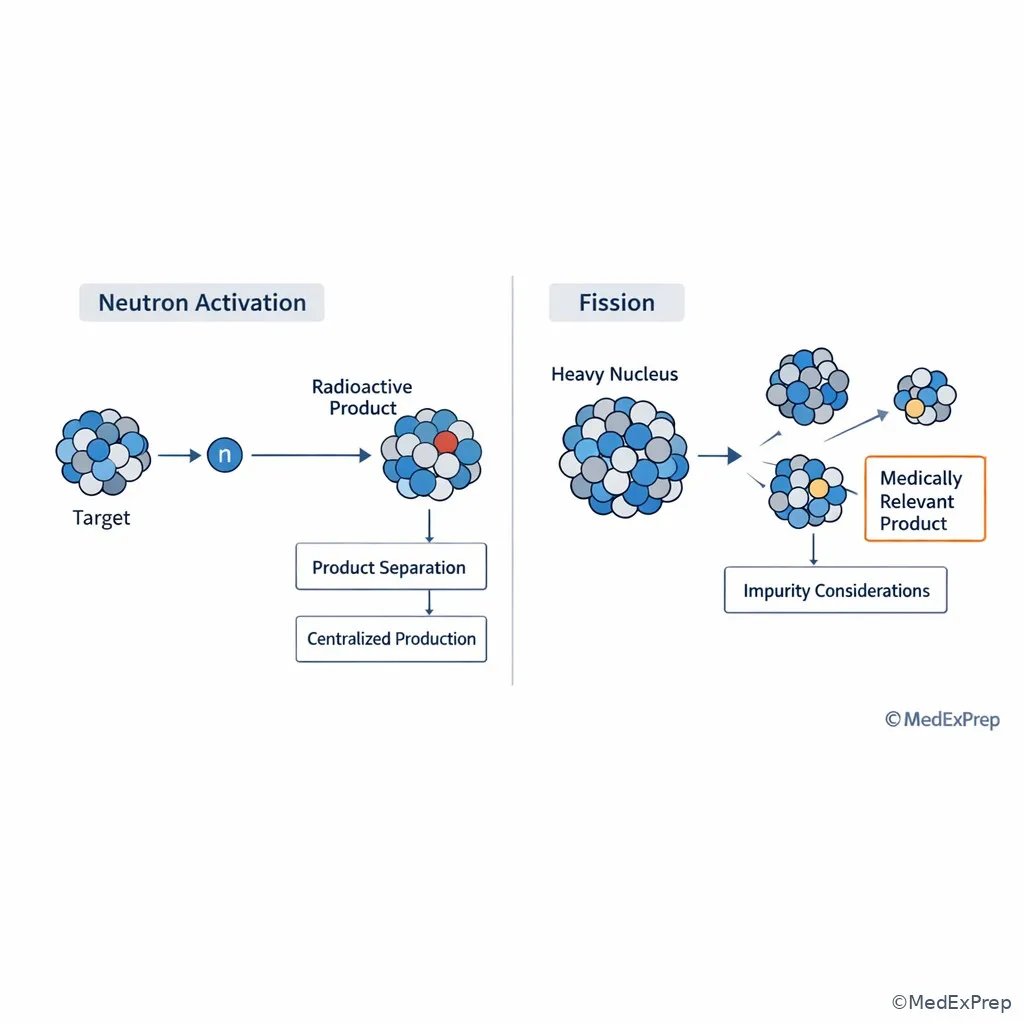
Reactor production concept illustration
Concept flow: Interpreting reactor-source clues
Identify neutron involvement
If the stem centers on neutron exposure in a reactor, start with reactor production.

Activation or fission?
Target captures neutron = activation. Heavy nucleus splits = fission.

Translate to practice
Expect centralized manufacture and route-specific impurity or separation concerns.

Recall: In the course introduction, we built the exam habit of asking, “What is the governing physical principle?” Here, that principle is the nuclear production route; in the next topic on Half-Life And Decay Modes, we will build on this by asking how that source constrains calibration timing and use window.
Key rule: Reactor is not synonymous with generator. A parent radionuclide may be reactor-produced upstream, yet the pharmacy-facing source of the clinical daughter can still be a generator.
Pharmacist Action: NOTICE: whether the stem asks about original manufacture or product access at the pharmacy. SAY: distinguish upstream production from downstream dispensing source when clarifying an order or teaching staff. MONITOR: source-related documentation and expected impurity/QC checks. HOLD/CLARIFY/ESCALATE: clarify if source documentation is inconsistent with expected procurement records or package insert information.

B. Worked example

A 59-year-old woman with metastatic thyroid cancer, hypertension, and atrial fibrillation is scheduled for a radiopharmaceutical therapy-related consult. The nuclear pharmacist reviews inventory documentation showing that the radionuclide was obtained from centralized manufacture and that the raw source involved splitting a heavy nucleus. A distracting note in the chart mentions recent PET/CT scheduling for a different malignancy, making cyclotron seem plausible. Another tempting clue is that the product will ultimately be dispensed from the pharmacy in a patient-specific dose, which might incorrectly make a learner think “direct local production.”

Reasoning chain: Identify task: determine the production mechanism described. Extract key facts: centralized source; splitting of a heavy nucleus; no elution device, no charged-particle bombardment. Apply rule: splitting a heavy nucleus identifies fission, which is a reactor-based production route. Eliminate distractors: cyclotron requires charged-particle bombardment, not nuclear splitting. Generator requires parent-daughter elution at point of use. Verify: the correct takeaway is not treatment selection but recognition that source route may affect supply and impurity considerations.

C. Exam trap

Common wrong answer: Generator.
WHY IT IS TEMPTING: many learners know Mo-99 leads to Tc-99m and collapse all related stems into “generator.”
SINGLE CLUE THAT ELIMINATES IT: the stem asks about heavy nucleus splitting, which identifies the original production mechanism as fission in a reactor.

D. Checkpoint

Question: Which stem clue most strongly supports reactor fission rather than neutron activation, cyclotron production, or generator availability?

  1. A stable target nucleus captures a neutron — tempting because it is reactor-based, but wrong because this describes neutron activation rather than fission.
  2. A daughter radionuclide is removed from a column before dispensing — tempting because it involves source access, but wrong because it describes generator use.
  3. A heavy nucleus is split and the desired radionuclide is separated from multiple products — correct because that is the defining pattern of fission.
  4. A proton beam strikes an enriched target — tempting because it is a real production method, but wrong because it describes cyclotron production.

Answer: C. A heavy nucleus is split and the desired radionuclide is separated from multiple products.

If you missed this: Review 1.1.1.2 Reactor production — focus on the discriminator heavy nucleus splitting = fission.
Quick Recall:

  • The most common reactor clue for direct target irradiation is neutron activation.
  • True or False: A generator daughter can originate from a reactor-produced parent upstream. True.
  • Name the 2 main reactor-production patterns tested in basic BCNP review: activation and fission.

1.1.1.3 Cyclotron production: charged-particle bombardment and short-timeline logistics

A. Explanation

The next decision conflict is cyclotron versus generator, especially for short-lived imaging radionuclides. The single resolving rule is this: if the radionuclide is made by bombarding a target with charged particles, it is cyclotron-produced. This matters because cyclotron products often have short half-lives, narrow distribution windows, and target-derived impurity considerations. In practice, the pharmacist should think not only “how was it made?” but also “what does that mean for calibration timing, product receipt, and release feasibility?” See Fig 3.

WHY THIS IS TESTED: many board stems are not really about nuclear physics; they are about whether a dose can be prepared, transported, and used on time. Cyclotron-produced radionuclides, especially PET radionuclides, make timing unforgiving. Delays in synthesis, QC, courier transport, or patient readiness can quickly convert an adequate activity into an unusable one. The source route also explains why local or regional manufacturing relationships matter operationally.

Choose cyclotron when the stem mentions proton bombardment, enriched targets, PET center manufacture, or same-day regional delivery. Reject cyclotron when the actionable clue is elution from a generator. Reject reactor when the focus is not neutron-based production. Source recognition sets up the upcoming lessons on half-life and emission type: production route tells you how the radionuclide appears in practice; decay mode and emission energy will later tell you how it behaves.

Fig 3. Cyclotron workflow and timing pressure
Exam takeaway: Cyclotron-produced radionuclides are identified by target bombardment and usually force tighter synthesis, QC, and transport timing.
flowchart LR
A[Enriched target] --> B[Charged-particle bombardment]
B --> C[Radionuclide produced]
C --> D[Chemical processing]
D --> E[QC and release]
E --> F[Rapid transport or on-site use]
F --> G[Short half-life increases timing pressure]
Cyclotron target and processing illustration
Exam takeaway: Associate cyclotron production with target bombardment, chemistry processing, and same-day dispensing pressure.
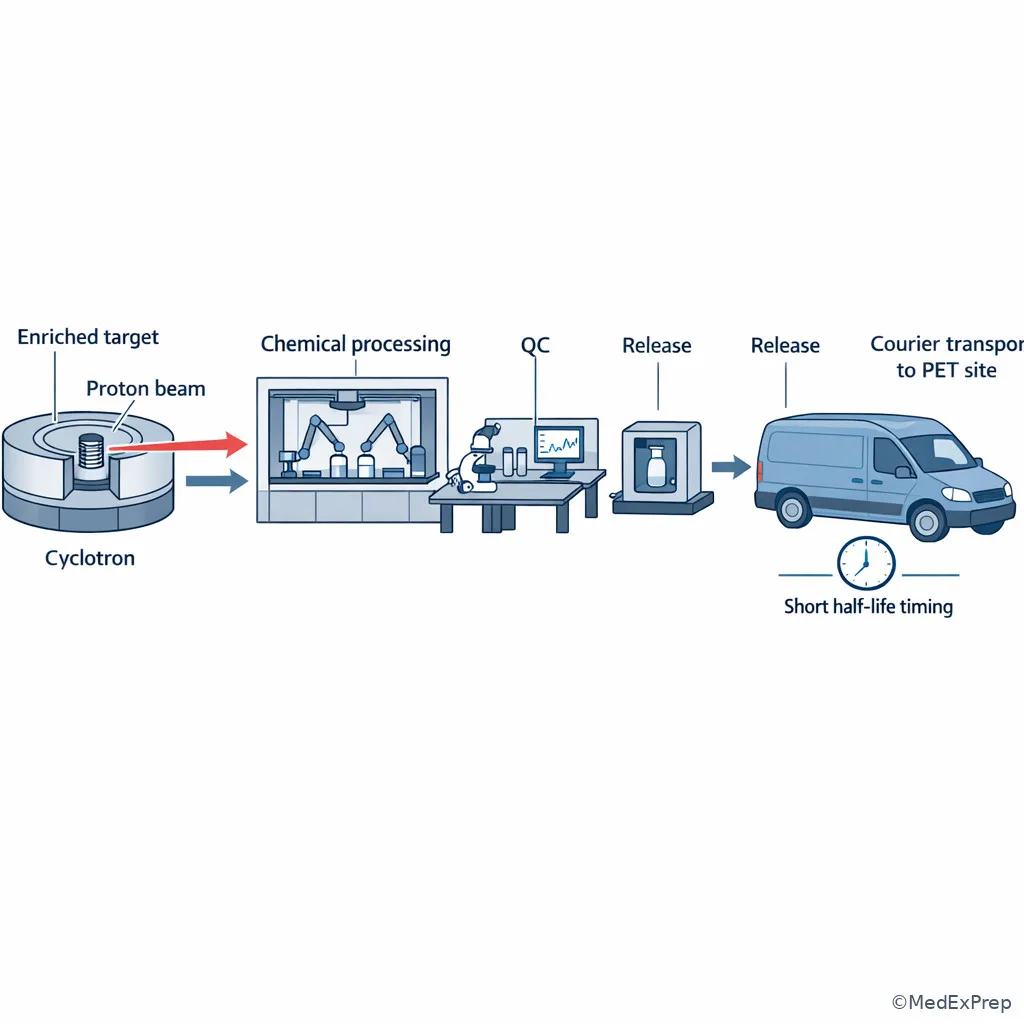
Cyclotron target and processing illustration
Concept flow: Cyclotron-source decision steps
Find the production clue
Protons or other charged particles striking a target point to cyclotron manufacture.

Decide release feasibility
If timing delays threaten usable activity or QC completion, hold and reassess rather than assume delivery is acceptable.

Translate to practice
Short-lived products demand calibration discipline, communication, and contingency planning.

High-Yield Connection: This concept is tested alongside Half-Life And Decay Modes. Know both cyclotron production and physical half-life timing pressure for exam day—they are frequently paired in stems about delayed synthesis, transport, or missed administration windows.
Memory anchor: \(Cyclotron = Charged particles\), City-to-site courier, Clock is ticking. The “3 C's” help you remember the practical board linkage.
Pharmacist Action: NOTICE: short-lived cyclotron products with narrow transport and administration windows. SAY: communicate expected calibration time and any delay risk to the imaging team. MONITOR: assay time, release time, and arrival-to-use interval. HOLD/CLARIFY/ESCALATE: hold if target production, processing, or QC timing makes the prescribed activity at administration time uncertain.

B. Worked example

A 71-year-old man with lung cancer, chronic obstructive pulmonary disease, and obesity is scheduled for PET imaging. The nuclear pharmacist receives notice that the morning product was manufactured at a regional center after proton bombardment of an enriched target. A distracting chart detail notes mild anemia, which is not relevant to source identification. The courier reports a traffic delay, and the technologist asks whether the dose can still be used because “it was already assayed this morning.”

Reasoning chain: Identify task: determine what production route is implied and what operational consequence matters. Extract key facts: proton bombardment; enriched target; regional center manufacture; transport delay. Apply rule: this is cyclotron production, likely with meaningful decay over the transport interval. Eliminate distractors: generator is wrong because no parent-daughter elution is described. Reactor is wrong because no neutron irradiation or fission clue appears. Verify: source recognition tells the pharmacist to think about activity at administration time, not just at earlier assay. The safest action is not to promise adequacy based on the morning assay; it is to verify whether the dose remains suitable at the intended time.

C. Exam trap

Common wrong answer: “Release it because it was assayed correctly earlier.”
WHY IT IS TEMPTING: learners may anchor on the existence of a valid assay and forget that short-lived cyclotron products lose activity continuously.
SINGLE CLUE THAT ELIMINATES IT: the stem includes a transport delay, so the relevant question is activity at the intended administration time.

D. Checkpoint

Question: A PET radiopharmaceutical is prepared from an enriched target after proton bombardment and then shipped to a nearby hospital. Which source-related concern is most important for the nuclear pharmacist to verify before release to the clinical team?

  1. Whether parent breakthrough testing from a generator was documented — tempting because breakthrough testing is a real QC issue, but wrong because the product is cyclotron-produced, not generator-eluted.
  2. Whether expected activity at administration time remains acceptable after transport delay — correct because short-lived cyclotron products are highly timing dependent.
  3. Whether the reactor target captured sufficient neutrons — tempting because production adequacy matters, but wrong because the source described is not reactor-based.
  4. Whether the daughter was allowed enough time to grow in after last elution — tempting because in-growth timing is important in generators, but wrong because no parent-daughter generator is involved.

Answer: B. Whether expected activity at administration time remains acceptable after transport delay.

If you missed this: Review 1.1.1.3 Cyclotron production — focus on the discriminator charged-particle production creates same-day timing pressure.

1.1.1.4 Generator systems: why parent-daughter logic dominates pharmacy workflow

A. Explanation

Generator questions are among the most practical in nuclear pharmacy because they directly affect daily preparation workflow. The decision conflict is use now versus wait, and release versus hold. The single finding that resolves many generator items is the relationship between parent decay, daughter in-growth, and elution timing. A generator provides repeated access to a short-lived daughter from a longer-lived parent. This solves supply problems for daughters that would be impractical to ship routinely from distant production. See Fig 4.

WHY THIS IS TESTED: generator logic sits at the intersection of production, half-life, QC, and release decisions. The pharmacist must recognize that a clinically useful daughter can be available on site even though the original parent came from elsewhere. The exam also likes the distinction between source category and downstream release criteria: knowing a product comes from a generator should immediately raise questions about elution schedule, expected yield, and parent breakthrough limits.

Choose generator as the governing framework when the stem mentions elution, parent-daughter pair, column, in-growth, or breakthrough. Reject a simplistic “always ready” assumption; daughters need time to regrow after elution. Reject source confusion: upstream reactor or accelerator manufacture of the parent does not change the pharmacy-facing workflow if the usable product is obtained by elution. Local protocols and manufacturer instructions vary, so the board-safe answer is to apply the governing principle and confirm specific procedural limits through authoritative references.

Fig 4. Generator parent-daughter workflow
Exam takeaway: In generator systems, the practical question is not original manufacture but whether daughter in-growth, elution timing, and breakthrough control support safe release.
flowchart TD
A[Longer-lived parent on column] --> B[Daughter grows in over time]
B --> C[Elution performed]
C --> D[Daughter collected for preparation]
D --> E[Assess yield and breakthrough]
E --> F[Release if specifications met]
C --> G[Immediate re-elution gives low daughter yield]
Generator column illustration
Exam takeaway: Picture the parent fixed on the column and the daughter being eluted to understand why timing and breakthrough checks matter.
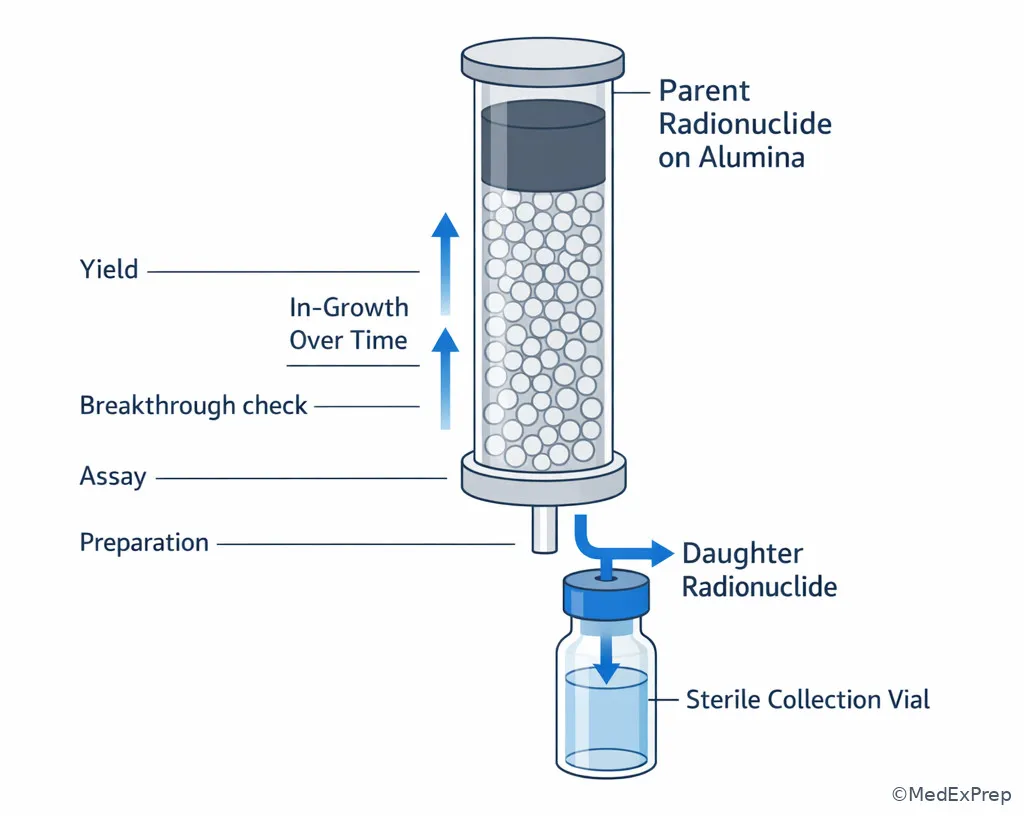
Generator column illustration
Concept flow: Generator-based pharmacist decisions
Confirm generator source
Look for parent-daughter pair, column, eluate, or breakthrough language.

Decision
If daughter has not adequately regrown or breakthrough is unacceptable, do not release.

Proceed safely
Assay, verify source-specific QC, document, then prepare only if criteria are met.

High-Yield Connection: This concept is tested alongside Generator Design And Elution later in the course and with Radionuclidic Identity And Breakthrough. Know both how a generator supplies the daughter and what source-specific QC must be checked.
Pharmacist Action: NOTICE: elution timing, expected daughter availability, and breakthrough documentation. SAY: explain to staff that a recent elution may reduce immediate daughter yield. MONITOR: assay of eluate, required breakthrough testing, and documentation each use cycle. HOLD/CLARIFY/ESCALATE: hold if breakthrough exceeds specification, documentation is missing, or yield is inconsistent with expected generator performance.

B. Worked example

A 64-year-old woman with obesity, heart failure, and rheumatoid arthritis is scheduled for a same-morning nuclear study. The generator was eluted earlier for another patient, and a technologist asks the pharmacist to “just elute again now” because the procedure room is open. A distracting lab shows mildly elevated alkaline phosphatase, which is unrelated. Another tempting clue is that the parent radionuclide was originally reactor-produced, which might mislead a learner into focusing on reactor source instead of current generator behavior.

Reasoning chain: Identify task: decide what production-related principle governs immediate product availability. Extract key facts: recent elution; need for a second same-morning dose; generator source; no issue yet about diagnosis or protocol. Apply rule: daughter yield depends on in-growth after prior elution, so an immediate repeat elution may produce less daughter activity than expected. Eliminate distractors: reactor production of the parent is background knowledge, not the operational decision point. Cyclotron timing logic is wrong because the product is not arriving from target bombardment that day. Verify: the correct pharmacist response is to assess expected yield and suitability before promising release.

C. Exam trap

Common wrong answer: “A second immediate elution should provide the same daughter activity as the earlier one.”
WHY IT IS TEMPTING: the physical device is still present, so learners assume availability equals full yield.
SINGLE CLUE THAT ELIMINATES IT: the stem states the generator was already eluted earlier, so daughter in-growth time becomes the limiting factor.

D. Checkpoint

Question: A generator was eluted one hour ago, and the clinical team requests another patient-specific dose immediately. Which is the most appropriate pharmacist interpretation of this source-related issue?

  1. The product should be treated like a cyclotron shipment, so transport time is the primary concern — tempting because short half-life always raises timing issues, but wrong because the key variable here is daughter regrowth after elution.
  2. The original parent production route determines current daughter yield more than elution timing — tempting because source history matters, but wrong because current availability depends on generator kinetics.
  3. A recent prior elution may reduce immediately available daughter activity, so suitability must be reassessed before release — correct because generator in-growth timing governs usable yield.
  4. Breakthrough risk is impossible after a second elution — tempting because fresh elution may feel cleaner, but wrong because breakthrough control remains relevant regardless of timing.

Answer: C. A recent prior elution may reduce immediately available daughter activity, so suitability must be reassessed before release.

If you missed this: Review 1.1.1.4 Generator systems — focus on the discriminator recent elution lowers immediately available daughter yield.
Quick Recall:

  • The most common reason generators are used is to provide short-lived daughters on site.
  • True or False: Parent source history is usually the best predictor of immediate daughter yield after a recent elution. False.
  • Name the 3 key generator clues in a stem: parent-daughter pair, elution, breakthrough.

1.1.1.5 Integrating production method with QC, procurement, and release decisions

A. Explanation

The final foundational integration step is to answer the question the BCNP exam actually cares about: What does the production route make you do differently as the pharmacist? The single resolving rule is to connect each source with its most likely operational risk. Reactor products push you to think about centralized production source, route-specific impurity concerns, and supply dependency. Cyclotron products push you to think about timing pressure from manufacture through administration. Generator products push you to think about elution schedule, in-growth, and parent breakthrough. See Fig 5.

WHY THIS IS TESTED: candidates often know definitions but miss the release decision. The board exam rewards source-to-action thinking: source clue -> dominant risk -> safest pharmacist step. If a stem includes a source inconsistency, missing documentation, impossible timing, or failed source-specific QC, the correct answer is usually hold or clarify rather than proceed for convenience.

Choose release only when the product meets source-appropriate criteria and timing remains feasible. Reject release when a generator product lacks breakthrough documentation, when a cyclotron product may no longer provide required activity at administration time, or when source labeling/documentation does not align with the expected production pathway. This is still within pharmacist scope: you are not selecting the physician's imaging protocol or interpreting the scan; you are determining whether the product is suitable to dispense safely and compliantly.

Fig 5. Source-to-action decision grid
Exam takeaway: Link each production method to its dominant pharmacist concern—reactor to source route, cyclotron to timing, and generator to elution plus breakthrough.
flowchart TD
A[Identify production method] --> B{Source type}
B -->|Reactor| C[Check source route and expected impurity context]
B -->|Cyclotron| D[Check timing from production to administration]
B -->|Generator| E[Check elution timing, yield, and breakthrough]
C --> F[Clarify documentation if inconsistent]
D --> G[Recalculate or verify usable activity]
E --> H[Hold if breakthrough or regrowth issues]
F --> I[Release only if source-appropriate criteria met]
G --> I
H --> I
Source-to-release comparison infographic
Exam takeaway: Remember the dominant release risk by pairing each production method with one operational checkpoint.
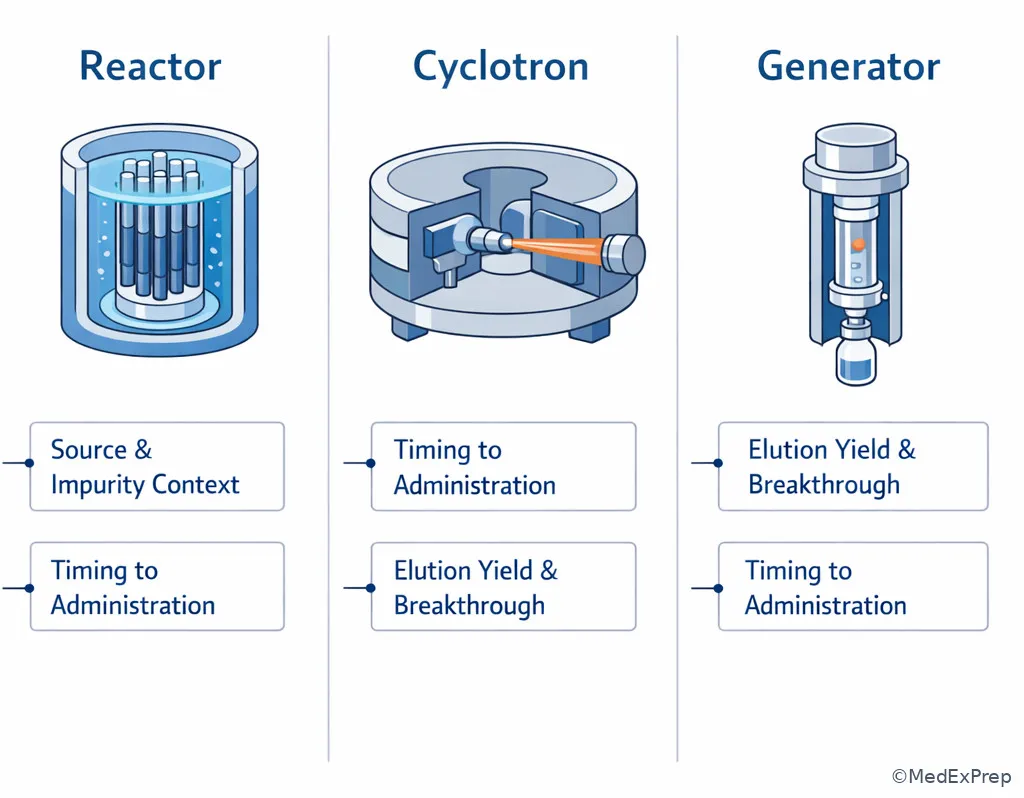
Source-to-release comparison infographic
Concept flow: Product release from a source-aware perspective
Identify source route
Do not answer until the product is classified as reactor, cyclotron, or generator supplied.

Find the dominant risk
Timing failure, breakthrough, or source-document mismatch each leads to different pharmacist action.

Choose action
Release only when source-appropriate specifications are satisfied; otherwise hold and clarify.

Forward link: The next two topics—Half-Life And Decay Modes and Emission Energy And Detection—turn this production knowledge into timing and shielding decisions. Production tells you where the radionuclide came from; half-life and emissions tell you what happens after you have it.
Pharmacist Action: NOTICE: whether the source category changes release feasibility or required QC. SAY: communicate the specific limiting factor, such as transport decay or missing breakthrough result. MONITOR: documentation, assay timing, and source-appropriate QC each preparation cycle. HOLD/CLARIFY/ESCALATE: hold any product when source-specific release criteria are not demonstrably met.

B. Worked example

A 74-year-old man with prostate cancer, chronic kidney disease, and poorly controlled hypertension has a scheduled radiopharmaceutical appointment. The pharmacy receives a product record showing cyclotron manufacture, but the attached internal worksheet includes a generator breakthrough checkbox instead of transport timing verification. A distracting note states the patient recently had a bone scan, which does not solve the release question. A technologist argues that all radioactive products use “the same QC logic,” making release seem acceptable.

Reasoning chain: Identify task: determine the most appropriate pharmacist action when source-specific documentation does not match the production route. Extract key facts: cyclotron-manufactured product; generator-focused documentation field; missing timing verification; pressure to proceed. Apply rule: QC and release checks must match the source-related risk. For cyclotron products, timing to administration is critical; generator breakthrough documentation does not substitute for that review. Eliminate distractors: it is tempting to release because some QC element exists, but the wrong QC element does not verify the correct risk. Verify: safest pharmacist action is hold and clarify source-appropriate release documentation before dispensing.

C. Exam trap

Common wrong answer: “Release because some radioactive QC form was completed.”
WHY IT IS TEMPTING: under operational pressure, learners may treat any signed form as evidence of adequacy.
SINGLE CLUE THAT ELIMINATES IT: the documentation is for a generator-specific check while the product is cyclotron-produced.

D. Checkpoint

Question: A product record identifies cyclotron manufacture, but the only source-related QC documentation available is a generator parent-breakthrough form. What is the most appropriate pharmacist action?

  1. Release because any source-related QC form is sufficient for radioactive products — tempting because it avoids delay, but wrong because QC must address the actual source-dependent risk.
  2. Reclassify the product as reactor-derived because cyclotron and generator documentation are interchangeable — tempting because learners may confuse upstream and downstream source categories, but wrong because the record explicitly identifies cyclotron manufacture.
  3. Hold and clarify, because documentation does not match the production-related release concern — correct because source-specific adequacy has not been established.
  4. Ignore the source mismatch and rely only on patient weight and indication — tempting because patient-specific factors are important, but wrong because product suitability must be established before clinical use.

Answer: C. Hold and clarify, because documentation does not match the production-related release concern.

If you missed this: Review 1.1.1.5 Integrating production method with QC, procurement, and release decisions — focus on the discriminator source-specific risk must match the release documentation.

Exam Traps & Differentiators

Common traps & distractors: The exam often gives a true statement about radionuclide origin but asks about the pharmacist-facing workflow. Upstream manufacture and downstream access are not always the same concept.

Most common wrong answer and why: choosing reactor whenever the learner recognizes that the parent ultimately came from reactor production. That is tempting because it is scientifically true in many cases. It is wrong when the actual practice question is about a generator daughter being eluted on site or a cyclotron product being delivered same day.

Looks similar But isn't Why confused Single discriminator
Reactor-produced parent Generator-supplied daughter at pharmacy Learners focus on origin instead of point-of-use workflow Elution/column language means generator for the dispensing decision
Cyclotron PET product Generator daughter Both may be short-lived Target bombardment versus parent-daughter elution
Reactor activation Reactor fission Both are reactor-based Neutron capture versus heavy nucleus splitting
Any QC form Source-appropriate QC Paperwork presence feels reassuring The check must match the source-specific risk
Earlier assay value Usable activity at administration time An assay exists, so learners stop thinking Timing matters most for short-lived cyclotron products

If the stem says ___, think ___

  • If the stem says proton bombardment of enriched target, think cyclotron production.
  • If the stem says daughter eluted from column, think generator workflow.
  • If the stem says heavy nucleus splitting, think reactor fission.
  • If the stem says stable target exposed to neutrons, think reactor activation.
  • If the stem says transport delay for same-day product, think verify activity at administration time.
  • If the stem says recent generator elution, think daughter regrowth may limit immediate yield.

Related confusions will recur in upcoming topics. For example, in Half-Life And Decay Modes, the trap will shift from “where did it come from?” to “how fast is it disappearing?” In Emission Energy And Detection, a different confusable pair appears: source route versus emission suitability. Do not use production method as a substitute for emission knowledge; they answer different questions.

Review connection: The traps above test source recognition linked to pharmacist action. If any felt unfamiliar, revisit 1.1.1.3 Cyclotron production and 1.1.1.4 Generator systems before attempting the Self-check quiz.

Tables

Key fact/value type High-yield point Why it matters on BCNP-style items
Reactor activation Neutron capture by target Distinguishes from fission and cyclotron stems
Reactor fission Heavy nucleus splits into multiple products Explains classic parent supply questions and separation concepts
Cyclotron Charged-particle bombardment of target Flags short-timeline manufacture and delivery logic
Generator Daughter eluted from longer-lived parent Flags in-growth, elution schedule, and breakthrough checks
Point-of-use clue Column/eluate language Usually outweighs upstream source history for dispensing questions
Timing clue Transport delay after regional manufacture Usually signals cyclotron product decay concern
Production type Typical exam clue Dominant pharmacist concern Most likely wrong assumption
Reactor Neutrons, activation, fission Source route and impurity context Confusing reactor source with generator use
Cyclotron Proton beam, enriched target, PET center Timing from manufacture to administration Assuming earlier assay alone guarantees usability
Generator Parent-daughter, elution, breakthrough Regrowth, yield, and breakthrough control Assuming repeated immediate elution gives full yield
Accelerator other Technical beam wording without classic cyclotron clues Recognize category, then confirm product-specific handling Overcommitting beyond the information provided
Scenario pattern Most likely source classification Best initial pharmacist action
Regional manufacturing center, courier delay, morning assay documented Cyclotron Verify activity at intended administration time before release
Column elution, parent breakthrough record pending Generator Hold until source-specific breakthrough requirement is addressed
Heavy nucleus splitting described in source certificate Reactor fission Recognize fission route; ensure documentation aligns with expected source
Stable target irradiated with neutrons Reactor activation Identify activation route; do not misclassify as cyclotron
Second generator elution requested shortly after first Generator Reassess daughter availability and suitability before promising dose
Generator QC form attached to non-generator product Documentation mismatch Hold and clarify because source-specific release support is inadequate

Algorithm / Approach

Fig 6. Source-first pharmacist algorithm
Exam takeaway: On production-method questions, classify the source first, then check the one operational risk that most often determines release versus hold.
Start
Read the stem for source words: bombardment, neutron activation, fission, parent, daughter, elution.

Classify the source
Charged particles → cyclotron. Neutron capture/splitting → reactor. Parent-to-daughter elution → generator.

Match the dominant risk
Cyclotron → timing decay. Reactor → source route and impurity context. Generator → regrowth, yield, breakthrough.

Release or hold?
If source-appropriate criteria are documented and feasible, proceed. If not, hold, clarify, and document.

Verify scope
Stay within pharmacist role: product suitability, QC, timing, communication, and escalation—not physician-only protocol selection.

Use this algorithm on virtually every production-method item. Source-first thinking prevents a common exam error: jumping directly to a clinical or operational answer before identifying the underlying physical pathway. See Fig 6.

Rapid Review

  • Reactor activation → neutron capture is the discriminator, not elution.
  • Reactor fission → heavy nucleus splitting separates it from all other source routes.
  • Cyclotron → charged-particle bombardment is the telltale phrase.
  • Generator → parent-daughter elution beats upstream origin for workflow questions.
  • Cyclotron logistics → earlier assay does not equal acceptable activity later.
  • Generator yield → recent elution lowers immediate daughter availability.
  • Generator QC → breakthrough concern is a source-specific release issue.
  • Reactor versus generator → one may explain origin, the other current access.
  • Regional same-day delivery → usually points toward cyclotron timing pressure.
  • Column language → almost never belongs to cyclotron stems.
  • Neutron wording → rules out cyclotron even if the product is familiar.
  • QC paperwork → only helpful if it matches the actual source-dependent risk.
  • Pharmacist scope → classify source, verify suitability, then hold or release appropriately.
Memory anchor: Origin, Access, Risk—for any radionuclide ask: Where was it made? How do I access it here? What source-specific risk could block release?

Self-check quiz

1. A nuclear pharmacist reviews a source note for sodium fluoride F 18 injection, 10 mCi IV once for PET imaging, scheduled for same-day delivery from a regional production site. The note states the radionuclide was created by proton bombardment of an enriched target. Which production method best fits this product?

  1. Reactor neutron activation
  2. Cyclotron charged-particle production
  3. Generator daughter elution
  4. Reactor fission separation

2. A nuclear pharmacist verifies a technetium-99m sestamibi preparation, 25 mCi IV once, after a dose was drawn from an eluate obtained from a parent column earlier that morning. The patient has diabetes and hypertension, and a fasting-status note is present but does not determine source category. Which production source category is most relevant to this dispensing workflow?

  1. Generator system
  2. Cyclotron direct target production
  3. Reactor fission of the clinical daughter at point of use
  4. Linear accelerator-only manufacture with no parent-daughter relationship

3. A 68-year-old man with lymphoma, atrial fibrillation, and stage 3 chronic kidney disease is scheduled for fluorodeoxyglucose F 18 injection, 12 mCi IV once. The product was assayed at the regional PET center, but courier delay will push administration 90 minutes later than planned. The technologist asks for the most appropriate pharmacist next step. Which is best?

  1. Release immediately because cyclotron products do not require timing reassessment once assayed
  2. Hold and verify expected activity at the intended administration time before release
  3. Convert the source classification to generator because short half-life is the main issue
  4. Ignore the delay if sterility documentation is present

4. A 61-year-old woman with coronary artery disease and obesity is ordered technetium-99m tetrofosmin, 30 mCi IV once. The generator was eluted 45 minutes ago for another patient, and the imaging team requests another elution now. A mildly elevated glucose in the chart is distracting. Which source-based interpretation is most appropriate?

  1. The second elution should provide full daughter activity because the parent remains on the column
  2. The earlier elution is irrelevant because generator products behave like reactor stock
  3. Recent elution may reduce immediately available daughter yield, so suitability must be reassessed
  4. Generator source eliminates the need for parent breakthrough considerations

5. A nuclear pharmacist reviews lutetium Lu 177 dotatate documentation for a scheduled dose, 200 mCi IV once per authorized user order. The certificate describes neutron irradiation of target material rather than heavy nucleus splitting. Which production description is most accurate?

  1. Reactor neutron activation
  2. Reactor fission
  3. Cyclotron proton bombardment
  4. Generator daughter elution

6. A 72-year-old man with metastatic prostate cancer, chronic kidney disease, and anemia is scheduled for a radiopharmaceutical dose, 7.4 GBq IV once. The product record identifies cyclotron manufacture, but the attached release packet only contains a generator parent-breakthrough worksheet and no timing verification. A nurse asks whether the dose can be sent because “the paperwork is signed.” Which is the most appropriate pharmacist action?

  1. Release, because any source-related QC form is adequate when the dose has been assayed
  2. Hold and clarify, because the documentation does not match the production-related release risk
  3. Reclassify the product as generator-supplied and document a verbal correction
  4. Send the dose if the authorized user is available, since source mismatch is a physician issue

7. A 66-year-old woman with differentiated thyroid cancer, hypertension, and osteoarthritis is scheduled for sodium iodide I 131 capsules, 100 mCi orally once. The source discussion in the pharmacy notes mentions a heavy nucleus being split to generate the desired radionuclide upstream. Another note references a previous same-day PET study, creating distracting cyclotron language. Which production pathway should the pharmacist identify from the source note?

  1. Reactor fission
  2. Reactor neutron activation
  3. Cyclotron bombardment
  4. Generator elution

8. A 70-year-old man with Parkinson disease, coronary artery disease, and chronic constipation is scheduled for a generator-derived diagnostic dose, 5 mCi IV once. The source worksheet correctly lists a parent-daughter system, but the dose was drawn after an unexpectedly low-yield elution shortly after a prior use. A staff member argues that because the parent originally came from reactor production, the current low yield should not delay release. Which statement is most appropriate?

  1. The staff member is correct because original reactor source overrides current elution timing
  2. The dose should be released if target bombardment records from the producer are complete
  3. Current generator behavior determines immediate daughter availability, so low-yield elution requires reassessment before release
  4. Low yield affects only image interpretation, not pharmacist dispensing suitability

Answer key

Question 1

Correct answer: B. Cyclotron charged-particle production

  • A. Reactor neutron activation — Tempting because many medical radionuclides come from reactors, but incorrect here because the single discriminating clue is proton bombardment of an enriched target, which defines cyclotron production. Authoritative source logic from nuclear pharmacy texts and PET drug labeling supports target bombardment as cyclotron manufacture.
  • B. Cyclotron charged-particle production — Correct because the PK/PD-relevant operational implication is same-day use of a short-lived PET radionuclide created by charged-particle bombardment. The discriminating clue is proton bombardment. This is consistent with standard nuclear pharmacy references and FDA labeling for F-18 products.
  • C. Generator daughter elution — Tempting because short-lived products can make learners think of generators, but incorrect because no parent-daughter column or elution is described. The eliminating fact is absence of elution language.
  • D. Reactor fission separation — Tempting because centralized production can suggest reactor origin, but incorrect because fission requires heavy nucleus splitting rather than charged-particle bombardment. The discriminating clue is enriched target plus proton bombardment.
If you missed this: Review 1.1.1.3 Cyclotron production — focus on proton bombardment of enriched target = cyclotron.

Question 2

Correct answer: A. Generator system

  • A. Generator system — Correct because the medication context involves Tc-99m prepared from an eluate obtained from a parent column. That exact phrase is the discriminating clue. Standard nuclear pharmacy references describe Tc-99m access through parent-daughter generator elution.
  • B. Cyclotron direct target production — Tempting because many imaging agents are associated with advanced production methods, but incorrect because the stem centers on eluate from a parent column, not bombardment.
  • C. Reactor fission of the clinical daughter at point of use — Tempting because the upstream parent may be tied to reactor production, but incorrect because the pharmacy-facing workflow is generator access, not point-of-use fission.
  • D. Linear accelerator-only manufacture with no parent-daughter relationship — Tempting because accelerator language sounds technical, but incorrect because the stem explicitly states a parent column.
If you missed this: Review 1.1.1.1 Foundational production categories — focus on eluate from parent column = generator workflow.

Question 3

Correct answer: B. Hold and verify expected activity at the intended administration time before release

  • A. Release immediately because cyclotron products do not require timing reassessment once assayed — Tempting because an assay was completed, but incorrect because short-lived cyclotron products continue to decay after assay. The single clue is 90-minute courier delay. Standard PET handling principles and labeling confirm that timing to administration matters.
  • B. Hold and verify expected activity at the intended administration time before release — Correct because the governing pharmacologic/physical principle is decay over time. The discriminating clue is the delay before administration, which requires reassessment of usable activity.
  • C. Convert the source classification to generator because short half-life is the main issue — Tempting because both generators and PET products involve timing, but incorrect because short half-life does not redefine the production source. The eliminating fact is regional PET center manufacture after bombardment.
  • D. Ignore the delay if sterility documentation is present — Tempting because sterility is necessary for release, but incorrect because sterility documentation does not answer the timing adequacy question. The discriminating clue is transport delay.
If you missed this: Review 1.1.1.3 Cyclotron production — focus on assay time is not the same as activity at administration time.

Question 4

Correct answer: C. Recent elution may reduce immediately available daughter yield, so suitability must be reassessed

  • A. The second elution should provide full daughter activity because the parent remains on the column — Tempting because the generator is still present, but incorrect because daughter activity requires regrowth after prior elution. The single clue is generator was eluted 45 minutes ago.
  • B. The earlier elution is irrelevant because generator products behave like reactor stock — Tempting because reactor origin may be remembered, but incorrect because current yield depends on generator in-growth, not stock-like static inventory.
  • C. Recent elution may reduce immediately available daughter yield, so suitability must be reassessed — Correct because the pharmacologic/physical rule is that daughter availability depends on time since prior elution. Standard generator practice confirms this source-dependent behavior.
  • D. Generator source eliminates the need for parent breakthrough considerations — Tempting because the question focuses on yield, but incorrect because breakthrough remains relevant in generator systems. The eliminating fact is that generator source creates, not removes, breakthrough concerns.
If you missed this: Review 1.1.1.4 Generator systems — focus on recent prior elution reduces immediate daughter availability.

Question 5

Correct answer: A. Reactor neutron activation

  • A. Reactor neutron activation — Correct because the stem specifies neutron irradiation of target material, which is the defining clue for activation. Nuclear pharmacy references identify neutron capture/irradiation as activation-based reactor production.
  • B. Reactor fission — Tempting because it is also reactor-based, but incorrect because fission requires heavy nucleus splitting, which the stem explicitly contrasts against.
  • C. Cyclotron proton bombardment — Tempting because bombardment is a familiar production word, but incorrect because the stem specifies neutrons, not charged particles.
  • D. Generator daughter elution — Tempting because many therapeutic radionuclide questions involve sourcing logistics, but incorrect because no parent-daughter column or elution is described.
If you missed this: Review 1.1.1.2 Reactor production — focus on neutron irradiation of target = activation, not fission.

Question 6

Correct answer: B. Hold and clarify, because the documentation does not match the production-related release risk

  • A. Release, because any source-related QC form is adequate when the dose has been assayed — Tempting because signed documentation and assay data feel reassuring, but incorrect because the single clue is a generator worksheet attached to a cyclotron product. Source-specific risk has not been addressed. Authoritative practice standards require appropriate, not generic, release support.
  • B. Hold and clarify, because the documentation does not match the production-related release risk — Correct because cyclotron production raises timing and route-appropriate release concerns, not generator breakthrough documentation alone. The discriminating clue is source-document mismatch.
  • C. Reclassify the product as generator-supplied and document a verbal correction — Tempting because paperwork problems sometimes reflect clerical error, but incorrect because the pharmacist should not invent a new source classification without evidence. The eliminating fact is that the record explicitly says cyclotron manufacture.
  • D. Send the dose if the authorized user is available, since source mismatch is a physician issue — Tempting because clinical urgency may push escalation to the physician, but incorrect because product release suitability is within pharmacist scope. The discriminating clue is that the problem is release documentation, not physician protocol selection.
If you missed this: Review 1.1.1.5 Integrating production method with QC, procurement, and release decisions — focus on QC documentation must match the actual source-specific risk.

Question 7

Correct answer: A. Reactor fission

  • A. Reactor fission — Correct because the stem identifies a heavy nucleus being split. That is the exact discriminator for fission. Standard nuclear pharmacy texts use this wording to distinguish fission from activation.
  • B. Reactor neutron activation — Tempting because the product is reactor-associated, but incorrect because activation means neutron capture, not splitting of a heavy nucleus. The discriminating clue is split.
  • C. Cyclotron bombardment — Tempting because the chart contains PET language, but incorrect because that is explicit noise unrelated to this source note. The eliminating fact is upstream heavy nucleus splitting.
  • D. Generator elution — Tempting because some radionuclides are used via parent-daughter systems, but incorrect because no column or daughter elution is described. The discriminating clue remains fission wording.
If you missed this: Review 1.1.1.2 Reactor production — focus on heavy nucleus splitting = fission.

Question 8

Correct answer: C. Current generator behavior determines immediate daughter availability, so low-yield elution requires reassessment before release

  • A. The staff member is correct because original reactor source overrides current elution timing — Tempting because upstream origin is scientifically true, but incorrect because the single clue is unexpectedly low-yield elution shortly after a prior use. That makes current generator behavior the relevant issue.
  • B. The dose should be released if target bombardment records from the producer are complete — Tempting because complete manufacture records sound sufficient, but incorrect because target bombardment is irrelevant to a generator-derived product's current availability. The eliminating fact is parent-daughter system.
  • C. Current generator behavior determines immediate daughter availability, so low-yield elution requires reassessment before release — Correct because the governing rule is daughter regrowth and yield after elution. Standard generator practice makes this the decisive factor for suitability.
  • D. Low yield affects only image interpretation, not pharmacist dispensing suitability — Tempting because clinicians interpret image quality, but incorrect because insufficient activity directly affects product suitability for release. The discriminating clue is low-yield elution before dispensing.
If you missed this: Review 1.1.1.4 Generator systems — focus on current elution timing, not upstream source origin, determines immediate daughter availability.

References

  • Kowalsky, Ronald J., Steven W. Falen, and Jonathan M. Peck. Radiopharmaceuticals in Nuclear Pharmacy and Nuclear Medicine. American Pharmacists Association.
  • Saha, Gopal B. Fundamentals of Nuclear Pharmacy. Springer.
  • Joint Commission of Pharmacy Practitioners and Board of Pharmacy Specialties exam-facing nuclear pharmacy competency materials and public BCNP content outline documents.
  • U.S. Food and Drug Administration. Approved prescribing information for representative PET and nuclear medicine drug products.
  • Society of Nuclear Medicine and Molecular Imaging practice resources and technical guidance relevant to radionuclide production and radiopharmaceutical handling.

Last reviewed: March 15, 2026

Lesson 2

Half-Life And Decay Modes

Half-life and decay modes

Physical decay behavior determines how a nuclear pharmacist calculates activity, plans calibration timing, evaluates operational feasibility, and connects emission characteristics with safe handling and intended radiopharmaceutical use.

What you'll learn

  • DOMAIN: 1.1.3 Physical and Chemical Properties of Radionuclides and Radiopharmaceuticals -> Physical half-life: Explain physical half-life and predict remaining activity across elapsed half-lives.
  • DOMAIN: Radionuclide Science -> Decay calculations: Apply exponential decay and half-life shortcuts to calibration and dispensing decisions with units and timing shown explicitly.
  • DOMAIN: 1.1.3 Physical and Chemical Properties -> Decay mode: Distinguish alpha, beta, positron, and gamma emission patterns at a pharmacist-relevant conceptual level.
  • DOMAIN: 3.1.3 Radiation Protection -> Emission-aware handling: Connect radiation type with the need to apply appropriate time, distance, shielding, contamination-control, and local-procedure considerations.
  • DOMAIN: Radionuclide Science -> Application matching: Determine which radionuclide characteristics support or conflict with a proposed timing or use scenario without assuming physician-only decision authority.

Blueprint mapping

Domain 1: Radionuclides and Radiopharmaceuticals - 47% -> 1.1 Procurement and Storage - 20% -> 1.1.3 Physical and Chemical Properties of Radionuclides and Radiopharmaceuticals. The lesson also reinforces pharmacist-level calculation, timing, radiation-protection, and release reasoning described across the supplied BCNP course context. No additional unpublished weighting is assumed.

Estimated time: 40-55 minutes

Prereqs: Radionuclide Production Methods; basic algebra and unit conversion.

Key outputs: You should be able to choose a correct decay calculation over a linear shortcut, distinguish major decay modes, identify when timing makes an activity request feasible or infeasible, and recognize when an emission-related safety question requires application of governing procedure or escalation.

Why it matters

  • A dispensed activity is meaningful only at a stated calibration time; physical half-life determines how much activity remains later.
  • Decay mode is not merely a memorization category. It influences what radiation leaves the nucleus, how exposure and contamination hazards are conceptualized, and what detection or shielding considerations may become relevant.
  • BCNP-style questions often hide the decisive clue in elapsed time, calibration time, or emission type while adding distracting clinical or operational details.
  • The pharmacist must separate what can be solved from radionuclide science from what must be confirmed through product instructions, local procedures, radiation-safety leadership, or authorized-user judgment.

Key Terms & Must-Know Facts

Key terms

Radioactive decay
Spontaneous nuclear transformation associated with emission of radiation and conversion toward a different nuclear state or nuclide.
Physical half-life
The time required for the number of radioactive nuclei, and therefore activity under the same sample conditions, to decrease to one-half of its starting value.
Activity
A measure of the rate of nuclear transformations; BCNP calculations commonly require activity to be linked to a stated time.
Decay constant
The proportionality term used in exponential decay, related to half-life by (lambda=0.693/T_{1/2}).
Calibration time
The reference time at which a stated activity applies.
Elapsed time
The interval between the stated reference time and the time for which activity must be determined.
Alpha emission
Emission of an alpha particle; the decay mode has distinct penetration and contamination implications relevant to radiation-protection planning.
Beta emission
Emission involving a beta particle; the pharmacist must recognize that particle radiation and photon radiation create different handling considerations.
Positron emission
Emission of a positron followed by annihilation processes that produce photons relevant to PET detection concepts.
Gamma emission
Photon emission from a nucleus transitioning from a higher to a lower energy state.
Parent radionuclide
A radioactive nuclide that transforms to a daughter nuclide.
Daughter radionuclide
The nuclide produced by decay of a parent; daughter behavior becomes especially important in generator and equilibrium topics.

Must-know facts

  • Physical half-life produces exponential, not linear, loss of activity.
  • After one physical half-life, 50% remains; after two, 25%; after three, 12.5%.
  • For elapsed time equal to an integer number of half-lives, repeated halving is usually faster and less error-prone than logarithmic manipulation.
  • For non-integer elapsed times, use the exponential decay equation or an equivalent decay-factor approach.
  • Always anchor the calculation to the correct calibration time before manipulating activity.
  • Decay mode and half-life are separate properties: one describes how transformation occurs; the other describes how rapidly the population decays.
  • Emission type affects application, detection, and safety reasoning, but exact shielding design belongs to applicable procedures and qualified radiation-safety or physics authorities rather than improvised pharmacist assumptions.
  • Local protocols, package insert instructions, and jurisdictional requirements may vary; confirm authoritative requirements before acting.
Concept Question to ask High-yield discriminator Pharmacist implication
Physical half-life How much activity remains after time passes? Exponential decrease Calculate activity at the requested calibration or administration-support time.
Decay mode What radiation is emitted during transformation? Particle versus photon behavior Connect emission to handling, detection, and application principles.
Calibration time When is the labeled activity valid? Time-specific reference Do not compare activities from different times without decay correction.
Application match Do half-life and emission characteristics fit the operational purpose? Property-to-purpose consistency Recognize conflicts, hold when necessary, and clarify rather than assuming physician authority.
Fig 1. Physical half-life as repeated halving
Exam takeaway: A half-life question is fundamentally a time-linked exponential reduction problem, not a fixed-amount subtraction problem.
{"prompt":"Textbook-style nuclear pharmacy educational illustration showing a row of four identical shielded radiopharmaceutical vials labeled only as Start, 1 half-life, 2 half-lives, and 3 half-lives, with simple activity bars decreasing to 100%, 50%, 25%, and 12.5%; include a clock timeline and calibration-time marker; clean white background, no brand names, no patient identifiers","caption":"Physical half-life as repeated halving","size":"1024x1024"}

Use the repeated-halving image as a mental model before reaching for a calculator. See Fig 1.

Decay property map
Exam takeaway: Half-life answers the rate question, whereas decay mode answers the transformation-and-emission question.
graph TD
A[Radionuclide physical behavior] --> B[Physical half-life]
A --> C[Decay mode]
B --> D[Activity remaining over time]
B --> E[Calibration and scheduling]
C --> F[Alpha beta positron gamma]
C --> G[Detection handling and application implications]

Core content

1. Physical half-life and exponential decay

A. Explanation

Decision conflict: choose a time-corrected activity based on exponential decay versus reject the tempting assumption that the same fixed amount disappears during each equal time interval.

WHY THIS IS TESTED: Nuclear-pharmacy dispensing and calibration questions depend on whether the candidate can connect a labeled activity to the correct time. A mathematically correct calculation performed from the wrong time reference is still operationally wrong.

Physical half-life is the interval required for activity to fall to one-half its starting value. The key word is fraction: each half-life removes one-half of what is present at the beginning of that interval, not one-half of the original amount every time.

The general form is (A_t=A_0e^{-lambda t}), where (A_0) is the activity at the reference time, (A_t) is activity after elapsed time (t), and (lambda) is the decay constant. The half-life form is often more intuitive for board questions: (A_t=A_0(1/2)^{t/T_{1/2}}). When elapsed time equals exactly one, two, or three half-lives, repeated halving is an efficient verification method.

Unit integrity: The units used for (t) and (T_{1/2}) must match before division. Hours cannot be divided by minutes without conversion. Activity units remain the same unless the question separately requires unit conversion.

1. Identify the activity and its exact reference time.
2. Determine the target time and elapsed interval.
3. Match time units to the physical half-life units.
4. Use repeated halving for integer half-lives or the exponential form for fractional intervals.
5. Verify that forward time produces less activity than the starting value.
Exponential activity curve
Exam takeaway: Equal time intervals remove equal fractions, so the activity curve decreases exponentially rather than as a straight line.
{"v":1,"type":"function","xLabel":"Elapsed half-lives","yLabel":"Fraction of activity remaining","function":"pow(0.5,x)","xMin":0,"xMax":5,"yMin":0,"yMax":1}

B. Worked example

A 67-year-old patient with chronic kidney disease and hypertension is scheduled for a nuclear medicine procedure. A radiopharmaceutical dose is stated to contain 24 activity units at 06:00. The problem states a physical half-life of 4 hours and asks for the activity at 14:00. The patient's potassium is 4.1, and a note says the imaging room changed at noon. A technician comments that only 8 activity units should be subtracted because 8 hours passed.

  1. Identify the task: Determine remaining activity at a later time.
  2. Extract key facts: Starting activity 24 units at 06:00; target 14:00; elapsed time 8 hours; half-life 4 hours.
  3. Apply the governing rule: (8/4=2) half-lives. Repeated halving gives (24rightarrow12rightarrow6).
  4. Eliminate distractors: Kidney disease, hypertension, potassium, and room assignment do not change the stated physical half-life. Subtracting a fixed amount is a linear-decay error.
  5. Verify: Two half-lives leave 25% of the starting activity; 25% of 24 is 6. The answer is internally consistent.

Most appropriate result: 6 activity units at 14:00, assuming the problem's stated physical half-life and no separate production or daughter contribution.

C. Exam trap

Common wrong answer: subtract the same number of activity units for each hour or half-life. Why it is tempting: linear subtraction feels intuitive when the stem gives evenly spaced time intervals. Single clue that eliminates it: the term half-life means repeated fractional reduction, not fixed-quantity loss.

D. Checkpoint MCQ

A preparation contains 40 activity units at its stated calibration time. Exactly three physical half-lives later, how much activity remains?

  1. A. 5 units. Correct. It is tempting to overcomplicate the problem, but three halvings give 40 to 20 to 10 to 5.
  2. B. 10 units. Tempting because 10 is the value after two half-lives, but the stem specifies three.
  3. C. 20 units. Tempting because it is the first halving, but it ignores two additional half-lives.
  4. D. 25 units. Tempting if one subtracts 5 units per interval, but half-life does not represent linear loss.
If you missed this: Review Physical half-life and exponential decay - focus on repeated fractional halving rather than fixed-amount subtraction.

2. Decay modes: alpha, beta, positron, and gamma

A. Explanation

Decision conflict: choose the interpretation based on what type of radiation is emitted versus reject the shortcut that all radioactive emissions have interchangeable penetration, detection, and safety implications.

WHY THIS IS TESTED: BCNP candidates must translate radionuclide physical properties into pharmacist-level handling and application reasoning. The exam can test whether the candidate notices that a particle emitter and a photon-emitting process create different operational considerations even when both are described simply as radioactive.

Alpha emission releases an alpha particle. Beta emission releases beta particle radiation. Positron emission produces a positron, which subsequently participates in annihilation processes that generate photons used in PET detection concepts. Gamma emission is photon emission associated with nuclear de-excitation. For foundational BCNP reasoning, classify the emission first, then connect it to its relevant application, detection, exposure, and contamination-control implications.

Do not convert a conceptual recognition question into unsupported facility-design advice. Exact shielding materials, thicknesses, room design, or engineering controls depend on radionuclide energy, source geometry, activity, work process, regulatory requirements, and qualified radiation-safety or physics evaluation.

1. Identify the named decay or emission type.
2. Classify it as particle emission, photon emission, or positron emission with annihilation-photon consequences.
3. Ask whether the stem tests detection, intended use, exposure, or contamination.
4. Apply the governing radiation-protection principle without inventing site-specific shielding rules.
5. Escalate engineering or facility-design questions to the appropriate authority.
Fig 2. Decay-mode classification for board reasoning
Exam takeaway: First classify the emission, then decide whether the question is about detection, application, exposure, or contamination control.
flowchart LR
A[Decay mode in stem] --> B{Emission category}
B --> C[Alpha particle]
B --> D[Beta particle]
B --> E[Positron]
B --> F[Gamma photon]
C --> G[Particle-specific handling implications]
D --> G
E --> H[Annihilation photon detection implications]
F --> I[Photon detection and external exposure considerations]

The examination value is in classification followed by application, not in treating every emission as operationally equivalent. See Fig 2.

Decay/emission concept What leaves or follows from the process Primary board-level connection What not to assume
Alpha Alpha particle Particle-radiation and contamination considerations Do not invent universal shielding specifications.
Beta Beta particle Particle-radiation handling and application reasoning Do not treat beta behavior as identical to gamma behavior.
Positron Positron followed by annihilation photons PET-related detection concepts and photon exposure considerations Do not describe the detected signal as if the positron itself were the only relevant detector event.
Gamma Photon Photon detection and external exposure concepts Do not equate gamma emission with particle contamination behavior.
Particle versus photon radiation
Exam takeaway: Visual separation of particle and photon pathways helps prevent the common error of applying one radiation-safety assumption to every decay mode.
{"prompt":"Professional nuclear pharmacy textbook illustration with four side-by-side panels labeled Alpha, Beta, Positron, and Gamma; each panel shows a simplified nucleus and the appropriate outgoing particle or photon arrow, with the positron panel also showing two opposite annihilation-photon arrows; no isotope-specific claims, clean scientific diagram, white background","caption":"Particle versus photon radiation","size":"1024x1024"}

B. Worked example

A 59-year-old patient with type 2 diabetes and coronary artery disease is scheduled for a PET procedure. The pharmacist is reviewing an operational note that identifies the radionuclide as a positron emitter. The patient's hemoglobin is mildly below the laboratory reference range, and the scanner room is available early. A trainee states that positron emission should be handled conceptually as though it were identical to direct gamma emission because both involve photons during imaging.

  1. Identify the task: Interpret the relevant decay-mode concept, not the patient's diagnosis or scan findings.
  2. Extract key facts: The radionuclide is a positron emitter; the statement equates positron emission with direct gamma emission.
  3. Apply the rule: Positron emission produces a positron, followed by annihilation processes that generate photons important for PET detection.
  4. Eliminate distractors: Diabetes, coronary disease, hemoglobin, and room availability do not change the physical decay classification.
  5. Verify: The correct conceptual statement preserves the distinction between the primary decay event and the subsequent photons relevant to detection.

Best interpretation: Reject the claim that the decay modes are identical; recognize the positron-to-annihilation-photon sequence and apply site-specific radiation-safety procedures as required.

C. Exam trap

Common wrong answer: call every imaging-related emission gamma decay. Why it is tempting: gamma photons and annihilation photons can both be relevant to photon detection. Single clue that eliminates it: the stem explicitly names positron emission, which is a distinct nuclear transformation followed by annihilation.

D. Checkpoint MCQ

Which statement best distinguishes positron emission from gamma emission?

  1. A. Positron emission produces a positron followed by annihilation-photon production, whereas gamma emission is photon emission from nuclear de-excitation. Correct; it distinguishes the primary processes while preserving their different physical meanings.
  2. B. Positron emission and gamma emission are the same process because both may lead to detectable photons. Tempting because photons are involved in both detection contexts, but the nuclear processes are not identical.
  3. C. Gamma emission always changes the atomic number, whereas positron emission never does. Tempting because some decay modes alter nuclear composition, but this statement incorrectly characterizes gamma de-excitation.
  4. D. Positron emission is defined by repeated halving of activity, whereas gamma emission is not. Tempting because half-life applies to radionuclides, but half-life and decay mode are different properties.
If you missed this: Review Decay modes: alpha, beta, positron, and gamma - focus on separating the primary decay event from subsequent detection-relevant radiation.
Quick Recall:

  • Fill in the blank: Physical half-life describes how rapidly activity falls; decay mode describes how nuclear transformation occurs.
  • True or false: Two elapsed half-lives leave one-fourth of the original activity. True.
  • One-liner: What follows positron emission that matters for PET detection? Annihilation-photon production.

3. Calibration timing and operational feasibility

A. Explanation

Decision conflict: choose the activity calculation anchored to the stated calibration time versus reject calculations that use the correct formula but the wrong start time.

WHY THIS IS TESTED: In nuclear pharmacy, a number without a time reference can be misleading. Board items commonly provide preparation, assay, calibration, delivery, and anticipated-use times together, forcing the candidate to select the interval that actually answers the question.

The safest sequence is to write a two-point timeline: known activity at known time -> desired activity at desired time. Only then calculate elapsed time. This prevents a common error in which the candidate calculates from the preparation time even though the activity was explicitly calibrated later.

For forward decay, activity should be lower at the later time when only physical decay is considered. If a forward-time calculation produces a larger activity, recheck the sign, time direction, or selected reference point. Back-calculation to an earlier time can produce a larger value, but the exam stem must support that direction.

Operational feasibility is more than arithmetic. If the required activity at a later time cannot be supplied by the stated source under the problem's assumptions, the pharmacist should recognize the mismatch and take the action supported by scope: hold, clarify, adjust preparation planning if allowed, or communicate rather than simply relabeling an incorrect activity.

1. Circle the activity value and the time attached to it.
2. Identify the requested target time.
3. Ignore unrelated times unless they define the reference or target.
4. Calculate the decay factor and target activity.
5. Compare the result with the requested operational need and choose release, clarification, or replanning as appropriate.
Fig 3. Calibration-time decision path
Exam takeaway: The most common timing error is selecting the wrong pair of times before applying an otherwise correct decay equation.
flowchart TD
A[Read all stated times] --> B[Find time attached to known activity]
B --> C[Find requested target time]
C --> D[Compute elapsed interval]
D --> E[Apply decay]
E --> F{Result operationally feasible?}
F -->|Yes| G[Proceed with appropriate verification]
F -->|No or unclear| H[Hold clarify or replan within scope]

The time labels themselves are part of the clinical-operational data. See Fig 3.

Calibration timeline with distractor times
Exam takeaway: Preparation, assay, dispatch, and use times may all appear in one stem, but only the known-activity time and target time define the decay interval.
{"prompt":"Nuclear pharmacy training illustration of a horizontal timeline with five labeled stations: Preparation, Assay, Calibration, Dispatch, Requested Use; visually emphasize Calibration and Requested Use as the two points used for decay calculation while the others are shown as secondary gray context; include a small shielded dose vial icon and clock symbols; professional textbook style","caption":"Calibration timeline with distractor times","size":"1024x1024"}

B. Worked example

A 72-year-old patient with heart failure and chronic obstructive pulmonary disease is scheduled for a diagnostic procedure. A vial was prepared at 04:30, assayed at 05:00, and labeled as containing 32 activity units at a calibration time of 06:00. Dispatch occurs at 06:15, and the requested-use time is 10:00. The stem gives a physical half-life of 2 hours. The patient's sodium is 138, and a courier delay of 10 minutes is mentioned. A trainee starts the decay calculation at 04:30 because that is when preparation began.

  1. Identify the task: Calculate activity at requested use.
  2. Extract key facts: Known activity 32 units at 06:00; target 10:00; half-life 2 hours.
  3. Apply the rule: Elapsed time is 4 hours, or two half-lives. (32rightarrow16rightarrow8).
  4. Eliminate distractors: Preparation time, assay time, dispatch time, sodium, and the 10-minute courier note do not replace the explicit calibration time for this question.
  5. Verify: Two half-lives leave 25%, and 25% of 32 is 8.

Best answer: 8 activity units at 10:00 under the problem's stated assumptions.

C. Exam trap

Common wrong answer: start the decay clock at the earliest operational time in the stem. Why it is tempting: preparation time appears chronologically first and feels like the beginning of the process. Single clue that eliminates it: the activity value is explicitly tied to a later calibration time.

D. Checkpoint MCQ

A dose is labeled 18 activity units at 09:00. The question asks for its activity at 13:00, and the stated physical half-life is 4 hours. Which value is correct?

  1. A. 9 units. Correct; the interval equals exactly one half-life.
  2. B. 4.5 units. Tempting because it is the result after two half-lives, but only one half-life has elapsed.
  3. C. 13.5 units. Tempting if one assumes a linear 25% decrease, but radioactive decay is exponential.
  4. D. 18 units. Tempting if one treats the labeled value as timeless, but the stated activity applies specifically at 09:00.
If you missed this: Review Calibration timing and operational feasibility - focus on anchoring activity to the exact time printed or stated with it.

4. Matching decay mode to safety, detection, and intended use

A. Explanation

Decision conflict: choose a property-to-purpose match based on decay characteristics versus reject a familiar radionuclide-style pattern when the stated emission or timing property conflicts with the proposed application.

WHY THIS IS TESTED: The BCNP blueprint emphasizes radionuclide properties, radiopharmaceutical handling, radiation protection, instrumentation, and clinical application. A foundational candidate must be able to connect these domains without stepping outside pharmacist scope.

Use a four-question screen. First, what radiation is associated with the decay? Second, how quickly does the activity change over the required time window? Third, what does the stem require: detection, therapeutic energy deposition, transport, delayed use, or routine dispensing? Fourth, does the proposed workflow conflict with governing safety or product requirements?

Half-life can create a timing conflict even when the decay mode seems appropriate. Conversely, a convenient half-life does not make an emission profile appropriate for every application. Match both properties rather than allowing one favorable feature to dominate the decision.

Shielding and exposure decisions must remain scope-aware. A pharmacist can identify that emission type matters, apply approved time-distance-shielding and contamination-control procedures, and stop an unsafe workflow. Detailed facility shielding design, engineering calculations, and radiation-plan approval belong to qualified authorities.

1. Identify the intended operational or clinical-support purpose in the stem.
2. Identify the stated half-life and decay mode.
3. Check timing compatibility: will sufficient activity remain when needed?
4. Check emission compatibility with detection, therapy, or safety concepts being tested.
5. Apply approved procedure or escalate rather than inventing unsupported site-specific controls.
Fig 4. Choose versus avoid property matching
Exam takeaway: A strong BCNP answer matches half-life, emission, timing, and safety needs together instead of choosing on a single attractive property.
{"prompt":"Board-review decision illustration for nuclear pharmacists split into two columns titled Choose and Avoid. Choose side shows icons for half-life compatible with schedule, emission compatible with intended detection or therapy concept, verified calibration time, and approved radiation-safety workflow. Avoid side shows mismatched timing, wrong emission assumption, unlabeled time reference, and improvised shielding design. Clean hospital pharmacy infographic, no brand names","caption":"Choose versus avoid property matching","size":"1024x1024"}

Property matching should be simultaneous rather than sequentially ignoring a conflict. See Fig 4.

Fig 5. Property-to-application decision tree
Exam takeaway: If either timing or emission characteristics conflict with the stated purpose, the pharmacist should investigate or clarify rather than force the product into the workflow.
flowchart TD
A[Proposed radionuclide use] --> B{Half-life fits timing?}
B -->|No| C[Replan or clarify]
B -->|Yes| D{Decay mode fits intended function?}
D -->|No| C
D -->|Yes| E{Safety and procedure requirements satisfied?}
E -->|No or unclear| F[Hold and consult governing procedure or authority]
E -->|Yes| G[Proceed with pharmacist verification]

The decision tree integrates the two properties emphasized in this lesson. See Fig 5.

B. Worked example

A 64-year-old patient with diabetes and peripheral vascular disease is scheduled for a nuclear medicine procedure later in the day. The pharmacy receives a proposal to prepare a radionuclide product many half-lives before the requested time because the product's emission type is described as suitable for the intended detection method. The patient's creatinine is stable, and the requisition includes a nonessential note about an old orthopedic implant. A staff member argues that emission suitability alone proves the plan is acceptable.

  1. Identify the task: Decide whether the physical properties support the proposed timing.
  2. Extract key facts: Emission compatibility is claimed, but preparation would occur many physical half-lives before use.
  3. Apply the principle: Application matching requires both emission suitability and sufficient activity at the required time.
  4. Eliminate distractors: Stable creatinine and the old implant do not rescue a radionuclide-timing mismatch in this physical-property question.
  5. Verify: If the calculation shows inadequate remaining activity or product requirements cannot be met, the pharmacist should not treat a favorable decay mode as overriding the timing problem.

Most appropriate next step: Quantify the expected activity at the target time and, if the proposed plan is not feasible or compliant, replan or clarify within pharmacist scope.

C. Exam trap

Common wrong answer: choose a radionuclide solely because its emission type matches the intended application. Why it is tempting: decay mode feels like the defining characteristic. Single clue that eliminates it: the stem describes a delay spanning multiple physical half-lives, making timing a separate required compatibility check.

D. Checkpoint MCQ

Which approach best evaluates whether a radionuclide is operationally suitable for a proposed use?

  1. A. Confirm both decay-mode relevance and half-life compatibility with the required timing, then apply product and safety requirements. Correct; it integrates physical properties with operational feasibility.
  2. B. Choose solely by the longest half-life because more activity will remain. Tempting because timing matters, but a long half-life does not guarantee the emission profile fits the intended purpose.
  3. C. Choose solely by emission type because half-life affects only inventory accounting. Tempting because emission drives detection and use, but half-life directly affects calibration and availability.
  4. D. Use whichever radionuclide requires the least handling time. Tempting operationally, but convenience cannot replace physical, product, safety, and regulatory suitability.
If you missed this: Review Matching decay mode to safety, detection, and intended use - focus on requiring both timing compatibility and emission compatibility.
Quick Recall:

  • True or false: A suitable emission type automatically makes any calibration schedule acceptable. False.
  • Fill in the blank: A forward-time physical-decay calculation should normally produce an activity that is lower than the starting activity.
  • One-liner: Who should determine detailed facility shielding design? The appropriate qualified radiation-safety, physics, engineering, or institutional authority rather than an improvised pharmacist calculation.

5. Integrated pharmacist reasoning: calculate, classify, verify, and escalate

A. Explanation

Decision conflict: choose a complete pharmacist response that combines decay calculation, physical-property interpretation, safety verification, and appropriate escalation versus reject an answer that solves only the arithmetic while ignoring a release or scope problem.

WHY THIS IS TESTED: Board-style questions often combine apparently simple science with professional judgment. The candidate may calculate the remaining activity correctly but still miss that the product is mistimed, mislabeled, operationally unsuitable, or associated with an unresolved safety issue.

A reliable framework is task - facts - principle - execution - verification. Identify whether the item asks for a number, interpretation, next step, or release decision. Extract the calibration time, elapsed time, half-life, and decay mode. Apply the physical principle. Execute the calculation or classification. Then verify product integrity, timing, safety, documentation, and professional scope.

Do not allow a correct decay calculation to legitimize an otherwise unsupported action. If the radionuclide property, labeled time, QC status, or safety requirement is unclear, the pharmacist's role may be to hold and clarify. Likewise, do not assume authority to select a physician imaging protocol, prescribe therapy, interpret images, design shielding, or override the authorized user.

1. Identify whether the stem asks for calculation, interpretation, release, or next action.
2. Extract half-life, decay mode, known activity, calibration time, and target time.
3. Calculate or classify using the governing physical rule.
4. Verify timing, labeling, safety, product requirements, and reasonableness.
5. Proceed only within pharmacist scope; otherwise hold, clarify, document, or escalate.
Fig 6. Nuclear pharmacist integrated decision screen
Exam takeaway: The strongest answer combines the correct physics with a final safety, labeling, and scope check before the product moves forward.
{"prompt":"Professional board-exam educational scene of a nuclear pharmacist at a clean workstation reviewing a radiopharmaceutical label, a decay calculation worksheet, an emission-type reference card, and a radiation-safety procedure checklist; four large conceptual labels around the scene: Calculate, Classify, Verify, Escalate; no logos, no identifiable patient information","caption":"Nuclear pharmacist integrated decision screen","size":"1024x1024"}

The final verification step distinguishes a board-ready pharmacist response from a calculator-only response. See Fig 6.

Scope boundary at the nuclear pharmacy interface
Exam takeaway: Pharmacists manage product science and dispensing decisions while physician, authorized-user, radiation-safety, physics, and engineering decisions remain with the appropriate professionals.
{"prompt":"Textbook infographic showing a central nuclear pharmacist connected to four adjacent professional roles: nuclear medicine physician or authorized user, technologist or nurse, radiation safety professional, and medical physicist or engineer. Place pharmacist responsibilities on the central desk: decay calculation, product verification, labeling, QC review, documentation. Place image interpretation, prescribing, facility shielding design, and formal radiation-plan approval outside the pharmacist circle. Clean educational layout","caption":"Scope boundary at the nuclear pharmacy interface","size":"1024x1024"}

B. Worked example

A 70-year-old patient with atrial fibrillation and chronic kidney disease is scheduled for a nuclear medicine procedure. The pharmacy label states 16 activity units at 08:00, and the provided half-life is 2 hours. The requested-use time is 12:00. A pre-procedure glucose value is mildly elevated, and a note mentions that the patient prefers an afternoon appointment. After calculating the expected activity, the pharmacist also notices that the accompanying paperwork lists a different calibration time from the vial label. A colleague suggests ignoring the paperwork discrepancy because the decay math is easy.

  1. Identify the task: Determine the safest pharmacist response, not merely the numerical activity.
  2. Extract key facts: Label says 16 units at 08:00; requested time 12:00; half-life 2 hours; documentation contains a conflicting calibration time.
  3. Apply the physical rule: Four hours equal two half-lives, so the label-based expected activity is (16rightarrow8rightarrow4).
  4. Identify the professional issue: The calibration-time discrepancy affects which activity statement is authoritative and may create a labeling or documentation problem.
  5. Eliminate distractors: Atrial fibrillation, kidney disease, mildly elevated glucose, and appointment preference do not resolve the conflicting product documentation.
  6. Verify safety and appropriateness: Do not release based solely on the arithmetic while the time reference is unresolved.

Most appropriate next step: Hold or clarify the product documentation according to governing procedure before release, while documenting the discrepancy as required.

C. Exam trap

Common wrong answer: release the product because the decay calculation itself is correct. Why it is tempting: candidates often interpret a calculation-heavy stem as asking only for arithmetic. Single clue that eliminates it: the vial label and accompanying documentation contain conflicting calibration times.

D. Checkpoint MCQ

A pharmacist obtains a correct decay result but discovers that the source document and product label give different calibration times. What is the best initial action?

  1. A. Hold and clarify the discrepancy using the governing procedure before release. Correct; the unresolved reference-time conflict can affect the validity of the stated activity.
  2. B. Use the earlier time because it is more conservative. Tempting because conservative assumptions can feel safer, but inventing a time reference is not acceptable verification.
  3. C. Use the later time because it preserves more labeled activity. Tempting operationally, but convenience cannot determine which document is correct.
  4. D. Average the two times and recalculate. Tempting as a compromise, but averaging conflicting source data creates a new unsupported value.
If you missed this: Review Integrated pharmacist reasoning: calculate, classify, verify, and escalate - focus on resolving source-data conflicts before release.
Half-life calculation workstation
Exam takeaway: A disciplined worksheet begins with known activity, known time, target time, elapsed interval, and half-life before any arithmetic is performed.
{"prompt":"Close-up educational illustration of a nuclear pharmacy calculation worksheet with clearly separated boxes labeled Known Activity, Calibration Time, Target Time, Elapsed Time, Physical Half-Life, Decay Factor, and Reasonableness Check; include a calculator and clock icon, but no real isotope names or patient data; clean board-review aesthetic","caption":"Half-life calculation workstation","size":"1024x1024"}
Radiation-type handling recognition
Exam takeaway: Emission classification should trigger the correct approved safety workflow rather than an improvised universal shielding rule.
{"prompt":"Nuclear pharmacy safety illustration showing four generic radiation-emission icons feeding into a pharmacist checklist labeled Identify radiation type, Apply approved time-distance-shielding practice, Control contamination, Verify local procedure, Escalate engineering questions; show shielded containers and survey equipment generically without specifying shield thickness or material; professional textbook style","caption":"Radiation-type handling recognition","size":"1024x1024"}

Exam Traps & Differentiators

Most common wrong answer: perform the right decay equation from the wrong time point. Why it is tempting: stems often list preparation, assay, calibration, dispatch, and use times together. Eliminating clue: start from the time explicitly attached to the known activity.

Looks similar but isn't

Pair Looks similar because... Key discriminator Exam consequence
Half-life vs decay mode Both are radionuclide physical properties. Half-life answers how fast; decay mode answers how. Do not use an emission label to calculate elapsed activity.
Calibration time vs preparation time Both appear in workflow chronology. The known activity is anchored to the stated calibration/reference time. Wrong anchor produces a wrong decay interval.
Positron emission vs gamma emission Both can involve photon detection concepts. Positron emission precedes annihilation-photon production; gamma emission is photon de-excitation. Preserve the physical distinction.
Correct calculation vs releasable product Both can appear in one quantitative stem. Release also requires resolved labeling, documentation, safety, QC, and procedural issues. A correct number does not override an unresolved discrepancy.
Radiation-safety recognition vs shielding design Both involve radiation protection. Pharmacists apply approved controls; detailed facility design belongs to qualified authorities. Choose escalation when the stem crosses the scope boundary.

If the stem says..., think...

  • 'Exactly two half-lives later' -> 25% of the starting activity remains.
  • 'Activity at a stated calibration time' -> that time is the decay-calculation anchor unless the stem explicitly directs otherwise.
  • 'Positron emitter' -> positron emission followed by annihilation-photon implications, not direct equivalence with gamma decay.
  • 'Conflicting calibration times' -> hold and clarify rather than average or guess.
  • 'Design the shielding' -> recognize scope boundary and involve the appropriate radiation-safety, physics, engineering, or institutional authority.
  • 'Many half-lives before requested use' -> check operational feasibility before assuming an otherwise suitable emission type is enough.
REVIEW CONNECTION: Return to Integrated pharmacist reasoning: calculate, classify, verify, and escalate when a question combines decay math with labeling, safety, release, or scope issues.

Algorithm / Approach

Use this six-step board approach whenever half-life or decay mode appears in a BCNP stem.

1. Identify the task. Is the question asking for remaining activity, decay-mode interpretation, operational feasibility, release, or the safest next action?
2. Build the time line. Write the known activity with its exact calibration/reference time and the requested target time.
3. Classify the physics. Record physical half-life, elapsed time, and named decay mode.
4. Execute. Use repeated halving or (A_t=A_0(1/2)^{t/T_{1/2}}); separately classify alpha, beta, positron, or gamma behavior.
5. Verify. Check units, direction of time, reasonableness, product timing, labeling, safety, and any release constraints.
6. Stay within scope. Proceed when verified; otherwise hold, clarify, document, or escalate to the prescriber, authorized user, radiation-safety leadership, medical physics, engineering, or institutional authority as appropriate.
Board-style half-life and decay algorithm
Exam takeaway: Calculation is only one branch of the decision; final verification determines whether the pharmacist can proceed.
flowchart TD
A[Identify task] --> B[Anchor known activity to time]
B --> C[Calculate elapsed time and decay]
C --> D[Classify emission when relevant]
D --> E{Labels safety and requirements consistent?}
E -->|Yes| F[Proceed within pharmacist scope]
E -->|No or unclear| G[Hold clarify document or escalate]

Self-check quiz

  1. Question 1. A radiopharmaceutical has 48 activity units at 07:00. Its stated physical half-life is 3 hours. What activity remains at 13:00?

    1. A. 6 units
    2. B. 12 units
    3. C. 24 units
    4. D. 36 units
  2. Question 2. Which statement best describes the difference between physical half-life and decay mode?

    1. A. Half-life describes the fraction remaining over time; decay mode describes the type of nuclear transformation and emitted radiation.
    2. B. Half-life identifies emitted radiation; decay mode gives the calibration time.
    3. C. Half-life applies only to therapeutic radionuclides; decay mode applies only to diagnostic radionuclides.
    4. D. Half-life and decay mode are interchangeable descriptions of radionuclide stability.
  3. Question 3. A dose is documented as 20 activity units at 10:00. Preparation occurred at 08:30, assay at 09:15, and transport began at 10:20. The requested activity is at 14:00. Which time should serve as the decay calculation's starting reference?

    1. A. 08:30
    2. B. 09:15
    3. C. 10:00
    4. D. 10:20
  4. Question 4. A product's emission type appears compatible with the intended application, but the requested use occurs after several physical half-lives. What is the best pharmacist approach?

    1. A. Accept the product automatically because emission type determines suitability.
    2. B. Calculate expected activity at the target time and verify feasibility and product requirements before proceeding.
    3. C. Ignore half-life if the route of administration is unchanged.
    4. D. Increase the labeled activity mathematically without confirming preparation feasibility.
  5. Question 5. The vial label and source documentation give different calibration times for the same stated activity. What is the best initial action?

    1. A. Average the two calibration times.
    2. B. Use the earlier time because it is conservative.
    3. C. Use the later time because it preserves more activity.
    4. D. Hold and clarify the discrepancy according to governing procedure before release.

Answer key & explanations

Question 1: B. 12 units

A. 6 units: Tempting because it would be correct after three half-lives, but only 6 hours, or two 3-hour half-lives, have passed.

B. 12 units: Correct. Six hours equals two half-lives: (48rightarrow24rightarrow12).

C. 24 units: Tempting because it is the value after one half-life, but a second half-life has elapsed.

D. 36 units: Tempting if one subtracts a fixed amount, but physical decay is exponential rather than linear.

If you missed this: Review Physical half-life and exponential decay - focus on counting elapsed half-lives before performing arithmetic.

Question 2: A. Half-life describes the fraction remaining over time; decay mode describes the type of nuclear transformation and emitted radiation.

A: Correct. It cleanly separates the rate-of-decay concept from the transformation/emission concept.

B: Tempting because both ideas are used in product timing, but it reverses their meanings.

C: Tempting because diagnostic and therapeutic products emphasize different properties, but both concepts can apply across radionuclides.

D: Tempting because both are physical properties, but they answer different questions.

If you missed this: Review Decay modes: alpha, beta, positron, and gamma - focus on 'how fast' versus 'how transformation occurs.'

Question 3: C. 10:00

A. 08:30: Tempting because it is the first workflow time, but the known activity is not stated at preparation time.

B. 09:15: Tempting because assay sounds measurement-related, but the stem explicitly ties 20 units to 10:00.

C. 10:00: Correct. The decay calculation starts from the time explicitly associated with the known activity.

D. 10:20: Tempting because transport affects workflow, but dispatch does not redefine the activity's stated calibration time.

If you missed this: Review Calibration timing and operational feasibility - focus on choosing the time attached to the known activity.

Question 4: B. Calculate expected activity at the target time and verify feasibility and product requirements before proceeding.

A: Tempting because emission compatibility is important, but it does not override inadequate timing or product constraints.

B: Correct. Suitability requires integration of emission properties, half-life, timing, and applicable product and safety requirements.

C: Tempting because route is operationally relevant, but unchanged route does not make radioactive decay irrelevant.

D: Tempting as a mathematical compensation, but labels and preparation plans cannot be altered without a valid operational and procedural basis.

If you missed this: Review Matching decay mode to safety, detection, and intended use - focus on checking both emission and timing compatibility.

Question 5: D. Hold and clarify the discrepancy according to governing procedure before release.

A. Average the times: Tempting as a compromise, but averaging creates an unsupported reference time.

B. Use the earlier time: Tempting because it may appear conservative, but conservative guessing does not resolve conflicting source data.

C. Use the later time: Tempting because it may produce a more favorable remaining activity, but operational convenience cannot determine correctness.

D. Hold and clarify: Correct. The reference-time discrepancy directly affects the validity of decay calculations and product labeling.

If you missed this: Review Integrated pharmacist reasoning: calculate, classify, verify, and escalate - focus on resolving calibration-time conflicts before release.

Rapid review / cheat-sheet

  • Physical half-life -> time for activity to fall to one-half.
  • One, two, three half-lives -> 50%, 25%, 12.5% remain.
  • Fractional half-life interval -> use the exponential decay equation or a valid decay-factor method.
  • Known activity -> always pair it with its stated calibration/reference time.
  • Forward decay -> later activity should be lower when only physical decay is considered.
  • Half-life -> how rapidly; decay mode -> how transformation occurs.
  • Positron emission -> positron followed by annihilation-photon implications.
  • Emission match alone -> insufficient; timing must also fit the intended use.
  • Correct arithmetic plus conflicting label data -> hold and clarify.
  • Safety concern -> apply approved time-distance-shielding and contamination controls; do not invent engineering specifications.
  • Scope boundary -> pharmacist verifies product science and dispensing decisions; physician, authorized-user, radiation-safety, physics, and engineering decisions remain with appropriate authorities.
See also: Radionuclide Production Methods for how radionuclides are created, and Emission Energy and Detection for the next layer of detector-facing physical-property reasoning.

Blueprint anchor recap

This lesson maps primarily to BPS BCNP Domain 1, Radionuclides and Radiopharmaceuticals - 47%, including 1.1 Procurement and Storage - 20% and 1.1.3 Physical and Chemical Properties of Radionuclides and Radiopharmaceuticals. It also reinforces pharmacist-level calculation, radiation-protection, timing, operational-judgment, and scope-boundary skills described in the supplied BCNP course profile. No hidden weighting or unpublished blueprint detail is assumed.

References / further study

  • Board of Pharmacy Specialties. Board Certified Nuclear Pharmacist Examination Content Outline. Blueprint excerpt supplied in this course source pack.

Learner note: Local protocols, package insert instructions, USP standards, NRC or Agreement State requirements, and institutional procedures may vary. Confirm authoritative requirements before applying operational details in practice.

Keep reading, free

Enter your email to read lesson 2 now.

Free. We may also email you about our programs. No spam, and you can ask us to remove your email at any time.

Liked it?

BCNP Prep Course (BCNP) has 72 lessons.

PharmExPrep
Programs
For organizations
ContactLog inGet a free guide