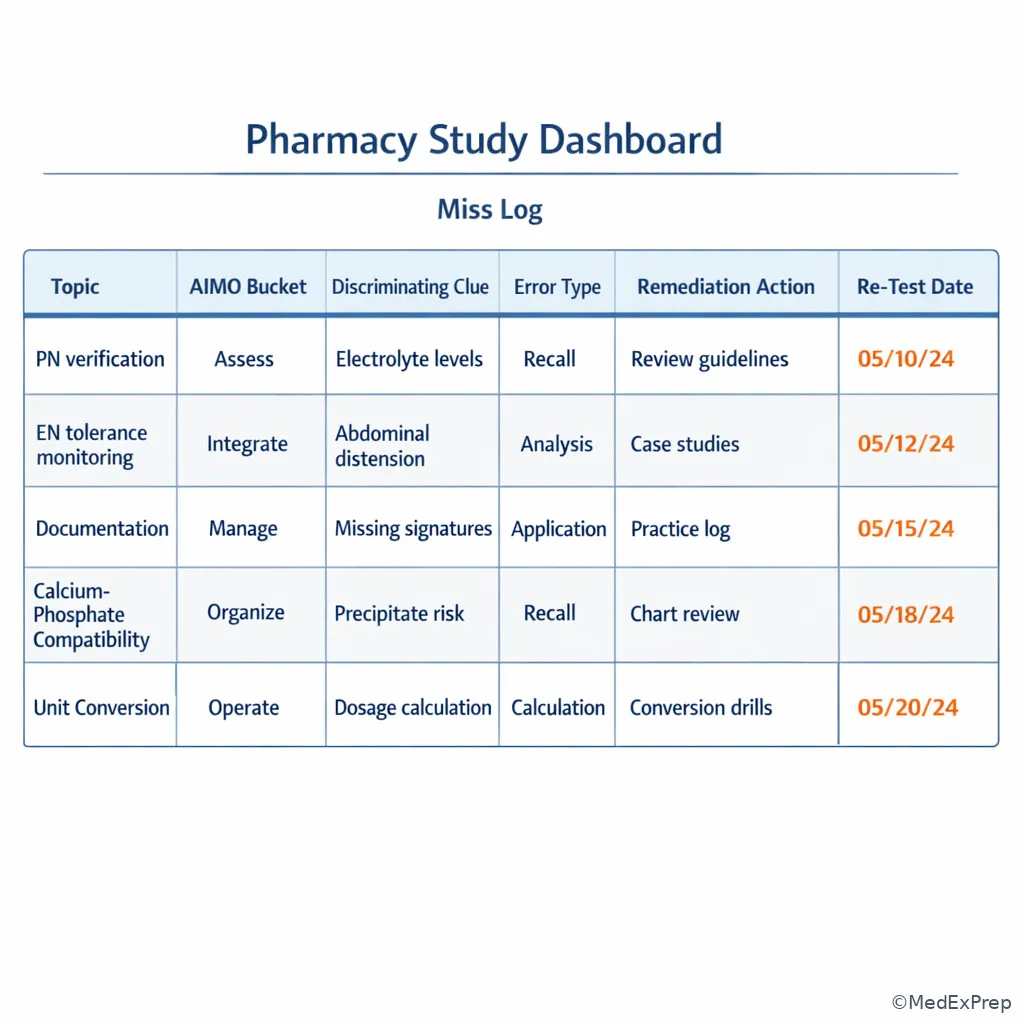
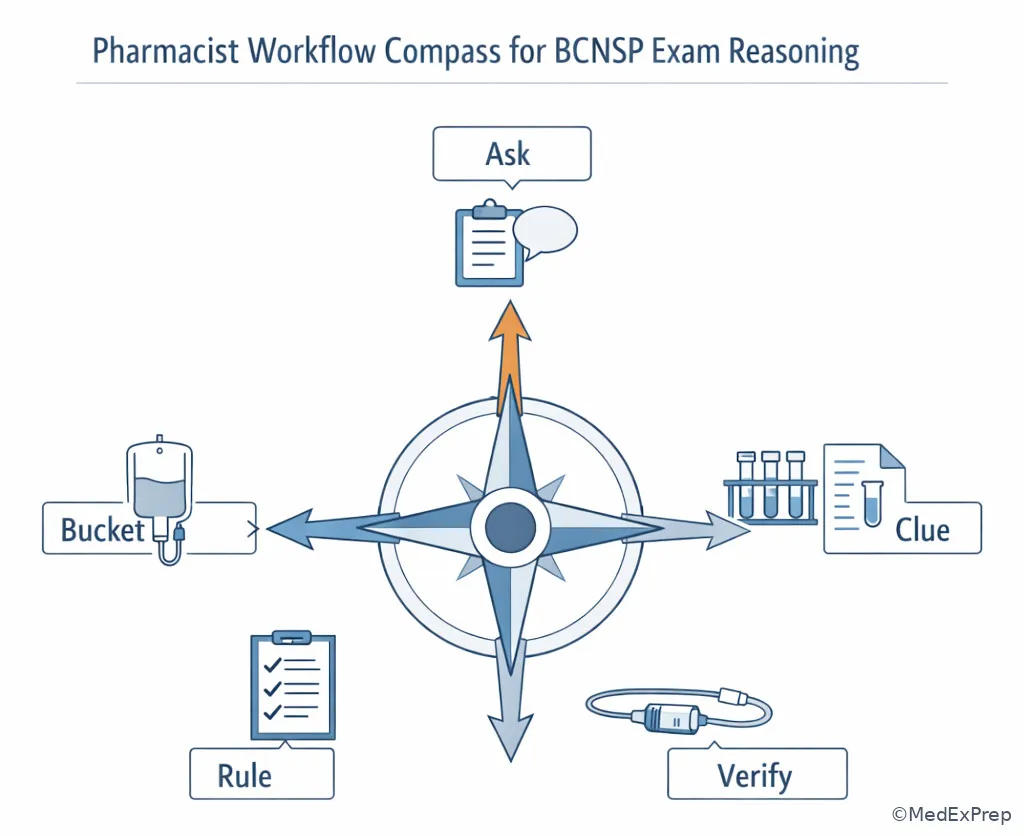
PharmExPrep

Free lesson

Pharmacist Scope Boundaries

The first lesson of BCNSP Prep Course (BCNSP), free to read.

Pharmacist Scope Boundaries

Course: BCNSP Prep Course (BCNSP)

Topic: 1.1.1 Pharmacist Scope Boundaries

Audience: Pharmacists preparing for the Board of Pharmacy Specialties Board Certified Nutrition Support Pharmacist (BCNSP) examination

What you’ll learn

  • DOMAIN: Professional Practice → 3.1.4 Safe Practices — distinguish pharmacist actions that are appropriate to verify, hold, clarify, compound, dispense, monitor, and document.
  • DOMAIN: Professional Practice → 3.2.1 Standards — identify when order verification must stop because a safety, sterility, compatibility, stability, or documentation issue is unresolved.
  • Derived subskill: pharmacist-scope decision making — choose continue versus hold versus modify versus clarify versus escalate in board-style stems.
  • Derived subskill: interdisciplinary communication — state what the pharmacist should communicate to prescribers, nurses, and the nutrition support team without crossing into prescriber-only decisions.
  • Derived subskill: quality-safety-and-ethics — recognize out-of-role actions such as diagnosing, prescribing independently, placing access, or releasing unsafe compounded products.

Blueprint mapping

  • Domain: Professional Practice → Subdomain/objective: Safe Practices (order appropriateness, sterility, release decisions, escalation)
  • Domain: Professional Practice → Subdomain/objective: Standards (documentation, compliance-aware verification, local/state/federal requirements)
  • Derived subskill: Safe pharmacist role boundaries in nutrition support operations and monitoring

Estimated time: 45–60 minutes

Prereqs: Course introduction; neighboring upcoming topics: Blueprint Domains And Subskills, Exam Reasoning Framework

Key outputs: You should be able to choose when a pharmacist should proceed, when the product or order must be held, when clarification is mandatory, and when escalation is required to prevent unsafe nutrition support care.

Why it matters

  • BCNSP questions often test not just what is clinically desirable, but what the pharmacist should do next within pharmacist scope.
  • Many exam distractors are attractive because they sound clinically helpful but actually require prescriber authority, procedural authority, or site-specific authority not granted in the stem.
  • Nutrition support is high risk: sterility failures, compatibility errors, route mismatches, and unclear orders can harm patients quickly; the safest correct answer is often hold and clarify.
  • Professional-practice items reward patient protection, documentation, and communication over convenience, speed, or assumptions.

Key Terms & Must-Know Facts

Key terms

  • Verify: pharmacist review of order accuracy, appropriateness, dose/rate, route, compatibility, and required safeguards before preparation or dispensing.
  • Clarify: obtain needed information before proceeding when the order or clinical context is incomplete, ambiguous, or conflicting.
  • Hold: stop preparation, verification, release, or continuation until a safety concern is resolved.
  • Escalate: notify the prescriber, nutrition support team, supervisor, or other appropriate clinician when risk exceeds routine correction.
  • Dispense/release: final product issue only after formulation, labeling, sterility workflow, and documentation checks are acceptable.
  • Compatibility: whether components can be mixed or co-administered safely without precipitate, emulsion destabilization, or other harm.
  • Stability: ability of a formulation to maintain intended physical and chemical integrity over time.
  • Sterility assurance: compounding and handling processes that reduce contamination risk consistent with applicable standards and policy.
  • Out-of-scope action: task beyond pharmacist authority in the scenario, such as diagnosing disease, placing a line, or independently prescribing therapy.
  • Continue vs modify vs hold: the central decision framework for BCNSP practice stems.
  • Operational discrepancy: mismatch in order, label, workflow, ingredients, access route, timing, or documentation that creates release risk.
  • Pharmacist recommendation: communication of concerns or options without assuming prescriber authority.

Must-know facts

  • The pharmacist’s safest default in unresolved high-risk situations is hold, clarify, document, and communicate.
  • If the stem asks you to do something outside pharmacist scope, reject that option even if the clinical idea sounds reasonable.
  • Do not independently diagnose, prescribe, place feeding access, place central access, or perform procedures reserved to others.
  • Do not release a nutrition support product that has unresolved compatibility, stability, labeling, sterility, or order discrepancy concerns.
  • Patient safety outranks workflow speed; “send now and fix later” is usually wrong on this exam.
  • When local policy or jurisdiction may vary, choose the answer that follows core pharmacist responsibilities and defers to current standards and institutional policy.
  • In a board-style item, the “most appropriate next step” often hinges on the single unresolved safety fact.
  • Documentation is part of the correct action, not an afterthought.

Memory anchor: Think V-H-C-E-D = Verify, Hold, Clarify, Escalate, Document. When the stem feels risky or incomplete, run this sequence before considering continuation.

Fig 1. Pharmacist boundary map
Exam takeaway: Separate pharmacist actions from prescriber-only or procedure-only actions before choosing the next step.
flowchart LR
A[Order or patient issue appears] --> B{Within pharmacist scope?}
B -->|Yes| C[Verify, calculate, monitor, document, communicate]
B -->|No| D[Hold and clarify with prescriber or team]
C --> E{Safe and complete?}
E -->|Yes| F[Prepare or release per standards]
E -->|No| D
D --> G[Escalate unresolved safety concern]

See Fig 1. This figure is the central mental model for the lesson: first decide scope, then decide safety, then decide action.

Fig 2. Continue versus hold decision tree
Exam takeaway: An unresolved safety variable usually beats convenience, timing pressure, and incomplete assumptions.
flowchart TD
A[PN or EN order arrives] --> B{Order complete and interpretable?}
B -->|No| H[Hold and clarify]
B -->|Yes| C{Compatibility, stability, route, access, label all acceptable?}
C -->|No| H
C -->|Yes| D{Clinical monitoring acceptable for continuation?}
D -->|No| E[Recommend modify or monitor and communicate]
D -->|Yes| F[Proceed with verification and release]
H --> G[Document issue and notify appropriate clinician]

See Fig 2. Many test items reduce to this: if a key variable is unresolved, continuation is premature.

Fig 3. Nutrition support pharmacist workflow boundaries
Exam takeaway: Pharmacists own verification, compounding oversight, release checks, monitoring support, and communication, not diagnosis or procedures.
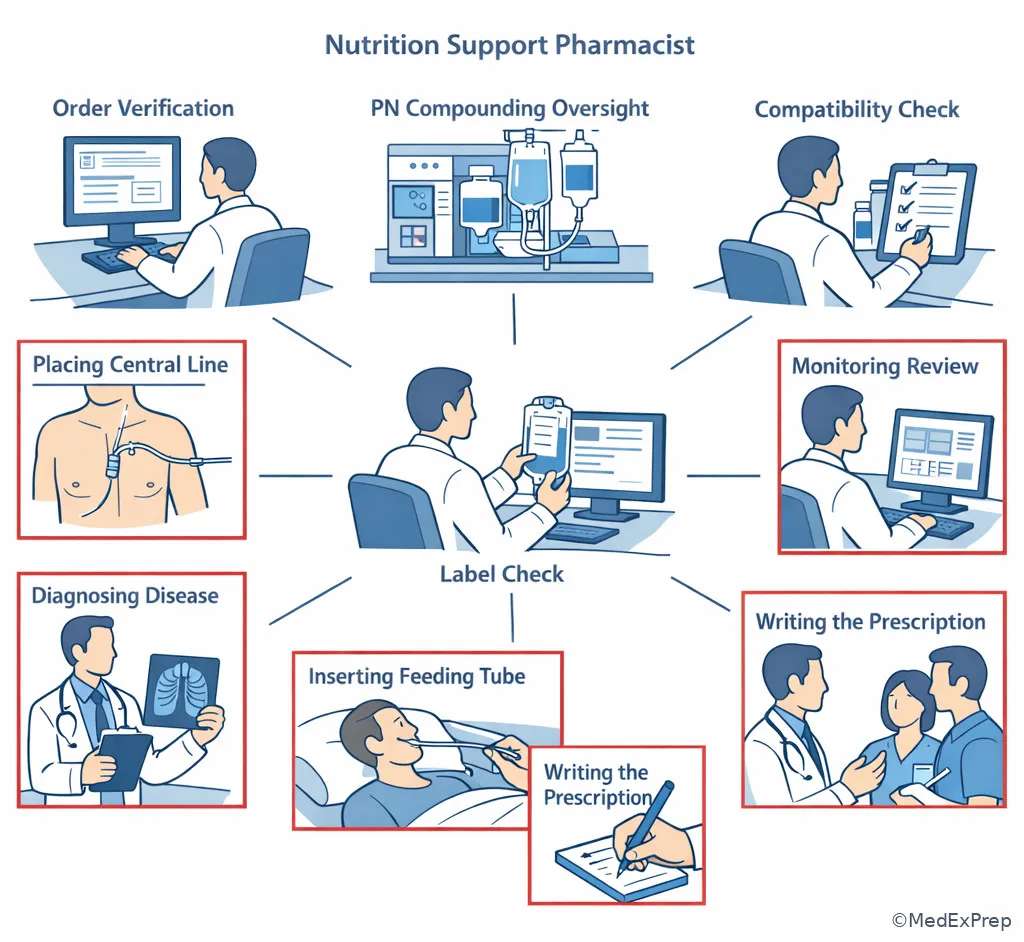
Fig 3. Nutrition support pharmacist workflow boundaries

See Fig 3. Use it to rapidly sort “can do,” “can recommend,” and “must not do.”

Fig 4. Unsafe order escalation checkpoints
Exam takeaway: Route mismatch, access mismatch, missing data, and compounding concerns are classic triggers to hold and clarify.
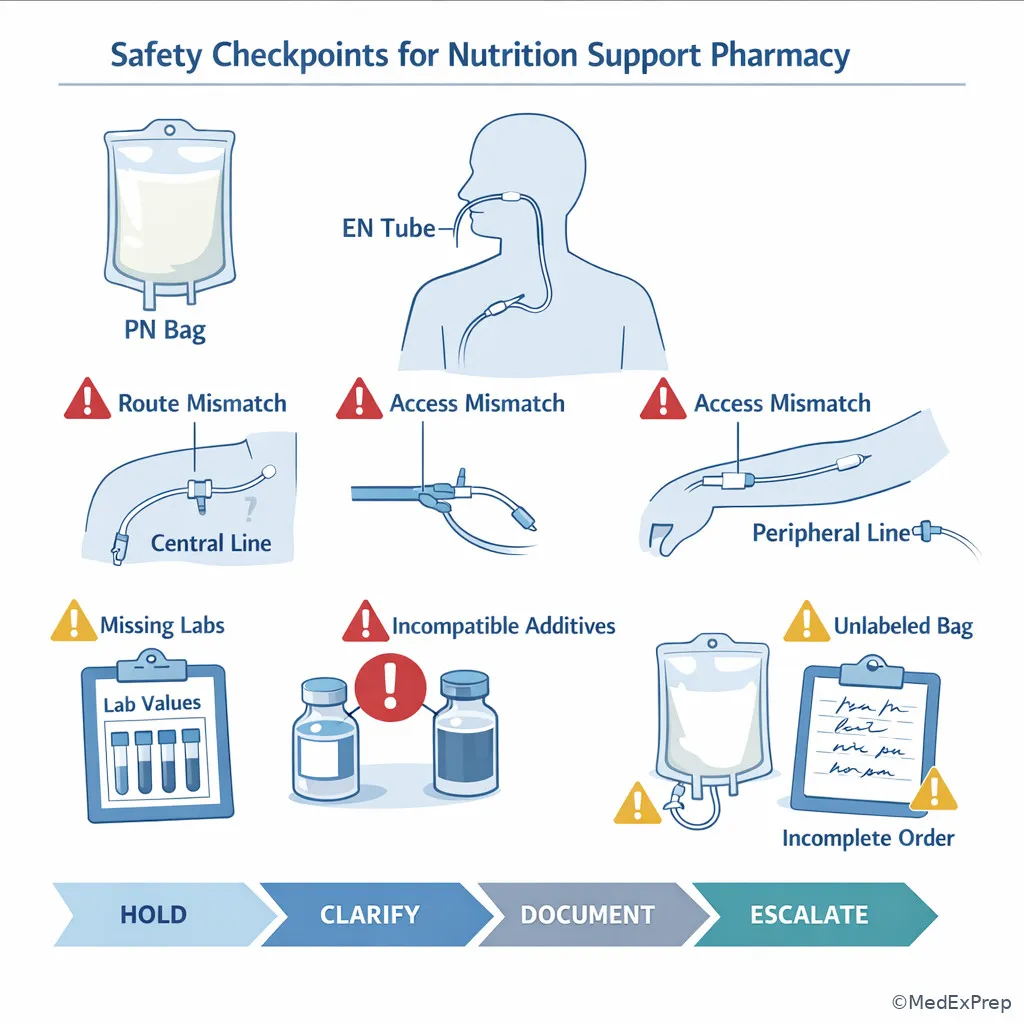
Fig 4. Unsafe order escalation checkpoints

See Fig 4. This is the exam’s favorite safety pattern: one red flag is enough to stop release.

Fig 5. Communication ladder for pharmacist action
Exam takeaway: The correct answer often includes what to say, whom to notify, and what to document after the hold decision.
flowchart LR
A[Notice discrepancy] --> B[Pause verification or release]
B --> C[Gather exact missing or conflicting facts]
C --> D[Contact prescriber or team with specific concern]
D --> E[Recommend safe options within scope]
E --> F[Document action and outcome]
F --> G[Reassess before proceeding]

See Fig 5. High-scoring answers include both the safety action and the communication step.

Fig 6. Order verification red flags
Exam takeaway: A visual checklist helps you spot the one unresolved variable that controls the answer.
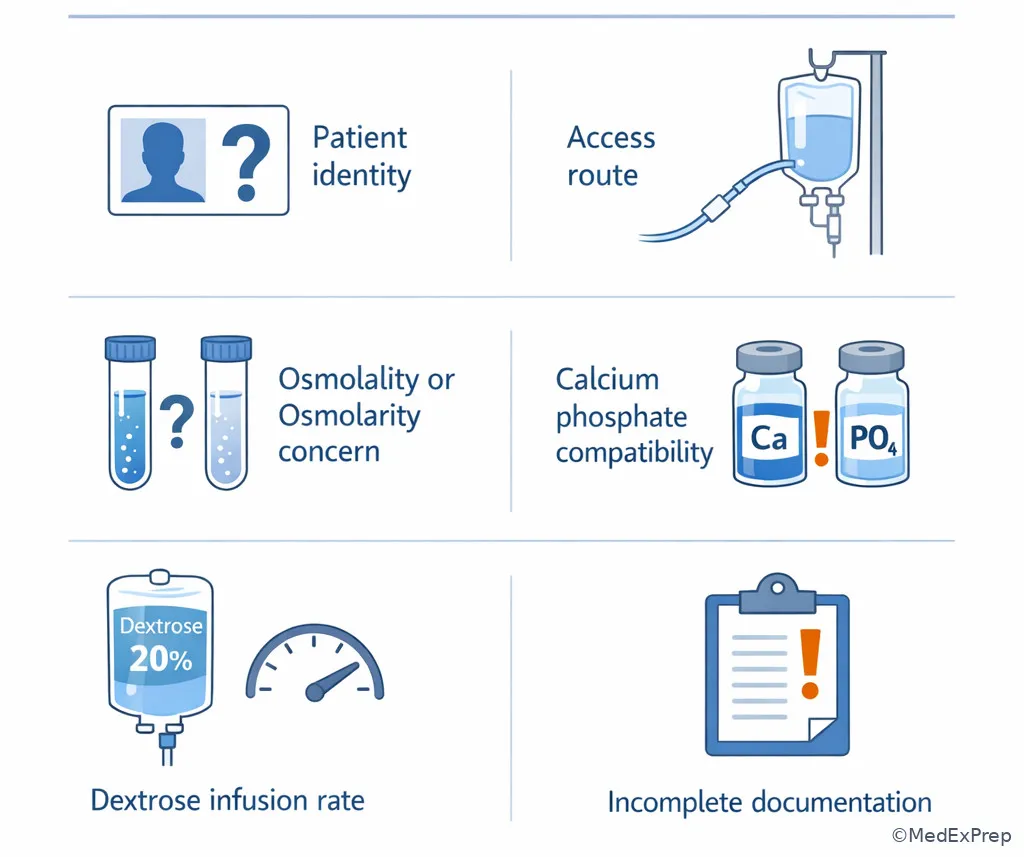
Order verification red flags
PN release hold points
Exam takeaway: Release decisions should follow safety checkpoints rather than staffing pressure or timing pressure.
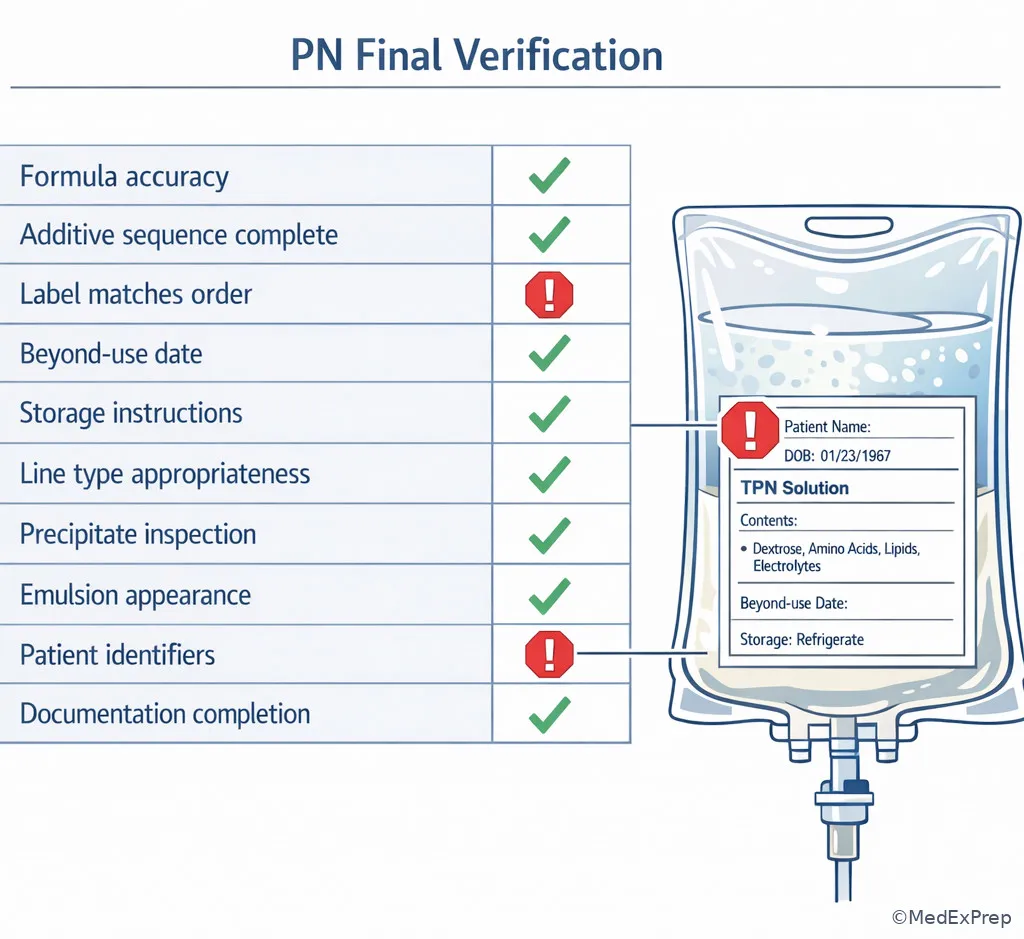
PN release hold points
Interdisciplinary handoff for nutrition support safety
Exam takeaway: Pharmacists protect patients by escalating to the right team member, not by assuming another discipline’s role.
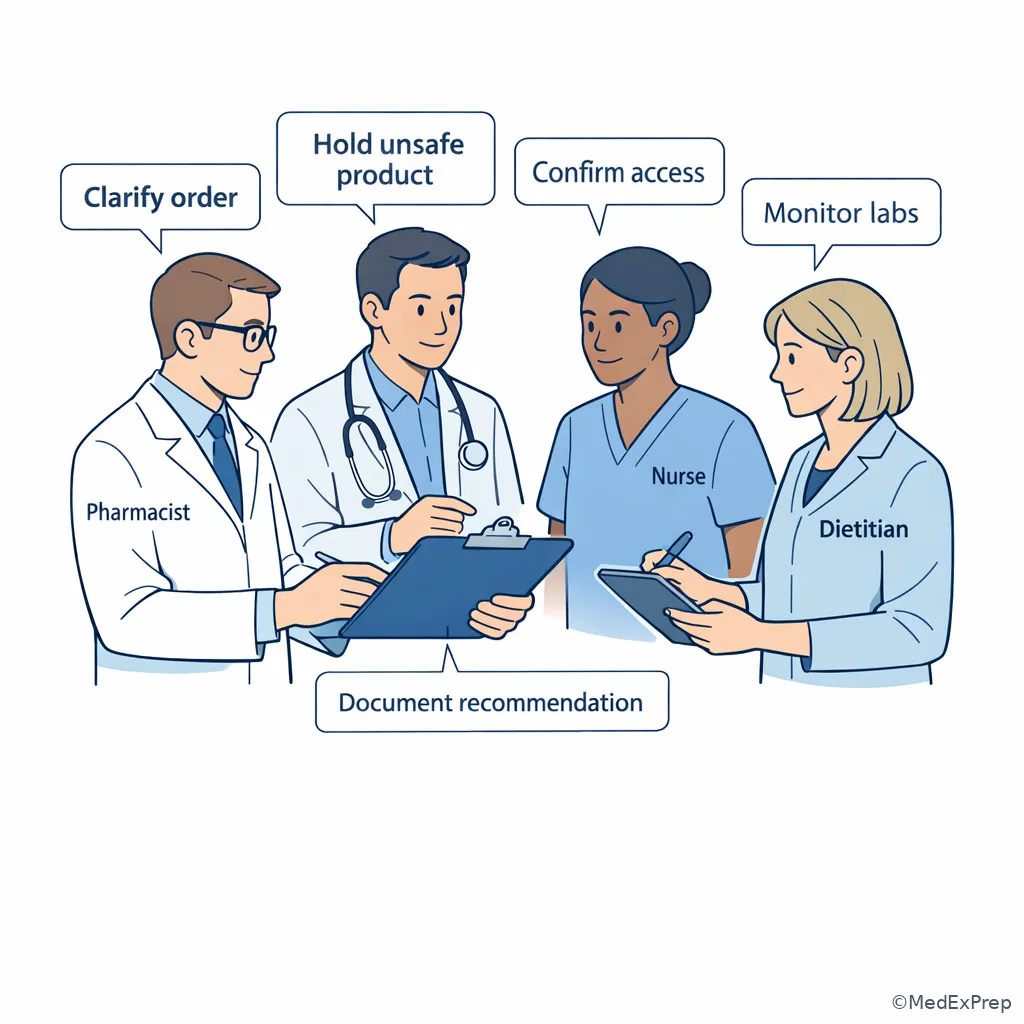
Interdisciplinary handoff for nutrition support safety
Scope boundary do-versus-do-not-do chart
Exam takeaway: Knowing the forbidden actions is just as testable as knowing the appropriate pharmacist actions.
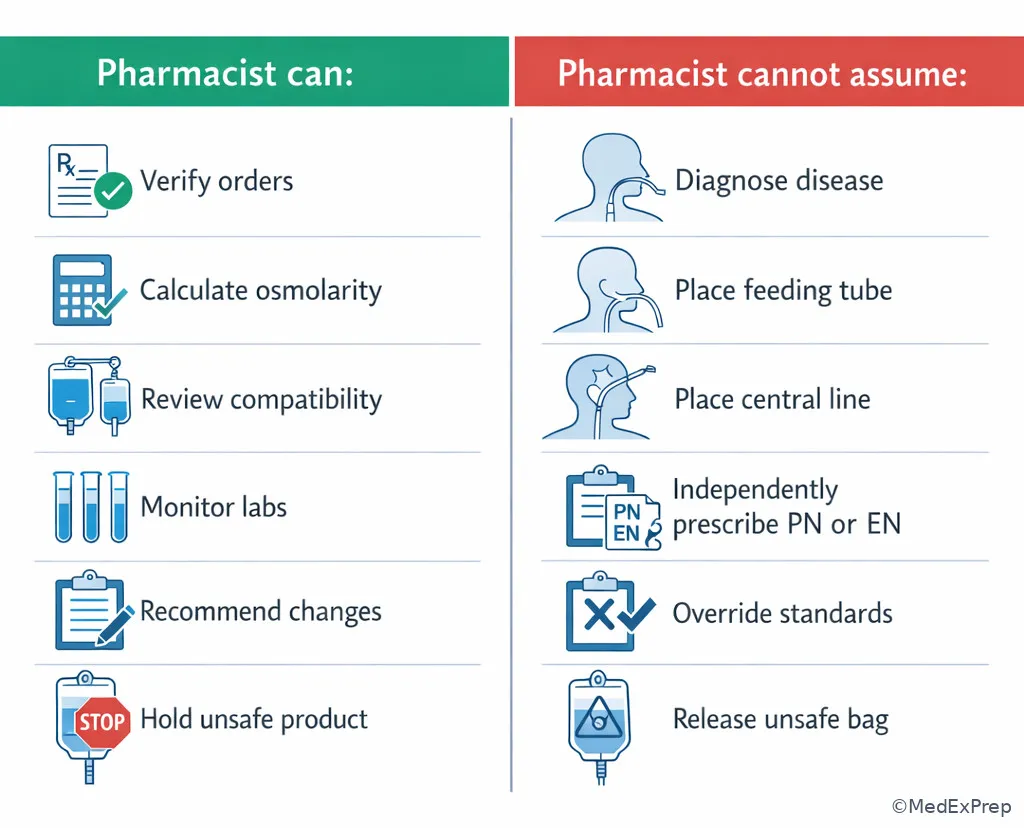
Scope boundary do-versus-do-not-do chart

Core content

1.1.1.1 Foundational boundary: what the pharmacist may do versus must not do

A. Explanation

A common BCNSP decision conflict is choosing between an action that seems clinically helpful and the action that is actually within pharmacist scope. The exam tests whether you can separate pharmacist responsibilities from prescriber or procedural responsibilities. The pharmacist may verify the order, assess whether it is safe to prepare or dispense, identify formulation or route concerns, calculate doses and rates, review compatibility and stability, monitor and interpret labs, recommend modifications, document, and communicate with the team. The pharmacist must reject options that require independently diagnosing the patient, writing or independently authorizing the nutrition support regimen as the treating clinician, placing access devices, inserting feeding tubes, or releasing an unsafe product simply because therapy is urgent.

WHY THIS IS TESTED: board questions frequently present a time-sensitive situation and tempt you to “solve the whole case.” The testable pattern is that the correct answer stays inside pharmacist authority while still protecting the patient. In practice terms, choose recommend and clarify, reject prescribe or perform.

Key rule: If the option asks you to act as the treating physician, proceduralist, or final diagnosing clinician, it is outside scope unless the stem explicitly grants authority.

Concept flow: Scope-first decision filter
Task appears
Identify whether the stem asks for verification, monitoring, compounding, communication, or a prescriber/procedural action.

Boundary check
If within pharmacist scope → continue safety review. If not → reject and clarify or escalate.

Safe action
Recommend, document, and notify the correct clinician rather than acting beyond authority.

Recall: In the course introduction, we framed this exam around pharmacist judgment rather than physician management. Here, we build on that by drawing a hard line between pharmacist-owned safety steps and out-of-role actions.

B. Worked example

A 68-year-old man with short bowel syndrome, chronic kidney disease stage 3, and insulin-treated diabetes has a pending central PN order: dextrose 300 g/day, amino acids 90 g/day, SMOF lipid 50 g/day, potassium phosphate 30 mmol, magnesium sulfate 16 mEq, multivitamins, and trace elements. The nurse notes that the patient’s tunneled line was removed 2 hours ago for suspected infection, and a peripheral IV is currently in place. A resident verbally says, “Just start this now through the peripheral line until we sort out the central access.” The patient also has a mildly elevated AST, which is distracting but not the key issue.

Reasoning chain: Identify task → pharmacist must decide whether to verify/release and what to communicate. Extract key facts → central PN order, current access is peripheral only, urgent verbal request, suspected line infection. Apply rule → pharmacist can assess route appropriateness and hold unsafe administration; pharmacist cannot independently rewrite the regimen, place access, or authorize unsafe infusion. Eliminate distractors → do not send as-is through peripheral access; do not independently convert to peripheral PN unless prescriber clarification and site policy support a safe revised formula. Verify → the safest next step is to hold the current PN release for peripheral administration, notify the prescriber that access does not match the order and route limits must be clarified, document the intervention, and recommend evaluation of alternative nutrition support options consistent with policy.

C. Exam trap

Common wrong answer: “Modify the current central PN yourself to a peripheral formulation and send it immediately.”

Why it is tempting: It sounds proactive and patient-centered, and pharmacists do perform calculations and formulation review.

Single clue that eliminates it: The stem never grants authority to independently prescribe or rewrite the nutrition regimen; the current order and current access are mismatched, so the pharmacist must hold and clarify rather than unilaterally create a new treatment plan.

D. Checkpoint

Question: A pharmacist receives an order to begin a high-osmolarity PN formulation through a peripheral catheter because central access was lost overnight. Which is the most appropriate next step?

  1. A. Verify and dispense the PN because the patient still needs nutrition support.
  2. B. Hold the order, clarify route/access appropriateness with the prescriber, document the concern, and recommend a safe alternative if needed.
  3. C. Independently write a new lower-osmolarity peripheral PN order and dispense it.
  4. D. Ask nursing to temporarily infuse the PN at half-rate through the peripheral catheter until rounds.

Answer: B

  • A: Tempting because nutrition should not be delayed; wrong because need for nutrition does not override route safety and order mismatch.
  • B: Correct because it keeps the pharmacist within scope and addresses the access-risk conflict directly.
  • C: Tempting because pharmacists understand formulation limits; wrong because independent prescribing or regimen rewriting is not granted.
  • D: Tempting because rate reduction sounds safer; wrong because rate reduction does not fix the fundamental route/access problem.
If you missed this: Review 1.1.1.1 Foundational boundary: what the pharmacist may do versus must not do — focus on the difference between recommending a safe option and independently authorizing a new therapy.

Pharmacist Action: NOTICE: any order that assumes the wrong access type or requires a procedure. SAY: “The current access does not support this ordered therapy safely; I need to hold and clarify before release.” MONITOR: access type, order-route match, and urgency at each verification. HOLD/CLARIFY/ESCALATE: hold immediately when ordered therapy exceeds current route or access limits.

1.1.1.2 Safety triggers that require hold and clarify

A. Explanation

The second foundational skill is recognizing the specific triggers that convert a routine order into a do not proceed yet situation. On the BCNSP exam, these triggers are often practical rather than dramatic: incomplete order elements, incompatible additives, route mismatch, impossible rate instructions, missing patient identifiers, unclear electrolyte salt or dose, unresolved allergy information, missing key labs in a high-risk patient, or product labeling that does not match the verified order. The decision conflict is whether to keep workflow moving or stop the process. The single finding that resolves it is any unresolved safety variable that materially affects formulation, administration, or monitoring.

WHY THIS IS TESTED: the exam wants pharmacists who protect patients from preventable harm. You are not rewarded for assumptions. If a critical detail is missing and your next action would commit the patient to a potentially unsafe product or administration route, you hold and clarify first. See Fig 4 and Fig 5.

Key rule: “I can probably infer what they meant” is usually dangerous exam reasoning. If the missing fact changes safety, the product is not ready for release.

Concept flow: Red-flag triage before release
Scan for red flags
Check order completeness, identifiers, access, additives, labels, and required data.

Safety impact?
If the unresolved item could change formulation, route, or harm risk → hold. If not material → follow standard workflow.

Close the loop
Clarify with the right team member, document the issue, then re-verify before release.

High-Yield Connection: This concept is tested alongside Aseptic Technique Principles and Labeling And Product Release. Know both the clinical safety trigger and the operational release rule for exam day — they are frequently paired in stems.

B. Worked example

A 54-year-old woman with metastatic ovarian cancer, severe malnutrition, and a history of recurrent catheter-related bloodstream infection is receiving home PN. Today’s order includes dextrose 220 g, amino acids 75 g, lipids 40 g, sodium acetate 80 mEq, potassium chloride 60 mEq, calcium gluconate 10 mEq, magnesium sulfate 12 mEq, multivitamins, and trace elements. The faxed order is missing patient weight, contains no phosphorus entry despite recent refeeding concern in the chart, and the printed label draft lists potassium acetate instead of potassium chloride. Her bilirubin is mildly elevated, which is distracting. The delivery deadline is in 30 minutes.

Reasoning chain: Identify task → decide whether to compound and release. Extract key facts → order-label mismatch, incomplete critical order information, recent refeeding concern, home PN setting, deadline pressure. Apply rule → unresolved mismatch and omitted clinically important information that may affect formulation require hold and clarification. Eliminate distractors → do not assume the intended potassium salt; do not release with a “note to fix later”; do not rely on deadline pressure. Verify → hold compounding or release, contact the prescriber/team to reconcile the discrepancy and current electrolyte plan, document the intervention, then proceed only when the final verified order matches the label and clinical plan.

C. Exam trap

Common wrong answer: “Compound according to the typed order and add a note that the label will be corrected after delivery.”

Why it is tempting: It seems operationally efficient and avoids therapy delay.

Single clue that eliminates it: The label does not match the verified formula, which is a release-level safety problem, not a clerical detail to defer.

D. Checkpoint

Question: Which unresolved issue most clearly requires the pharmacist to hold PN release rather than proceed?

  1. A. A mildly elevated bilirubin in a patient already receiving chronic PN.
  2. B. A delivery cutoff time that will be missed if clarification is requested.
  3. C. A mismatch between the PN order’s potassium salt and the printed label’s potassium salt.
  4. D. A stable patient who prefers infusion start at 8 PM instead of 7 PM.

Answer: C

  • A: Tempting because hepatic markers matter in PN monitoring; wrong because this alone does not automatically prevent release of an otherwise correct order.
  • B: Tempting because timing pressure is real in practice; wrong because deadlines never override a material safety discrepancy.
  • C: Correct because the product label and formula conflict on a clinically meaningful component.
  • D: Tempting because administration timing matters operationally; wrong because patient preference does not create a release-level safety stop.
If you missed this: Review 1.1.1.2 Safety triggers that require hold and clarify — focus on the rule that any unresolved mismatch affecting formulation or administration blocks release.

Pharmacist Action: NOTICE: order-label mismatches, additive ambiguities, and missing data with safety implications. SAY: “I cannot release this PN until the formula, label, and clinical intent match.” MONITOR: order completeness and release documentation every verification cycle. HOLD/CLARIFY/ESCALATE: escalate when discrepancies remain unresolved despite attempted clarification.

Quick Recall:

  • The safest default for an unresolved material discrepancy is hold and clarify.
  • True or False: A delivery deadline can justify releasing a mislabeled PN product. False.
  • Name 3 classic hold triggers: route/access mismatch, order-label mismatch, unresolved compatibility/stability concern.

1.1.1.3 Pharmacist communication: recommend, document, and escalate without overstepping

A. Explanation

Once you identify that the order cannot proceed safely, the next tested skill is how the pharmacist should act. The exam is not satisfied with “hold” alone. You should also choose the option that communicates the concern clearly, gives a pharmacist-level recommendation when appropriate, documents the issue, and escalates if the risk remains unresolved. The decision conflict is between passively delaying and actively closing the loop. The resolving rule is simple: pharmacists should be specific about the problem, specific about the risk, and specific about what needs clarification. They may recommend options or monitoring priorities, but they should not assume prescriber authority.

WHY THIS IS TESTED: patient safety depends on action that is both limited and effective. A pharmacist who simply says “this seems wrong” without identifying the exact discrepancy has not completed the job. On the other hand, a pharmacist who writes a new therapy plan without authority has crossed the boundary. See Fig 5.

Key rule: A strong pharmacist response names the issue, the risk, the needed clarification, and the documentation step.

Concept flow: Communicate without overstepping
State the discrepancy
Describe the exact order, route, label, lab, or compatibility issue.

State the risk
Tie the discrepancy to unsafe administration, compounding, or monitoring consequences.

Recommend within scope
Request clarification or suggest options; do not independently prescribe or perform procedures.

Document and recheck
Record who was contacted, what changed, and whether the product can now proceed.

Memory anchor: Use I-R-A-D = Issue, Risk, Ask, Document. It turns vague concern into exam-ready pharmacist communication.

B. Worked example

A 43-year-old man with Crohn disease, high-output ostomy, and recent acute kidney injury is admitted for dehydration and is being restarted on PN. The order includes dextrose 350 g/day and insulin regular 40 units in the bag. His current glucose today ranges from 88 to 116 mg/dL because he has been NPO with an insulin infusion that was discontinued one hour ago. A covering prescriber writes, “continue home PN exactly.” The patient’s magnesium is slightly low, which is relevant but not the decisive issue.

Reasoning chain: Identify task → pharmacist must determine the most appropriate communication and verification action. Extract key facts → home PN order copied forward, recent change in insulin therapy, current glucose lower than expected, inpatient context changed. Apply rule → pharmacist can identify that the copied insulin dose may no longer match the current clinical setting and should clarify the dextrose/insulin plan before release. Eliminate distractors → do not silently remove the insulin from the PN without discussion; do not compound “because it was the home dose”; do not diagnose the glycemic disorder. Verify → contact the prescriber/team with the specific discrepancy between historical PN insulin and current inpatient glucose context, recommend review of insulin-in-PN dosing strategy, document, and proceed only after clarification.

C. Exam trap

Common wrong answer: “Just remove the insulin from the PN bag and send it, because the current glucose is normal.”

Why it is tempting: It looks like a cautious correction and uses pharmacist formulation expertise.

Single clue that eliminates it: The question tests communication and authority; the pharmacist identified a concern but cannot independently alter a therapeutically meaningful order component without clarification in this scenario.

D. Checkpoint

Question: Which pharmacist statement best stays within scope while addressing a potentially unsafe copied-forward PN order?

  1. A. “I changed the insulin dose in the PN because the current glucose values look lower.”
  2. B. “The PN was continued as written because this was the patient’s home regimen.”
  3. C. “The copied insulin-in-PN dose may not reflect the current inpatient status; I am holding verification and requesting clarification of the dextrose and insulin plan.”
  4. D. “Nursing should decide whether the insulin amount seems reasonable before the bag is dispensed.”

Answer: C

  • A: Tempting because pharmacists often identify dose concerns; wrong because it assumes independent therapeutic authority.
  • B: Tempting because continuity with home therapy often matters; wrong because copied-forward regimens must still match current clinical conditions.
  • C: Correct because it names the issue, states the action, and remains within pharmacist scope.
  • D: Tempting because nurses are key partners; wrong because the pharmacist cannot offload the verification responsibility.
If you missed this: Review 1.1.1.3 Pharmacist communication: recommend, document, and escalate without overstepping — focus on the Issue-Risk-Ask-Document structure.

Pharmacist Action: NOTICE: copied-forward orders, verbal shortcuts, and “same as before” requests. SAY: “This historical regimen may not match the current clinical picture; I need clarification before verification.” MONITOR: handoff changes, prior-to-current order differences, and documented callback resolution. HOLD/CLARIFY/ESCALATE: escalate if urgent therapy pressure persists despite unresolved risk.

1.1.1.4 Distinguishing modify versus continue versus hold in real nutrition support workflows

A. Explanation

The most nuanced foundational judgment is deciding among continue, modify, and hold. The exam often gives several plausible pharmacist actions from the same general category, so you need the discriminating rule. Continue is appropriate when the order is complete, safe, and consistent with the clinical situation. Modify is appropriate when a pharmacist-level adjustment is clearly within established authority or standard verification workflow in the stem or policy context. Hold is appropriate when there is unresolved uncertainty that could affect patient safety, formulation integrity, route suitability, or regulatory compliance. The decision conflict is whether an issue is a routine adjustment or a stop-level discrepancy. The single finding that resolves it is whether the pharmacist can fully correct the issue within authority and without assumption.

WHY THIS IS TESTED: this is the core operational reasoning model for BCNSP. Future topics will attach formulas, monitoring, compatibility, and complications to this same action grid. The exam rewards a structured answer: identify the discrepancy, decide if it is pharmacist-correctable, and if not, hold and clarify.

High-Yield Connection: This concept is tested alongside the upcoming Exam Reasoning Framework. Know the sequence identify task → extract key facts → apply rule → execute → verify; scope-boundary questions are the simplest place to build that habit.

Concept flow: Continue-modify-hold triage
Verify safety
Confirm complete order, correct route, release readiness, and no unresolved red flags.

Can pharmacist fix it within scope?
Yes, and authority is clear → modify. No, or information is missing → hold and clarify.

Proceed only after resolution
Continue when safe, documented, and compliant; never release through uncertainty.

B. Worked example

A 59-year-old woman with chronic intestinal failure, heart failure with reduced ejection fraction, and chronic hyponatremia receives home PN five nights per week. Today’s refill order matches the prior formula except the bag label auto-populates the old infusion duration of 12 hours, while the current verified order says 14 hours because of prior intolerance at the faster rate. Patient weight and current labs are otherwise stable; the family is waiting for courier pickup. This is a real discrepancy, but unlike a route mismatch, the error is fully identifiable and correctable within pharmacist workflow.

Reasoning chain: Identify task → determine whether to continue, modify, or hold. Extract key facts → order-label mismatch on infusion duration, current intended schedule already verified, no need for new prescribing, release not yet final. Apply rule → when the pharmacist can correct a clerical or transcription-related release problem within established workflow and verify the corrected label matches the authorized order, modification/correction is appropriate. Eliminate distractors → do not send the old label; do not hold therapy indefinitely when the discrepancy is fully correctable before release; do not ask the patient to “remember the correct duration.” Verify → correct the label to match the verified order, complete standard final check, document per workflow, and release only after the corrected product is accurate.

C. Exam trap

Common wrong answer: “Because every discrepancy is unsafe, hold the bag until tomorrow even though the error is only a correctable label duration typo.”

Why it is tempting: After learning “hold if unsafe,” learners can overapply the rule to issues the pharmacist can actually resolve before release.

Single clue that eliminates it: The discrepancy is fully correctable within pharmacist verification workflow and does not require new clinical authorization if the current verified order is already clear.

D. Checkpoint

Question: Which situation most supports pharmacist correction and continuation rather than hold-and-clarify?

  1. A. The order specifies central PN, but the patient has only peripheral access.
  2. B. The label infusion duration auto-populated from an old template, but the current verified order clearly lists the intended duration and the product has not yet been released.
  3. C. The phosphate dose is missing from the order in a patient at refeeding risk.
  4. D. The prescriber requests a verbal change to “adjust electrolytes as needed” without specifics.

Answer: B

  • A: Tempting because route issues can feel operationally fixable; wrong because route/access mismatch is a stop-level clinical safety issue.
  • B: Correct because the pharmacist can correct the release documentation to match the already authorized and verified order.
  • C: Tempting because pharmacists understand refeeding concerns; wrong because a missing therapeutic component in a high-risk patient requires clarification.
  • D: Tempting because pharmacists often help adjust electrolytes; wrong because the requested change lacks specific authorized instructions.
If you missed this: Review 1.1.1.4 Distinguishing modify versus continue versus hold in real nutrition support workflows — focus on whether the pharmacist can fully correct the issue within clear authority and without assumption.

Pharmacist Action: NOTICE: whether the problem is clerical-and-correctable or clinically unresolved. SAY: “This can be corrected within verification” versus “This requires prescriber clarification before release.” MONITOR: final label accuracy, release checklist completion, and documentation closure. HOLD/CLARIFY/ESCALATE: escalate when pressure to proceed persists despite an unresolved stop-level discrepancy.

Quick Recall:

  • True or False: Every discrepancy requires prescriber clarification. False — some are pharmacist-correctable release errors.
  • The single discriminator between modify and hold is whether the issue can be fully corrected within scope and without assumption.
  • Name the three action buckets: continue, modify, hold.

1.1.1.5 Integrating scope boundaries with safety, sterility, compliance, and exam reasoning

A. Explanation

The final integration step is understanding why scope boundaries matter beyond professional etiquette: they are the mechanism by which the pharmacist protects sterility assurance, compatibility standards, documentation integrity, and patient safety. A pharmacist who compounds or releases an unclear PN order does not merely cross a role boundary; that choice can create a mislabeled, unstable, incompatible, or otherwise unsafe product. The decision conflict is between solving the clinical need quickly and preserving the full safety chain. The single resolving rule is that unresolved process risk is still patient risk. Questions in this lesson are foundational, but the same structure will later appear in calcium-phosphate compatibility, aseptic workflow, labeling and release, and complication management.

WHY THIS IS TESTED: BCNSP is a pharmacist certification, not a pure therapeutics exam. The safest answer often combines pharmacist scope, operational standards, and the duty to prevent unsafe release. See Fig 1 through Fig 5.

Key rule: If a product is not safe to verify, not safe to compound, or not safe to release, the correct action is not “try your best.” It is to stop the unsafe step and close the gap.

Concept flow: Boundary-safe practice chain
Scope check
Reject tasks that require diagnosing, prescribing independently, or doing procedures.

Safety check
Assess route, access, formula, compatibility, label, and required data.

Communication check
Notify the right clinician with a specific issue and recommendation.

Documentation check
Record the discrepancy, intervention, and final disposition before release.

B. Worked example

A 72-year-old man with pancreatic cancer, cholestasis, and severe weight loss is receiving compounded PN in the hospital. During final verification, the pharmacist notices that the preparation record is incomplete, one additive entry is handwritten and difficult to read, and the final bag label omits storage instructions required by site process. The nurse calls twice asking for immediate delivery because the patient missed the previous evening’s infusion. The patient’s sodium is mildly low, which may catch attention but is not the release-determining fact.

Reasoning chain: Identify task → decide whether to release an already compounded product. Extract key facts → incomplete compounding record, ambiguous documentation, label omission, time pressure. Apply rule → the pharmacist is responsible for preventing unsafe or noncompliant release; unresolved documentation and labeling concerns can invalidate safe release. Eliminate distractors → do not release because therapy is overdue; do not “fix the chart later”; do not assume the handwritten entry was intended correctly. Verify → quarantine or hold release pending reconciliation according to policy, notify the appropriate team, document the issue, and only release after required verification elements are complete.

C. Exam trap

Common wrong answer: “Because the bag is already compounded, release it now and complete the record afterward.”

Why it is tempting: Learners may think the main risk is during compounding rather than during release.

Single clue that eliminates it: Final verification and release are pharmacist safety functions; unresolved documentation and label defects mean the product is not ready to leave pharmacy control.

D. Checkpoint

Question: During final PN verification, which finding most clearly requires the pharmacist to prevent product release until resolved?

  1. A. The patient missed the previous infusion and nursing requests immediate delivery.
  2. B. The patient has mild hyponatremia that is already known to the team.
  3. C. The compounding record is incomplete and the final label omits required release information.
  4. D. The patient’s infusion normally begins one hour earlier than today.

Answer: C

  • A: Tempting because delayed therapy matters; wrong because urgency does not overrule release requirements.
  • B: Tempting because electrolyte abnormalities are common PN monitoring triggers; wrong because this finding alone does not answer the release question.
  • C: Correct because incomplete record and labeling defects are direct barriers to safe and compliant release.
  • D: Tempting because infusion timing can matter operationally; wrong because timing change alone is not the primary release stop here.
If you missed this: Review 1.1.1.5 Integrating scope boundaries with safety, sterility, compliance, and exam reasoning — focus on the rule that unresolved release-process defects are patient-safety defects.

Pharmacist Action: NOTICE: incomplete records, illegible entries, unlabeled or mismatched products, and requests to bypass release steps. SAY: “I cannot release this product until the verification and documentation requirements are complete.” MONITOR: final verification checklist, label completeness, and release documentation every batch. HOLD/CLARIFY/ESCALATE: escalate immediately if anyone requests release of a product that fails required safeguards.

Exam Traps & Differentiators

Most common wrong answer and why: The most common wrong answer is the option that sounds decisive and clinically helpful but requires authority not granted in the stem. Examples include independently changing the regimen, authorizing a different route, instructing a procedure, or releasing an unsafe product because “the patient needs nutrition.” These are tempting because they appear proactive. The differentiator is the single unresolved safety or authority variable.

Looks similar Actually means Correct pharmacist response Discriminator
Recommend a therapy adjustment Communicate a pharmacist-level suggestion Clarify with prescriber and document No independent prescribing authority stated
Correct a label typo before release Pharmacist-correctable workflow error Modify within workflow, re-verify, then release Current verified order is already clear
Proceed despite route mismatch Unsafe administration risk Hold and clarify Current access cannot support ordered therapy safely
Release and document later Bypassing final safety controls Prevent release until complete Required release elements are unresolved
Ask another discipline to decide if it is okay Deflecting pharmacist verification duty Own the safety screen and contact the right clinician Verification remains pharmacist responsibility
If the stem says… Think…
“Can you just send it now?” Time pressure is probably a distractor; re-check for a release-level safety issue.
“Use the old order” or “same as home” Copied-forward orders may not fit the current clinical picture; verify before continuing.
“The line was removed” or “peripheral access only” Route/access mismatch is a classic hold-and-clarify trigger.
“Label can be fixed later” Release defect; do not send a mismatched or incomplete product.
“The resident verbally said…” Look for incomplete authorization details and clarify specifics before action.
“Missing weight/labs/electrolyte details” in a high-risk patient Do not infer critical data that materially changes safety or formulation.

Common traps & distractors: A safe recommendation is not the same as an authorized order; a compounded product is not automatically releasable; a copied-forward regimen is not automatically appropriate; and another team member’s urgency does not remove the pharmacist’s safety duty.

Related traps recur in Aseptic Technique Principles, Compounding Error Prevention, and Labeling And Product Release, where the confusing pair is often “workflow convenience” versus “required safeguard.”

Review connection: The traps above test continue-versus-hold professional judgment. If any felt unfamiliar, revisit 1.1.1.2 Safety triggers that require hold and clarify and 1.1.1.4 Distinguishing modify versus continue versus hold in real nutrition support workflows before attempting the Self-check quiz.

Tables

Reference action When it applies What the pharmacist does What the pharmacist does not do
Continue Order is complete, safe, and release-ready Verify, prepare/release, document, monitor Ignore new risks or skip final checks
Modify Issue is correctable within workflow and authority Correct, re-verify, document Assume new therapeutic authority
Hold Safety-critical issue unresolved Pause process, clarify, document Proceed based on assumption
Escalate Risk persists or exceeds routine correction Notify prescriber/team/supervisor per policy Quietly release or ignore concern
Recommend Therapeutic or operational concern identified Suggest pharmacist-level options with rationale Write or independently authorize treatment if not granted
Document Every intervention or release decision Record issue, communication, outcome Rely on memory or verbal-only closure
Comparison point Within pharmacist scope Outside pharmacist scope in this exam context
Order review Assess appropriateness, compatibility, stability, route, dose, rate Assume medical diagnosis independently
Therapy changes Recommend changes and clarify orders Independently prescribe or rewrite regimen unless authority is explicitly granted
Access decisions Identify mismatch between access and ordered therapy Place central line or feeding tube
Compounding Prepare, verify, and release only if standards are met Release products with unresolved safety defects
Monitoring Interpret labs and identify needed action or clarification Ignore abnormal trends because another discipline is involved
Documentation Document discrepancies and interventions Bypass required records to save time
Differential scenario type Best action Why
Correctable label auto-population error before release, verified order is clear Modify within workflow No new therapeutic decision is being made
Central PN order but only peripheral access available Hold and clarify Route/access mismatch creates unsafe administration risk
Missing phosphorus in a patient at refeeding risk Hold and clarify Missing therapeutic component changes clinical safety
Incomplete compounding record at final check Prevent release and escalate per workflow Product is not release-ready
Stable, complete, correctly labeled, verified PN order Continue No unresolved safety or authority conflict
Prescriber asks pharmacist to “adjust as needed” without specifics Clarify details before proceeding Instruction is too vague for safe authorization

Algorithm / Approach

Concept flow: BCNSP scope-boundary decision algorithm
Identify the task
Is the question asking you to verify, modify, hold, monitor, communicate, or release?

Boundary check
If the option requires diagnosing, prescribing independently, or performing a procedure, reject it.

Safety check
Look for unresolved route, access, compatibility, stability, label, documentation, or missing-data red flags.

Action choice
Safe and complete → continue. Correctable within workflow → modify. Unresolved material risk → hold and clarify.

Close the loop
Communicate specifically, document the intervention, and re-verify before release.

This algorithm becomes the base framework for later lessons on calculations, route selection, compatibility, compounding, and monitoring.

Rapid Review

  • Out-of-scope option → reject if it requires diagnosis, prescribing independently, or performing a procedure.
  • Route/access mismatch → hold, clarify, do not “temporarily send.”
  • Order-label mismatch → release stop until reconciled.
  • Copied-forward regimen → verify against current clinical context, not past routine.
  • Deadline pressure → distractor unless safety is already resolved.
  • Correctable clerical release error → modify within workflow, then re-verify.
  • Missing therapeutic detail that changes safety → clarify before compounding or release.
  • Already compounded bag with unresolved defect → still do not release.
  • Recommendation versus authorization → pharmacists may suggest; they do not assume prescriber authority unless explicitly granted.
  • Final verification duty → cannot be delegated away because another discipline is busy.
  • Strong intervention note → names issue, risk, contact, and outcome.
  • Exam “best next step” → usually hinges on one unresolved material variable.
  • Patient need for nutrition → does not justify bypassing sterility, compatibility, or release safeguards.

Self-check quiz

1. A pharmacist receives a PN order for dextrose 250 g IV continuous over 24 hours via central line, amino acids 80 g IV continuous, and potassium phosphate 20 mmol in the bag. The chart now shows only a peripheral catheter after the central line was removed. What is the most appropriate next step?

  1. A. Verify and dispense the PN through the peripheral catheter at half-rate.
  2. B. Hold the order, clarify route/access with the prescriber, document the concern, and recommend a safe alternative if needed.
  3. C. Independently rewrite the order as peripheral PN and dispense it.
  4. D. Ask nursing to decide whether peripheral infusion is acceptable.

2. A home PN refill for amino acids 70 g IV, dextrose 200 g IV, lipids 35 g IV, infused over 14 hours is otherwise unchanged. During final check, the printed label lists the prior duration of 12 hours, while the current verified order clearly states 14 hours. Which action is most appropriate?

  1. A. Correct the label within workflow, re-verify against the current order, document, and release if all else is accurate.
  2. B. Release the bag with the incorrect label because the patient knows the correct infusion time.
  3. C. Hold the bag until the prescriber writes an entirely new order.
  4. D. Ask the courier to explain the correct infusion duration at delivery.

3. A 61-year-old woman with metastatic gastric cancer, chronic kidney disease, and severe malnutrition has a PN order for dextrose 280 g/day IV, amino acids 90 g/day IV, SMOF lipid 50 g/day IV, calcium gluconate 12 mEq, and potassium chloride 50 mEq. The typed order lists potassium chloride, but the draft label lists potassium acetate. She is due for discharge this afternoon. What is the pharmacist’s most appropriate next step?

  1. A. Compound and dispense using the typed order, then correct the label after delivery.
  2. B. Hold release, clarify the intended potassium salt, reconcile the label and formula, document, and proceed only after the final verified order matches.
  3. C. Choose potassium acetate because it may be preferable in acidosis and dispense immediately.
  4. D. Release the product because both salts provide potassium and the difference is minor.

4. A 48-year-old man with Crohn disease, short bowel syndrome, and insulin-treated diabetes is admitted on home PN: dextrose 320 g IV, amino acids 100 g IV, regular insulin 36 units in the bag. Today his glucose values are 85 to 110 mg/dL after several changes in inpatient insulin therapy. The covering prescriber writes, “continue home PN as before.” What is the most appropriate pharmacist action?

  1. A. Remove the insulin from the PN bag independently and dispense the revised formulation.
  2. B. Verify the old PN formula because it has been tolerated at home.
  3. C. Hold verification, contact the prescriber to clarify whether the prior insulin-in-PN dose still matches the current inpatient plan, document, and then proceed.
  4. D. Tell nursing to use sliding-scale insulin instead of clarifying the PN order.

5. A 67-year-old man with pancreatic cancer, cholestasis, and weight loss has a compounded PN bag containing dextrose 240 g IV, amino acids 85 g IV, and lipids 45 g IV. During final verification, the compounding record is incomplete and the final label omits a required storage instruction. The nurse requests immediate delivery because the previous dose was delayed. What is the most appropriate next step?

  1. A. Release the bag now and complete the documentation later because the product is already compounded.
  2. B. Hold release pending reconciliation of the compounding record and required labeling elements, document the issue, and escalate per workflow if needed.
  3. C. Send the bag and verbally tell nursing the missing storage instruction.
  4. D. Ask the nurse to document the missing verification information on behalf of pharmacy.

6. A 72-year-old woman with chronic intestinal failure, heart failure, and recurrent electrolyte instability has a new PN order: dextrose 210 g IV nightly over 14 hours, amino acids 75 g IV nightly, sodium acetate 60 mEq, potassium phosphate 12 mmol, and magnesium sulfate 10 mEq. The prescriber also writes, “adjust electrolytes as needed.” Her current labs show sodium 132 mEq/L and phosphorus 2.5 mg/dL. Which pharmacist action is most appropriate?

  1. A. Increase phosphate and magnesium based on current labs, document the change, and dispense.
  2. B. Verify the order as written because the phrase “as needed” gives adequate flexibility.
  3. C. Clarify the specific electrolyte changes authorized before modifying the order, document the communication, and proceed only once the therapeutic intent is explicit.
  4. D. Omit all electrolytes from the bag to avoid making an unauthorized change.

7. A 58-year-old man with sepsis, acute kidney injury, and severe protein-calorie malnutrition has an urgent PN order: dextrose 300 g IV continuous, amino acids 95 g IV continuous, lipids 40 g IV daily. The resident verbally asks pharmacy to “just start it through whatever access is available,” but the line documentation is conflicting: one note says central venous catheter, another says peripheral midline, and bedside nursing cannot confirm. Which is the most appropriate pharmacist action?

  1. A. Proceed with compounding and let nursing determine the line type at administration.
  2. B. Assume central access is intended because the order appears to be central PN.
  3. C. Hold verification until the access type is definitively confirmed, communicate the route-safety concern, document, and then reassess the order.
  4. D. Convert the formulation to peripheral PN and send it to avoid delay.

8. A 63-year-old woman on home PN for chronic bowel obstruction has a refill order for dextrose 230 g IV, amino acids 80 g IV, lipids 40 g IV, multivitamins, and trace elements. The prescriber’s office sends a signed order, but the fax is partially cut off so the electrolyte section is unreadable. The prior month’s formula is available in the chart, and courier pickup is scheduled in 20 minutes. What is the most appropriate pharmacist action?

  1. A. Use last month’s electrolyte formula because continuity is usually appropriate in home PN.
  2. B. Omit electrolytes and send the bag to avoid missing the delivery window.
  3. C. Hold preparation or release until the electrolyte section is clarified, document the incomplete order, and communicate promptly with the prescriber’s office.
  4. D. Ask the patient to confirm the usual electrolytes from memory and proceed.

Answer key

1. Answer: B

A: Tempting because nutrition support delay feels harmful and rate reduction sounds like a compromise. Incorrect because the single discriminating clue is the loss of central access; reducing rate does not solve a route/access mismatch. Core pharmacist practice and nutrition support safety standards favor holding and clarifying rather than infusing a central-type PN through inappropriate access. Sources: ASPEN PN practice guidance; ASHP nutrition support references.

B: Correct because the pharmacist stays within scope, recognizes the access conflict, prevents unsafe administration, documents the issue, and communicates with the prescriber. The PK/PD angle is not about drug metabolism here; it is about route suitability and safe delivery of a high-risk formulation. This is the guideline-consistent pharmacist action. Sources: ASPEN; ASHP.

C: Tempting because pharmacists understand formulation adjustments and peripheral PN limits. Incorrect because the single clue is that the stem does not grant independent prescribing authority. Rewriting the regimen is not the pharmacist’s autonomous next step here. Sources: ASHP; professional practice standards.

D: Tempting because nurses are critical administration partners. Incorrect because the pharmacist cannot defer the verification decision to nursing; access-route verification is part of pharmacist safety judgment before release. Sources: ASPEN; ASHP.

If you missed this: Review 1.1.1.1 Foundational boundary: what the pharmacist may do versus must not do — focus on the route/access mismatch rule and rejection of independent regimen rewriting.

2. Answer: A

A: Correct because the discrepancy is a pharmacist-correctable release error, not a new therapeutic decision. The single clue is that the current verified order already clearly states the intended 14-hour duration. Correcting the label, re-verifying, documenting, and then releasing aligns with workflow safety. Sources: ASHP compounding and labeling references.

B: Tempting because experienced home PN patients may know their routine. Incorrect because patient familiarity does not permit pharmacy to release a mislabeled product. The label must match the verified order before release. Sources: ASHP; labeling and release standards.

C: Tempting because a mismatch can feel like an automatic hold. Incorrect because the key clue is that the order itself is already clear; this is not a new clinical ambiguity requiring a full new order, but a correctable workflow issue. Sources: ASHP.

D: Tempting because courier and home infusion staff often reinforce instructions. Incorrect because counseling or delivery communication does not replace accurate product labeling at release. Sources: ASHP professional standards.

If you missed this: Review 1.1.1.4 Distinguishing modify versus continue versus hold in real nutrition support workflows — focus on when a discrepancy is fully correctable within pharmacist workflow.

3. Answer: B

A: Tempting because the typed order seems authoritative and discharge timing adds pressure. Incorrect because the single discriminating clue is the clinically meaningful mismatch between intended potassium salt and printed label. Release with a discrepancy is unsafe. Sources: ASPEN; ASHP.

B: Correct because it addresses both therapeutic clarity and release accuracy. Potassium salts are not interchangeable by assumption in a verification stem; the pharmacist must reconcile the formula and label before dispensing. This follows nutrition support verification standards. Sources: ASPEN; ASHP; AHFS Drug Information for electrolyte salts.

C: Tempting because acid-base reasoning can make acetate sound attractive. Incorrect because the stem is not asking what salt might be preferable in another context; it asks for the pharmacist’s next step when the order and label conflict. The single clue is the discrepancy itself. Sources: AHFS; ASPEN.

D: Tempting because both options deliver potassium. Incorrect because the accompanying anion matters clinically and operationally, and a label-formula mismatch is never minor at release. Sources: AHFS; ASHP.

If you missed this: Review 1.1.1.2 Safety triggers that require hold and clarify — focus on order-label mismatches as release-level safety defects.

4. Answer: C

A: Tempting because lower current glucose can make insulin removal look conservative. Incorrect because the single clue is the copied-forward order in a changed inpatient context; the pharmacist should clarify rather than independently altering a therapeutically significant component. Sources: ASPEN; ASHP; Lexicomp for insulin product considerations.

B: Tempting because home tolerance is reassuring. Incorrect because prior tolerance does not guarantee current appropriateness after recent insulin-management changes. Sources: ASPEN; DiPiro.

C: Correct because it identifies a clinically relevant mismatch between historical formulation and current condition, then uses the proper pharmacist action: hold verification, clarify, document, proceed after resolution. Sources: ASPEN; ASHP.

D: Tempting because it offers a workaround using another glucose-management strategy. Incorrect because it does not solve the immediate order-verification issue and improperly shifts decision-making without clarifying the PN order. Sources: Lexicomp; ASPEN.

If you missed this: Review 1.1.1.3 Pharmacist communication: recommend, document, and escalate without overstepping — focus on copied-forward orders that no longer clearly fit the current clinical context.

5. Answer: B

A: Tempting because the product is already prepared and delay feels harmful. Incorrect because the single clue is incomplete compounding record plus omitted label element; release safeguards are not optional after compounding. Sources: USP-aligned sterile compounding principles; ASHP.

B: Correct because the pharmacist’s role includes preventing release of a product that fails documentation or labeling requirements. The operational safety chain is incomplete, so release must wait pending reconciliation. Sources: ASHP; USP-informed practice standards.

C: Tempting because verbal reinforcement can sometimes supplement counseling. Incorrect because spoken instructions do not replace required label content and verified release documentation. Sources: ASHP.

D: Tempting because nursing is involved in administration. Incorrect because the missing verification data are pharmacy release responsibilities and cannot be completed by another discipline as a workaround. Sources: ASHP professional practice standards.

If you missed this: Review 1.1.1.5 Integrating scope boundaries with safety, sterility, compliance, and exam reasoning — focus on the rule that incomplete release documentation blocks dispensing even after compounding.

6. Answer: C

A: Tempting because pharmacists routinely assess electrolytes and the labs suggest possible adjustment. Incorrect because the phrase “adjust as needed” is too vague to serve as a specific therapeutic authorization in this stem. The single discriminating clue is lack of explicit authorized modification details. Sources: ASPEN; ASHP; AHFS electrolyte references.

B: Tempting because ambiguity may seem intentionally permissive. Incorrect because vague wording cannot replace clear order parameters when therapeutic components may change materially. Sources: ASHP professional standards.

C: Correct because the pharmacist identifies that a change may be appropriate but clarification is required before making a therapeutically meaningful modification. This is the right boundary-preserving action. Sources: ASPEN; ASHP.

D: Tempting because it avoids unauthorized adjustment. Incorrect because omitting all electrolytes is itself a major therapeutic change and does not solve the ambiguity appropriately. Sources: AHFS; ASPEN.

If you missed this: Review 1.1.1.4 Distinguishing modify versus continue versus hold in real nutrition support workflows — focus on the discriminator “within clear authority and without assumption.”

7. Answer: C

A: Tempting because administration staff will ultimately handle the line. Incorrect because the pharmacist must verify route/access suitability before release; the single clue is conflicting access documentation that directly affects safety. Sources: ASPEN; ASHP.

B: Tempting because the formula looks like central PN and that may be the intended plan. Incorrect because intent cannot substitute for confirmed current access. Sources: ASPEN.

C: Correct because it prevents unsafe assumption, targets the exact unresolved variable, and uses appropriate communication and documentation. This is the board-style safest next step. Sources: ASPEN; ASHP.

D: Tempting because it avoids delay by changing the route strategy. Incorrect because converting to peripheral PN is a therapeutic reformulation choice not authorized in the stem, and the actual access status is still unconfirmed. Sources: ASHP; professional role standards.

If you missed this: Review 1.1.1.1 Foundational boundary: what the pharmacist may do versus must not do — focus on confirming access-route compatibility before compounding or release.

8. Answer: C

A: Tempting because home PN often continues prior formulas and continuity is common. Incorrect because the single clue is that the current signed order is unreadable in the electrolyte section; last month’s formula may not reflect current needs. Sources: ASPEN; ASHP.

B: Tempting because sending something may seem better than delaying. Incorrect because omitting electrolytes creates a major unauthorized therapeutic change. Sources: AHFS; ASPEN.

C: Correct because the order is incomplete in a way that changes formulation safety and therapeutic content. Holding preparation or release, documenting, and clarifying with the office is the appropriate pharmacist action. Sources: ASHP; ASPEN.

D: Tempting because patients on long-term home PN may know their regimen. Incorrect because patient memory cannot substitute for a complete, verified current order when electrolytes are missing or unreadable. Sources: ASHP professional standards.
If you missed this: Review 1.1.1.2 Safety triggers that require hold and clarify — focus on incomplete orders where the missing section changes the actual formulation.

References

  • Ayers, Peggi, et al. “A.S.P.E.N. Parenteral Nutrition Safety Consensus Recommendations.” Journal of Parenteral and Enteral Nutrition, vol. 38, no. 3, 2014, pp. 296–333.
  • Mirtallo, Jay M., et al. A.S.P.E.N. Adult Nutrition Support Core Curriculum. 4th ed., American Society for Parenteral and Enteral Nutrition, 2020.
  • American Society of Health-System Pharmacists. AHFS Drug Information. Current edition.
  • American Society of Health-System Pharmacists. ASHP Guidelines on Compounding Sterile Preparations. Current guidance.
  • Lexicomp Online. Wolters Kluwer, current clinical database.

Last reviewed: March 19, 2026

Lesson 2

Blueprint Domains And Subskills

Blueprint Domains And Subskills

Course: BCNSP Prep Course (BCNSP)

Topic: 1.1.2

Position: 2 of 66

Estimated time: 45–60 minutes

Prereqs: Pharmacist Scope Boundaries Related next: Units Concentrations And Conversions Related next: Exam Reasoning Framework

Key outputs: You should be able to translate broad BCNSP blueprint language into study-ready subskills, map every practice task to a domain tag, build a balanced study plan, and recognize when a question is testing assessment versus implementation versus monitoring versus operations.

What you'll learn

  • DOMAIN: Cross-Cutting → Blueprint Mapping: Convert broad blueprint language into specific, teachable BCNSP subskills.
  • DOMAIN: Cross-Cutting → Study Planning: Build a gap-free study map that covers assessment, implementation, monitoring, and operations.
  • DOMAIN: Professional Practice → 3.1.3 Guidelines: Distinguish official blueprint intent from derived subskills and guideline-linked practice expectations.
  • DOMAIN: Cross-Cutting → Exam Reasoning: Match question stems to the domain actually being tested.
  • DOMAIN: Cross-Cutting → Weakness Analysis: Use misses and near-misses to identify blueprint gaps rather than memorizing isolated facts.

Blueprint mapping

  • Domain: Cross-Cutting → Objective/Subskill: Blueprint mapping, subskill derivation, study-plan balancing
  • Domain: Professional Practice → Objective/Subskill: Guidelines, standards-aware interpretation, pharmacist-role boundaries
  • Domain: Cross-Cutting → Objective/Subskill: Exam strategy and calculations linkage to future topics

Why it matters

  • BCNSP stems often use broad wording; success depends on recognizing the underlying task category before choosing an answer.
  • Many misses come from omission, not ignorance: candidates over-study formulas or PN design but under-map monitoring, workflow, documentation, and safety decisions.
  • A blueprint-to-subskill map prevents false confidence by showing whether you can assess, verify, monitor, clarify, and escalate across the full pharmacist scope.
  • When blueprint language is broad, the safest exam strategy is to translate it into operational pharmacist actions rather than inventing unofficial weighting claims.
Fig 1. Blueprint-to-subskill map
Exam takeaway: Convert each broad domain into concrete pharmacist decisions so no tested task is left unmapped.
flowchart TD
A[BCNSP blueprint wording] --> B[Translate to practice task]
B --> C[Assessment]
B --> D[Implementation and verification]
B --> E[Monitoring and adjustment]
B --> F[Operations and documentation]
C --> G[Patient-specific questions]
D --> H[Order accuracy and formulation safety]
E --> I[Continue hold modify clarify]
F --> J[Standards workflow communication]

Use this lesson as the bridge between scope and strategy. In the prior topic, pharmacist boundaries defined what you may verify, clarify, monitor, and escalate. Here, we map those responsibilities onto exam-ready subskills. See Fig 1.

Key Terms & Must-Know Facts

Key terms

  • Blueprint domain: broad tested competency area
  • Subskill: narrower, teachable task derived from domain wording
  • Assessment: collecting and interpreting patient-specific data for nutrition support decisions
  • Implementation: designing, verifying, compounding, dispensing, or initiating therapy within pharmacist scope
  • Monitoring: tracking response, tolerance, labs, safety, and need for regimen change
  • Operations: workflow, standards, documentation, labeling, release, communication
  • Domain mapping: linking every lesson and every miss to a blueprint area
  • Derived subskill: teachable skill inferred from broad blueprint wording without claiming unpublished official detail
  • Coverage gap: unstudied or under-practiced blueprint area
  • Task recognition: identifying what the question is asking before solving it
  • Discriminator: the single clue that separates close answer choices
  • Hold/clarify/escalate: pharmacist safety response when an order or process is unsafe or unclear
  • Guideline-linked reasoning: using official standards and authoritative references instead of habit or local custom alone

Must-know facts

  • Do not claim unofficial blueprint percentages if not published.
  • Broad blueprint wording must be translated into specific study tasks.
  • A good study plan balances assessment, implementation, monitoring, and operations.
  • Every domain should map to pharmacist-scope actions, not physician-only actions.
  • Near-misses often reveal pattern-recognition gaps, not content absence.
  • Operational and documentation items are testable, not “extra.”
  • Questions may test judgment about clarifying or holding, not just selecting a formula.
  • Use derived subskills to prevent omission when official wording is broad.
Blueprint language type What it usually means on exam day How to study it
Broad domain Several different pharmacist tasks may be tested under one label Break into 3–6 subskills
Therapeutic wording Indication, product, route, dose, safety, monitoring Study by decision point, not by paragraph
Professional practice wording Clarify, document, verify, communicate, release or hold Use workflow checklists and standards
Monitoring wording Trend interpretation and next-step adjustment Practice lab-to-action mapping
Operations wording Compounding, labeling, storage, shortages, release decisions Build safety-trigger tables

Core content

1.1.2.1 Foundational domain map: what the blueprint is really testing

A. Explanation

The first decision conflict is this: Is the stem testing content recall, or is it testing a pharmacist task category? On BCNSP-style questions, the safer approach is to identify the task category first. Broad blueprint wording usually hides a practical action such as assess appropriateness, verify an order, identify a compatibility risk, interpret monitoring data, or hold and clarify. The single rule that resolves the conflict: translate nouns into actions. If the blueprint says “parenteral nutrition design,” the testable subskills are not just “know PN exists”; they include macronutrient dosing, electrolyte salt selection, osmolarity limits, calcium-phosphate reasoning, and final verification.

WHY THIS IS TESTED: Candidates who memorize topic titles without converting them into pharmacist-scope actions miss questions that look unfamiliar but are actually testing the same underlying skill.

Recall: In Pharmacist Scope Boundaries, we covered verify-versus-prescribe and hold-versus-escalate logic. Here, we build on that by attaching those actions to blueprint domains so you know where each action belongs in your study plan.
Concept flow: Turn broad wording into a tested action
Read the domain label
Start with the broad phrase exactly as written.

Ask what action it implies
Assess, implement, monitor, or operate?

Break into subskills
List specific decisions, calculations, or safety checks.

Study by decision point
Practice the action the pharmacist must take.

See Fig 1 for the highest-yield version of this map.

Memory anchor: Think AIMO for blueprint translation: Assessment, Implementation, Monitoring, Operations. If a lesson or a miss does not fit one of these, your map is incomplete.
Fig 2. AIMO blueprint buckets
Exam takeaway: Sort every tested task into assessment, implementation, monitoring, or operations before drilling details.
flowchart LR
A[Assessment] --- B[Implementation]
B --- C[Monitoring]
C --- D[Operations]
A --> A1[Indication history data]
B --> B1[Route formula PN verification]
C --> C1[Trend safety adjust]
D --> D1[Compounding documentation release]

B. Worked example

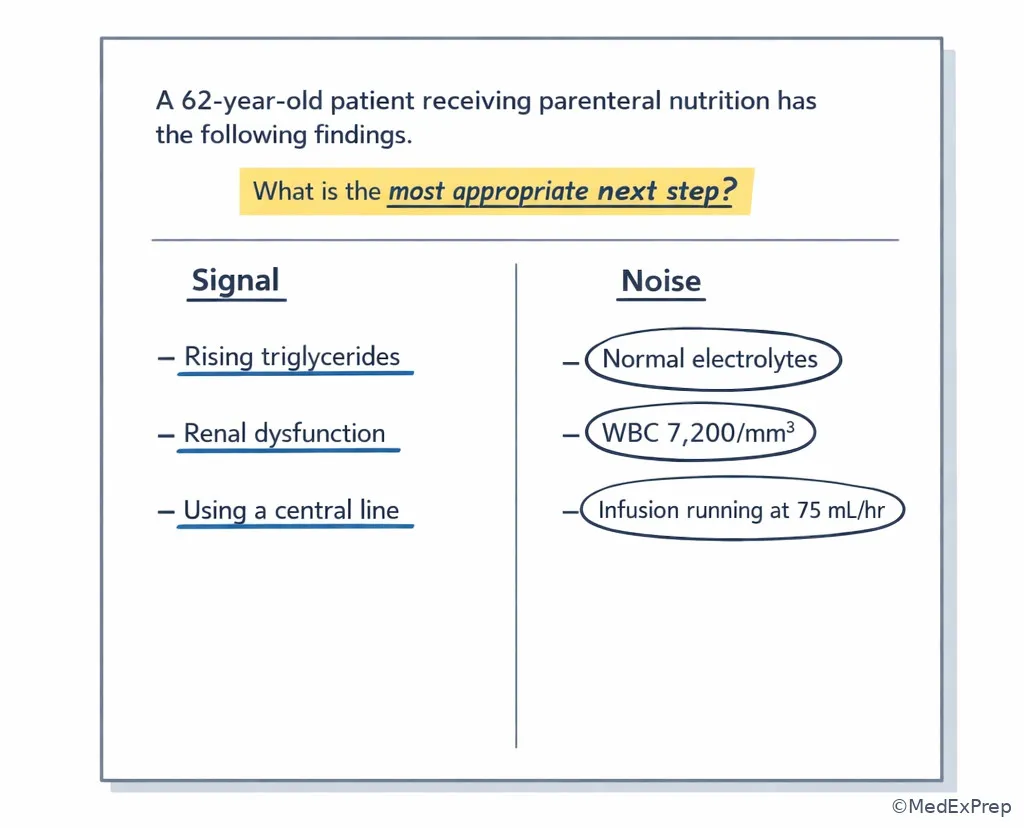
A 67-year-old man with short bowel syndrome, stage 3 CKD, and type 2 diabetes is receiving home PN. The pharmacist reviews a practice exam item asking for the “most appropriate next step” after rising triglycerides, a distracting note about a recent ostomy appliance change, and a central line that has remained functional. A candidate labels this as “lipid facts.” That is too narrow.

Reasoning chain: Identify task → this is a monitoring and adjustment question, not a pure formulation-recall question. Extract key facts → home PN, rising triglycerides, comorbid diabetes and CKD, functioning access, irrelevant ostomy detail. Apply rule → when the stem asks what to do after new data, the subskill is interpreting monitoring trends and deciding continue versus modify versus hold. Eliminate distractors → options about line replacement or ostomy troubleshooting do not answer the tested task. Verify → correct framing improves the odds of choosing the right lipid adjustment or clarification step.

C. Exam trap

Common wrong answer: Studying by product category alone, such as “all about lipids” or “all about tube feeds.” WHY IT IS TEMPTING: Topic labels feel concrete and easier to outline. The SINGLE CLUE that eliminates it: BCNSP stems often ask for a pharmacist action after a patient-specific change; if the action changes with the scenario, the real unit of study is the subskill, not the product name.

D. Checkpoint

Question: A practice stem presents a patient on EN with new abdominal distention, stable sodium, one distracting medication timing issue, and asks for the most appropriate pharmacist recommendation. Which blueprint bucket best captures the primary skill tested?

  1. A. Assessment
  2. B. Implementation
  3. C. Monitoring
  4. D. Operations

Answer: C. Monitoring.

  • A is tempting because symptom recognition starts with patient data, but wrong because the key action is responding to a change after therapy has started.
  • B is tempting because EN administration details may be involved, but wrong because the stem centers on interpreting tolerance and next-step modification.
  • C is right because new distention during ongoing EN most directly tests tolerance monitoring and adjustment logic.
  • D is tempting if medication timing or workflow details appear in the stem, but wrong because those are noise unless the question asks about release, documentation, or process safety.
If you missed this: Review 1.1.2.1 Foundational domain map: what the blueprint is really testing — focus on translating stem wording into the AIMO bucket before solving details.
Pharmacist Action: NOTICE: broad topic labels that hide a practical next-step decision. SAY: “This item is primarily testing assessment/implementation/monitoring/operations.” MONITOR: your missed-question log by bucket weekly. HOLD/CLARIFY/ESCALATE: if you cannot classify a question, pause content drilling and clarify the tested task first.

1.1.2.2 Derived subskills: how to turn broad domains into teachable units

A. Explanation

The second conflict is choosing between official wording and usable study detail. You must respect official blueprint language, but broad wording alone is not enough to study from. The resolving rule is: derive subskills without inventing unofficial weighting or secret categories. For example, “professional practice” can be translated into guideline use, documentation, communication, order clarification, release decisions, sterility-awareness, and standards-aware judgment. These are legitimate derived subskills because they reflect pharmacist tasks already named in the role and practice scope.

WHY THIS IS TESTED: The exam rewards safe, operationally specific reasoning. Candidates who refuse to derive subskills under-study practical judgment. Candidates who over-derive into made-up precision study the wrong things.

Concept flow: Safe subskill derivation
Start with published wording
Do not replace the blueprint with your own system.

Ask what pharmacist tasks live inside it
List decisions the pharmacist can safely perform.

Build study units
Use compact subskills with examples and traps.

Audit for overreach
Remove physician-only or unpublished claims.

See Fig 2 and the comparison tables below to keep subskills anchored to scope rather than speculation.

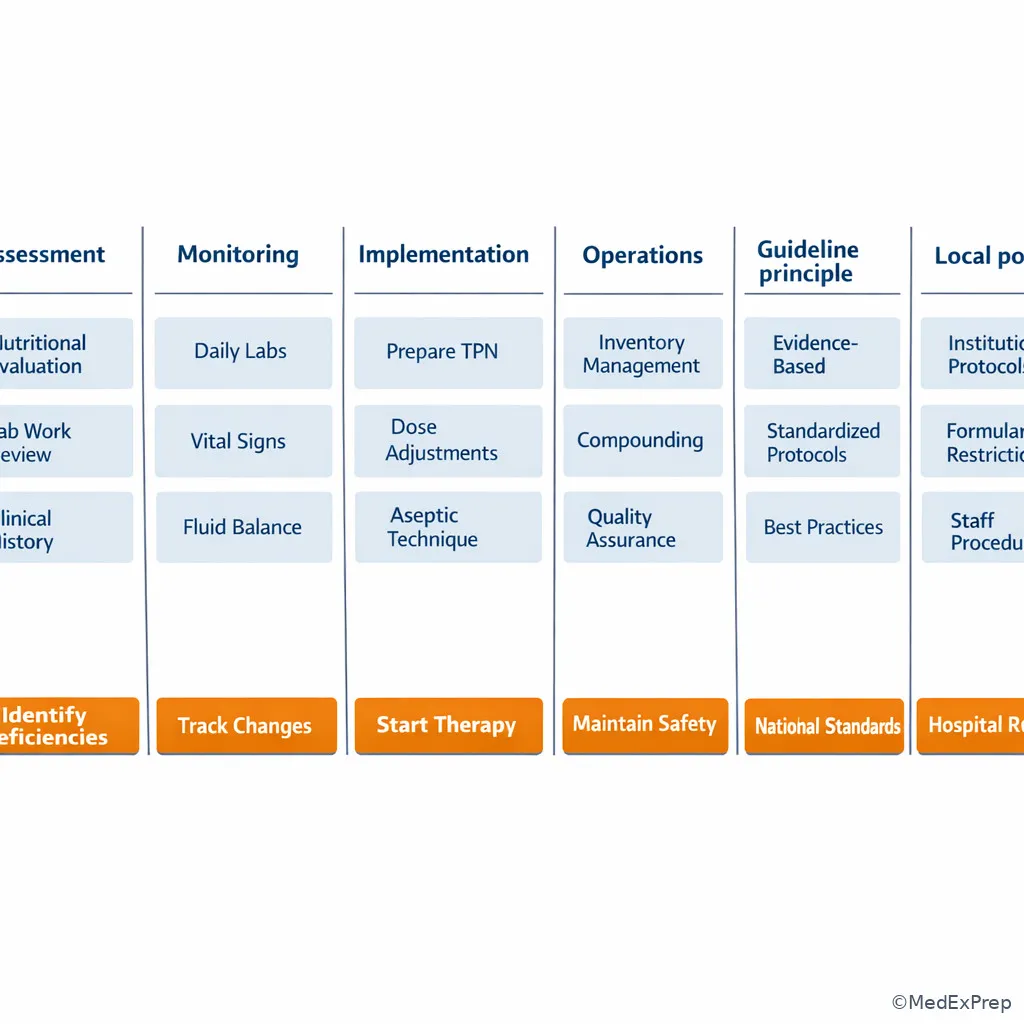
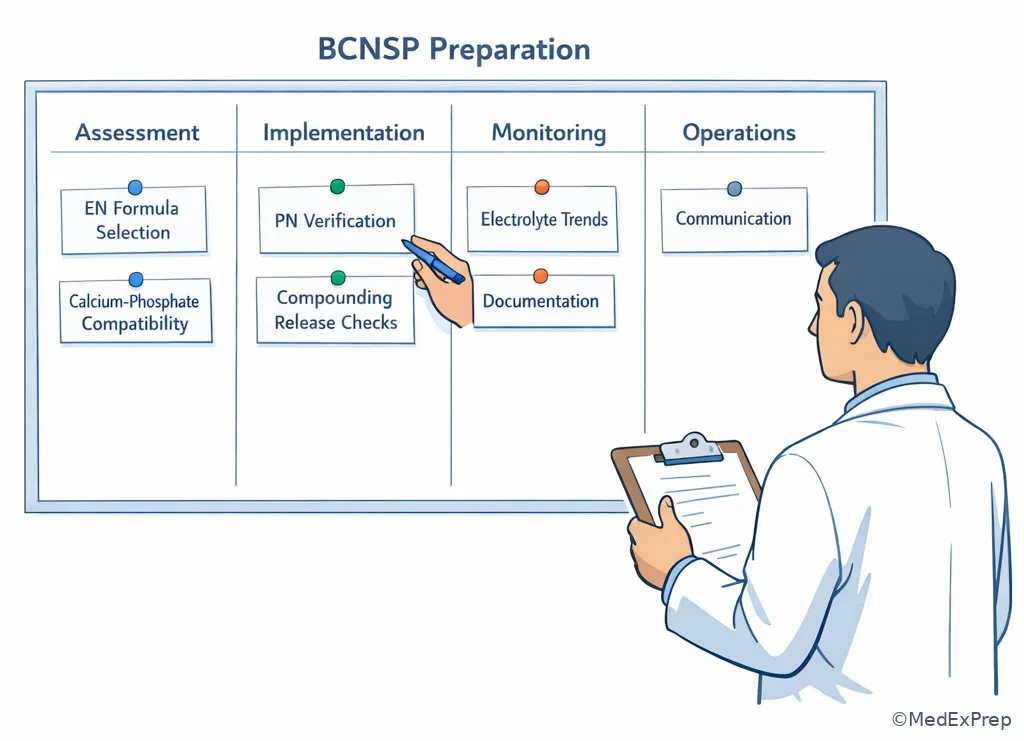
Fig 3. Study blueprint wall with pharmacist task cards
Exam takeaway: A visible map of domains to pharmacist actions makes coverage gaps easier to spot than a linear note set.
Fig 3. Study blueprint wall with pharmacist task cards

B. Worked example

A 54-year-old woman with Crohn disease, recurrent line infections in the past, and chronic hypomagnesemia is discussed in a study session. The practice item references “professional practice and guidelines” and asks what the pharmacist should do when a PN order contains a nonstandard abbreviation and unclear lipid frequency. A tempting but wrong study move is to file this under “fat emulsions only.”

Reasoning chain: Identify task → professional practice subskill. Extract key facts → unclear order, documentation issue, lipid frequency ambiguity, history details that add realism but do not change the core task. Apply rule → broad professional-practice wording should be translated into order clarity, communication, documentation, and safe release decisions. Eliminate distractors → micronutrient memorization and line-infection management are not the primary tested action. Verify → the correct preparation focus is hold/clarify/document, not nutrient-content recall.

C. Exam trap

Common wrong answer: Deriving subskills that depend on local custom only. WHY IT IS TEMPTING: Real practice is full of site-specific workflows, so learners overfit to their institution. The SINGLE CLUE that eliminates it: if a rule changes mainly by hospital policy and is not stated in the stem, study the broadly applicable pharmacist principle and note that local protocols vary.

D. Checkpoint

Question: Which is the best example of an acceptable derived subskill from broad BCNSP blueprint language?

  1. A. Predict the exact unpublished percentage of sterile compounding items on the exam
  2. B. Translate “professional practice” into order clarification, documentation, and standards-aware product release decisions
  3. C. Replace blueprint domains with your own disease-state chapters only
  4. D. Study only the tasks used in your own hospital’s PN software workflow

Answer: B.

  • A is tempting because weighting feels strategic, but wrong because unofficial percentages are not a safe study framework.
  • B is right because it translates broad wording into pharmacist-scope actions without inventing secret blueprint detail.
  • C is tempting because disease-state organization feels familiar, but wrong because it can hide workflow and monitoring skills.
  • D is tempting because local practice experience feels high-yield, but wrong because the exam tests transferable principles, not site-specific software habits.
If you missed this: Review 1.1.2.2 Derived subskills: how to turn broad domains into teachable units — focus on deriving pharmacist-scope study units without inventing unofficial weighting or local-only rules.
Quick Recall:

  • Fill in the blank: Broad domain → specific pharmacist ______. action
  • True or False: Local workflow details should replace general standards when the stem is silent. False
  • Name the four AIMO buckets. Assessment, Implementation, Monitoring, Operations
Pharmacist Action: NOTICE: broad domain labels that are too vague to study directly. SAY: “I’m converting this into pharmacist tasks: verify, clarify, document, monitor, and communicate.” MONITOR: whether each study note is tagged to a domain and subskill. HOLD/CLARIFY/ESCALATE: if a study source claims exact blueprint weights without official publication, do not rely on it.

1.1.2.3 Balanced study planning: prevent omissions across assessment, implementation, monitoring, and operations

A. Explanation

The next conflict is between studying what feels hard and studying what is broad enough to be safe. Many BCNSP candidates spend disproportionate time on calculations or PN formulation because these feel tangible. The rule that resolves this: balance study time across the full pharmacist workflow. Assessment asks whether nutrition support is appropriate and what the patient-specific constraints are. Implementation asks how to design, verify, compound, label, and administer safely. Monitoring asks whether therapy should continue, hold, advance, reduce, or be clarified. Operations asks whether the process itself meets safety and standards expectations.

WHY THIS IS TESTED: The exam is not only a nutrient-memory test; it measures practice judgment across the life cycle of nutrition support.

Concept flow: Balanced study allocation
Inventory topics
List all planned chapters and question sources.

Tag each item
Assign A, I, M, or O to every lesson and miss.

Find undercovered buckets
Look for low-volume or low-confidence areas.

Rebalance the plan
Add targeted drills instead of repeating favorites.

High-Yield Connection: This concept is tested alongside Exam Reasoning Framework and Integrated Case Decision Sets. Know both the domain bucket and the stepwise solve sequence; they are frequently paired in stems.
Fig 4. Balanced study plan decision tree
Exam takeaway: If one bucket dominates your prep, rebalance before adding more detail to your strongest area.
flowchart TD
A[Study plan] --> B{All AIMO buckets covered?}
B -- No --> C[Add missing bucket sessions]
B -- Yes --> D{Weakest bucket identified?}
D -- No --> E[Audit question misses]
D -- Yes --> F[Schedule targeted review]
F --> G[Re-test with mixed cases]

See Fig 4 when planning weekly review blocks.

B. Worked example

A 42-year-old pharmacist candidate working in home infusion reviews his last 60 missed questions. He is strong in PN osmolarity and dextrose calculations, but repeatedly misses items on EN interruption handling, discharge handoffs, and unclear order communication. He also notes mild anxiety about not “doing enough math,” plus a distracting tendency to redo favorite practice sets.

Reasoning chain: Identify task → build a study plan, not solve a clinical case. Extract key facts → strengths are implementation calculations; misses cluster in monitoring and operations. Apply rule → rebalance toward undercovered AIMO buckets rather than adding more of the same. Eliminate distractors → studying only calculations, or only refeeding syndrome, does not address the actual pattern. Verify → a stronger plan allocates time to transition-of-care documentation, order clarification, EN troubleshooting, and mixed-case decision-making.

C. Exam trap

Common wrong answer: “I’ll master calculations first, then circle back to everything else.” WHY IT IS TEMPTING: calculations give a visible sense of progress. The SINGLE CLUE that eliminates it: if your misses cluster in decisions like clarify, monitor, release, or document, more calculations will not fix the tested weakness.

D. Checkpoint

Question: A candidate’s self-audit shows excellent performance on nutrient dosing but repeated misses on line-related workflow, labeling, and communication. What is the most appropriate study adjustment?

  1. A. Continue current plan because calculations are the hardest content
  2. B. Shift targeted review toward operations and professional-practice subskills
  3. C. Stop studying EN and focus only on PN since it is more complex
  4. D. Memorize additional disease-state summaries without tagging misses to domains

Answer: B.

  • A is tempting because difficult content feels higher yield, but wrong because the miss pattern identifies the real gap.
  • B is right because a blueprint-safe plan corrects the undercovered bucket rather than polishing strengths.
  • C is tempting if PN feels central to BCNSP, but wrong because the exam spans EN, monitoring, and operations too.
  • D is tempting because more notes feel productive, but wrong because untagged review does not fix omission patterns.
If you missed this: Review 1.1.2.3 Balanced study planning: prevent omissions across assessment, implementation, monitoring, and operations — focus on rebalancing study time based on miss clusters, not perceived difficulty alone.
Pharmacist Action: NOTICE: repeated misses in the same workflow stage. SAY: “My weakest bucket is monitoring/operations, not calculations.” MONITOR: miss frequency by AIMO bucket every 20–30 questions. HOLD/CLARIFY/ESCALATE: if one bucket remains neglected for two review cycles, pause new content and remediate it directly.

1.1.2.4 Reading stems through the blueprint lens: identify the real tested task

A. Explanation

Now move from study planning to live question interpretation. The conflict is usually between the surface topic and the true task. A stem may mention PN, magnesium sulfate, EN tube position, or a guideline, but the tested action may be clarification, safety screening, monitoring, or dose verification. The rule that resolves this: read the question verb first. “Most appropriate next step,” “most important to monitor,” “requires immediate clarification,” and “best interpretation” signal different subskills even when the product is the same.

WHY THIS IS TESTED: BCNSP items often contain realistic noise—comorbidities, access details, labs, policy hints, or medication timing—that can distract from the actual pharmacist decision.

Concept flow: Stem decoding sequence
Read the ask first
Find the verb: choose, verify, monitor, clarify, hold.

Tag the AIMO bucket
Decide what category of action is being tested.

Extract only decisive facts
Ignore realistic noise unless it changes the action.

Apply rule and verify
Choose the option that matches the tested task.

Fig 5. Annotated exam stem with noise versus signal
Exam takeaway: Circle the action verb and the single discriminating clue before evaluating answer choices.
Fig 5. Annotated exam stem with noise versus signal

See Fig 5 for a visual stem-marking routine. This directly prepares you for the upcoming Exam Reasoning Framework topic.

B. Worked example

A 73-year-old man with heart failure, chronic kidney disease, and recent ileus resolution has an order for enteral nutrition at 25 mL/hour, advancing every 8 hours. A practice stem includes a medication context: metoclopramide 10 mg IV every 6 hours, insulin glargine 18 units subcutaneously nightly, and enoxaparin 40 mg subcutaneously daily. It notes mild edema and one distracting low-normal phosphorus value from two days ago. The question asks which order element “requires immediate clarification.”

Reasoning chain: Identify task → operations/professional-practice safety check. Extract key facts → the ask is clarification, not tolerance monitoring. Apply rule → focus on order completeness, route appropriateness, rate, access context, and safety mismatch. Eliminate distractors → edema and the old phosphorus value may matter clinically, but if they do not create the immediate order discrepancy, they are secondary. Verify → the correct answer will be the order element that cannot be safely released or acted on as written.

C. Exam trap

Common wrong answer: Choosing the most clinically interesting abnormality. WHY IT IS TEMPTING: dramatic labs or comorbidities attract attention. The SINGLE CLUE that eliminates it: when the stem asks what requires clarification, the winning option is the unsafe or incomplete order detail, even if another finding is medically important.

D. Checkpoint

Question: Which stem feature most reliably identifies that a question is testing an operations/professional-practice subskill rather than therapeutic monitoring?

  1. A. The patient has multiple comorbidities
  2. B. The stem contains one abnormal laboratory value
  3. C. The question asks what requires immediate clarification before verification or release
  4. D. The product discussed is PN rather than EN

Answer: C.

  • A is tempting because complex patients feel operationally risky, but wrong because comorbidity count does not define the tested skill.
  • B is tempting because labs often drive monitoring, but wrong because a single abnormal value can appear in many buckets.
  • C is right because clarification before verification or release is classic operations/professional-practice language.
  • D is tempting because PN often carries more workflow detail, but wrong because both EN and PN can be tested under any AIMO bucket.
If you missed this: Review 1.1.2.4 Reading stems through the blueprint lens: identify the real tested task — focus on using the question verb to classify the item before processing all details.
Quick Recall:

  • True or False: The product named in the stem always reveals the blueprint bucket. False
  • Fill in the blank: Read the question ______ first. verb/ask
  • Name one clue that signals operations. Requires clarification before verification/release
Pharmacist Action: NOTICE: verbs such as verify, clarify, hold, monitor, and adjust. SAY: “This asks for a release decision, not a disease explanation.” MONITOR: whether you can classify the stem within 10–15 seconds. HOLD/CLARIFY/ESCALATE: if you keep chasing noise, stop and restate the question in one line before choosing.

1.1.2.5 Using misses and near-misses to build a blueprint-driven remediation plan

A. Explanation

The final integration conflict is between reviewing by question source order and reviewing by missed-skill pattern. The better rule is: every miss should be tagged to both content and subskill. A wrong answer on calcium-phosphate compatibility might reflect content knowledge, but it might also reflect a monitoring-versus-verification mix-up or a failure to identify the real task. Near-misses matter too. If you guessed correctly for the wrong reason, that is still a weakness.

WHY THIS IS TESTED: BCNSP readiness depends on reliable judgment, not lucky recognition. Pattern-based remediation is how you prevent repeat misses across different clinical wrappers.

Concept flow: Remediation from a missed question
Log the miss
Capture stem clue, chosen option, and correct rule.

Tag content and bucket
What topic? Which AIMO category?

Find the discriminator
What one clue should have changed your answer?

Assign targeted remediation
Review the exact section and re-test with similar cases.

High-Yield Connection: This concept overlaps with Units Concentrations And Conversions and Rate Osmolarity And Load Checks. On exam day, calculation misses are often really unit-recognition or verification-subskill misses; know both the arithmetic and the workflow context.
Fig 6. Miss log dashboard for blueprint remediation
Exam takeaway: Tag every miss by content, bucket, and discriminating clue so remediation targets the true weakness.
Fig 6. Miss log dashboard for blueprint remediation

See Fig 6 for the structure of a high-yield miss log.

B. Worked example

A candidate misses a practice item about a PN order containing potassium phosphate, calcium gluconate, and a high final amino acid concentration. The patient is a 58-year-old woman with pancreatitis, obesity, hypertriglyceridemia, and improving renal function. A distracting note mentions that the team is eager for discharge. The candidate blames “not memorizing enough compatibility facts.”

Reasoning chain: Identify task → likely implementation/verification. Extract key facts → the question centers on whether the formulation is safe to verify, not on discharge planning. Apply rule → tag the miss to both content (calcium-phosphate compatibility) and subskill (final verification decision). Eliminate distractors → if the error came from ignoring the release question and chasing discharge urgency, the weakness is partly task recognition. Verify → remediation should include both compatibility review and verification-oriented question drills.

C. Exam trap

Common wrong answer: Logging misses only by topic name. WHY IT IS TEMPTING: topic-only spreadsheets are simple to maintain. The SINGLE CLUE that eliminates it: if the same topic is missed under different actions—calculate, verify, monitor, clarify—you need subskill tags or the true pattern stays hidden.

D. Checkpoint

Question: Which miss-log entry is most useful for BCNSP remediation?

  1. A. “Wrong: electrolytes”
  2. B. “Wrong because I was tired”
  3. C. “PN electrolytes; implementation/verification; missed calcium-phosphate release risk; discriminator was incompatible formulation concern”
  4. D. “Need more practice questions”

Answer: C.

  • A is tempting because it names the broad content, but wrong because it misses the tested action and discriminator.
  • B is tempting because fatigue can matter, but wrong because it does not guide targeted remediation.
  • C is right because it captures content, blueprint bucket, and the single clue that should have changed the answer.
  • D is tempting because volume can help, but wrong because untargeted repetition often repeats the same error.
If you missed this: Review 1.1.2.5 Using misses and near-misses to build a blueprint-driven remediation plan — focus on tagging every error with content, AIMO bucket, and single discriminator.
Pharmacist Action: NOTICE: whether your explanation for a miss is vague or specific. SAY: “I missed a verification item because I ignored the release-risk clue.” MONITOR: re-test performance on the same subskill within one week. HOLD/CLARIFY/ESCALATE: if a weakness persists across multiple topics, treat it as a strategy problem, not a single-content problem.

Exam Traps & Differentiators

Most common wrong answer and why: The most common mistake in this topic is building a study plan around familiar product categories while ignoring the workflow stage being tested. This is tempting because product labels are concrete. It fails because BCNSP questions often hinge on whether the pharmacist must assess, verify, monitor, document, clarify, or escalate.

Looks similar But is actually Discriminator
Assessment vs Monitoring Pre-therapy data gathering vs response to therapy already underway Has treatment started, and is the question about change over time?
Implementation vs Operations Clinical formulation/verification vs workflow/documentation/release process Does the stem ask whether the order/product can be safely processed?
Topic miss vs Strategy miss Knowledge deficit vs misidentified question task Could you explain the governing action before solving?
Guideline-based principle vs local policy detail Portable exam logic vs institution-specific rule Would the answer still hold if the hospital changed software or workflow?
Official domain vs invented weighting Published structure vs unsupported precision Is the claim officially published and relevant to safe preparation?

If the stem says… think…

  • “Most appropriate next step” → likely monitoring, verification, or workflow action; classify before solving.
  • “Requires immediate clarification” → operations/professional-practice release safety.
  • “Most important to monitor” → trend-based bucket, not static knowledge alone.
  • “Best interpretation” → assessment or monitoring, depending on whether therapy has started.
  • “According to guidelines/standards” → portable principle first; avoid local-only assumptions.
Decision trigger map
Exam takeaway: The question verb often predicts the domain bucket more reliably than the product named in the stem.
flowchart LR
A[Question verb] --> B{Verb type}
B -->|interpret| C[Assessment or monitoring]
B -->|verify| D[Implementation]
B -->|clarify release| E[Operations]
B -->|adjust continue hold| F[Monitoring]
Blueprint confusion pairs board
Exam takeaway: Side-by-side confusable pairs help you separate similar tasks that use the same patient data differently.
Blueprint confusion pairs board

Related trap from the prior topic Pharmacist Scope Boundaries: learners sometimes choose physician-level actions because the clinical picture is vivid. In this lesson, the confusable pair is different: even within pharmacist scope, you still must identify the correct bucket—assessment, implementation, monitoring, or operations.

Review connection: The traps above test blueprint translation and task recognition. If any felt unfamiliar, revisit 1.1.2.4 Reading stems through the blueprint lens: identify the real tested task before attempting the Self-check quiz.

Tables

AIMO bucket Typical stem asks Examples in BCNSP scope Common learner error
Assessment Most appropriate nutrition support approach; best interpretation of data Indication, access constraints, malnutrition context, baseline labs Jumping to a product before deciding whether it fits the patient
Implementation Best regimen, safest verification, most appropriate formulation detail PN macronutrients, EN product choice, osmolarity checks, additive selection Confusing initiation design with later monitoring changes
Monitoring Best next adjustment; most important parameter to track Glucose, triglycerides, electrolytes, GI tolerance, intake adequacy Focusing on baseline facts instead of trends
Operations Requires clarification; safe release; documentation priority Labeling, BUD awareness, compounding workflow, communication, handoffs Treating operational items as low yield
Broad blueprint phrase Derived subskills Good study artifact
Enteral nutrition therapy Formula selection, route, administration method, intolerance troubleshooting, interruptions Comparison chart + troubleshooting algorithm
Parenteral nutrition design Dosing, access, electrolyte salts, osmolarity, compatibility, verification Calculation sheet + verification checklist
Monitoring and adjustments Trend interpretation, advance/hold logic, metabolic complication response Lab-to-action table
Professional practice Clarification, documentation, communication, standards-aware release decisions Workflow trigger table
Calculations and data Units, conversions, rates, concentrations, reasonableness checks Formula table + worked examples
Differential problem Wrong frame Right frame Single clue
Question mentions PN electrolytes “This is just memorization” May be calculation, verification, or monitoring Read the ask: dose, safety release, or trend?
Question mentions EN intolerance “This is formula selection only” Often monitoring/troubleshooting Symptoms developed after initiation
Question mentions guidelines “Need site policy details” Use broad standards-based principle Stem does not specify local policy
Misses cluster in one topic “Need more facts from same chapter” May be same subskill across multiple topics Same task verb appears repeatedly
Complex patient with many details “Every detail matters equally” Signal-versus-noise filtering One clue resolves the choice

Algorithm / Approach

Concept flow: Blueprint-first question approach
Identify the ask
Read the final sentence first and isolate the action verb.

Assign AIMO bucket
Assessment, Implementation, Monitoring, or Operations?

Extract decisive facts
Keep only details that change the pharmacist action.

Apply the governing rule
Use the subskill rule: calculate, clarify, verify, monitor, or escalate.

Verify the fit
Confirm the answer matches both scope and stem wording.

Pharmacist workflow compass
Exam takeaway: A fixed sequence of ask → bucket → clue → rule → verify reduces errors caused by realistic noise.
Pharmacist workflow compass

Rapid Review

  • Blueprint domain → study the action inside it, not the title alone
  • Assessment → pre-therapy appropriateness and constraint recognition
  • Implementation → regimen design or verification before release
  • Monitoring → trend plus next-step modification
  • Operations → process safety, documentation, labeling, communication
  • “Requires clarification” → think release safety, not broad disease review
  • Guideline wording → portable standard first, local policy second
  • Miss log → tag by topic, bucket, and discriminator
  • Near-miss → still remediate if reasoning was wrong
  • Complex stem → action verb outranks interesting noise
  • Balanced prep → weakness is often omitted bucket, not hardest chapter
  • Derived subskill → acceptable if it reflects pharmacist-scope tasks
  • Unofficial weighting → poor foundation for planning
  • Upcoming conversions topic → many “calculation misses” are actually unit-and-verification misses
Memory anchor: For question solving, use ABCV: Ask, Bucket, Clue, Verify. For study planning, use AIMO.

Self-check quiz

1. A pharmacist reviews a BCNSP study outline and sees repeated entries on patient-specific indication, access limitations, and baseline labs before EN or PN initiation. Which blueprint bucket best fits those tasks?

  1. A. Assessment
  2. B. Implementation
  3. C. Monitoring
  4. D. Operations

2. During review of a mixed question set, a pharmacist notices items that ask what “requires immediate clarification” before a PN order can be verified and released. Which bucket is most directly being tested?

  1. A. Assessment
  2. B. Implementation
  3. C. Monitoring
  4. D. Operations

3. A 63-year-old woman with short bowel syndrome, type 2 diabetes, and stage 3 CKD receives home PN with dextrose 250 g, amino acids 90 g, and SMOF lipid 40 g IV daily. Her triglycerides have risen over two weeks; the stem also notes a recent change in home nursing agency and stable catheter function. Which is the most appropriate first study classification for this item before choosing an answer?

  1. A. Assessment, because comorbidities determine baseline appropriateness
  2. B. Implementation, because PN ingredients are listed
  3. C. Monitoring, because new trend data drive a next-step decision
  4. D. Operations, because home care workflow is mentioned

4. A 71-year-old man with heart failure and chronic kidney disease has an EN order for a concentrated formula at 20 mL/hour via feeding tube, advancing every 12 hours. Medication context includes insulin glargine 16 units subcutaneously nightly and metoclopramide 5 mg IV every 6 hours. The question asks which order element “requires immediate clarification” before processing. Which approach is best?

  1. A. Treat it primarily as a monitoring question because insulin is listed
  2. B. Treat it primarily as an operations/professional-practice question because clarification before processing is the task
  3. C. Treat it primarily as an assessment question because heart failure affects fluid status
  4. D. Treat it primarily as a calculation question because a rate is included

5. A pharmacist candidate has excellent scores on PN osmolarity calculations but repeated misses on discharge handoffs, ambiguous abbreviations, and documentation of changes to EN regimens. Which study-plan revision is most appropriate?

  1. A. Add more osmolarity sets because they are mathematically demanding
  2. B. Shift scheduled review toward operations and professional-practice subskills
  3. C. Stop mixed practice and memorize micronutrient doses instead
  4. D. Focus only on central-versus-peripheral PN access rules

6. A 58-year-old man with pancreatitis, obesity, and improving AKI is started on PN containing amino acids 120 g, dextrose 220 g, calcium gluconate 12 mEq, and potassium phosphate 30 mmol IV daily. The team wants discharge planning started, and the stem also notes insulin regular 8 units added to the PN bag. The question asks for the “most appropriate pharmacist action before product release.” Which blueprint framing best fits?

  1. A. Assessment, because obesity affects protein targets
  2. B. Implementation/verification, because the pharmacist must judge formulation safety before release
  3. C. Monitoring, because insulin in PN requires glucose follow-up
  4. D. Operations only, because discharge planning is mentioned

7. A 66-year-old woman with metastatic cancer, ascites, and severe malnutrition has a practice stem describing EN intolerance after advancement from 15 to 45 mL/hour. Medication context includes ondansetron 4 mg IV every 8 hours and furosemide 40 mg IV daily. There is a distracting note about a pending palliative care meeting. The final sentence asks for the “most important parameter to trend over the next 24 hours” after an adjustment. Which bucket should guide answer selection?

  1. A. Assessment
  2. B. Implementation
  3. C. Monitoring
  4. D. Operations

8. A pharmacist logs 40 missed questions involving EN, PN, fluids, and documentation. Most entries say only “electrolytes” or “wrong calculation.” Review shows many stems actually asked for clarification before verification, while others asked for best monitoring after therapy changes. Which remediation method is most appropriate?

  1. A. Keep a content-only list because topic names are enough
  2. B. Rework only the questions answered incorrectly, without tagging why
  3. C. Rebuild the miss log to include topic, AIMO bucket, and single discriminator
  4. D. Abandon the log and restart with random mixed questions

Answer key

1. Answer: A

A. Assessment is tempting because the stem emphasizes baseline indication, access, and initial labs, and it is correct because those are classic pre-implementation patient-specific appropriateness tasks. The single discriminating clue is that therapy has not yet been framed as ongoing with trend-based changes. This bucket is consistent with the pharmacist’s role in evaluating appropriateness before implementation. Sources: ASPEN practice frameworks; DiPiro.

B. Implementation is tempting because EN/PN initiation often follows assessment, but it is incorrect here because the stem focuses on deciding whether and how the patient qualifies before designing or verifying the regimen. The single clue is “baseline labs before initiation.” Sources: ASPEN; DiPiro.

C. Monitoring is tempting because labs are present, but it is incorrect because there is no trend after therapy initiation. The single clue is absence of post-start changes. Sources: ASPEN monitoring guidance.

D. Operations is tempting if one associates access and workflow with process steps, but it is incorrect because the stem does not ask about release, documentation, or clarification. The single clue is the patient-specific appropriateness focus. Sources: ASPEN; ASHP.

If you missed this: Review 1.1.2.1 Foundational domain map: what the blueprint is really testing — focus on distinguishing baseline appropriateness from post-initiation monitoring.

2. Answer: D

A. Assessment is tempting because clarifying an order can feel like gathering information, but it is incorrect because the stem centers on whether the order can be processed and released safely. The discriminating clue is “before verified and released.” Sources: ASHP and USP-aware workflow principles.

B. Implementation is tempting because PN verification sits close to regimen design, but it is incorrect when the question specifically targets immediate clarification and release readiness. The single clue is the process barrier rather than nutrient design alone. Sources: ASHP; ASPEN.

C. Monitoring is tempting if one thinks about follow-up after release, but it is incorrect because the item has not progressed to post-initiation response. The discriminating clue is timing: pre-release. Sources: ASPEN.

D. Operations is correct because ambiguous or incomplete orders requiring clarification before release fall squarely into workflow safety, communication, and professional practice. The single clue is “immediate clarification before verification and release.” Sources: ASHP Guidelines; USP principles; DiPiro.

If you missed this: Review 1.1.2.4 Reading stems through the blueprint lens: identify the real tested task — focus on how “requires immediate clarification” signals an operations/professional-practice item.

3. Answer: C

A. Assessment is tempting because CKD and diabetes affect PN appropriateness, but it is incorrect here because the stem gives ongoing therapy and a new triglyceride trend. The single clue is “risen over two weeks.” Sources: ASPEN monitoring recommendations; DiPiro.

B. Implementation is tempting because the PN formula is listed in full, but it is incorrect because ingredient listing is stem context, not necessarily the tested task. The single clue is that trend data drive a next-step question. Sources: ASPEN.

C. Monitoring is correct because new triglyceride data after PN initiation require interpretation and likely regimen modification or clarification. The home nursing agency change is a workflow distractor. The single clue is serial worsening during active therapy. Sources: ASPEN; AHFS/Clinical Pharmacology for lipid monitoring concepts.

D. Operations is tempting because home infusion logistics matter, but it is incorrect because catheter function is stable and workflow is not the action focus. The discriminating clue is clinically relevant lab trend during ongoing PN. Sources: ASPEN; ASHP.

If you missed this: Review 1.1.2.3 Balanced study planning: prevent omissions across assessment, implementation, monitoring, and operations — focus on recognizing that new post-initiation data usually move the item into monitoring.

4. Answer: B

A. Treat it primarily as monitoring is tempting because insulin and metoclopramide suggest tolerance and glucose follow-up, but it is incorrect because the stem explicitly asks what requires clarification before processing. The single clue is the pre-processing action verb. Sources: ASHP practice standards; DiPiro.

B. Treat it as operations/professional practice is correct because clarification before order processing is a release and workflow safety task, even when clinical details are present. The single clue is “before processing.” Sources: ASHP; ASPEN.

C. Treat it as assessment is tempting because heart failure and CKD influence formula choice, but it is incorrect because the question is not asking whether concentrated EN is appropriate in principle; it is asking about order clarification. The discriminating clue is the operational ask. Sources: ASPEN.

D. Treat it as a calculation question is tempting because rate details appear, but it is incorrect because presence of numbers does not mean the item is primarily arithmetic. The single clue is the clarification verb. Sources: DiPiro; ASPEN.

If you missed this: Review 1.1.2.4 Reading stems through the blueprint lens: identify the real tested task — focus on letting the question verb outrank the product and number details.

5. Answer: B

A. Add more osmolarity sets is tempting because quantitative work feels high yield and objective, but it is incorrect because the miss pattern is in operations and communication. The single clue is repeated errors on handoffs, abbreviations, and documentation. Sources: ASPEN; ASHP.

B. Shift toward operations and professional-practice subskills is correct because the candidate’s current deficit is not nutrient calculation but workflow and standards-based judgment. The single clue is consistent clustering in those subskills. Sources: ASHP guidelines; DiPiro.

C. Memorize micronutrient doses is tempting because it feels like adding more content breadth, but it is incorrect because it does not address the demonstrated weakness. The discriminating clue is mismatch between remediation and miss pattern. Sources: ASPEN.

D. Focus only on central-versus-peripheral PN is tempting because access questions are common, but it is incorrect because the audit did not identify access as the issue. The single clue is handoff/documentation ambiguity, not access selection. Sources: ASPEN.

If you missed this: Review 1.1.2.3 Balanced study planning: prevent omissions across assessment, implementation, monitoring, and operations — focus on matching remediation to the actual bucket of repeated misses.

6. Answer: B

A. Assessment is tempting because obesity and pancreatitis affect protein goals and indication context, but it is incorrect because the question asks for pharmacist action before product release. The single clue is “before product release.” Sources: ASPEN PN guidance; DiPiro.

B. Implementation/verification is correct because the pharmacist must evaluate formulation safety, including additive compatibility and order correctness, before release. The insulin in the bag and discharge pressure are distractors unless they change release safety. The single clue is the pre-release safety judgment. Sources: ASPEN; ASHP; compatibility references such as Clinical Pharmacology/Lexicomp as applicable.

C. Monitoring is tempting because insulin-containing PN does require glucose follow-up, but it is incorrect for this specific ask because monitoring occurs after a safe formulation is verified and dispensed. The single clue is timing relative to release. Sources: ASPEN.

D. Operations only is tempting because discharge planning suggests workflow, but it is incorrect because the key decision is still clinical formulation verification rather than generic discharge process. The single clue is the content of the PN components and release safety. Sources: ASPEN; ASHP.

If you missed this: Review 1.1.2.5 Using misses and near-misses to build a blueprint-driven remediation plan — focus on pairing content topics with the correct action bucket, especially implementation/verification before release.

7. Answer: C

A. Assessment is tempting because advanced cancer and ascites shape goals of care, but it is incorrect because the question asks what to trend after an EN adjustment. The single clue is “over the next 24 hours.” Sources: ASPEN EN monitoring principles.

B. Implementation is tempting because EN advancement rate is part of regimen design, but it is incorrect because the stem moves beyond design into follow-up after a change. The single clue is post-adjustment trending. Sources: ASPEN; DiPiro.

C. Monitoring is correct because the pharmacist must track response after therapy modification in an active EN intolerance scenario. The palliative care meeting is realistic noise unless the ask shifts to goals-of-care alignment. The single clue is trend monitoring after adjustment. Sources: ASPEN.

D. Operations is tempting because pending meetings and care coordination appear, but it is incorrect because the question is not about documentation or handoff. The discriminating clue is the parameter-to-trend language. Sources: ASHP; ASPEN.

If you missed this: Review 1.1.2.4 Reading stems through the blueprint lens: identify the real tested task — focus on recognizing that “what to trend next” is a monitoring signal even when goals-of-care details are present.

8. Answer: C

A. Content-only list is tempting because it is simple and familiar, but it is incorrect because topic names alone do not reveal whether the problem was assessment, verification, monitoring, or operations. The single clue is that the same broad topics contained different task verbs. Sources: educational best practice consistent with blueprint mapping principles; DiPiro/ASHP practice frameworks.

B. Rework only incorrect questions without tagging why is tempting because repetition can improve recognition, but it is incorrect because the learner may repeat the same reasoning error. The single clue is absence of a discriminator field. Sources: exam-prep strategy principles grounded in targeted remediation.

C. Rebuild the miss log with topic, AIMO bucket, and single discriminator is correct because it captures the true pattern behind mixed misses and supports targeted re-testing. The single clue is that some errors were clarification items while others were monitoring items. Sources: blueprint mapping logic in this lesson; ASHP/ASPEN role-consistent decision making.

D. Abandon the log and restart randomly is tempting because fresh questions can feel motivating, but it is incorrect because random volume without structured review rarely fixes hidden strategy errors. The single clue is repeated vague logging, which requires refinement rather than abandonment. Sources: targeted remediation principles.

If you missed this: Review 1.1.2.5 Using misses and near-misses to build a blueprint-driven remediation plan — focus on logging the exact discriminator and AIMO bucket for every miss.

References

  • Mueller, Charles M., et al., editors. The ASPEN Adult Nutrition Support Core Curriculum. 4th ed., American Society for Parenteral and Enteral Nutrition, 2024.
  • Worthington, Patricia, et al. “When Is Parenteral Nutrition Appropriate?” JPEN. Journal of Parenteral and Enteral Nutrition, vol. 41, no. 3, 2017, pp. 324–377.
  • Ayers, Phil, et al., editors. ASPEN Parenteral Nutrition Handbook. 3rd ed., American Society for Parenteral and Enteral Nutrition, 2020.
  • AHFS Drug Information. American Society of Health-System Pharmacists, current edition.
  • DiPiro, Joseph T., et al., editors. Pharmacotherapy: A Pathophysiologic Approach. 12th ed., McGraw-Hill, 2023.
  • American Society of Health-System Pharmacists. Relevant guidelines and statements on pharmacy practice, sterile compounding workflow, and medication-use systems, current versions.

Last reviewed: March 19, 2026

Keep reading, free

Enter your email to read lesson 2 now.

Free. We may also email you about our programs. No spam, and you can ask us to remove your email at any time.

Liked it?

BCNSP Prep Course (BCNSP) has 66 lessons.

PharmExPrep
Programs
For organizations
ContactLog inGet a free guide