






Age Groups And Milestones
What you’ll learn
- D1 Patient-Specific Assessment: Assign the correct developmental age group using gestational age, postnatal age, chronologic age, and corrected age when relevant.
- D1 Patient-Specific Assessment → developmental subskill: Match key gross motor, fine motor, language, cognitive, and social milestones to age bands that are commonly tested.
- D2 Therapeutic Planning: Choose age-appropriate formulations, routes, adherence strategies, and caregiver education based on developmental stage.
- D3 Monitoring/Follow-Up: Recognize milestone delays or age-incongruent findings that should trigger clarification, escalation, or referral.
- D5 Medication-Use Safety/Systems: Anticipate age-specific medication safety hazards such as excipient exposure, swallowing limitations, accidental ingestion, and adolescent confidentiality/adherence barriers.
Blueprint mapping
- D1 Patient-Specific Assessment → developmental stage identification; corrected-age interpretation; age-specific history elements
- D2 Therapeutic Planning → formulation selection; caregiver counseling; age-adjusted medication-use planning
- D3 Monitoring/Follow-Up → milestone surveillance; therapy follow-up expectations by age
- D5 Medication-Use Safety/Systems → medication safety across neonatal, infant, child, and adolescent transitions
Why it matters
- Many pediatric pharmacy questions are not really about the drug first; they are about whether the pharmacist correctly identifies the developmental stage that changes the drug choice, dosage form, monitoring plan, or caregiver instructions.
- A wrong age classification can cascade into multiple errors: incorrect weight expectations, incorrect route or formulation, unrealistic adherence advice, and missed safety counseling.
- Milestones appear in stems as hidden clues. A child who cannot swallow tablets, an infant with poor head control, or an adolescent seeking privacy each points toward different pharmacist actions.
- Developmental stage also predicts risk: neonates are vulnerable to excipients and immature organ function, toddlers to accidental ingestion, school-age children to technique problems, and adolescents to nonadherence and transition-of-care failures.
Key Terms & Must-Know Facts
Key terms
- Preterm neonate: infant born before 37 weeks’ gestation
- Term neonate: birth through 27 days of life
- Infant: 28 days through 12 months
- Toddler: 1 through 3 years
- Preschool child: 3 through 5 years
- School-age child: 6 through 11 years
- Adolescent: 12 through 18 years, sometimes extending to transition age depending on system
- Chronologic age: time since birth
- Gestational age: age in weeks from last menstrual period to birth
- Postnatal age: time elapsed after birth
- Postmenstrual age: gestational age plus postnatal age
- Corrected age: chronologic age adjusted for prematurity
- Developmental milestone: expected skill reached by a typical age range
- Medication readiness: developmental ability to receive, understand, and safely use a medication form or device
Must-know facts
- Use corrected age, not chronologic age alone, for many developmental interpretations in preterm infants.
- Milestones are tested as age bands, not exact birthdays; know the order and approximate timing.
- If the stem involves feeding, swallowing, or device technique, developmental stage often matters more than the diagnosis.
- Loss of a previously attained milestone is more concerning than simple delay.
- Neonates and young infants require special attention to excipients, concentrations, and caregiver measurement technique.
- Toddlers are the peak group for exploratory ingestion and household poisoning risk.
- School-age children may follow simple schedules and device steps, but still need caregiver verification for safety-critical medications.
- Adolescents may understand therapy yet still fail due to privacy concerns, stigma, body-image issues, or transition barriers.
Exam takeaway: Start every stem by placing the patient in the correct age band before choosing formulation, counseling, or monitoring.
flowchart TD
A[Patient age given in stem] --> B{Born preterm and still early infancy?}
B -->|Yes| C[Check gestational age, postnatal age, corrected age]
B -->|No| D[Use chronologic age]
C --> E[Assign developmental expectations carefully]
D --> F{Age band}
F --> G[Neonate]
F --> H[Infant]
F --> I[Toddler or preschool]
F --> J[School-age]
F --> K[Adolescent]
G --> L[Immature handling and formulation limits]
H --> M[Rapid milestone change and caregiver dependence]
I --> N[Accidental ingestion and refusal issues]
J --> O[Technique training and routine building]
K --> P[Adherence, autonomy, confidentiality]
Exam takeaway: Use the visual age progression to connect milestone expectations to pharmacist counseling and dosage-form decisions.
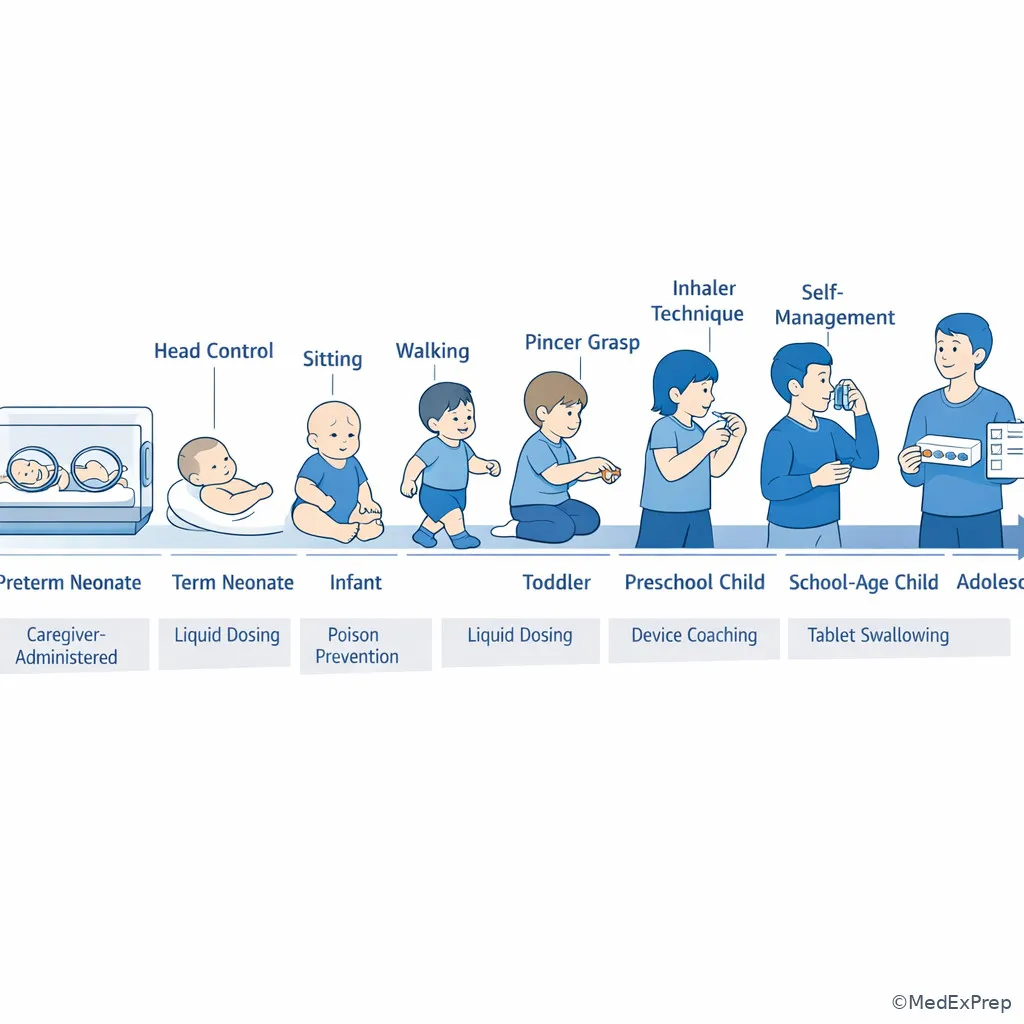
Core content
1.1.1.1 Foundational age groups: classify the child before you choose the drug-use plan
A. Explanation
The first decision conflict in pediatric pharmacy is simple but high-yield: Do you treat this patient as a neonate, infant, child, or adolescent for medication-use purposes? The single rule that resolves the conflict is to identify which age framework the question is asking for. If the stem is about organ maturation or prematurity, corrected-age thinking may matter. If the stem is about school performance, inhaler technique, confidentiality, or adherence, chronologic developmental stage usually drives the answer. WHY THIS IS TESTED: exam items often hide the true task inside age-specific interpretation rather than pharmacology alone.
For BCPPS-style reasoning, begin every stem with a short age-label statement in your mind: “This is a 10-day-old term neonate,” “This is a 7-month-old infant,” or “This is a 15-year-old adolescent.” That mental anchor changes what is plausible. A term neonate likely cannot safely receive many excipient-heavy preparations and depends entirely on caregiver administration. A toddler may resist medication, spit out liquids, and access unsecured bottles. A school-age child can often learn device steps. An adolescent may need private counseling about adherence, reproductive issues, substance use, and transition readiness.
Choose corrected age when prematurity is the key discriminator in early development. Reject chronologic age alone if a former 28-week preterm infant is only a few months postnatal age and the question asks about developmental readiness. Choose chronologic age when the issue is legal consent structure, school attendance, or adolescent-style self-management capacity.
Key rule: In young former preterm infants, if the stem asks whether a milestone is expected, first calculate whether corrected age changes the developmental interpretation.
See Fig 1 for a fast framework you can apply before reading the options.
B. Worked example
A pharmacist reviews a discharge order for ferrous sulfate oral drops 15 mg elemental iron by mouth once daily for a former 30-week gestation infant who is now 14 weeks old chronologically and weighs 4.3 kg. The infant also has mild bronchopulmonary dysplasia and reflux. The caregiver asks whether it is concerning that the infant is not yet rolling. The chart notes occasional spit-up, and a family member mentions that a cousin “walked early,” making delay sound more worrisome.
Identify task: This is not primarily an iron-dosing question; it is a developmental-age interpretation question. Extract key facts: Former 30-week preterm infant, now 14 weeks chronologic age. Apply rule: Corrected age is about 4 weeks, so lack of rolling is not the useful milestone expectation here. Eliminate distractors: Reject answers that interpret development by chronologic age alone. Reject caregiver comparison to a cousin because milestone timing varies. Verify: The safest pharmacist response is to reassure that corrected-age expectations should be used for milestone interpretation in early infancy while reinforcing follow-up with routine pediatric developmental surveillance.
C. Exam trap
Common wrong answer: Use chronologic age alone to judge developmental readiness in a former preterm infant.
Why it is tempting: The stem gives an age in months, and learners reflexively match that number to a memorized milestone table.
Single clue that eliminates it: The stem explicitly includes prematurity data such as 28, 30, or 32 weeks’ gestation.
D. Checkpoint
A pharmacist is verifying acetaminophen 40 mg by mouth every 6 hours as needed for fever in a patient documented as “20 days old, born at 39 weeks’ gestation, weight 3.6 kg.” Which age-group classification is most appropriate for interpreting medication-use risk?
- A. Preterm neonate — Tempting because the patient is very young, but wrong because birth at 39 weeks indicates term, not preterm.
- B. Term neonate — Correct because birth through 27 days in a term infant is the neonatal period most relevant to medication-use considerations.
- C. Infant — Tempting because some learners use “under 1 year” too broadly, but wrong because neonatal distinctions matter and are specifically more precise here.
- D. Toddler — Tempting only if one loses track of age bands; wrong because this category begins around 1 year.
Pharmacist Action: NOTICE whether the stem provides gestational age and postnatal age; SAY “I want to confirm developmental expectations using the correct age framework”; MONITOR milestone appropriateness and formulation tolerance at each follow-up; HOLD/CLARIFY/ESCALATE if age classification changes safety, dosing assumptions, or counseling accuracy.
1.1.1.2 Milestones that change pharmacist recommendations
A. Explanation
The next decision conflict is not “What milestone does this child have?” but rather “Which milestone matters for this medication-use decision?” The single finding that resolves the conflict is the specific functional skill tied to the medication task: head control for feeding position, sitting and aspiration risk context, pincer grasp for exploratory ingestion, language level for counseling, and coordinated hand-breath timing for devices. WHY THIS IS TESTED: stems often include a milestone detail to justify whether a route, formulation, counseling plan, or monitoring method is realistic.
For exam purposes, know the broad sequence more than exact dates: social smile and visual engagement appear early; head control improves in early infancy; rolling and sitting emerge later in infancy; walking appears around late infancy to early toddlerhood; language rapidly expands in toddler years; school-age children improve in rule-following and device technique; adolescents gain abstract reasoning but may not apply it consistently to adherence. The medication-use implication is what matters. For example, an infant with poor head control should not be counseled as if ready for certain feeding positions without caregiver support. A toddler with a pincer grasp and mobility can reach unsecured medications. A school-age child may learn inhaler/spacer steps. An adolescent may be able to self-administer but still need privacy-sensitive counseling.
Recall: This is the first topic in the course, so there is no prior topic to revisit yet. Build the habit now: convert every developmental detail into a medication-use implication rather than memorizing milestones in isolation.
Memory anchor: Think “HEAD–HANDS–WORDS–WHEELS”: head control early infancy, hand pincer/exploration later infancy, word burst in toddler years, wheeled independence and routines in school-age/adolescence. The exact ages vary slightly, but the sequence helps you choose realistic counseling and safety plans.
Exam takeaway: Match the milestone in the stem to the specific pharmacy task it enables or makes unsafe.
flowchart LR
A[Milestone clue in stem] --> B{What task is being tested?}
B --> C[Administration safety]
B --> D[Dosage-form readiness]
B --> E[Device technique]
B --> F[Counseling target]
C --> G[Head control, feeding coordination]
D --> H[Swallowing, refusal, chewing risk]
E --> I[Spacer or inhaler steps, self-injection ability]
F --> J[Language level, autonomy, confidentiality]
G --> K[Caregiver-led administration]
H --> L[Liquid or alternative formulation strategy]
I --> M[Teach-back and demonstration]
J --> N[Age-matched education plan]
See Fig 2 when a milestone is present but the question seems to ask about a drug choice; the hidden task is often formulation or counseling.
B. Worked example
A pharmacist is asked to counsel on albuterol metered-dose inhaler 2 puffs inhaled every 4 hours as needed with a valved holding chamber for a 6-year-old child with asthma, obesity, and allergic rhinitis. The child is chatty, reads at grade level, and wants to “do it alone.” A distracting chart note mentions mild speech delay at age 2, and the caregiver asks whether a nebulizer is automatically better for children.
Identify task: Determine whether the child is developmentally ready for inhaler-plus-spacer teaching, not whether nebulizers are always preferred in pediatrics. Extract key facts: School-age child, can follow multistep commands, motivated to participate. Apply rule: School-age children commonly can learn inhaler technique with demonstration and teach-back. Eliminate distractors: Reject nebulizer-only reasoning based solely on young age. Reject the old speech-delay clue because the current functional ability matters more. Verify: The pharmacist should provide age-appropriate device counseling, have the child demonstrate technique, and include caregiver supervision for rescue-use tracking.
C. Exam trap
Common wrong answer: Assume all young children need nebulizers instead of MDI plus spacer.
Why it is tempting: Nebulizers look easier and more “pediatric,” so learners overgeneralize device simplicity.
Single clue that eliminates it: The child is school-age and able to follow steps, making inhaler-plus-spacer technique a realistic option with teaching.
D. Checkpoint
A pharmacist is counseling on amoxicillin suspension 400 mg by mouth twice daily for acute otitis media in a 20-month-old child with eczema and a history of medication refusal. Which milestone-linked medication-use risk is most relevant to address?
- A. Risk of accidental self-ingestion from exploratory behavior — Correct because toddlers are mobile, curious, and able to access bottles if storage counseling is poor.
- B. Inability to understand any spoken instructions — Tempting because toddlers have limited language, but wrong because caregiver counseling, not child comprehension alone, is the primary focus.
- C. Need for adolescent-level confidentiality counseling — Tempting if one thinks about autonomy, but wrong because this is not developmentally relevant here.
- D. Expected ability to independently use a metered-dose inhaler correctly — Tempting because toddlers can imitate actions, but wrong because reliable independent technique is unrealistic.
- The age group with the highest exploratory ingestion risk is the toddler.
- True or False: A school-age child can never be taught inhaler-plus-spacer technique. False.
- Name the 3 medication-use domains most often changed by milestones: administration, safety, counseling.
High-Yield Connection: This concept is tested alongside Inhaled Injectable And Topical and Age Appropriate Interviewing. Know both device technique readiness and caregiver communication strategy for exam day; they are frequently paired in stems.
Pharmacist Action: NOTICE the skill in the stem that affects medication use; SAY “Let’s match the medicine and instructions to what your child can actually do today”; MONITOR administration success, refusal, and device technique at each refill or visit; HOLD/CLARIFY/ESCALATE if the prescribed dosage form requires abilities the child does not yet have.
1.1.1.3 Developmental stage and dosage-form selection
A. Explanation
The key decision conflict here is when to choose a dosage form because it is pharmacologically appropriate versus when to reject it because it is developmentally inappropriate. The single rule that resolves this conflict is: the best dosage form is the one the child can receive accurately and safely. WHY THIS IS TESTED: BCPPS items often make several formulations seem clinically reasonable, but only one matches age, swallowing ability, caregiver capacity, and safety constraints.
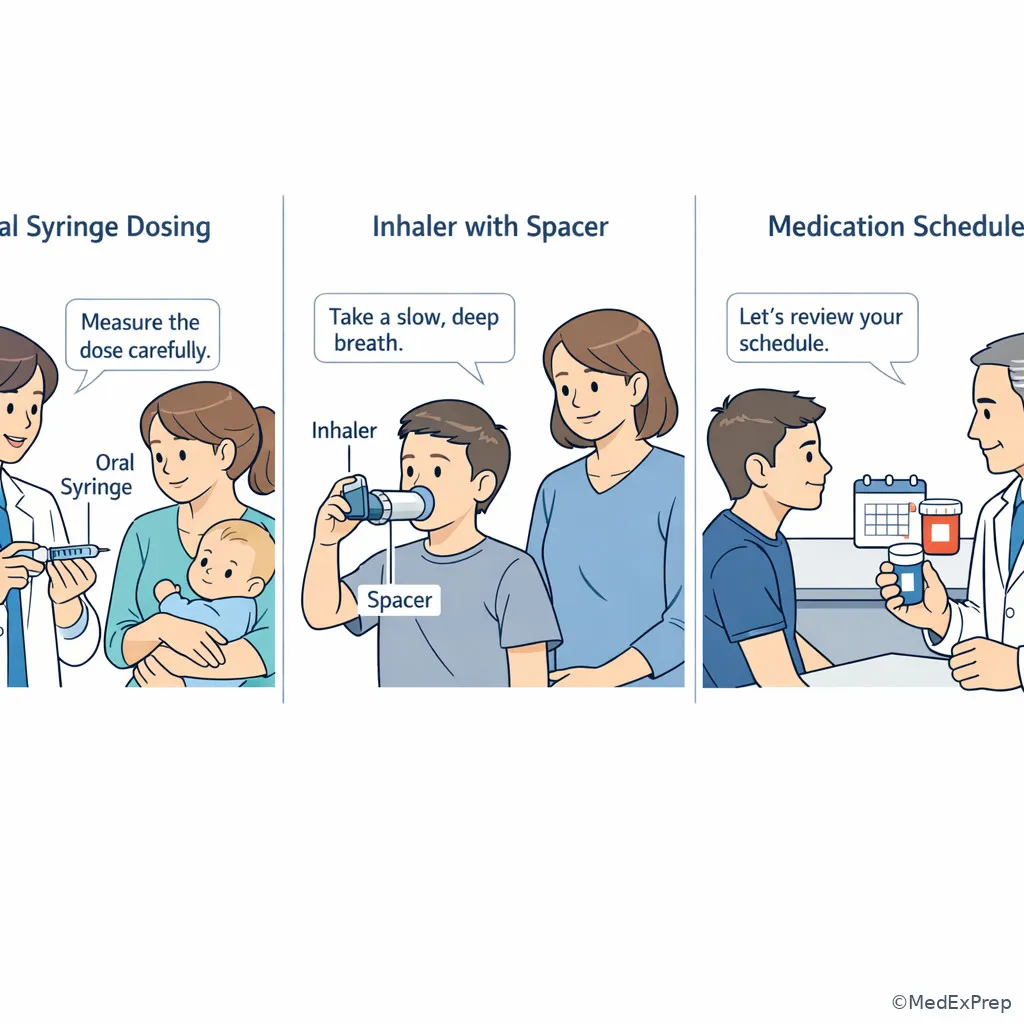
Neonates and young infants usually require liquids, diluted oral syringes, or specialized enteral administration plans, but liquid does not automatically mean safe. Concentration differences, excipients, osmolar load, and dosing-volume feasibility matter. Toddlers and preschool children often still need liquids, chewables, or other child-friendly forms; however, flavored products and “gummy-like” presentations can increase accidental ingestion risk if storage counseling is weak. School-age children may transition to chewables, ODTs, or tablets depending on swallowing ability and practice. Adolescents may prefer tablets or self-administered devices, but adherence may worsen if regimen burden, stigma, or scheduling conflicts are ignored.
Choose a measured oral syringe rather than household spoons whenever dosing precision matters. Reject a seemingly convenient tablet if the child cannot swallow it, if crushing alters release properties, or if the caregiver has no reliable manipulation instructions. Choose an inhaler with spacer when the child can be trained and technique can be assessed. Reject age-inappropriate excipients or alcohol-containing products in neonates and young infants when safer alternatives exist.
Exam takeaway: The safest product is the one that matches swallowing, technique, caregiver measurement, and age-specific safety limits.
flowchart TD
A[Medication needed] --> B{Can child receive exact dose safely?}
B -->|No| C[Reject formulation]
B -->|Yes| D{Main barrier}
D --> E[Swallowing limitation]
D --> F[Technique limitation]
D --> G[Measurement limitation]
D --> H[Excipient or safety limitation]
E --> I[Liquid, chewable, ODT, compounded option]
F --> J[Device teaching or alternate route]
G --> K[Oral syringe and simplified schedule]
H --> L[Select safer product or clarify order]
I --> M[Verify caregiver can administer]
J --> M
K --> M
L --> M
See Fig 3 when multiple formulations look equivalent in the options.
Common pitfall: “Liquid” is not automatically the right answer. Check concentration, volume, excipients, and whether the caregiver can measure the dose accurately.
B. Worked example
A pharmacist receives a prescription for oseltamivir 75 mg capsule by mouth twice daily for 5 days for a 4-year-old child with asthma and sensory aversion to textures. Weight is appropriate, and the child has no renal dysfunction. A distracting note says an older sibling can swallow capsules at age 4, and the caregiver wonders if the capsule can just be “hidden in food.”
Identify task: Decide whether this dosage form is developmentally appropriate. Extract key facts: Preschool child, sensory aversion, probable swallowing limitation, time-sensitive antiviral therapy. Apply rule: Reject a capsule plan if reliable swallowing is doubtful or manipulation instructions are unclear. Eliminate distractors: Do not be anchored by sibling comparison. Do not accept the capsule merely because the strength matches the target dose. Verify: The pharmacist should recommend a formulation strategy the child can receive accurately, such as an appropriate oral suspension or institutionally accepted manipulation method if supported by product-specific guidance.
C. Exam trap
Common wrong answer: Pick the exact-strength tablet or capsule because it looks mathematically cleaner.
Why it is tempting: Learners are drawn to precise strengths and adult-like dosage forms.
Single clue that eliminates it: The stem gives a swallowing, sensory, or administration barrier.
D. Checkpoint
A pharmacist reviews cetirizine 10 mg tablet by mouth once daily for a 5-year-old child with allergic rhinitis, autism spectrum disorder, and documented tablet refusal. Which is the safest pharmacist recommendation?
- A. Dispense the tablet because the dose is correct and ask the caregiver to crush it without further verification — Tempting because the active ingredient is right, but wrong because formulation manipulation and administration feasibility are unverified.
- B. Recommend a developmentally appropriate liquid or other suitable formulation and confirm exact dosing instructions — Correct because dosage-form feasibility and administration accuracy are the key discriminators.
- C. Hold antihistamine therapy until the child is old enough to swallow tablets — Tempting if one overvalues tablet swallowing, but wrong because alternative formulations may exist now.
- D. Substitute any over-the-counter sedating antihistamine liquid because liquids are always preferred in children — Tempting because it solves swallowing, but wrong because the drug itself and safety profile are not equivalent.
Pharmacist Action: NOTICE swallowing barriers, measurement barriers, and excipient risk; SAY “I want to use the formulation your child can take consistently and safely”; MONITOR acceptance, dosing accuracy, and missed doses after initiation; HOLD/CLARIFY/ESCALATE when a formulation requires crushing, splitting, or device skills that are not clearly supported.
1.1.1.4 Age-specific safety hazards across the pediatric spectrum
A. Explanation
This section shifts from foundational recognition to application: which safety hazard is most likely in this age group, and what pharmacist action prevents it? The single rule is to match the child’s developmental abilities and environment to the likely failure mode. WHY THIS IS TESTED: exam questions commonly present a medication order with one subtle safety risk that is predictable from age alone.
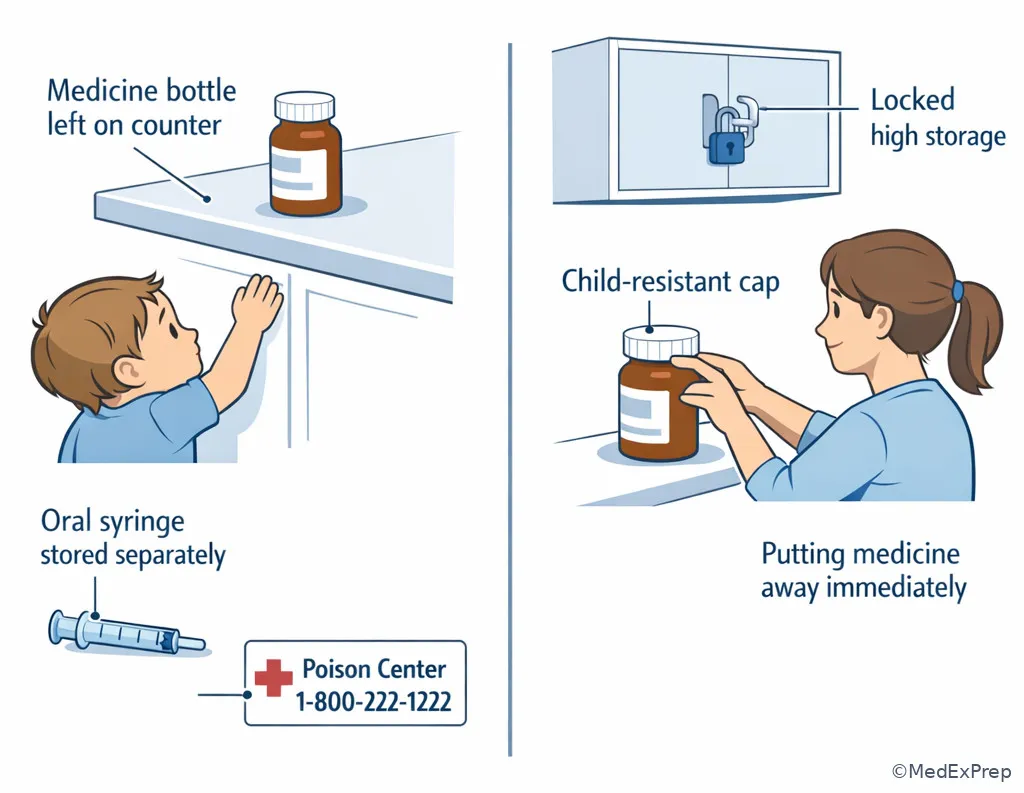
In neonates, major risks include concentrated doses, small-volume measurement error, excipient exposure, and reliance on caregiver technique. In infants, rapid weight change and caregiver sleep deprivation increase wrong-volume errors. In toddlers, accidental ingestion, climbing/reaching behavior, and confusion between “medicine” and candy become central. Preschool and school-age children add self-administration imitation, school-day dosing problems, and device misuse. Adolescents raise different hazards: intentional nonadherence, embarrassment, sports/body-image issues, unsupervised supplements, privacy concerns, and risky co-use with alcohol or recreational substances.
Choose the hazard that best fits the developmental stage rather than the one that is generally serious. For example, a lock-box counseling point is especially high-yield in toddlers. Technique demonstration is especially important for school-age inhaled therapies. Private, nonjudgmental adherence counseling matters in adolescents. Reject one-size-fits-all counseling because age-specific hazards are what the exam tests.
High-Yield Connection: This concept overlaps with High Alert Pediatric Errors and Dosage Forms And Excipients. Know both the developmental hazard and the product-specific hazard; board stems often pair them.
Exam takeaway: Different ages fail medication use in different ways, so counseling should target the likely developmental hazard.
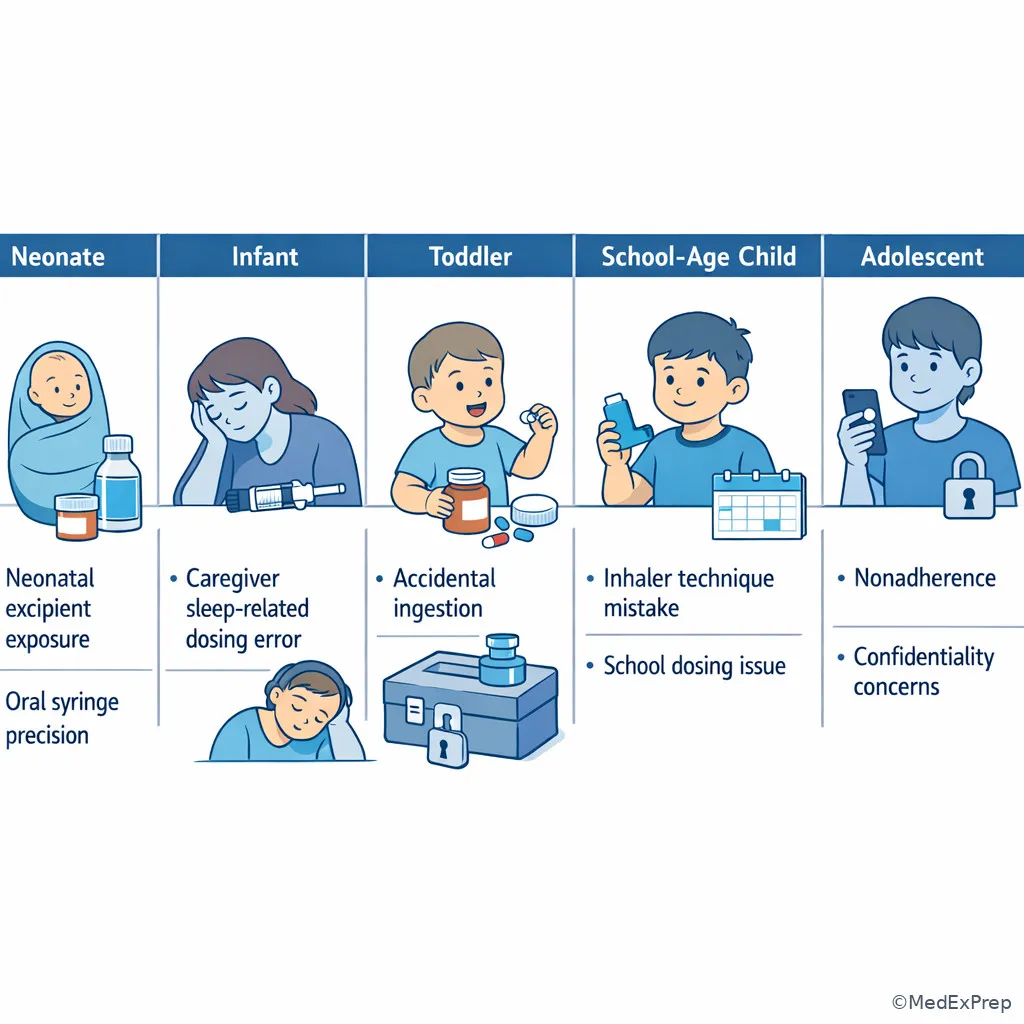
See Fig 4 for a fast “hazard by age” mental map.
B. Worked example
A pharmacist discharges a 2-year-old child on clonidine suspension 20 mcg by mouth at bedtime for sleep difficulty related to neurodevelopmental disorder. Comorbid eczema and constipation are noted. The caregiver seems organized but is also caring for a newborn sibling. A distracting detail is that the child “likes sweet medicines” and can open some kitchen drawers.
Identify task: Select the highest-yield safety counseling priority. Extract key facts: Toddler, potentially attractive liquid, household distraction from newborn, exploratory access risk. Apply rule: Toddler medication safety centers on accidental ingestion prevention and secure storage. Eliminate distractors: While constipation monitoring matters, it is not the developmental hazard most likely to produce immediate serious harm. Verify: The safest pharmacist recommendation is locked storage, child-resistant closure verification, no “candy” language, and caregiver education to keep the product out of sight and reach after each dose.
C. Exam trap
Common wrong answer: Give only general adverse-effect counseling and skip age-specific storage counseling.
Why it is tempting: Drug adverse effects feel more pharmacologic and therefore more “board-like.”
Single clue that eliminates it: The patient is a mobile toddler with access behaviors described in the stem.
D. Checkpoint
A pharmacist is reviewing insulin glargine 18 units subcutaneously nightly for a 16-year-old with type 1 diabetes, depression, and inconsistent refill history. Which age-specific safety concern most warrants targeted pharmacist counseling?
- A. Lack of pincer grasp for device use — Tempting if one thinks about developmental milestones broadly, but wrong because this skill should be long established in adolescence.
- B. Caregiver inability to measure oral liquid volumes — Tempting because pediatric counseling often focuses on caregivers, but wrong because the therapy and developmental stage do not fit.
- C. Nonadherence related to autonomy, privacy, or psychosocial factors — Correct because adolescent safety risk often comes from inconsistent self-management rather than inability to understand the regimen.
- D. Inability to participate in any self-care discussions — Tempting if one overcorrects toward caregiver-only care, but wrong because adolescents should be engaged directly.
- The pediatric stage most associated with accidental ingestion is toddlerhood.
- True or False: Adolescents always have better adherence than school-age children because they understand the disease better. False.
- Name 3 neonatal medication safety concerns: excipients, small-volume dosing error, caregiver measurement precision.
Pharmacist Action: NOTICE the likely age-specific failure mode; SAY the one prevention point most likely to avoid harm for that stage; MONITOR refills, technique, storage practices, and caregiver understanding at transition points; HOLD/CLARIFY/ESCALATE if the order creates a predictable developmental safety hazard that is not yet addressed.
1.1.1.5 Developmental red flags, communication, and when to clarify
A. Explanation
The final integration task is deciding when a developmental detail is reassuring, when it simply changes counseling, and when it requires clarification or escalation. The single rule is to act when the stem shows loss of milestone, major mismatch between stated age and expected function, or a medication plan that assumes an ability the child does not have. WHY THIS IS TESTED: exam items often ask for the “most appropriate next step” when the pharmacist notices a developmental mismatch before dispensing or counseling.
Examples of red flags include a former infant who has lost previously achieved feeding coordination, a school-age child prescribed a self-administered device but unable to demonstrate basic technique, or an adolescent on a complex regimen who gives cues of nonadherence, stigma, or unsafe co-use. The pharmacist is not independently diagnosing developmental disorders; the role is to recognize that the medication plan may fail or become unsafe and to clarify with the caregiver, team, or prescriber.
Communication should be stage-matched. For infants and toddlers, most communication is caregiver-directed, with simple observation of the child’s responses. For school-age children, involve the child in explanation and demonstration. For adolescents, include direct conversation, respect privacy where appropriate, and screen for barriers that caregivers may not know. Local protocols vary; confirm with your institution regarding confidentiality workflow, especially for sensitive medications.
Recall: In the upcoming topic Growth Curves And Percentiles, you will add anthropometric trends to this same reasoning. Here, you are learning to classify age and function; next, you will combine that with weight, length, BMI, and head-circumference interpretation.
Exam takeaway: Escalate when the medication plan assumes a developmental ability the child does not have or when a milestone has regressed.
flowchart TD
A[Developmental clue in stem] --> B{Does it change safe medication use?}
B -->|No| C[Proceed with standard counseling]
B -->|Yes| D{Is this a barrier or a red flag?}
D -->|Barrier only| E[Adjust formulation, teaching, follow-up]
D -->|Red flag| F[Clarify with caregiver or care team]
F --> G{Loss of skill or major mismatch?}
G -->|Yes| H[Escalate promptly]
G -->|No| I[Document and monitor closely]
E --> J[Teach-back and verify]
H --> K[Do not rely on unsafe plan]
See Fig 5 when the best answer is not “dispense as written” or “reassure,” but “clarify first.”
B. Worked example
A pharmacist is asked to discharge a 13-year-old on tacrolimus 2 mg by mouth every 12 hours after transplant. The adolescent has anxiety, mild hearing impairment, and a history of missed school appointments. A caregiver answers most questions, but the patient shrugs when asked how doses will be remembered. A distracting detail is excellent recent serum creatinine. The prescriber note says “patient understands regimen.”
Identify task: Determine the safest pharmacist next step related to developmental communication and adherence risk. Extract key facts: Adolescent, complex high-risk medication, unclear self-management plan, caregiver dominance, history of missed appointments. Apply rule: Adolescents require direct assessment of understanding and adherence barriers; apparent understanding by the team is insufficient if the pharmacist detects mismatch. Eliminate distractors: Do not be reassured by current creatinine or generic chart language. Verify: The pharmacist should directly engage the adolescent, assess ability to state the schedule and plan for missed doses, and clarify the discharge education if self-management readiness is uncertain.
C. Exam trap
Common wrong answer: Accept caregiver reassurance as proof that an adolescent can safely self-manage a complex regimen.
Why it is tempting: The caregiver appears competent and the clinical status is stable.
Single clue that eliminates it: The adolescent cannot articulate a medication plan despite being the likely day-to-day user.
D. Checkpoint
A pharmacist is counseling on levetiracetam oral solution 350 mg by mouth twice daily for a 9-year-old with epilepsy, ADHD, and recent difficulty following multistep school routines. Which is the most appropriate pharmacist next step?
- A. Counsel only the caregiver because school-age children should not participate in medication discussions — Tempting because caregivers remain responsible, but wrong because school-age children benefit from age-appropriate participation and demonstration.
- B. Ask the child to describe or demonstrate the routine in simple steps and reinforce caregiver supervision — Correct because school-age children can often participate, and technique/routine mismatch should be identified early.
- C. Convert immediately to tablets without further discussion to promote independence — Tempting if one equates age with tablet readiness, but wrong because the stem raises routine-execution concerns, not formulation maturity alone.
- D. Delay counseling until adolescence because adherence barriers are not relevant before age 12 — Tempting if one overassociates adherence with adolescents, but wrong because routine-related barriers can occur earlier.
Memory anchor: Use “RIDE” for clarification triggers: Regression, Incongruent skill, Device/formulation mismatch, Expressed barrier to adherence.
Pharmacist Action: NOTICE milestone regression, age-function mismatch, or weak self-management signals; SAY “Before discharge, I want to be sure this plan matches who will actually give the medication”; MONITOR teach-back success, refill behavior, and caregiver/patient role clarity at follow-up; HOLD/CLARIFY/ESCALATE if the plan depends on a skill the patient cannot demonstrate or if a previously attained function has been lost.
Exam Traps & Differentiators
Common traps & distractors: The most common wrong answer is choosing based on a memorized exact milestone age instead of the pharmacy task the milestone changes. The exam rewards functional interpretation, not trivia.
Most common wrong answer and why
Most common wrong answer: Use chronologic age alone for every developmental question. Why it is tempting: It is faster and feels objective. What beats it: Prematurity in early infancy requires corrected-age thinking when developmental expectations are the issue.
Looks similar but isn’t
| Confusable pair | Why they look similar | Single clue that separates them | Pharmacist implication |
|---|---|---|---|
| Chronologic age vs corrected age | Both are expressed as age in weeks or months | Prematurity included and developmental expectation questioned | Use corrected age for early milestone interpretation |
| Infant vs toddler | Both may still receive liquids and require caregiver administration | Walking/mobility and exploratory ingestion behavior point toward toddlerhood | Shift counseling toward poison prevention and locked storage |
| School-age child vs adolescent | Both may use devices and participate in self-care | Privacy, autonomy, and transition planning signal adolescence | Address adherence privately and directly with the patient |
| Correct drug vs correct formulation | Same active ingredient appears across options | Swallowing or measurement barrier in the stem | Reject pharmacologically correct products that are developmentally unusable |
| General adverse-effect counseling vs age-specific hazard counseling | Both are reasonable pharmacist tasks | Developmental behavior clue such as access, technique, or nonadherence | Prioritize the hazard most likely for that age group |
If the stem says ___, think ___
- If the stem says “born at 28–32 weeks”, think corrected age may change milestone interpretation.
- If the stem says “can open cabinets,” “climbs,” or “likes sweet medicine”, think toddler accidental ingestion counseling.
- If the stem says “can follow multistep directions”, think school-age device teaching may be feasible.
- If the stem says “wants privacy,” “misses doses,” or “caregiver answers everything”, think adolescent adherence and direct counseling.
- If the stem says “tablet refusal,” “sensory aversion,” or “cannot swallow pills”, think reassess dosage form before accepting the order.
- If the stem says “lost a skill”, think red flag; clarify or escalate rather than reassure.
Exam takeaway: Match counseling to who can actually receive and act on the information at that age.
Tables
| Age band | Typical age span | High-yield developmental focus | Medication-use implication |
|---|---|---|---|
| Preterm neonate | Before term-equivalent maturity; context-specific | Immature organ handling; corrected-age relevance | Use extra caution with excipients, concentration, and developmental expectations |
| Term neonate | Birth to 27 days | Total caregiver dependence; feeding and measurement precision | Caregiver-only administration, small-volume accuracy, safety verification |
| Infant | 28 days to 12 months | Rapid milestone change; still fully supervised | Frequent dose re-evaluation with growth; route and feeding coordination matter |
| Toddler | 1 to 3 years | Mobility, exploration, refusal | Locked storage, palatability planning, reliable caregiver administration |
| Preschool child | 3 to 5 years | Expanding language, limited logic, imitation | Simple explanations, supervised participation, formulation flexibility |
| School-age child | 6 to 11 years | Rules, routines, device learning | Teach-back, school dosing planning, partial self-management with oversight |
| Adolescent | 12 to 18 years | Autonomy, privacy, transition, peer influence | Direct counseling, adherence assessment, confidential barrier screening |
| Medication task | Choose when | Reject when | Best follow-up check |
|---|---|---|---|
| Oral liquid | Child cannot swallow solids and dose can be measured accurately | Concentration confusion, excipient concern, or large/poorly tolerated volume | Oral syringe teach-back and volume verification |
| Chewable/ODT | Child can handle the form safely and accept the taste/texture | Choking, spitting, or inaccurate partial dosing risk | Observe administration feasibility |
| Tablet/capsule | Swallowing ability is demonstrated or clearly established | Refusal, sensory barrier, or unsupported crushing/splitting | Confirm child can state or show how it will be taken |
| MDI with spacer | Child can follow steps with demonstration and supervision | Technique remains unreliable after teaching | Return demonstration |
| Self-managed chronic regimen | Adolescent shows understanding and realistic adherence plan | Cannot explain routine, privacy barriers, or missed-dose pattern | Refill history and direct counseling |
| Stem finding | Most likely interpretation | Most appropriate pharmacist response | Why not the close distractor |
|---|---|---|---|
| Former 30-week infant not rolling at 14 weeks chronologic age | Corrected age changes developmental expectation | Interpret using corrected age and reinforce follow-up | Do not overcall delay from chronologic age alone |
| 2-year-old prescribed a sweet liquid medication | High accidental ingestion risk | Prioritize locked storage and caregiver poison-prevention counseling | Adverse-effect review alone misses the main developmental hazard |
| 6-year-old with asthma can follow multistep instructions | Likely ready for inhaler-plus-spacer teaching | Provide demonstration and teach-back | Nebulizer is not automatically preferred solely due to age |
| 5-year-old refuses tablets | Formulation mismatch | Recommend an age-appropriate alternative form if available | Correct strength in a tablet does not make it usable |
| Adolescent with complex regimen cannot explain dosing plan | Self-management barrier | Clarify understanding and adherence strategy before discharge | Stable current labs do not prove future medication success |
Exam takeaway: Swallowing ability, caregiver measurement, and manipulation limits matter more than convenience alone.
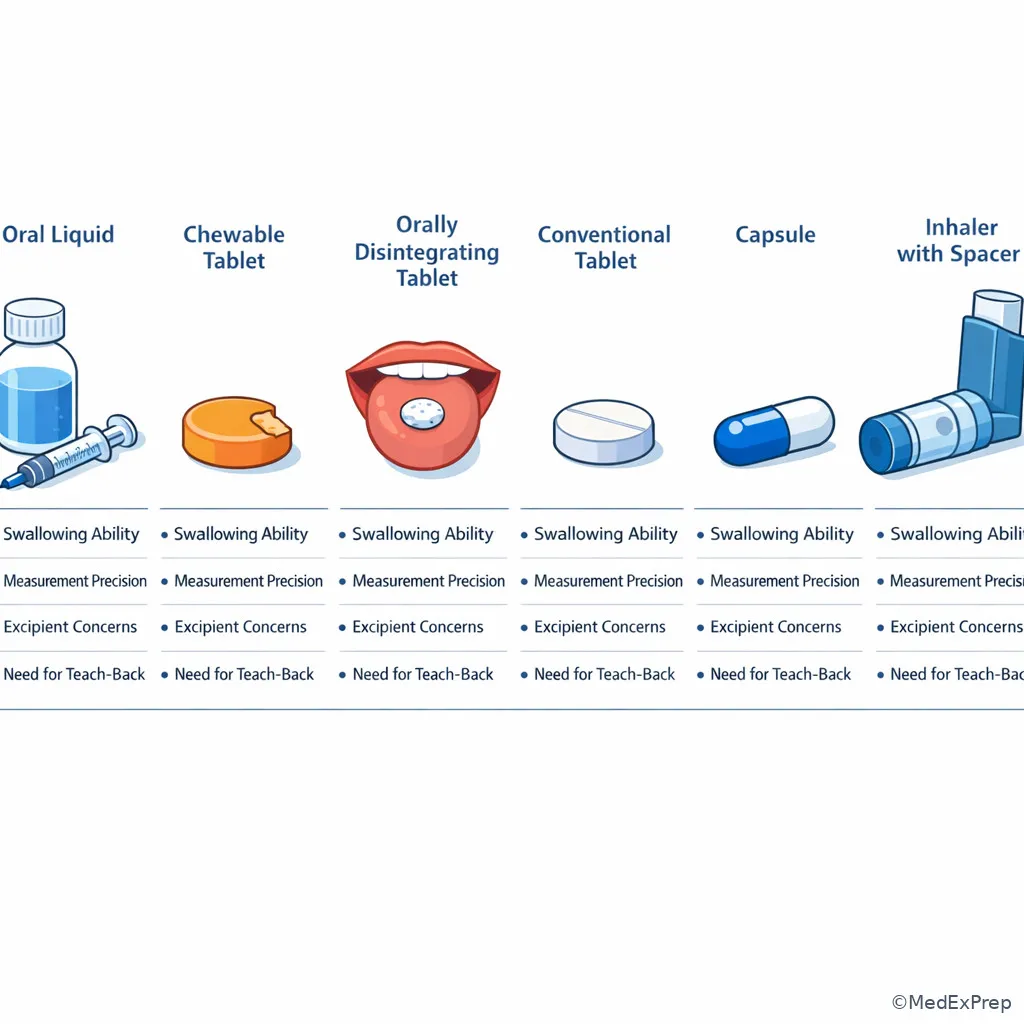
Exam takeaway: For toddlers, secure storage and caregiver behavior change prevent more harm than generic counseling alone.
Algorithm / Approach
Exam takeaway: Classify age, identify the medication-use task, then choose the developmental rule that changes the safest recommendation.
flowchart TD
A[Read stem] --> B[Identify medication context: drug, dose, route, frequency]
B --> C[Classify age band]
C --> D{Prematurity relevant?}
D -->|Yes| E[Check corrected age]
D -->|No| F[Use chronologic developmental stage]
E --> G[Find milestone or functional clue]
F --> G
G --> H{What decision is being tested?}
H --> I[Formulation or route]
H --> J[Safety counseling]
H --> K[Device technique]
H --> L[Clarify or escalate]
I --> M[Choose form child can receive accurately]
J --> N[Target age-specific hazard]
K --> O[Use demonstration and teach-back]
L --> P[Escalate if regression or mismatch]
M --> Q[Verify caregiver plan]
N --> Q
O --> Q
P --> Q
See Fig 6 as your default board-style workflow. The highest-yield sequence is:
- Read the medication context first: drug, dose, route, and frequency.
- Assign the developmental age band.
- Ask whether prematurity changes the developmental interpretation.
- Identify the pharmacy task: dosage form, counseling, safety, device technique, or clarification.
- Choose the single developmental rule that rules options in or out.
- Verify with a pharmacist-scope action: teach-back, storage plan, direct adolescent counseling, or prescriber clarification.
Rapid Review
- Former preterm infant → developmental questions may require corrected age, not chronologic age.
- Term neonate → birth through 27 days remains a distinct medication-use category.
- Infant → rapid developmental change means today’s counseling may not fit next month.
- Toddler → think accidental ingestion before you think nuanced self-management barriers.
- Preschooler → can cooperate briefly but still cannot be trusted with unsupervised accuracy-critical dosing.
- School-age child → best group for demonstration-based device teaching with caregiver backup.
- Adolescent → understanding does not equal adherence; privacy and autonomy are the discriminator.
- Milestone clue → ask what medication-use task it changes, not what trivia fact it tests.
- Correct drug, wrong formulation → still the wrong answer.
- Loss of milestone → red flag that beats simple reassurance.
- Liquid formulation → verify concentration, volume, excipients, and oral syringe use.
- Device counseling → teach-back beats verbal explanation alone.
- Caregiver comparison to siblings → noise, unless it changes actual administration capacity.
- Upcoming growth topic → next add percentiles and trends to developmental-stage reasoning.
Memory anchor: “AGE → TASK → RULE → ACTION”. If you get stuck, classify the age, name the pharmacy task, apply the developmental rule, then choose the pharmacist action.
Self-check quiz
Question 1
A pharmacist verifies vitamin D3 drops 400 units by mouth once daily for an infant documented as “18 days old, born at 40 weeks’ gestation, weight 3.9 kg.” Which developmental classification is most appropriate for medication-use interpretation?
- A. Preterm neonate
- B. Term neonate
- C. Infant older than 1 month
- D. Toddler
Question 2
A pharmacist is counseling on polyethylene glycol oral powder 8.5 g by mouth once daily for a 2-year-old with constipation and eczema. Which safety emphasis is most appropriate for this developmental stage?
- A. Locked medication storage to reduce exploratory ingestion
- B. Adolescent confidentiality around refill pickup
- C. Independent self-administration training without caregiver supervision
- D. Concern that poor head control limits oral administration
Question 3
A pharmacist reviews ferrous sulfate 15 mg elemental iron by mouth daily for a former 29-week gestation infant who is now 16 weeks old chronologically, weighs 4.8 kg, and has mild reflux and resolved apnea of prematurity. The caregiver asks whether absence of rolling means the infant has missed a milestone. Which is the most appropriate pharmacist response?
- A. Interpret the milestone concern using corrected age and reinforce routine developmental follow-up
- B. Interpret using chronologic age alone and recommend urgent neurologic evaluation
- C. Reassure that milestones are irrelevant in former preterm infants receiving supplementation
- D. Hold iron therapy because delayed rolling suggests medication-related toxicity
Question 4
A pharmacist is counseling on albuterol MDI 2 puffs inhaled every 4 hours as needed with spacer for a 7-year-old with asthma, obesity, and allergic rhinitis. The child follows multistep directions well but the caregiver prefers a nebulizer because “he is still little.” Which is the most appropriate pharmacist recommendation?
- A. Use the MDI with spacer and confirm technique by return demonstration
- B. Switch to nebulized albuterol because all children younger than 8 years require it
- C. Delay rescue therapy until tablet swallowing improves
- D. Use the inhaler without a spacer because school-age children no longer benefit from one
Question 5
A pharmacist receives cetirizine 10 mg tablet by mouth once daily for a 5-year-old with allergic rhinitis, autism spectrum disorder, and consistent tablet refusal. Renal function is normal, and the caregiver says the child spits out crushed medicines mixed in food. Which is the best next step?
- A. Dispense the tablet because the strength is correct and advise repeated crushing attempts
- B. Recommend an age-appropriate alternative formulation and verify exact dosing instructions
- C. Suggest diphenhydramine liquid at an equivalent daily antihistamine effect without clarifying with the prescriber
- D. Delay therapy until the child reaches school age
Question 6
A pharmacist discharges a 15-year-old on tacrolimus 3 mg by mouth every 12 hours after kidney transplant. The patient has anxiety, mild acne treated with over-the-counter supplements, and a history of missed clinic visits. Serum creatinine is stable, and the caregiver states, “I handle everything.” Which pharmacist action is most appropriate before discharge?
- A. Accept caregiver assurance because current renal function confirms adherence readiness
- B. Counsel only on nephrotoxicity monitoring and avoid direct questions to the adolescent
- C. Directly assess the adolescent’s understanding, dosing plan, and supplement use before finalizing education
- D. Recommend immediate conversion to once-daily therapy solely to improve convenience
Question 7
A pharmacist reviews clonidine oral suspension 20 mcg by mouth nightly for a 22-month-old with developmental delay and sleep difficulty. The caregiver also has a newborn at home and says the toddler can open several drawers. Which counseling point is most important to prioritize at dispensing?
- A. Expected adolescent privacy concerns around sedative use
- B. Secure locked storage and avoidance of candy-like language about the medication
- C. Independent child teach-back of the bedtime routine
- D. Conversion to tablets to reduce liquid palatability
Question 8
A pharmacist is counseling on levetiracetam oral solution 350 mg by mouth twice daily for a 9-year-old with epilepsy, ADHD, and a new after-school dosing schedule. The child can read simple instructions but often misses multistep routines, and the caregiver works evening shifts. Which is the most appropriate pharmacist recommendation?
- A. Counsel only the caregiver because direct child involvement reduces adherence
- B. Ask the child to practice the routine in simple steps, reinforce caregiver oversight, and clarify how doses will be tracked
- C. Change immediately to tablets to promote maturity-based adherence
- D. Assume school-age children can self-manage oral liquids reliably without follow-up
Answer key
Question 1: B. Term neonate
A. Preterm neonate: Tempting because the patient is very young and neonatal safety issues clearly apply. Incorrect for this scenario because the birth history states 40 weeks’ gestation, which excludes prematurity. Single stem clue: “born at 40 weeks’ gestation.” Source: Pediatric age-band conventions summarized in pediatric pharmacotherapy references such as DiPiro and Lexicomp pediatric content.
B. Term neonate: Tempting because it precisely matches the age and gestational context. Correct because birth through 27 days in a term infant is the neonatal period most relevant to pharmacist assessment of formulation, caregiver technique, and safety. Single stem clue: “18 days old.” Source: Lexicomp Pediatric & Neonatal Lexi-Drugs; DiPiro Pharmacotherapy.
C. Infant older than 1 month: Tempting because many learners collapse all infants under 1 year into one group. Incorrect because the neonatal distinction is still active before 28 days and materially affects medication-use interpretation. Single stem clue: age under 28 days. Source: AHFS Drug Information; pediatric foundational references.
D. Toddler: Tempting only if the learner loses track of age categories. Incorrect because toddlerhood begins around 1 year and carries very different safety concerns such as accidental ingestion rather than neonatal dosing precision. Single stem clue: patient is 18 days old. Source: Standard pediatric developmental age classifications in pediatric pharmacy texts.
Question 2: A. Locked medication storage to reduce exploratory ingestion
A. Locked medication storage to reduce exploratory ingestion: Tempting because it seems more like a public-health counseling point than a pharmacotherapy issue. Correct because a 2-year-old is in the peak developmental stage for mobile, curious, accidental ingestion behavior. Single stem clue: “2-year-old.” Source: ASHP pediatric medication safety principles; FDA medication safety communications; pediatric pharmacy texts.
B. Adolescent confidentiality around refill pickup: Tempting because confidentiality is an important pediatric counseling topic. Incorrect because it applies more to adolescents than toddlers and does not match the developmental hazard in this case. Single stem clue: age 2 years. Source: Pediatric counseling framework in ACCP/ASHP pediatric practice guidance.
C. Independent self-administration training without caregiver supervision: Tempting because promoting autonomy can improve long-term adherence. Incorrect because toddlers cannot be expected to dose themselves accurately or safely, especially with oral powders and household mixing steps. Single stem clue: toddler developmental stage. Source: Lexicomp pediatric administration guidance.
D. Concern that poor head control limits oral administration: Tempting because infants raise feeding-position questions. Incorrect because head-control limitations are an early infancy issue, not the best developmental concern in a typical 2-year-old. Single stem clue: age beyond infancy. Source: Pediatric developmental milestone references in pharmacotherapy education.
Question 3: A. Interpret the milestone concern using corrected age and reinforce routine developmental follow-up
A. Interpret the milestone concern using corrected age and reinforce routine developmental follow-up: Tempting because it requires a developmental framework rather than a direct drug answer. Correct because former 29-week prematurity makes corrected age the relevant lens for early developmental interpretation; iron supplementation does not change that framework. Single stem clue: “former 29-week gestation infant.” Source: Lexicomp Pediatric & Neonatal; DiPiro; standard pediatric developmental guidance.
B. Interpret using chronologic age alone and recommend urgent neurologic evaluation: Tempting because failure to roll by a certain chronologic age sounds concerning on superficial recall. Incorrect for this specific scenario because prematurity shifts developmental expectation; the case does not describe regression, focal neurologic signs, or acute decline. Single stem clue: prematurity data. Source: Pediatric developmental references; pharmacotherapy reasoning texts.
C. Reassure that milestones are irrelevant in former preterm infants receiving supplementation: Tempting because the child is already under follow-up and the medication is unrelated to gross motor skills. Incorrect because milestones remain clinically important; the error is not that milestones are irrelevant, but that they must be interpreted correctly. Single stem clue: caregiver asks about developmental expectation. Source: Pediatric pharmacy care models and developmental surveillance guidance.
D. Hold iron therapy because delayed rolling suggests medication-related toxicity: Tempting because pharmacy questions often ask whether a drug is causing a problem. Incorrect because nothing in the stem suggests iron toxicity, overdose, or adverse neurologic effect. Single stem clue: standard supplementation context without toxicity findings. Source: Lexicomp monograph for iron products; AHFS.
Question 4: A. Use the MDI with spacer and confirm technique by return demonstration
A. Use the MDI with spacer and confirm technique by return demonstration: Tempting because it requires trusting developmental function over age-based heuristics. Correct because a 7-year-old who follows multistep directions is developmentally appropriate for inhaler-plus-spacer teaching, and demonstration verifies technique. Single stem clue: “follows multistep directions well.” Source: NHLBI/GINA-aligned pediatric asthma device use principles reflected in Lexicomp and pediatric practice references.
B. Switch to nebulized albuterol because all children younger than 8 years require it: Tempting because nebulizers are perceived as easier and more child-friendly. Incorrect because age alone does not mandate nebulizer use; school-age children often do well with MDI plus spacer. Single stem clue: school-age ability to follow steps. Source: Pediatric asthma education guidance; ASHP and Lexicomp device counseling resources.
C. Delay rescue therapy until tablet swallowing improves: Tempting only if one confuses all pediatric route decisions with oral dosage-form limitations. Incorrect because rescue bronchodilator therapy is inhaled and unrelated to tablet swallowing. Single stem clue: MDI route already specified. Source: Standard asthma management guidance.
D. Use the inhaler without a spacer because school-age children no longer benefit from one: Tempting because older children may sometimes coordinate inhalation better. Incorrect because spacers often remain beneficial and the stem specifically includes one; removing it without reason undermines delivery. Single stem clue: prescribed spacer and need for technique optimization. Source: Pediatric inhaler administration guidance in Lexicomp and asthma guidelines.
Question 5: B. Recommend an age-appropriate alternative formulation and verify exact dosing instructions
A. Dispense the tablet because the strength is correct and advise repeated crushing attempts: Tempting because the active drug and dose appear right, and pharmacists often adapt formulations. Incorrect because the child has documented tablet refusal and spits out crushed products; repeating a failed strategy ignores developmental feasibility. Single stem clue: “consistent tablet refusal” and “spits out crushed medicines.” Source: Lexicomp product administration guidance; pediatric formulation best practices.
B. Recommend an age-appropriate alternative formulation and verify exact dosing instructions: Tempting because it seems operational rather than pharmacologic. Correct because the developmental mismatch, not the antihistamine indication, is the key issue; the safest plan is a formulation the child can receive accurately. Single stem clue: repeated failure with current form. Source: Lexicomp; AHFS; pediatric pharmacy formulation principles.
C. Suggest diphenhydramine liquid at an equivalent daily antihistamine effect without clarifying with the prescriber: Tempting because it solves the swallowing issue and stays within the same therapeutic area. Incorrect because it changes to a clinically different agent with different sedating properties and is not simply a formulation substitution. Single stem clue: the problem is formulation, not failure of cetirizine’s indication. Source: AHFS Drug Information; Lexicomp comparative monographs.
D. Delay therapy until the child reaches school age: Tempting if one falsely believes tablet swallowing readiness must precede treatment. Incorrect because age-appropriate alternatives may be available now; delaying treatment is unnecessary. Single stem clue: only the form is problematic. Source: Pediatric allergy pharmacotherapy references.
Question 6: C. Directly assess the adolescent’s understanding, dosing plan, and supplement use before finalizing education
A. Accept caregiver assurance because current renal function confirms adherence readiness: Tempting because stable creatinine suggests the regimen is working right now. Incorrect because present graft function does not prove future adherence readiness, and adolescents require direct assessment of self-management barriers. Single stem clue: history of missed clinic visits and caregiver speaking for the patient. Source: Transplant pharmacotherapy principles in DiPiro and Lexicomp; pediatric adherence literature used in specialty practice.
B. Counsel only on nephrotoxicity monitoring and avoid direct questions to the adolescent: Tempting because tacrolimus monitoring is critical and within pharmacist scope. Incorrect because this misses the main developmental hazard: adolescent autonomy, adherence risk, and possible supplement interactions. Single stem clue: over-the-counter supplement use and unclear patient engagement. Source: Lexicomp tacrolimus monograph; pediatric transplant practice standards.
C. Directly assess the adolescent’s understanding, dosing plan, and supplement use before finalizing education: Tempting because it is more time-intensive. Correct because the patient is the likely daily medication user, and tacrolimus safety depends on highly reliable administration plus interaction review; direct adolescent assessment is the single best action. Single stem clue: “history of missed clinic visits” plus supplement use. Source: Lexicomp tacrolimus; DiPiro; pediatric transplant medication adherence guidance.
D. Recommend immediate conversion to once-daily therapy solely to improve convenience: Tempting because simplifying regimens can improve adherence. Incorrect because convenience alone is not enough to justify regimen change in this discharge moment, and the true gap is unassessed understanding plus interaction risk. Single stem clue: no evidence that formulation/frequency change is the primary issue. Source: Product labeling and transplant practice references.
Question 7: B. Secure locked storage and avoidance of candy-like language about the medication
A. Expected adolescent privacy concerns around sedative use: Tempting because clonidine use can raise sensitive counseling issues. Incorrect because the patient is 22 months old; the developmental hazard is accidental ingestion, not privacy. Single stem clue: toddler age. Source: Pediatric medication safety principles; FDA poison-prevention messaging.
B. Secure locked storage and avoidance of candy-like language about the medication: Tempting because it may seem less pharmacologic than adverse-effect counseling. Correct because a mobile toddler who can open drawers is at high risk for unintentional ingestion, especially with a flavored suspension. Single stem clue: “can open several drawers.” Source: ASHP medication safety guidance; Lexicomp counseling points for pediatric liquid medications.
C. Independent child teach-back of the bedtime routine: Tempting because teach-back is a strong counseling tool. Incorrect because a 22-month-old cannot reliably serve as the safety-check learner for a nighttime medication routine. Single stem clue: developmental stage is too young for accurate self-management. Source: Pediatric counseling practice standards.
D. Conversion to tablets to reduce liquid palatability: Tempting because less palatable forms may reduce ingestion interest. Incorrect because the developmental barrier is not solved by a form the child likely cannot swallow; secure storage is the primary safety intervention. Single stem clue: toddler age and access behavior. Source: Lexicomp pediatric administration guidance.
Question 8: B. Ask the child to practice the routine in simple steps, reinforce caregiver oversight, and clarify how doses will be tracked
A. Counsel only the caregiver because direct child involvement reduces adherence: Tempting because caregivers remain responsible and the child has ADHD. Incorrect because school-age children benefit from participation, and observing the child’s functional ability helps detect routine barriers. Single stem clue: “can read simple instructions.” Source: Pediatric counseling and adherence strategies in ASHP/ACCP practice guidance.
B. Ask the child to practice the routine in simple steps, reinforce caregiver oversight, and clarify how doses will be tracked: Tempting because it adds steps rather than giving a quick answer. Correct because the child is school-age, partially capable, and at risk for routine failure; demonstration plus tracking plan fits the developmental stage and medication context. Single stem clue: misses multistep routines and caregiver works evenings. Source: Pediatric epilepsy medication counseling practices; Lexicomp levetiracetam monograph.
C. Change immediately to tablets to promote maturity-based adherence: Tempting because older children may transition to tablets. Incorrect because the stem identifies routine-execution problems, not a liquid-specific problem; a tablet could worsen adherence if swallowing readiness is not established. Single stem clue: the issue is schedule execution. Source: Lexicomp administration guidance.
D. Assume school-age children can self-manage oral liquids reliably without follow-up: Tempting because age 9 suggests greater independence. Incorrect because the child has ADHD and trouble with multistep routines, making unsupported self-management a poor assumption. Single stem clue: “often misses multistep routines.” Source: Pediatric adherence counseling principles; specialty pharmacy follow-up models.