






CMAP Domain Structure
What you'll learn
- DOMAIN: D1 - Blueprint and Test Strategy: Organize the CMAP course into the operational domains D1-D9 and use them as a study map.
- DOMAIN: D3 - Scope and Responsibility: Distinguish allowed medication aide actions from actions that require a supervising licensed nurse or other authorized professional.
- DOMAIN: D5 - Safe Process: Use a repeatable exam decision framework: identify task - extract key facts - apply rule/policy - choose safest in-scope action - document/escalate.
- DOMAIN: D7 - Documentation and Communication: Recognize when the best answer is factual reporting, clarification, or immediate escalation.
- DOMAIN: D9 - Error Prevention: Spot common distractors built around shortcuts, assumptions, and role violations.
Why it matters
- The exam often rewards the safest in-scope action, not the most medically sophisticated action.
- If you know the domain structure, you can quickly tell whether a stem is mainly about verification, timing, observation, documentation, calculation, or escalation.
- Many wrong answers look efficient but are unsafe because they skip a required check, rely on assumptions, or exceed the medication aide role.
- A clear domain map improves review efficiency: weak area identified - targeted practice selected - repeated errors corrected faster.
Exam takeaway: Use the domain map to identify what the item is testing before you choose an action.
flowchart TD
A[CMAP Exam Tasks] --> B[D1 Test Strategy]
A --> C[D2 Foundations]
A --> D[D3 Scope and Responsibility]
A --> E[D4 Orders Labels Verification]
A --> F[D5 Safe Administration Process]
A --> G[D6 Observation Issues Escalation]
A --> H[D7 Documentation Communication]
A --> I[D8 Calculations Timing Protocols]
A --> J[D9 Error Prevention Review]
E --> K[Compare order label MAR]
F --> L[Sequence tasks safely]
G --> M[Notice change and report]
H --> N[Document factually]
I --> O[Calculate basic dose or timing]
J --> P[Stop unsafe shortcut]
When you begin a question, ask yourself which domain is being tested. A label mismatch points toward D4. A refusal or change in condition points toward D6. A charting question points toward D7. A “best next step” after spotting a discrepancy usually combines D3, D5, and D9. See Fig 1.
Key Terms & Must-Know Facts
Key terms
- Operational blueprint: The course-wide D1-D9 map used to organize preparation.
- Domain: A major tested content area such as verification, documentation, or calculations.
- Subskill: A smaller task within a domain, such as label comparison or refusal documentation.
- MAR: Medication Administration Record used to guide and document administration per policy.
- Safest next step: The action that protects the resident and stays within assigned authority.
- In-scope: Allowed under training, delegation, law, and facility policy.
- Out-of-scope: Requires authority or judgment beyond the medication aide role.
- Escalation: Promptly notifying the supervising nurse or following emergency procedures.
- Verification: Confirming the resident, medication, dose, route, time, and related order details per policy.
- Discrepancy: A mismatch, missing element, or safety concern that prevents safe proceeding.
- Objective documentation: Factual charting without guesses, blame, or interpretation.
- Near miss: An error caught before reaching the resident.
- Role boundary: The line between delegated task performance and licensed clinical decision-making.
Must-know facts
- The CMAP exam is built around safe medication administration behavior, not independent diagnosis or prescribing.
- If a scenario exceeds role, the usual correct action is stop, keep the resident safe, notify the supervising nurse, and document/report per policy.
- When exam specifics are unclear, prefer verify policy and escalate rather than improvise.
- Wrong answers commonly include shortcuts: assuming identity, accepting unclear instructions, altering dosage forms without authorization, or documenting something not done.
- Order, label, resident, route, timing, observation, and documentation problems may be tested alone or combined.
- The best answer often comes from one clue: missing information, discrepancy, refusal, change in condition, or role limit.
- Factual communication beats vague language: report what was ordered, what was seen, what was done, and who was notified.
- Being “helpful” does not justify acting beyond scope.
| Domain | What it covers | Typical exam wording | Default safe action |
|---|---|---|---|
| D1 | Blueprint and strategy | Most appropriate approach; identify tested issue | Classify the task before answering |
| D2 | Medication basics | Term, form, route, basic rule | Use definitions and basic safety facts |
| D3 | Role and scope | Who should decide; what exceeds authority | Stop and notify supervising nurse |
| D4 | Orders, labels, verification | Mismatch, unclear order, wrong label | Do not administer until clarified |
| D5 | Preparation and administration sequence | Best next step; correct order of actions | Follow trained sequence exactly |
| D6 | Observation and escalation | Resident refuses; coughing; rash; change | Observe, hold as policy requires, report promptly |
| D7 | Documentation and communication | How to chart; what to report | Document factually and promptly |
| D8 | Calculations and timing | How much; when due; interval | Compute carefully and verify units |
| D9 | Error prevention and review | Near miss; wrong action; prevention | Stop, disclose per policy, and report immediately |
Core content
1.1.1.1 Foundational map: what the domains mean and how to use them
A. Explanation
Exam takeaway: Sort the item into a domain first so the answer choices become easier to eliminate.
The first decision conflict in this topic is simple: Do you treat the blueprint as memorized trivia, or as a practical sorting tool? The correct choice is to use it as a sorting tool. When you classify a stem into a domain, you immediately narrow the likely correct action. For example, an item about a resident coughing while swallowing is not mainly a calculation problem; it is an observation and escalation problem. A stem about an unreadable label is not mainly a timing question; it is a verification and safety stop question.
WHY THIS IS TESTED: test writers want to know whether you can recognize the governing rule before acting. Candidates miss easy points when they answer from habit instead of from the domain being tested. The single rule that resolves the conflict is this: identify what kind of safety problem the stem presents before selecting the next step.
The D1-D9 map is not just course organization. It mirrors how medication-administration tasks happen in real settings: prepare, verify, administer, observe, document, and prevent error. The exam uses that workflow repeatedly. See Fig 1.
Exam takeaway: One clue usually identifies the domain that should control your next action.
flowchart LR
A[Stem clue] --> B{Main issue}
B -->|Missing order element or label mismatch| C[D4 Verification]
B -->|Unsafe shortcut or role issue| D[D3 Scope]
B -->|Sequence of administration steps| E[D5 Process]
B -->|Resident reaction refusal or condition change| F[D6 Observation and Escalation]
B -->|How to chart or report| G[D7 Documentation]
B -->|Dose amount or time interval| H[D8 Calculations and Timing]
B -->|Near miss or prevention step| I[D9 Error Prevention]
Use a cue-to-domain approach on exam day. See Fig 2. If the clue is a missing label, reject answers that tell you to “go ahead since the resident always takes it.” If the clue is a role boundary, reject answers that ask you to make a clinical judgment reserved for the nurse or prescriber.
B. Worked example
An 82-year-old assisted-living resident with hypertension, osteoarthritis, and mild hearing impairment is scheduled to receive lisinopril 10 mg by mouth at 0800. The MAR lists lisinopril 10 mg PO daily, but the blister pack in the cart shows lisinopril 20 mg tablets from a different manufacturer. The resident says, “That pill always looks different now; just give it to me because breakfast is getting cold.” A blood pressure note from yesterday is visible on the chart, and a staff member says the nurse is busy.
Identify the task: best next action in a medication-administration scenario. Extract key facts: there is a dose-strength discrepancy between MAR and available medication; resident familiarity with appearance is not enough; the nurse being busy is a distracting operational detail. Apply the rule: this is primarily D4 verification plus D3 scope. Eliminate distractors: do not administer based on resident reassurance; do not guess the tablet can be split unless authorized and policy allows; do not change the dose. Verify: hold the medication until clarified per policy and notify the supervising nurse. This example shows why the domain map matters: once you identify D4/D3, the correct answer becomes obvious.
C. Exam trap
D. Checkpoint
Question: A CMAP candidate reads a stem about a resident refusing a scheduled furosemide 20 mg PO dose and asking to take it later because visitors are coming. Which domain most directly governs the next step?
- A. D4 Orders, Labels, and Verification - Tempting because medication questions often involve MAR and label comparison, but the key issue here is not a mismatch in written information.
- B. D6 Observation, Issues, and Escalation - Correct because refusal is an administration barrier that requires following refusal procedure, reporting as required, and documenting factually.
- C. D8 Calculations, Timing, and Protocol Application - Tempting because “later” sounds like scheduling, but the first problem is refusal and authority, not independent rescheduling.
- D. D2 Foundations of Medication Administration - Tempting because the item includes a drug and route, but basic terminology is not the tested discriminator.
1.1.1.2 Role boundaries: what a CMAP candidate may do, must not do, and must escalate
A. Explanation
Exam takeaway: If the step requires independent judgment, changing therapy, or bypassing policy, stop and escalate.
The key decision conflict in role-boundary questions is: Should you solve the problem yourself or recognize that the problem is outside your authority? The single rule is that medication aides carry out delegated tasks exactly as authorized; they do not independently change therapy, interpret uncertain clinical findings to make treatment decisions, or accept unclear workarounds. This is a foundational exam theme because unsafe confidence is heavily tested.
WHY THIS IS TESTED: many wrong answers appeal to helpfulness, speed, or experience. The exam is not asking whether you can “figure it out.” It is asking whether you can protect the resident by staying within scope. In-scope actions include verifying identity, comparing order/label/MAR, administering delegated medications by approved routes within training, documenting promptly, observing for obvious problems, and reporting concerns. Out-of-scope actions include changing the dose, deciding on your own to hold or restart a medication, substituting another product, or altering a dosage form when not specifically authorized.
Board-style items often hide the role limit inside a practical problem: “the resident cannot swallow,” “the tablet is too large,” “the order copy is blurry,” or “the family says the doctor changed it yesterday.” The correct move is not to improvise. It is to stop and clarify through the supervising nurse or policy pathway.
Exam takeaway: Separate delegated task performance from independent clinical decisions to avoid high-frequency distractors.
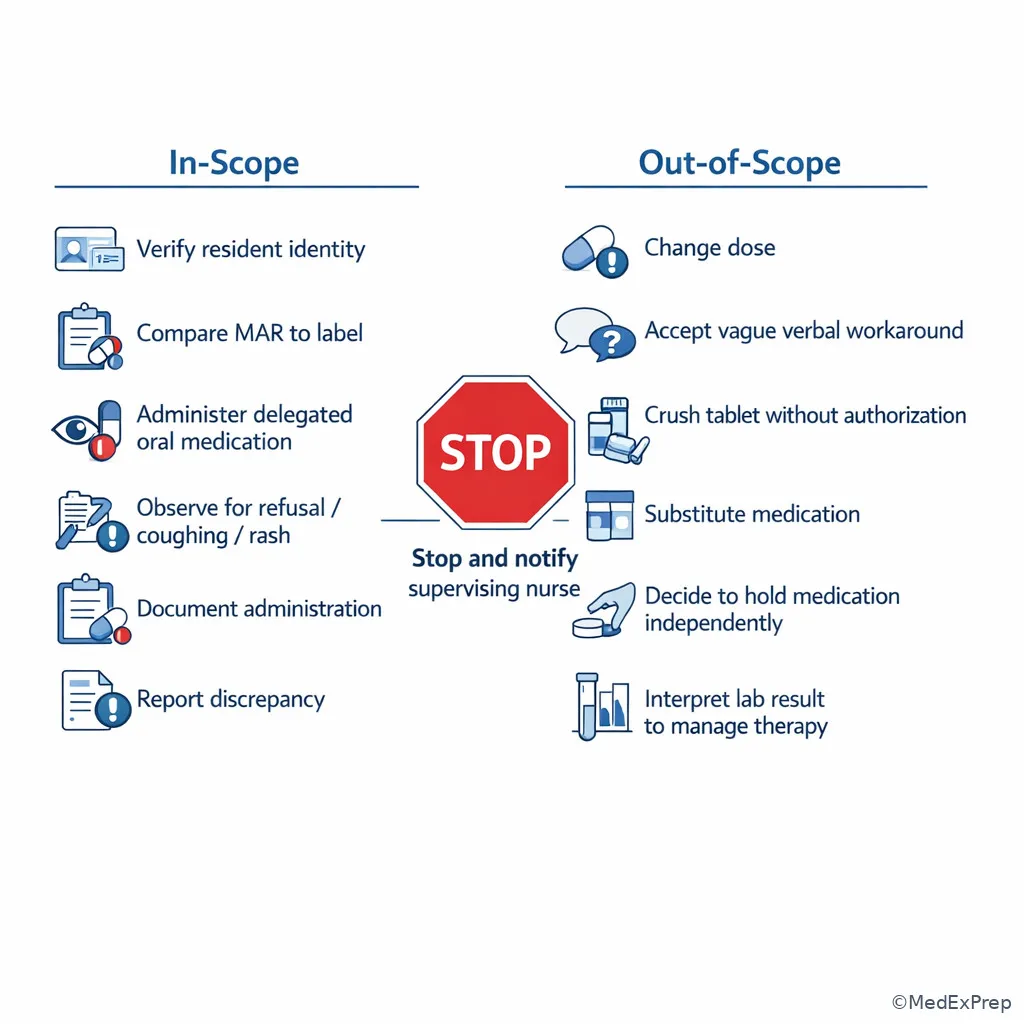
See Fig 3 when deciding whether an answer choice stays within the aide role. If the option requires you to make a treatment decision instead of following a clear delegated procedure, reject it.
B. Worked example
A 76-year-old long-term-care resident with Parkinson disease and chronic constipation is due for carbidopa-levodopa 25/100 mg PO at 0900. He says the pill is hard to swallow and asks you to crush it in applesauce “like they did at the hospital.” He also has diabetes and asks if taking it late will hurt his blood sugar. The MAR lists the scheduled oral dose, but there is no specific notation about crushing. Another aide says, “It’s fine, just crush it so he gets it.”
Identify the task: determine the safest next action within role. Extract key facts: resident reports swallowing difficulty; crushing is not specifically authorized in what you have; another staff opinion is not a valid authorization; diabetes is distracting noise. Apply the rule: deciding to crush or alter a dosage form without authorization is out of scope. Eliminate distractors: do not crush because “it helps adherence”; do not tell the resident to skip; do not make a judgment about timing effects on another condition. Verify: hold administration as required by policy, notify the supervising nurse, and document the observed swallowing concern and action taken per policy.
C. Exam trap
D. Checkpoint
Question: A resident is due for metoprolol 25 mg PO at 0800. The resident's daughter states that the prescriber told the family to increase it to 50 mg starting today, but the MAR still shows 25 mg. What is the most appropriate next step?
- A. Administer 50 mg because family members often receive updates first - Tempting because it appears responsive to new information, but family report is not an authorized medication order for the aide to act on.
- B. Administer 25 mg because the MAR is the only document that matters - Tempting because sticking to the record feels safer, but a claimed change creates a discrepancy that must be clarified before proceeding.
- C. Hold the medication and notify the supervising nurse for clarification according to policy - Correct because the action stays within role, addresses the discrepancy, and protects the resident.
- D. Ask the daughter to sign a note confirming the change and then administer 50 mg - Tempting because it creates written support, but it still does not create a valid authorization for dose change.
- True or False: A medication aide may independently decide to crush a tablet if the resident requests it. False.
- The safest response to a dose discrepancy is hold per policy and notify the supervising nurse.
- Name 3 out-of-scope actions: changing dose, changing route/form, independently holding/restarting/substituting.
1.1.1.3 Exam stem decoding: identify the tested issue before choosing the answer
A. Explanation
Exam takeaway: The best answer usually follows from one trigger clue plus one governing rule.
The decision conflict here is: Do you answer based on the whole story, or on the single tested clue that controls the safe next action? On board-style items, many details are included to mimic real work. Not every detail matters equally. You should identify the one clue that changes what you are allowed to do. That clue is often a mismatch, a resident barrier, a missing parameter, or a role-boundary issue.
WHY THIS IS TESTED: test writers deliberately add noise. Age, chronic diagnoses, old labs, busy staff, family pressure, and resident preferences can all distract from the real issue. The rule that resolves the conflict is: the main safety problem outranks convenience details. If the medication label is expired, that matters more than the fact that the resident is late for breakfast. If the resident begins coughing when swallowing, that matters more than the schedule pressure.
An efficient decoding method is to read the last line first, then scan for the trigger clue, then classify the domain, then reject shortcut answers. This avoids over-reading and helps under timed conditions.
Exam takeaway: Circle the trigger clue that changes the safe action, then ignore the noise.
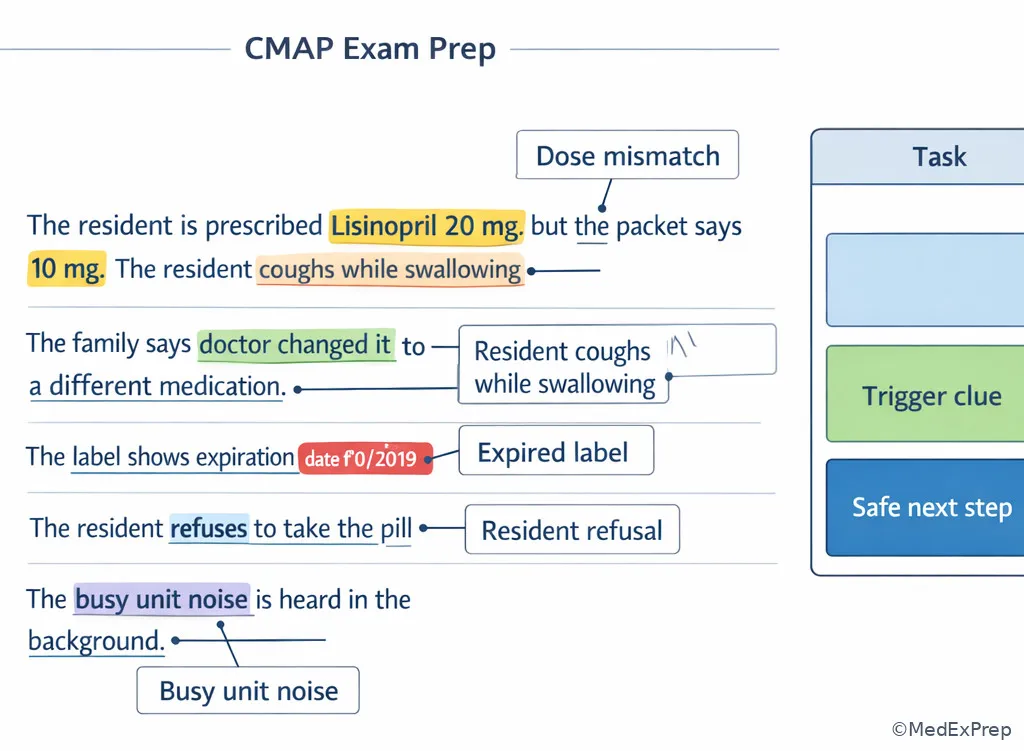
B. Worked example
An 88-year-old resident with heart failure, chronic kidney disease, and hearing loss is due for furosemide 40 mg PO at 1400. The resident has just returned from physical therapy and is tired. The aide notices the medication cup contains one white tablet, but the blister package in hand says furosemide 20 mg. A coworker states that “two twenties equal forty, so it’s fine,” but only one tablet is in the cup. The resident asks for water and says she wants to lie down.
Identify the task: choose the most appropriate next step. Extract key facts: order requires 40 mg; visible supply/cup does not match that dose; coworker logic is tempting but incomplete because only one 20 mg tablet is present. Resident fatigue is noise. Apply rule: D4 verification and D5 sequencing control the situation. Eliminate distractors: do not assume another tablet was already taken; do not administer first and correct later; do not document after the fact as if the full dose was given. Verify: stop before administration, reconcile the discrepancy with the supervising nurse per policy, and document appropriately if administration is delayed or omitted.
C. Exam trap
D. Checkpoint
Question: Which single clue most strongly changes a routine medication pass into a stop-and-clarify situation?
- A. The resident says the pill tastes bitter - Tempting because resident comments matter, but taste alone does not automatically create a verification stop.
- B. The medication cup is ready before the resident is seated - Tempting because sequence matters, but this can be corrected without necessarily requiring clarification.
- C. The dose on the label does not match the dose on the MAR - Correct because a dose mismatch prevents safe administration until resolved.
- D. The unit is short-staffed and the pass is behind schedule - Tempting because time pressure is real, but it does not justify bypassing safety checks.
1.1.1.4 The safest-next-step framework: a repeatable answer method for CMAP items
A. Explanation
Exam takeaway: Use the same five-step method on every scenario to avoid shortcut distractors.
This is the lesson’s main practical tool. The decision conflict is: Should you respond to the first plausible answer or force yourself through a structured reasoning chain? The correct choice is the structured chain. On the CMAP exam, unsafe choices often sound efficient because they skip a step. A fixed method protects you from those traps.
WHY THIS IS TESTED: scenario questions measure process discipline. The exam is less interested in whether you recognize a drug name than whether you act safely when the situation becomes imperfect. The five-step framework is: identify task, extract key facts, apply rule, eliminate distractors, verify/document/escalate. This sequence mirrors course goals and helps across all later chapters.
The framework especially helps when two answer choices both sound reasonable. Example: “administer and then report” versus “hold and clarify first.” The deciding issue is often whether safe verification is complete. If it is not complete, the answer is rarely to proceed first. See Fig 4.
Exam takeaway: When a discrepancy or role-limit clue appears, stop before administration and move into clarification or escalation.
flowchart TD
A[Read the question] --> B[Identify the task]
B --> C[Find key facts: dose route time resident clue]
C --> D{Safe to proceed exactly as ordered and authorized?}
D -->|Yes| E[Perform delegated step]
E --> F[Observe and document]
D -->|No| G[Do not proceed]
G --> H[Protect resident]
H --> I[Notify supervising nurse or follow policy]
I --> J[Document/report factually per policy]
B. Worked example
An 81-year-old resident with atrial fibrillation, hypertension, and arthritis is due for apixaban 5 mg PO at 2000. At the bedside, he says he had a nosebleed earlier and asks whether he should skip it tonight. He also mentions that his grandson brought him salty snacks. The MAR is present, the blister pack matches the order, and the resident identity is confirmed. The candidate is unsure whether a nosebleed means the medication should be held.
Identify the task: safest next action when a resident reports a potential bleeding issue before a scheduled dose. Extract key facts: medication due now; order and label match; resident reports a concerning symptom; deciding whether to hold based on symptom interpretation may exceed role depending on policy. Salty snacks are noise. Apply rule: D6 observation plus D3 scope. Eliminate distractors: do not reassure and give automatically; do not independently decide the drug must be permanently stopped; do not ignore the report because the label matches. Verify: follow policy for holding when safety concerns are present and notify the supervising nurse immediately for direction, while documenting the resident statement and action taken per policy.
C. Exam trap
D. Checkpoint
Question: Which answer best reflects the CMAP safest-next-step framework?
- A. Read the stem, look for the drug name, and choose the answer that sounds most clinically advanced - Tempting because expertise feels impressive, but this exam rewards safe role-limited action, not advanced independent judgment.
- B. Identify the task, extract the trigger facts, apply the governing rule, eliminate shortcuts, then verify/document/escalate - Correct because it matches the structured method designed for CMAP scenario items.
- C. Focus first on the resident's diagnoses because medical complexity always determines the answer - Tempting because comorbidities matter, but often a single process or scope clue is more decisive than diagnosis lists.
- D. Choose the action that keeps the medication on schedule whenever possible - Tempting because timing matters, but schedule never overrides an unresolved safety problem.
- The five-step framework starts with identify the task.
- True or False: If the label matches the MAR, administration should always proceed. False.
- The final step after choosing the safe action is usually verify and document/escalate.
1.1.1.5 Integration: how the domains combine in multi-step questions
A. Explanation
Exam takeaway: Many questions test more than one domain, but one domain usually controls the immediate next step.
By the end of the course, most questions will not stay inside one domain. A single stem may involve D4 verification, D6 observation, and D7 documentation. The conflict is: Do you treat all problems as equal, or identify which one controls the immediate next step? The resolving rule is priority: the issue that makes proceeding unsafe controls the first action.
WHY THIS IS TESTED: real medication passes are not neatly separated into chapters. A resident may refuse, the label may be unclear, and timing may be late. The exam tests whether you can prioritize safely. For instance, if the resident is actively coughing and cannot swallow, that immediate safety concern controls the action, even if a documentation entry also needs correction later.
This prioritization skill keeps you from being tricked by answers that are eventually correct but not the best next step. “Document the omission” may be necessary, but first you may need to hold, secure the medication, and notify the supervising nurse. “Recalculate the dose” may be relevant, but if the label is expired, the first step is not calculation.
Exam takeaway: In mixed-domain stems, identify the issue that makes proceeding unsafe and act on that first.
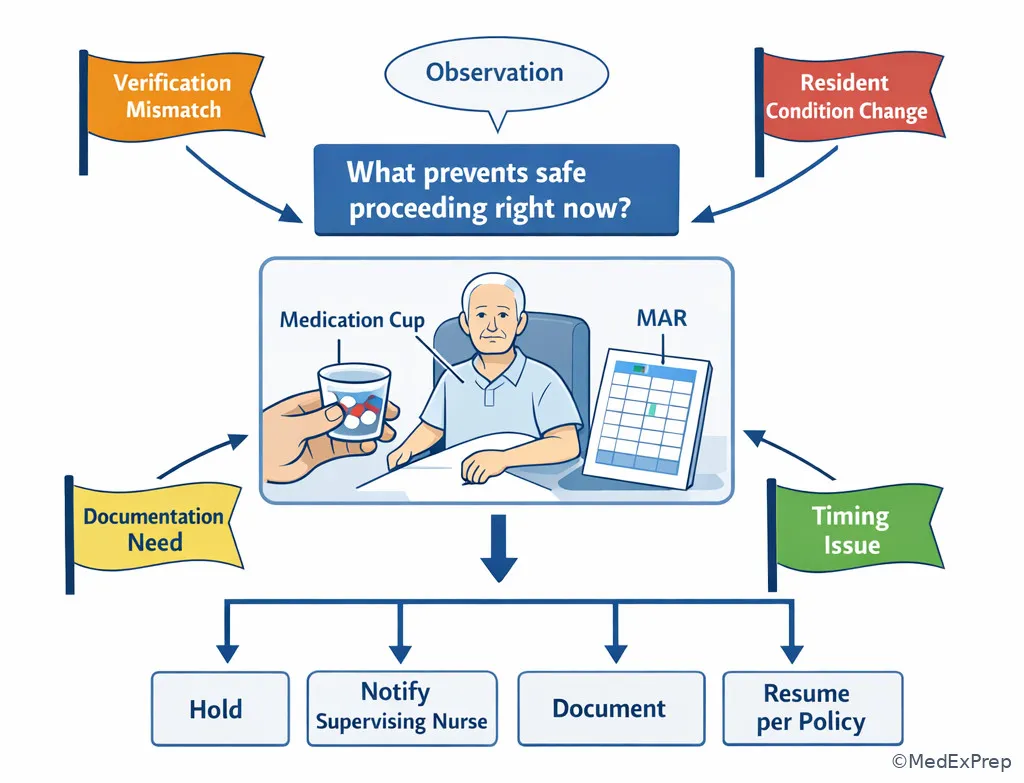
See Fig 5. On multi-domain stems, think in two layers: immediate safety action first, follow-through tasks second.
B. Worked example
An 85-year-old resident with dementia, type 2 diabetes, and chronic pain is due for metformin 500 mg PO at 1700. You verify identity, but the resident becomes agitated and says, “No pills today.” While speaking calmly, you notice the tablet packet for another resident with a similar last name is sitting on the top shelf of the cart next to the correct bin. A coworker suggests documenting refusal now and moving on because dinner service is starting.
Identify the task: choose the best next action in a combined refusal and wrong-resident-risk situation. Extract key facts: resident is refusing; there is also a name-alert/wrong-product risk nearby; similar last name increases error risk; time pressure is noise. Apply rule: immediate control issue is D5/D9 safety of medication handling plus D6 refusal. Eliminate distractors: do not leave mixed-up medication items unattended; do not document before securing the situation; do not persuade aggressively or conceal the near miss. Verify: secure and separate medications correctly, follow refusal procedure, notify the supervising nurse per policy if required, and document refusal and relevant facts objectively.
C. Exam trap
D. Checkpoint
Question: In a mixed-domain stem, what should determine the first action?
- A. The task that is fastest to complete - Tempting under time pressure, but speed does not define priority.
- B. The task that the resident prefers - Tempting because resident cooperation matters, but safety threats still control the immediate next step.
- C. The issue that makes proceeding unsafe unless addressed first - Correct because exam priority follows immediate safety.
- D. The domain that appears earliest in the chapter outline - Tempting if using memorized order, but stems are prioritized by risk, not chapter sequence.
Exam Traps & Differentiators
Most common wrong answer and why: The most common wrong answer is the option that “solves” the immediate workflow problem by bypassing a safety check or role boundary. It is tempting because it sounds efficient, resident-friendly, or experienced. It is wrong because the exam prioritizes safe, authorized, documented action, not improvisation.
| Looks similar | Actually tested concept | What separates them | Best exam response pattern |
|---|---|---|---|
| Late medication time | Verification mismatch | If order/label/dose is unclear, safety issue outranks schedule pressure | Hold and clarify first |
| Resident preference | Role boundary | Resident request does not authorize dose change or crushing | Stop and notify supervising nurse |
| Routine charting task | Urgent observation issue | Active coughing, rash, or condition change comes before documentation completion | Protect, report, then document |
| Calculation detail | Wrong product risk | Accurate math does not fix a product mismatch | Verify correct product first |
| Family report of change | Unverified order discrepancy | Family statements are not authorized orders for action | Clarify through supervising nurse/policy |
If the stem says... think...
- “The family says the dose changed” - think discrepancy requiring clarification, not dose adjustment.
- “The resident always takes it this way” - think habit is not authorization.
- “The nurse is busy” - think workflow pressure is noise; safety rules still apply.
- “Just this once” - think shortcut distractor.
- “The label is hard to read” - think do not guess; stop and verify.
- “The resident begins coughing with oral medication” - think barrier/unsafe to continue; escalate per policy.
Exam takeaway: The most tempting wrong answers usually trade safety for speed, convenience, or false confidence.
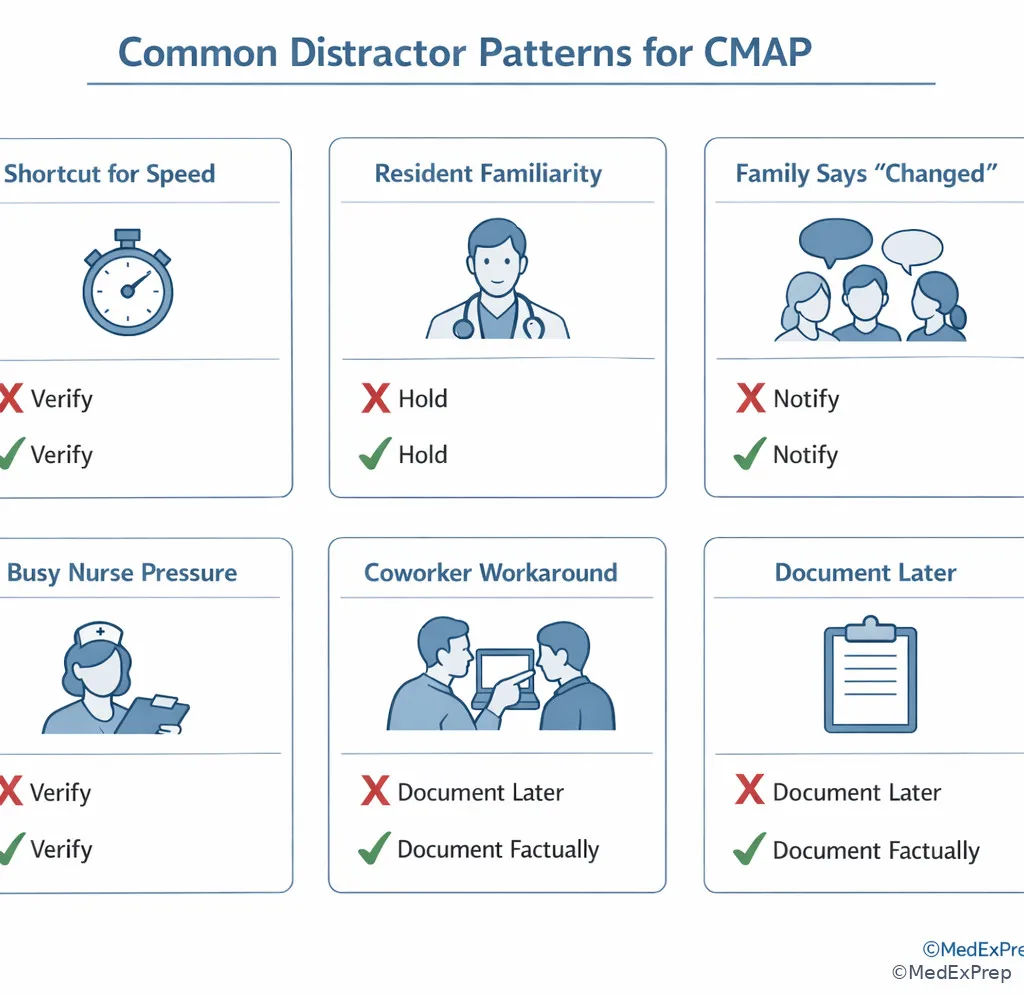
Tables
| High-yield reference item | Use on exam | Unsafe shortcut to reject |
|---|---|---|
| Order + label + MAR must align | Verification items | Assuming a near match is acceptable |
| Resident condition can override routine progression | Observation/escalation items | Giving first and reporting later |
| Role limit controls independent choices | Scope items | Changing dose or form to be helpful |
| Documentation is factual and prompt | Charting/reporting items | Back-charting or documenting before completion |
| Time pressure never cancels a safety check | Best next step items | Skipping confirmation because the pass is late |
| When unclear, follow policy and notify supervising nurse | Vague/variable policy items | Inventing a workaround |
| Choice pattern | Usually correct when... | Usually wrong when... |
|---|---|---|
| Proceed with administration | Identity, order, label, route, dose, time, and resident readiness are all confirmed | Any discrepancy, refusal, or unsafe condition remains unresolved |
| Hold and clarify | There is a mismatch, missing information, or unsafe condition per policy | The task is clear and fully authorized with no safety concern |
| Notify supervising nurse | The issue exceeds role, requires clinical judgment, or policy requires reporting | The option is used to avoid routine delegated duties you can safely perform |
| Document refusal/omission | The event actually occurred and immediate safety actions are complete | The answer charts before the event is resolved or before required reporting |
| Recalculate/remeasure | The product is correct and the task is a true math issue | The real problem is a wrong product, unclear order, or scope limit |
| Scenario clue | Domain classification | Differential with similar-looking clue | Discriminator |
|---|---|---|---|
| Unreadable expiration date | D4 verification | Busy medication pass | The label problem blocks safe use; workload does not fix it |
| Resident says “not now” | D6 refusal/barrier | Routine rescheduling request | Refusal requires refusal procedure, not independent time change |
| Tablet seems too large to swallow | D3 scope + D6 barrier | Preference for applesauce | Need for alteration triggers authorization issue |
| Charting question after omitted dose | D7 documentation | Medication error prevention | D7 asks what/how to record; D9 asks how to prevent or report the event |
| Two residents with similar names | D4 verification + D9 prevention | Resident memory lapse | Name-alert is a system safety risk, not just confusion |
Algorithm / Approach
Exam takeaway: Use this sequence whenever the stem asks for the most appropriate next step.
Exam takeaway: Think of exam items as bedside workflows: verify, decide safety, act in scope, then document and report.
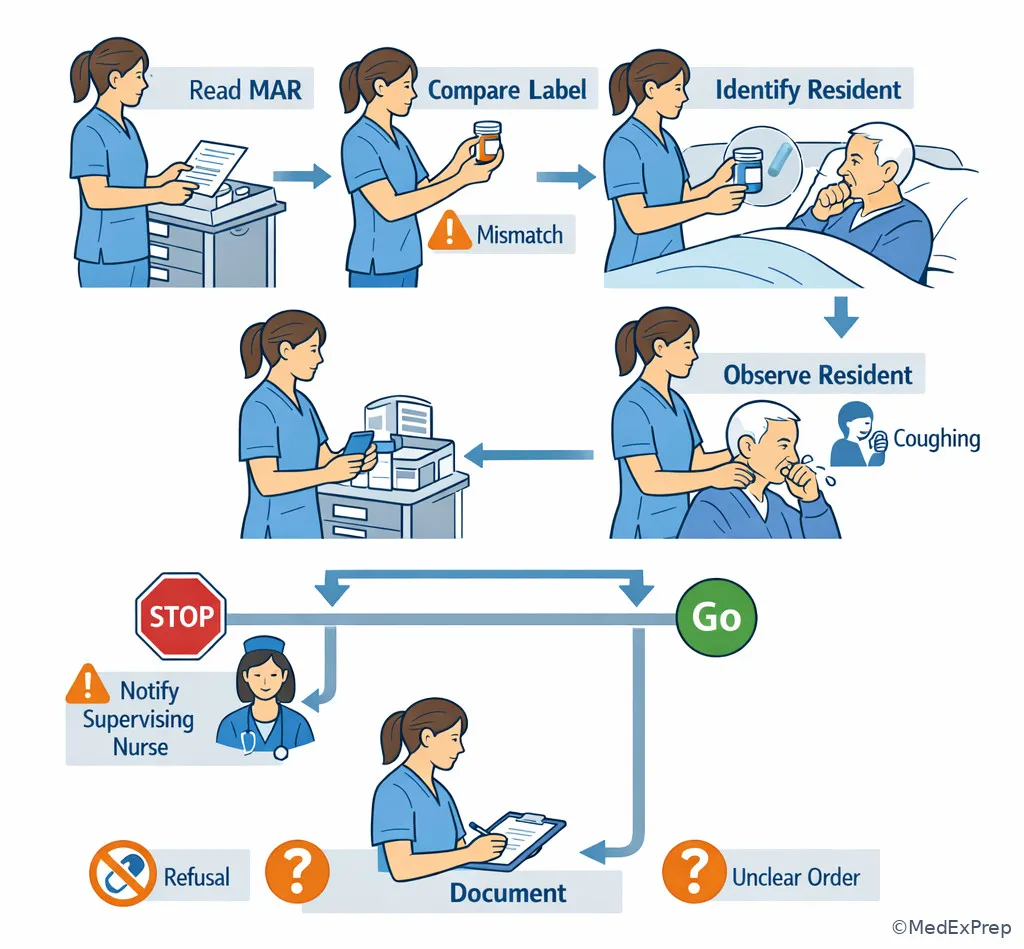
See Fig 6. This visual turns abstract test strategy into a bedside routine. The more you connect questions to workflow, the fewer shortcut distractors will fool you.
Rapid Review
- D1 - map the tested task before evaluating options.
- D3 scope - if the option changes therapy, reject it.
- D4 verification - mismatch beats schedule pressure.
- D5 sequencing - correct order matters when multiple safe steps are listed.
- D6 observation - new resident problem can stop routine administration.
- D7 documentation - factual, prompt, after the event or action as required by policy.
- D8 calculations - math is irrelevant if the product itself is wrong or unclear.
- D9 prevention - near miss still matters; secure safety and report per policy.
- Family request - not a valid dose change authorization.
- Resident familiarity - does not replace label/order verification.
- Busy unit - noise, not permission for shortcuts.
- Best next step - immediate safety issue first, follow-through second.
- Mixed-domain stem - choose the issue that prevents safe proceeding.
- Good distractor - sounds efficient, helpful, or experienced, but bypasses policy or scope.
Self-check quiz
1. A CMAP candidate is reviewing a question about acetaminophen 650 mg PO every 6 hours as needed. The stem asks which domain most directly addresses comparing the medication label with the MAR before administration. Which is the most appropriate answer?
- A. D2 Foundations of Medication Administration
- B. D4 Orders, Labels, and Verification
- C. D7 Documentation and Communication
- D. D9 Error Prevention, Quality, and Review
2. A resident is due for senna 8.6 mg PO at bedtime. The candidate notices an answer option that says, “Change the schedule to the morning because the resident prefers it.” Which domain is most directly being violated by that option?
- A. D1 Exam Blueprint and Test Strategy
- B. D3 Candidate Role, Scope, and Responsibility
- C. D6 Observation, Issues, and Escalation
- D. D8 Calculations, Timing, and Protocol Application
3. An 84-year-old resident with hypertension and chronic back pain is scheduled for amlodipine 5 mg PO daily. The MAR lists 5 mg, but the card in hand reads amlodipine 10 mg. The resident says, “I always take the small white one,” and breakfast trays are arriving. What is the most appropriate next step?
- A. Administer the 10 mg tablet because the resident recognizes it
- B. Split the 10 mg tablet and administer 5 mg
- C. Hold administration and notify the supervising nurse for clarification per policy
- D. Document the dose as refused and return later
4. A 79-year-old resident with Parkinson disease and diabetes is due for carbidopa-levodopa 25/100 mg PO at 0900. He says he cannot swallow the tablet and asks for it crushed in pudding. The MAR lists the medication but does not indicate crushing instructions. What is the most appropriate next step?
- A. Crush the tablet because swallowing difficulty makes the request reasonable
- B. Offer extra water and insist he swallow it whole now
- C. Hold the medication as required by policy and notify the supervising nurse
- D. Skip documentation unless the nurse later confirms a change
5. An 86-year-old resident with heart failure, osteoarthritis, and mild confusion is due for furosemide 20 mg PO at 1400. The resident refuses, saying, “Not now, my family is visiting.” The label and MAR match. Which action best reflects correct domain prioritization?
- A. Reclassify the issue as a calculation question because timing changed
- B. Follow refusal procedure, notify/report per policy, and document factually
- C. Administer anyway because the medication was due at 1400
- D. Change the dose to half and try again later
6. An 82-year-old resident with atrial fibrillation, chronic kidney disease, and seasonal allergies is due for apixaban 5 mg PO at 2000. Identity is confirmed and the label matches the MAR. Before administration, the resident reports a nosebleed earlier in the evening and asks if the dose should be skipped. Which is the most appropriate next step?
- A. Administer the dose because verification is complete and a nosebleed can be minor
- B. Independently hold tonight's dose and document that the medication was discontinued
- C. Follow policy for an unsafe condition, withhold if required, and notify the supervising nurse immediately
- D. Ask the resident to decide whether to take it now or later
7. An 87-year-old resident with dementia, chronic pain, and type 2 diabetes is due for metformin 500 mg PO with dinner. She refuses the medication and pushes the cup away. At the same moment, you notice a blister card for another resident with a similar last name resting beside her medications on the cart. Which is the best next step?
- A. Document refusal immediately and continue the pass
- B. Secure and separate the medications correctly, then follow refusal procedure and reporting/documentation per policy
- C. Re-offer the wrong-resident blister card because the names are similar and dinner is beginning
- D. Leave both medications in place until the supervising nurse completes the entire pass
8. A 90-year-old resident with hypertension, constipation, and hearing impairment is scheduled for lisinopril 10 mg PO daily and docusate 100 mg PO daily. The family reports the prescriber “changed the blood pressure pill yesterday,” but the MAR still lists lisinopril 10 mg and the available blister pack is lisinopril 20 mg. The resident says, “Just give me what my daughter said.” What is the most appropriate next step?
- A. Administer lisinopril 20 mg because the family likely received updated instructions
- B. Administer lisinopril 10 mg by splitting the 20 mg tablet without further clarification
- C. Hold the lisinopril and notify the supervising nurse for clarification before administration
- D. Substitute docusate first and come back later without reporting the discrepancy
Answer key
1. Correct answer: B. D4 Orders, Labels, and Verification
- A. D2 Foundations of Medication Administration - Tempting because basic medication concepts support all other tasks, but the stem specifically asks about comparing the label with the MAR. Single clue: “comparing the medication label with the MAR.”
- B. D4 Orders, Labels, and Verification - Correct because D4 directly covers comparing the authorized record to the label before administration. Single clue: verification task.
- C. D7 Documentation and Communication - Tempting because MAR is also a documentation tool, but the question is about pre-administration checking, not recording the event. Single clue: before administration.
- D. D9 Error Prevention, Quality, and Review - Tempting because verification prevents errors, but D9 is broader prevention/review rather than the direct operational verification domain. Single clue: label-MAR comparison is a D4 subskill.
2. Correct answer: B. D3 Candidate Role, Scope, and Responsibility
- A. D1 Exam Blueprint and Test Strategy - Tempting because this lesson is about structure, but the problem in the option is acting beyond authority. Single clue: “change the schedule.”
- B. D3 Candidate Role, Scope, and Responsibility - Correct because independently changing a medication schedule based on preference exceeds the delegated role unless specifically authorized by policy and direction. Single clue: unauthorized schedule change.
- C. D6 Observation, Issues, and Escalation - Tempting because resident preference may create an issue, but the stem focuses on unauthorized action, not a clinical barrier. Single clue: the question asks about role violation.
- D. D8 Calculations, Timing, and Protocol Application - Tempting because schedule is involved, but D8 does not authorize independent schedule changes. Single clue: timing is present, but scope is decisive.
3. Correct answer: C. Hold administration and notify the supervising nurse for clarification per policy
- A. Administer the 10 mg tablet because the resident recognizes it - Tempting because residents often notice familiar medications, but resident recognition does not resolve a dose mismatch. Single clue: MAR says 5 mg while label says 10 mg.
- B. Split the 10 mg tablet and administer 5 mg - Tempting because mathematically it seems to match the order, but altering dosage form without authorization/policy confirmation is unsafe and may exceed role. Single clue: no authorization to split is given.
- C. Hold administration and notify the supervising nurse for clarification per policy - Correct because an unresolved dose discrepancy prevents safe administration. Single clue: strength mismatch.
- D. Document the dose as refused and return later - Tempting because delay may occur, but the resident did not refuse; the problem is verification. Single clue: resident recognition is not refusal.
4. Correct answer: C. Hold the medication as required by policy and notify the supervising nurse
- A. Crush the tablet because swallowing difficulty makes the request reasonable - Tempting because it seems compassionate and practical, but the request does not authorize altering the dosage form. Single clue: no crushing instruction is provided.
- B. Offer extra water and insist he swallow it whole now - Tempting because it tries to preserve the schedule, but swallowing difficulty is an administration barrier, not something to push through. Single clue: “cannot swallow the tablet.”
- C. Hold the medication as required by policy and notify the supervising nurse - Correct because the resident has a swallowing barrier and the candidate may not independently decide to crush or force administration. Single clue: swallowing difficulty plus no authorization to alter form.
- D. Skip documentation unless the nurse later confirms a change - Tempting because the situation is unresolved, but observations and actions still require appropriate factual reporting/documentation per policy. Single clue: documentation cannot be ignored.
5. Correct answer: B. Follow refusal procedure, notify/report per policy, and document factually
- A. Reclassify the issue as a calculation question because timing changed - Tempting because “not now” sounds like rescheduling, but the immediate issue is refusal. Single clue: the resident explicitly refuses.
- B. Follow refusal procedure, notify/report per policy, and document factually - Correct because refusal is a D6 issue with D7 follow-through. Single clue: resident refusal despite correct label/MAR match.
- C. Administer anyway because the medication was due at 1400 - Tempting because schedule matters, but due time does not override refusal. Single clue: resident says no.
- D. Change the dose to half and try again later - Tempting because it sounds like compromise, but changing dose independently is out of scope. Single clue: unauthorized dose change.
6. Correct answer: C. Follow policy for an unsafe condition, withhold if required, and notify the supervising nurse immediately
- A. Administer the dose because verification is complete and a nosebleed can be minor - Tempting because identity and label checks are complete, but a new possible bleeding concern changes the safety picture before administration. Single clue: reported nosebleed before dose.
- B. Independently hold tonight's dose and document that the medication was discontinued - Tempting because holding may be appropriate, but the candidate cannot independently discontinue therapy. Single clue: “discontinued” exceeds role.
- C. Follow policy for an unsafe condition, withhold if required, and notify the supervising nurse immediately - Correct because observation concerns plus role boundaries require prompt escalation and policy-based withholding if indicated. Single clue: symptom report before administration.
- D. Ask the resident to decide whether to take it now or later - Tempting because it respects autonomy, but it improperly shifts clinical safety judgment to the resident and ignores escalation needs. Single clue: safety concern requires staff response, not resident decision-making alone.
7. Correct answer: B. Secure and separate the medications correctly, then follow refusal procedure and reporting/documentation per policy
- A. Document refusal immediately and continue the pass - Tempting because refusal must be charted, but it ignores the active wrong-resident error risk on the cart. Single clue: another resident's blister card is beside the current medications.
- B. Secure and separate the medications correctly, then follow refusal procedure and reporting/documentation per policy - Correct because immediate safety requires controlling the wrong-resident risk before routine follow-through tasks. Single clue: mixed medication items plus refusal.
- C. Re-offer the wrong-resident blister card because the names are similar and dinner is beginning - Tempting only under extreme time pressure, but similar names are a classic wrong-resident trap and never justify proceeding. Single clue: similar last name creates a verification hazard.
- D. Leave both medications in place until the supervising nurse completes the entire pass - Tempting because escalation is important, but leaving an active mix-up unattended is not the safest immediate action. Single clue: unsafe setup must be secured now.
8. Correct answer: C. Hold the lisinopril and notify the supervising nurse for clarification before administration
- A. Administer lisinopril 20 mg because the family likely received updated instructions - Tempting because family may have recent information, but family report is not a valid authorization for dose change. Single clue: MAR still lists 10 mg.
- B. Administer lisinopril 10 mg by splitting the 20 mg tablet without further clarification - Tempting because it appears to match the MAR mathematically, but the discrepancy about a reported change plus alteration of the tablet requires clarification, not assumption. Single clue: unresolved order conflict remains.
- C. Hold the lisinopril and notify the supervising nurse for clarification before administration - Correct because there is a reported dose change plus a mismatch between MAR and available strength. Single clue: combined family-report discrepancy and strength mismatch.
- D. Substitute docusate first and come back later without reporting the discrepancy - Tempting because the other medication may still be routine, but the lisinopril discrepancy must still be reported; “come back later” is not a complete safe response. Single clue: the question asks about the discrepant blood pressure medication next step.