






ECS Components And Enzymes
What you’ll learn
- Foundational Knowledge and Terminology: Objective - ECS architecture -> Name the core ECS components: endogenous ligands, receptors, synthesis enzymes, degradation enzymes.
- Foundational Knowledge and Terminology: Objective - Enzyme recognition -> Distinguish which enzymes make versus break down anandamide and 2-AG.
- Applied Decision-Making and Scenario Analysis: Objective - Product/mechanism interpretation -> Interpret whether a stem is describing direct receptor agonism, indirect ECS modulation, or a vague marketing claim.
- Interpretation, Documentation, and Communication: Objective - Counseling language -> Explain ECS basics accurately without overstating evidence or stepping outside pharmacist scope.
- Processes, Workflows, and Procedures: Objective - Medication profile review -> Recognize when enzyme-related ECS language in orders, notes, or products requires clarification or escalation.
Blueprint mapping
- DOMAIN: Foundational Knowledge and Terminology -> ECS structure and vocabulary
- DOMAIN: Applied Decision-Making and Scenario Analysis -> Mechanism-based interpretation of cannabis and cannabinoid products
- DOMAIN: Interpretation, Documentation, and Communication -> Accurate, role-appropriate explanation of ECS concepts
- DOMAIN: Professional Standards, Ethics, and Responsibilities -> Avoid unsupported mechanism claims and stay within pharmacist scope
Why it matters
- Exam stems often hide the answer in mechanism language: if you know which molecule or enzyme belongs where, you eliminate attractive distractors fast.
- Pharmacists are commonly asked to explain how cannabis-related products “work”; the high-yield task is to give accurate, bounded counseling without making diagnostic or efficacy claims beyond evidence.
- Many product descriptions misuse terms like “boosts endocannabinoids” or “targets ECS enzymes”; you must know when that wording is plausible, incomplete, or requires verification.
- Later topics on receptor roles, homeostasis, pharmacokinetics, and drug interactions all assume this component-level map; this is the foundation for the rest of the course.
Key Terms & Must-Know Facts
Key terms
- Endocannabinoid system (ECS): Signaling network involving endogenous ligands, receptors, enzymes, and downstream physiologic effects.
- Anandamide (AEA): Endogenous cannabinoid ligand often associated with partial CB1 activity.
- 2-arachidonoylglycerol (2-AG): Major endogenous ligand present at higher tissue levels than AEA in many settings.
- CB1 receptor: Cannabinoid receptor concentrated in the central nervous system; heavily tied to psychoactive effects.
- CB2 receptor: Cannabinoid receptor more associated with immune and peripheral tissues.
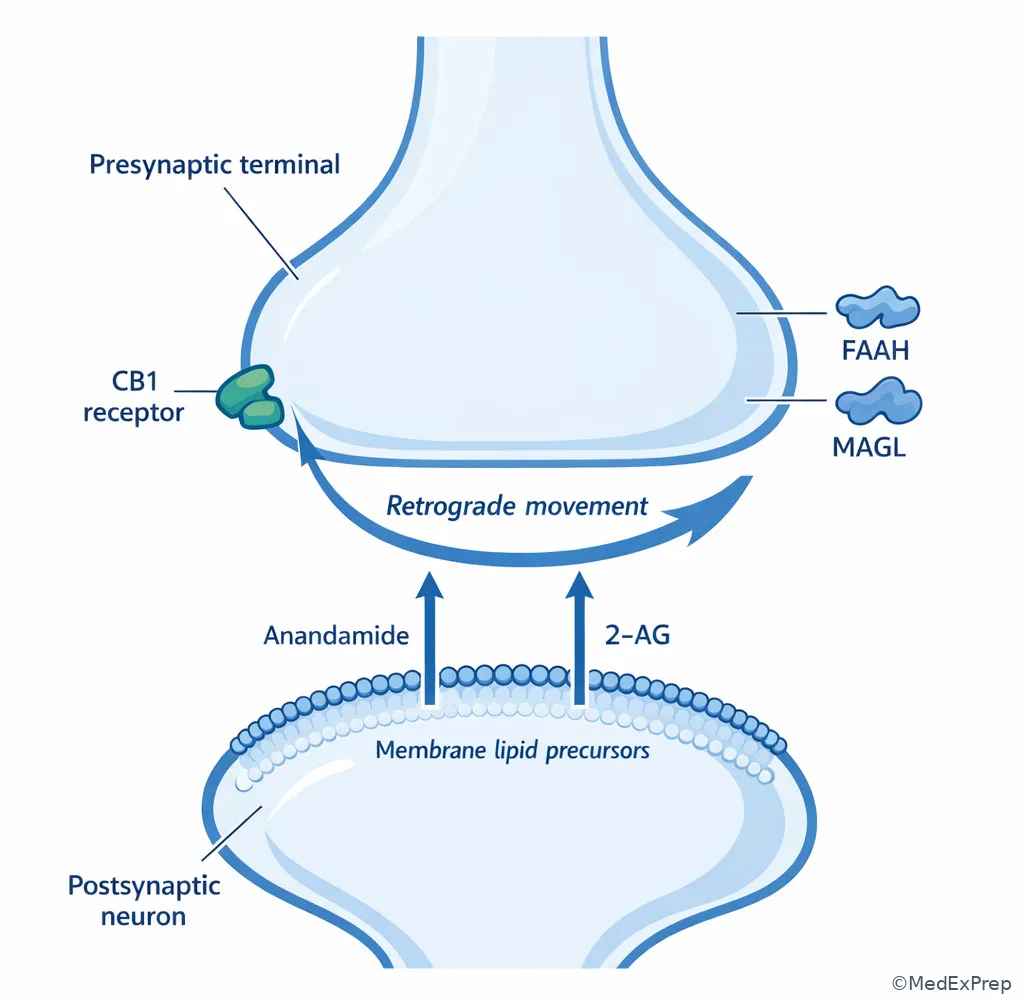
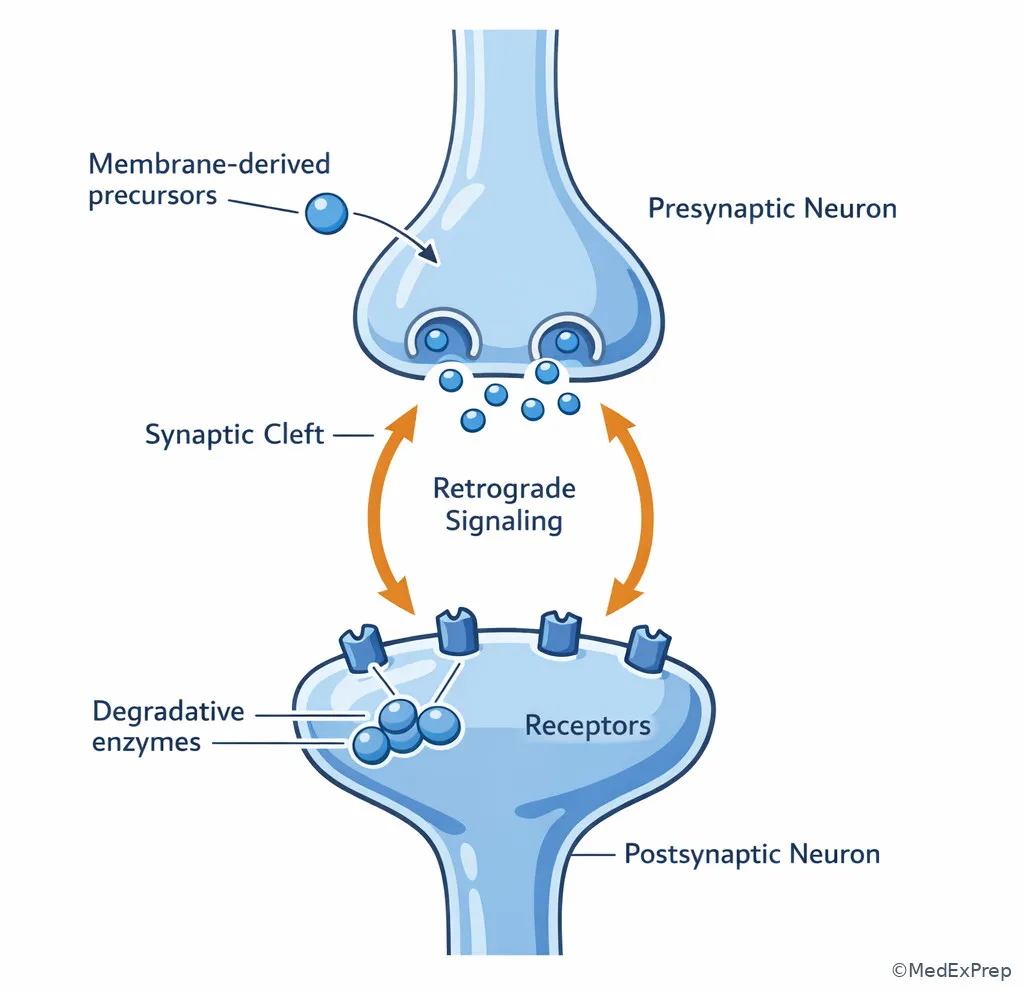
- Retrograde signaling: Postsynaptic production of endocannabinoids that travel backward to presynaptic terminals.
- NAPE-PLD: Key enzyme involved in anandamide synthesis.
- DAGL: Diacylglycerol lipase; key enzyme involved in 2-AG synthesis.
- FAAH: Fatty acid amide hydrolase; major enzyme that degrades anandamide.
- MAGL: Monoacylglycerol lipase; major enzyme that degrades 2-AG.
- On-demand synthesis: Endocannabinoids are generally produced when needed rather than stored in large vesicles like classic neurotransmitters.
- Tonic versus phasic signaling: Baseline versus stimulus-driven ECS activity.
- Indirect modulation: Altering ligand levels or signaling tone without directly agonizing CB receptors.
Must-know facts
- A high-yield pairing is AEA - FAAH and 2-AG - MAGL.
- Anandamide and 2-AG are endogenous ligands, not phytocannabinoids.
- The ECS includes ligands + receptors + synthesis enzymes + degradation enzymes; exam stems may omit one category as the hidden test point.
- Endocannabinoids are typically made on demand from membrane lipid precursors.
- 2-AG is usually treated as the more abundant endogenous cannabinoid signal in many tissues.
- FAAH inhibition raises anandamide tone; MAGL inhibition raises 2-AG tone.
- Knowing “which enzyme goes with which ligand” is more testable than memorizing every biosynthetic branch.
- Pharmacist exam questions emphasize mechanism interpretation, counseling accuracy, and claim verification, not speculative marketing language.
Exam takeaway: Organize stems into ligand, receptor, synthesis enzyme, or degradation enzyme before choosing an answer.
flowchart LR
A[Membrane lipids] --> B[Endocannabinoid synthesis]
B --> C[Anandamide AEA]
B --> D[2-AG]
C --> E[CB1 and CB2 signaling]
D --> E
C --> F[FAAH breakdown]
D --> G[MAGL breakdown]
E --> H[Homeostatic effects]
Exam takeaway: Match AEA with FAAH and 2-AG with MAGL to eliminate the most common mechanism distractors.
flowchart TB
A[Anandamide AEA] --> B[Synthesis: NAPE-PLD]
A --> C[Breakdown: FAAH]
D[2-AG] --> E[Synthesis: DAGL]
D --> F[Breakdown: MAGL]
C --> G[Lower AEA tone]
F --> H[Lower 2-AG tone]
Exam takeaway: Visualize postsynaptic ligand production and presynaptic receptor modulation to answer signaling-direction questions.
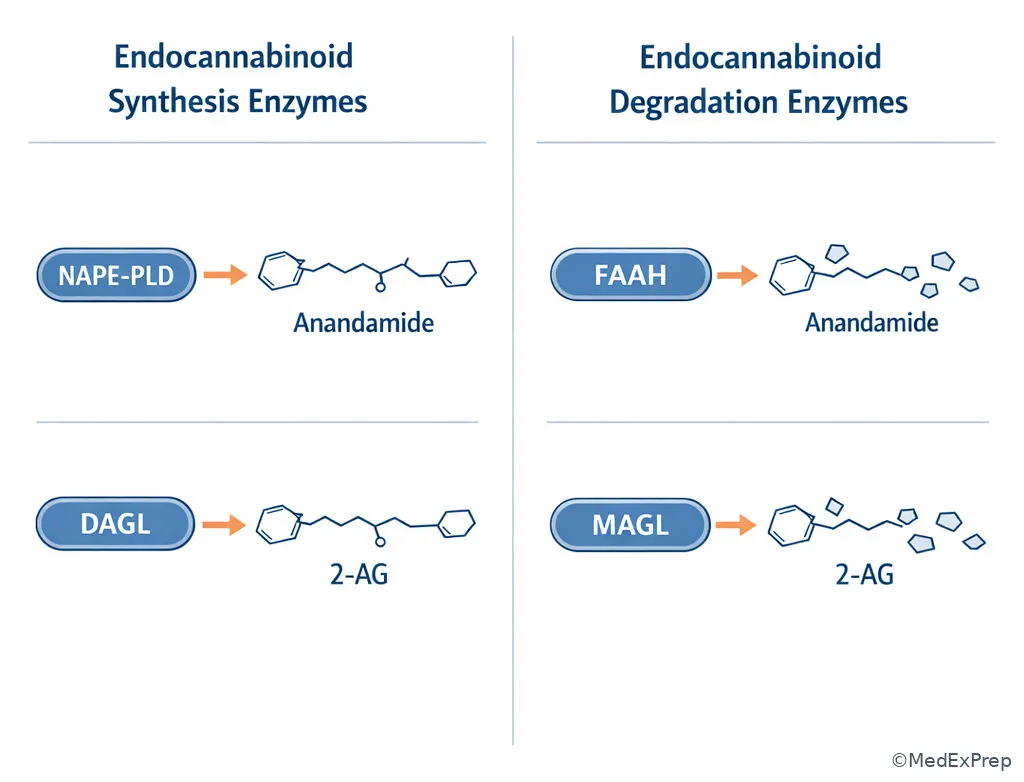
Exam takeaway: Separate synthesis enzymes from degradation enzymes when a product claims to alter ECS tone.
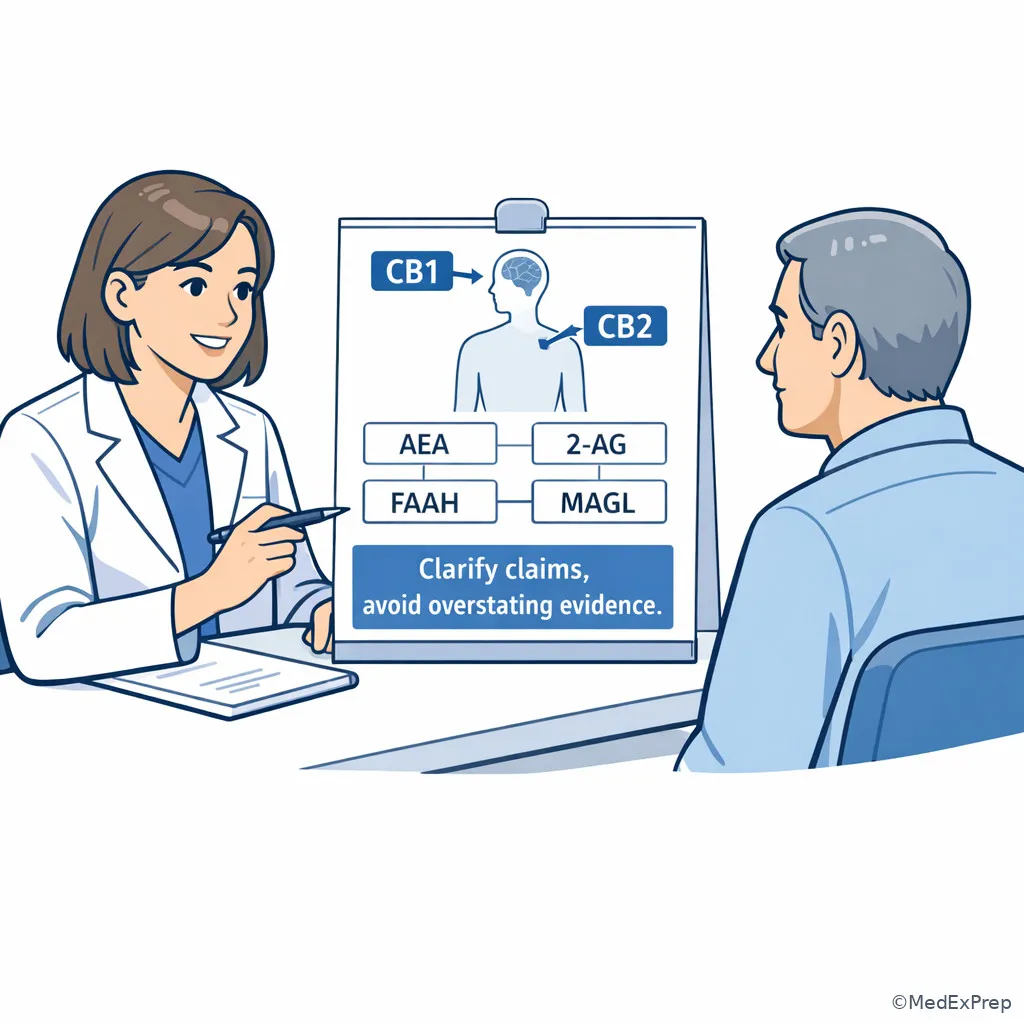
Exam takeaway: Keep explanations mechanism-based, evidence-bounded, and within pharmacist scope when patients ask how cannabis products work.
Exam takeaway: Decide whether a stem describes direct receptor action, endogenous ligand change, or a claim needing clarification before acting.
flowchart TD
A[Mechanism statement in stem] --> B{Named target?}
B -->|CB1 or CB2 agonist| C[Direct receptor action]
B -->|FAAH or MAGL inhibition| D[Indirect increase in endocannabinoids]
B -->|Vague boost balance support wording| E[Clarify evidence and source]
C --> F[Assess expected effects and safety]
D --> F
E --> G[Do not overstate mechanism]
Exam takeaway: Receptor location and direction of ligand travel are easier to remember when attached to a visual map.
Exam takeaway: Translate note language into mechanism categories to avoid mixing endogenous ligands with phytocannabinoids.
Exam takeaway: Recognize anandamide as an endogenous fatty-acid-derived ligand rather than a plant cannabinoid.
CCCCCC/C=C\C/C=C\C/C=C\C/C=C\CCCC(=O)NCCO
Exam takeaway: 2-AG is a glycerol ester endocannabinoid and is commonly paired with MAGL in exam questions.
CCCCCC/C=C\C/C=C\C/C=C\C/C=C\CCCCC(=O)OCC(O)CO
| Component | Category | Main testable association | High-yield cue |
|---|---|---|---|
| Anandamide (AEA) | Endogenous ligand | Broken down mainly by FAAH | Think “amide” with fatty acid amide hydrolase |
| 2-AG | Endogenous ligand | Broken down mainly by MAGL | Often more abundant signal |
| CB1 | Receptor | CNS-heavy distribution | Psychoactive pairing tested next topic |
| CB2 | Receptor | Immune/peripheral association | Inflammation/immune stems |
| NAPE-PLD | Synthesis enzyme | Anandamide formation | “Makes AEA” |
| DAGL | Synthesis enzyme | 2-AG formation | “Makes 2-AG” |
| FAAH | Degradation enzyme | Anandamide hydrolysis | Do not confuse with MAGL |
| MAGL | Degradation enzyme | 2-AG hydrolysis | Major 2-AG terminator |
| Term in stem | Best interpretation | Choose | Reject |
|---|---|---|---|
| CB1 agonist | Direct receptor activation | Mechanism-specific answer | Calling it an enzyme inhibitor |
| FAAH inhibitor | Indirectly increases anandamide tone | Enzyme modulation | Calling it direct phytocannabinoid receptor binding |
| MAGL inhibitor | Indirectly increases 2-AG tone | Ligand preservation | Confusing with AEA pathway |
| Supports ECS balance | Vague marketing wording | Clarify evidence/source | Assuming proven receptor selectivity |
| Endocannabinoid | Body-produced ligand | AEA or 2-AG framing | Equating with THC or CBD automatically |
| Common confusion | Looks similar because | Single discriminator | Exam-safe correction |
|---|---|---|---|
| Anandamide vs THC | Both interact with cannabinoid receptors | Anandamide is endogenous | THC is a phytocannabinoid; AEA is body-derived |
| 2-AG vs CBD | Both may appear in mechanism discussions | 2-AG is an endocannabinoid; CBD is plant-derived | Do not classify CBD as an endocannabinoid |
| FAAH vs DAGL | Both are enzymes in the ECS | FAAH degrades; DAGL synthesizes | Sort enzymes by make versus break |
| MAGL vs NAPE-PLD | Both tied to lipid signaling | MAGL degrades 2-AG; NAPE-PLD helps make AEA | Link each enzyme to the correct ligand |
| CB1 vs CB2 | Both cannabinoid receptors | CB1 is CNS-heavy; CB2 more immune/peripheral | Full location-function pairing comes next lesson |
Core content
1.1.1.1 Foundational map: what counts as an ECS component?
A. Explanation
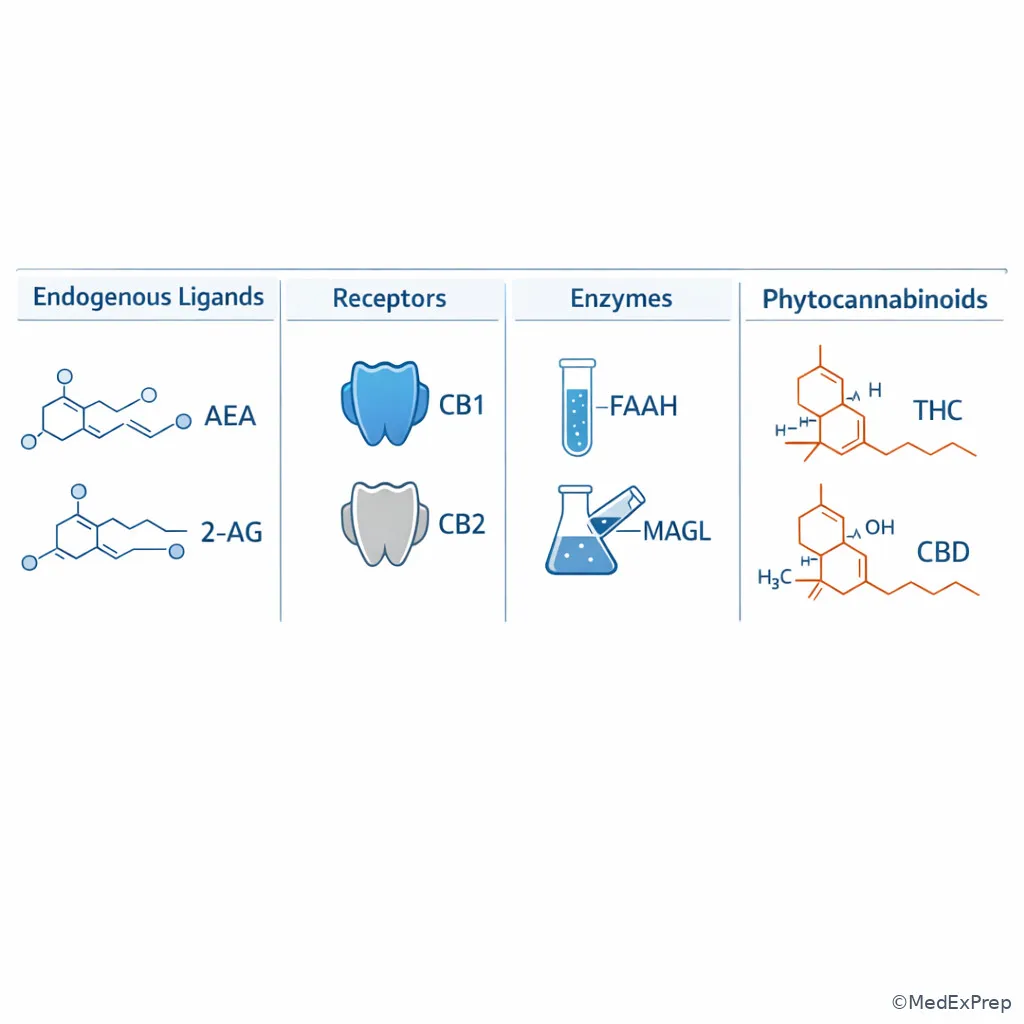
The first exam decision conflict is simple but high yield: when a stem lists several cannabis-related terms, do you classify each item as a ligand, receptor, or enzyme? The single rule that resolves most introductory questions is this: the ECS is built from endogenous ligands that signal through cannabinoid receptors and are controlled by synthesis and degradation enzymes. If a term is body-produced and binds into this signaling network, it is likely a ligand; if it receives the signal, it is a receptor; if it makes or terminates the signal, it is an enzyme. See Fig 1.
WHY THIS IS TESTED: exam writers know learners often mix endogenous ligands with plant cannabinoids or memorize enzyme names without understanding their category. Questions become easy when you first sort the vocabulary. In pharmacist practice, the analogous task is reading a note, product sheet, or patient question and translating vague wording into a clear mechanism category before counseling or documenting.
For this topic, keep the architecture tight: AEA and 2-AG are the two classic endocannabinoids; CB1 and CB2 are the primary receptors; NAPE-PLD and DAGL are synthesis-associated enzymes; FAAH and MAGL are the major degradation enzymes. Do not overcomplicate the introductory layer with every alternate pathway. The exam is more likely to test the big pairings than obscure branches.
B. Worked example
A 48-year-old woman with fibromyalgia, generalized anxiety disorder, and GERD brings a hemp-derived oral product handout to a pharmacist-run ambulatory consult. Her medication list includes sertraline 100 mg orally daily, omeprazole 20 mg orally daily, and trazodone 50 mg orally at bedtime as needed. The handout states that the product “replenishes your body’s endocannabinoids by activating FAAH receptors.” She also mentions that her friend said anandamide is “basically the same as CBD.” A normal CBC from last week is included in the chart, which is unrelated noise.
Reasoning chain: Identify task: mechanism clarification and counseling. Extract key facts: the handout mislabels FAAH as a receptor; the patient is also mixing endogenous ligands with phytocannabinoids. Apply rule: FAAH is a degradation enzyme, not a receptor; anandamide is an endogenous ligand, whereas CBD is plant-derived. Eliminate distractors: do not endorse the wording “activating FAAH receptors,” and do not equate AEA with CBD. Verify: the safest counseling is to explain the categories accurately, document the clarification, and avoid endorsing unsupported product claims.
C. Exam trap
D. Checkpoint
Question: A pharmacist reviews educational material stating that anandamide, CB1, and FAAH are all “types of cannabinoid receptors.” Which correction is most appropriate?
- A. Anandamide is a receptor, CB1 is an enzyme, and FAAH is a ligand.
- B. Anandamide is an endogenous ligand, CB1 is a receptor, and FAAH is a degradation enzyme.
- C. Anandamide is a phytocannabinoid, CB1 is an endogenous ligand, and FAAH is a synthesis enzyme.
- D. Anandamide and FAAH are both receptors, while CB1 is a transport protein.
Answer: B
- A: Tempting if categories blur together, but every assignment is reversed; the stem tests basic ECS architecture.
- B: Correct because it preserves the ligand-receptor-enzyme structure of the ECS.
- C: Tempting because learners may confuse cannabinoids broadly with phytocannabinoids, but anandamide is endogenous and FAAH is degradative.
- D: Tempting only if one guesses from unfamiliarity; CB1 is a receptor, not a transport protein.
1.1.1.2 Endogenous ligands: anandamide and 2-AG
A. Explanation
The next decision conflict is whether a stem is describing endogenous cannabinoids or plant-derived cannabinoids. The single resolving rule: if the molecule is produced by the body within ECS signaling, it is an endocannabinoid; in this lesson, the two names to know are anandamide (AEA) and 2-arachidonoylglycerol (2-AG). These are not THC and not CBD. See Fig 2 and Fig 3.
From an exam standpoint, you do not need exhaustive receptor pharmacodynamics yet. What matters most is that AEA and 2-AG are lipid-derived signaling molecules made on demand from membrane precursors. They are not typically stored and released like classic neurotransmitters in large presynaptic vesicles. That “on-demand” concept prepares you for the next topic on ECS homeostasis and retrograde signaling. 2-AG is often presented as the more abundant endogenous ligand, while anandamide is the classic name students hear first and therefore the one most often targeted by enzyme-pairing questions.
Choose the answer that respects origin. Reject any answer that calls AEA or 2-AG a phytocannabinoid. Reject any answer that implies THC and CBD are themselves endogenous ligands. For counseling, a pharmacist should explain that the body has its own cannabinoid-like signaling molecules and that cannabis-derived compounds may interact with the same broader system, but they are not interchangeable molecules.
B. Worked example
A 67-year-old man with diabetic neuropathy, hypertension, and benign prostatic hyperplasia asks about a CBD oral solution 25 mg by mouth nightly. His medications include gabapentin 300 mg orally three times daily, tamsulosin 0.4 mg orally nightly, and lisinopril 20 mg orally daily. He says a wellness store clerk told him the product “contains the body’s main endocannabinoid, 2-AG, plus CBD.” He also mentions seasonal allergies and shows a mildly elevated LDL from a recent wellness fair, which is distracting but irrelevant.
Reasoning chain: Identify task: counseling accuracy and claim verification. Extract key facts: 2-AG is an endogenous ligand, not a standard listed plant ingredient in a routine CBD product; the mechanism claim likely confuses product contents with body signaling. Apply rule: distinguish endogenous compounds from phytocannabinoids. Eliminate distractors: do not validate the statement just because both compounds relate to the ECS. Verify: advise the patient that 2-AG is a body-produced endocannabinoid, review the actual product labeling, and avoid endorsing unsupported ingredient claims.
C. Exam trap
D. Checkpoint
Question: Which pair includes the two classic endogenous cannabinoid ligands most likely to appear in a foundational ECS stem?
- A. THC and CBD
- B. CB1 and CB2
- C. Anandamide and 2-AG
- D. FAAH and MAGL
Answer: C
- A: Tempting because they are the most familiar cannabinoid names, but they are plant-derived rather than endogenous ligands.
- B: Tempting because they are core ECS terms, but they are receptors, not ligands.
- C: Correct because anandamide and 2-AG are the principal endocannabinoids tested at this level.
- D: Tempting because they are paired with endocannabinoids, but they are degradation enzymes.
- The two classic endocannabinoids are ______ and ______.
- True or False: CBD is an endogenous ligand.
- The more commonly tested “more abundant” endogenous ligand is ______.
1.1.1.3 Enzymes that make the signal: synthesis pathways worth knowing
A. Explanation
Now the conflict shifts from what the molecules are to how they appear. When the exam asks which enzyme helps generate a specific endocannabinoid, choose the synthesis enzyme and reject the degradation enzyme. The single resolving rule is make versus break. For introductory questions, pair NAPE-PLD with anandamide synthesis and DAGL with 2-AG synthesis. See Fig 4.
Because this is a foundational topic, do not get distracted by every alternate biosynthetic route reported in the research literature. Board-style exams typically reward the canonical pairing, not edge-case biochemistry. In an applied stem, if a product note or research summary claims to increase endogenous cannabinoids by inhibiting NAPE-PLD, that wording is internally inconsistent because NAPE-PLD is a synthesis-associated enzyme; inhibiting it would be expected to reduce, not raise, anandamide production under the simplified exam model.
WHY THIS IS TESTED: learners often memorize FAAH and MAGL because they are repeated in cannabis literature, then mistakenly assign them to synthesis. A safer method is to classify enzymes by direction first, then by ligand. If the mechanism preserves ligand production, think NAPE-PLD or DAGL. If it terminates signaling, think FAAH or MAGL.
B. Worked example
A pharmacist reviews a continuing education slide deck used in a dispensary-adjacent counseling program. One slide states: “DAGL inhibition increases 2-AG production and may amplify endogenous signaling.” The audience for the session includes patients taking duloxetine 60 mg orally daily and pregabalin 75 mg orally twice daily for chronic pain, but those medications are irrelevant to the biochemical correction. A learner asks whether the statement is accurate.
Reasoning chain: Identify task: verify educational accuracy. Extract key facts: DAGL is the synthesis-associated enzyme for 2-AG. Apply rule: inhibiting a synthesis enzyme would not be expected to increase the ligand under the simplified exam framework. Eliminate distractors: do not confuse DAGL with MAGL, and do not assume all enzyme inhibition raises signaling. Verify: the corrected statement is that DAGL contributes to 2-AG synthesis; inhibition would be expected to reduce 2-AG formation.
C. Exam trap
D. Checkpoint
Question: A mechanism note says a candidate compound may reduce formation of 2-AG by inhibiting a key synthetic enzyme. Which enzyme best matches that description?
- A. DAGL
- B. MAGL
- C. FAAH
- D. CB1
Answer: A
- A: Correct because DAGL is the key synthesis-associated enzyme for 2-AG.
- B: Tempting because it is strongly paired with 2-AG, but MAGL degrades rather than synthesizes it.
- C: Tempting if one remembers “enzyme in ECS” without ligand specificity, but FAAH primarily degrades anandamide.
- D: Tempting if target and enzyme categories are blurred, but CB1 is a receptor, not a synthetic enzyme.
1.1.1.4 Enzymes that terminate the signal: FAAH and MAGL
A. Explanation
If a stem asks what happens when the system preserves endogenous ligands by slowing their breakdown, the answer usually turns on FAAH versus MAGL. The single resolving rule is AEA - FAAH and 2-AG - MAGL. This is one of the most valuable memorized pairings in early cannabis science. See Fig 2 and Fig 4.
FAAH, or fatty acid amide hydrolase, is the major degradation enzyme associated with anandamide. MAGL, or monoacylglycerol lipase, is the major degradation enzyme associated with 2-AG. So if a question describes inhibition of FAAH, the expected conceptual consequence is increased anandamide tone; if it describes inhibition of MAGL, the expected consequence is increased 2-AG tone. That does not mean you should infer a specific clinical outcome unless the evidence is clearly stated; as a pharmacist, mechanism understanding does not justify overstating efficacy.
WHY THIS IS TESTED: many learners know one half of the pair and swap the other under pressure. Exam items often offer both FAAH and MAGL to force precise pairing. In practice, this matters because education materials and product claims may say “enzyme support” or “blocks endocannabinoid breakdown” without specifying which ligand pathway is meant. Your job is to ask: breakdown of what?
B. Worked example
A 59-year-old woman with osteoarthritis, insomnia, and controlled hypothyroidism asks whether a nonprescription supplement marketed to “slow FAAH and preserve the body’s 2-AG” is accurately described. Her medication list includes levothyroxine 75 mcg orally daily and naproxen 220 mg orally twice daily as needed. She also notes that her vitamin D level was low last year, which is irrelevant here.
Reasoning chain: Identify task: verify mechanism statement. Extract key facts: the claim links FAAH with 2-AG preservation. Apply rule: FAAH primarily degrades anandamide, not 2-AG. Eliminate distractors: do not accept the statement simply because both are ECS-related. Verify: the single clue is the wrong ligand-enzyme pair; if the claim were about MAGL preserving 2-AG, it would fit the canonical framework better.
C. Exam trap
D. Checkpoint
Question: A pharmacist is asked to correct a mechanism slide. Which statement is most appropriate?
- A. FAAH inhibition is expected to lower anandamide levels.
- B. MAGL inhibition is expected to raise 2-AG levels.
- C. FAAH is the main synthetic enzyme for 2-AG.
- D. MAGL is a receptor that binds anandamide.
Answer: B
- A: Tempting if one misreads inhibition as activation, but blocking degradation would conceptually increase rather than lower anandamide.
- B: Correct because MAGL is the major degradation enzyme for 2-AG; inhibition preserves 2-AG tone.
- C: Tempting only if synthesis and degradation are reversed; FAAH is degradative and linked to AEA.
- D: Tempting if target categories are blurred, but MAGL is an enzyme, not a receptor.
- The primary degradation enzyme for anandamide is ______.
- True or False: MAGL is primarily associated with 2-AG breakdown.
- If MAGL is inhibited, the endocannabinoid most likely to increase is ______.
1.1.1.5 Interpreting ECS mechanism claims in products, notes, and counseling
A. Explanation
This is the first applied pharmacist-level section. The decision conflict is whether a mechanism statement should be accepted as a precise description, translated into safer language, or flagged for clarification. The single rule: if the statement names a real ECS component accurately and keeps claims within evidence, it may be usable; if it uses vague language like “balances the ECS” or mixes up receptor, ligand, and enzyme terminology, you should clarify rather than repeat it. See Fig 5 and Fig 6.
In practice, this often arises when patients bring labels, online screenshots, or dispensary education sheets. A pharmacist can explain ECS basics, identify whether a claim is plausible mechanistically, and document uncertainty. What you should not do is convert a mechanistic possibility into a promise of clinical effect. For example, “may interact with cannabinoid signaling pathways” is very different from “will restore endocannabinoid deficiency.” The latter overreaches evidence and may step beyond responsible counseling. Board-style stems often reward the answer that uses precise terms, acknowledges uncertainty, and stays within scope.
WHY THIS IS TESTED: CMCaP candidates are expected to make medication-related judgments, communicate clearly, and avoid unsupported claims. The best answer is often not the most detailed biochemistry answer; it is the safest accurate pharmacist response.
B. Worked example
A 73-year-old man with Parkinson disease, constipation, atrial fibrillation on apixaban 5 mg orally twice daily, and chronic back pain brings a product website printout to the pharmacy. The site claims its topical balm “selectively upregulates CB2 enzymes and normalizes anandamide deficiency.” He wants to know whether the explanation is medically accurate before purchase. He also shows a recent potassium of 4.1 mEq/L, which is unrelated noise.
Reasoning chain: Identify task: evaluate scientific wording, not recommend therapy independently. Extract key facts: “CB2 enzymes” is internally incorrect because CB2 is a receptor; “normalizes deficiency” overstates mechanistic certainty. Apply rule: classify each named ECS part and check whether the claim stays evidence-bounded. Eliminate distractors: avoid validating the website simply because CB2 and anandamide are real ECS terms. Verify: the best pharmacist response is to explain that CB2 is a receptor, not an enzyme, and that broad claims about correcting a deficiency should be treated cautiously unless supported by authoritative evidence.
C. Exam trap
D. Checkpoint
Question: A patient asks whether a product that “supports ECS balance by acting on FAAH receptors” is accurately described. What is the most appropriate pharmacist response?
- A. Confirm the statement because FAAH is a receptor that binds anandamide.
- B. Explain that FAAH is a degradation enzyme, so the claim uses imprecise language and should be clarified.
- C. State that FAAH is the body’s main phytocannabinoid and that the claim is likely accurate.
- D. Recommend the product because all ECS-modifying products have equivalent mechanisms.
Answer: B
- A: Tempting if the learner latches onto “binds” language, but FAAH is not a receptor.
- B: Correct because it fixes the scientific category error and keeps counseling within evidence-bounded scope.
- C: Tempting only if terminology is deeply confused; FAAH is neither a phytocannabinoid nor a receptor.
- D: Tempting because it avoids mechanism details, but it is unsafe and scientifically inaccurate.
1.1.1.6 Integration: how ECS component knowledge drives safe pharmacist reasoning
A. Explanation
The final integration conflict is choosing between answering the biochemical question directly and taking a scope-appropriate safety action. The single rule: if the mechanism can be clarified accurately within pharmacist scope, do so; if the situation requires diagnosis, authorization, or unsupported legal interpretation, clarify and escalate. The ECS component map is not just trivia; it lets you know what you can confidently explain and where your boundaries are.
For example, if a prescriber note says “start product because patient likely has endocannabinoid deficiency syndrome,” the pharmacist should not independently diagnose or validate the syndrome claim. The appropriate action is to address medication-related questions, verify product details, review interactions and precautions, and communicate any uncertainty or documentation issues to the prescriber or institutional process. Similarly, if a counseling stem asks you to choose between direct receptor agonism and indirect modulation through enzyme inhibition, the right answer comes from component knowledge; if the stem asks whether the mechanism guarantees symptom relief, the safest answer is no—mechanism is not equal to proven outcome.
WHY THIS IS TESTED: certification exams frequently reward the option that combines correct science with professional boundaries. See Fig 6. For this lesson, the integrated take-home is: classify the ECS term, interpret the mechanism modestly, and act within role.
B. Worked example
A 35-year-old woman with migraine, PTSD, and ulcerative colitis presents to a pharmacist-led cannabis education visit. Her current medications are venlafaxine XR 75 mg orally daily, mesalamine 1.2 g orally four tablets daily, and sumatriptan 50 mg orally as needed. She says an outside wellness consultant told her she has “clinical endocannabinoid deficiency” and asks the pharmacist to document that diagnosis so she can use it for program paperwork. She also brings a normal TSH result, which is distracting.
Reasoning chain: Identify task: scope and documentation decision. Extract key facts: the request is not simply mechanism counseling; it asks the pharmacist to document a diagnosis for external use. Apply rule: pharmacists may explain ECS components and review product considerations, but not independently diagnose when authority is not granted. Eliminate distractors: avoid being drawn into the biochemical discussion as if it resolves the scope issue. Verify: the best response is to explain the ECS in general terms if helpful, document the encounter accurately, and refer or clarify through the appropriate clinician or institutional process for any diagnostic or authorization needs.
C. Exam trap
D. Checkpoint
Question: A pharmacist is asked to verify a note that states, “Patient has cannabinoid deficiency due to low FAAH.” What is the most appropriate next step?
- A. Finalize the note because FAAH is a receptor and low levels confirm diagnosis.
- B. Diagnose ECS dysfunction and recommend treatment independently.
- C. Clarify the scientific and scope issues, document concerns, and refer the diagnostic question to the appropriate clinician/process.
- D. Replace FAAH with MAGL and sign the note without further review.
Answer: C
- A: Tempting if one accepts the note’s language at face value, but FAAH is an enzyme and the note makes an unsupported diagnostic leap.
- B: Tempting because it seems decisive, but independent diagnosis is outside the pharmacist role in this context.
- C: Correct because it addresses both the science problem and the professional boundary.
- D: Tempting as a quick edit, but changing one enzyme does not fix the unsupported diagnosis or scope issue.
Exam Traps & Differentiators
- Most common wrong answer and why: swapping FAAH and MAGL because both are degradation enzymes. This is tempting when the learner remembers “endocannabinoid breakdown” but not the ligand-specific pair.
- Looks similar but isn’t: calling THC or CBD “endocannabinoids” because they interact with the ECS. The single differentiator is origin: endocannabinoids are body-produced.
- Scope trap: using accurate ECS words to justify a diagnosis or authorization. Knowing the mechanism does not expand scope.
- Marketing trap: accepting “supports ECS balance” as if it were a precise mechanistic statement. Vague claims require clarification, not automatic endorsement.
| Looks similar but isn’t | If the stem says... | Think... | Do not think... |
|---|---|---|---|
| Endocannabinoid vs phytocannabinoid | Anandamide or 2-AG | Body-produced ligand | Plant constituent |
| Synthesis enzyme vs degradation enzyme | NAPE-PLD or DAGL | Ligand formation | Ligand breakdown |
| Receptor vs enzyme | CB1 or CB2 | Signal target | Catalytic protein |
| Mechanism clarification vs diagnosis | “Can you document deficiency?” | Clarify/refer within scope | Diagnose independently |
- If the stem says “body’s own cannabinoid ligand,” think AEA or 2-AG.
- If the stem says “major degradation enzyme for anandamide,” think FAAH.
- If the stem says “major degradation enzyme for 2-AG,” think MAGL.
- If the stem says “synthesis enzyme for 2-AG,” think DAGL.
- If the stem says “supports ECS balance,” think mechanism wording may be vague and needs evidence-based clarification.
- If the stem says “document diagnosis/authorize use,” think pharmacist scope boundary.
Related trap from upcoming topics: in CB1 Versus CB2 Roles, learners commonly mix receptor location-function pairs the same way they mix enzyme-ligand pairs here. In ECS Homeostasis And Signaling, a common confusable pair is on-demand retrograde signaling versus classic presynaptic neurotransmitter release. Build the pairings now so those later stems feel patterned rather than random.
Algorithm / Approach
Rapid Review
- ECS components → ligands send, receptors receive, enzymes regulate duration.
- Anandamide → endogenous ligand, not a plant cannabinoid.
- 2-AG → endogenous ligand commonly treated as more abundant in many tissues.
- CB1 → receptor category, not enzyme category.
- CB2 → receptor category, not ligand category.
- NAPE-PLD → synthesis-side pairing with anandamide.
- DAGL → synthesis-side pairing with 2-AG.
- FAAH → breakdown-side pairing with anandamide.
- MAGL → breakdown-side pairing with 2-AG.
- On-demand synthesis → supports later retrograde signaling questions.
- “Supports ECS balance” → mechanism claim may be too vague to endorse.
- Mechanism understanding → does not equal evidence of clinical benefit.
- Pharmacist scope → explain, verify, document, clarify; do not diagnose or authorize unless explicitly permitted.
Self-check quiz
1. A pharmacist reviews a draft patient handout for an oral cannabis education class. The handout states that “CBD and THC are the body’s main endocannabinoids.” Which correction is most appropriate?
- A. Replace CBD and THC with anandamide and 2-AG.
- B. Replace CBD and THC with CB1 and CB2.
- C. Replace CBD and THC with FAAH and MAGL.
- D. Replace CBD and THC with NAPE-PLD and DAGL.
2. During medication reconciliation, a patient taking cannabidiol 20 mg/kg/day orally asks which ECS enzyme is most closely associated with anandamide breakdown. Which answer is best?
- A. FAAH
- B. MAGL
- C. DAGL
- D. NAPE-PLD
3. A 62-year-old man with diabetic neuropathy and insomnia takes gabapentin 300 mg orally three times daily and melatonin 5 mg orally nightly. He brings a brochure for a topical product that claims to “increase anandamide by inhibiting FAAH.” A normal A1c from last month is included in the chart. Which interpretation is most appropriate?
- A. The claim is internally plausible because FAAH is linked to anandamide breakdown.
- B. The claim is internally inconsistent because FAAH synthesizes anandamide.
- C. The claim is internally implausible because FAAH is a receptor, not an enzyme.
- D. The claim proves the product will provide clinical analgesia.
4. A 54-year-old woman with generalized anxiety disorder and chronic pain takes sertraline 100 mg orally daily and acetaminophen 650 mg orally every 8 hours as needed. A clinic note says a supplement “preserves 2-AG by reducing MAGL activity.” She asks the pharmacist whether the statement matches ECS fundamentals. She also mentions a remote appendectomy. Which answer is best?
- A. Yes; MAGL is the major degradation enzyme associated with 2-AG.
- B. No; MAGL is the major synthesis enzyme for 2-AG.
- C. No; FAAH, not MAGL, is the major degradation enzyme for 2-AG.
- D. Yes; MAGL is the receptor most selective for 2-AG.
5. A pharmacist reviews an order clarification request tied to a counseling plan for dronabinol 2.5 mg orally twice daily. The draft note reads, “CB2 enzyme activation may explain benefit.” The patient has HIV-related weight loss, hypertension, and depression treated with amlodipine 5 mg orally daily and bupropion XL 150 mg orally daily. Which revision is most appropriate?
- A. Change “CB2 enzyme” to “CB2 receptor.”
- B. Change “CB2 enzyme” to “CB2 endocannabinoid.”
- C. Change “CB2 enzyme” to “CB2 phytocannabinoid.”
- D. Leave the note unchanged because CB2 is both an enzyme and a receptor.
6. A 44-year-old woman with migraine, PTSD, and ulcerative colitis takes venlafaxine XR 75 mg orally daily, mesalamine 1.2 g orally four tablets daily, and sumatriptan 50 mg orally as needed. She asks the pharmacist to certify in the record that she has “endocannabinoid deficiency caused by low FAAH” so she can use that documentation externally. A normal CMP is attached. What is the most appropriate next step?
- A. Document the diagnosis because FAAH abnormalities directly establish endocannabinoid deficiency.
- B. Explain ECS basics, clarify that FAAH is a degradation enzyme, and refer the diagnostic request to the appropriate clinician/process.
- C. Replace FAAH with MAGL and finalize the documentation.
- D. Recommend a cannabinoid product and avoid documenting uncertainty.
7. A 70-year-old man with osteoarthritis, atrial fibrillation, and chronic kidney disease takes apixaban 5 mg orally twice daily, acetaminophen 1,000 mg orally three times daily as needed, and topical diclofenac 1% four times daily. He brings a website stating a balm “raises 2-AG by inhibiting DAGL.” He asks whether the mechanism is accurate. Which response is best?
- A. Yes; DAGL inhibition should preserve 2-AG because DAGL is the main degradative enzyme.
- B. No; DAGL is associated with 2-AG synthesis, so inhibition would not fit a claim of raising 2-AG under the standard framework.
- C. Yes; all ECS enzyme inhibition increases endocannabinoids regardless of pathway direction.
- D. No; 2-AG is a receptor, so the claim is category-inaccurate for that reason.
8. A 58-year-old woman with neuropathic pain, insomnia, and GERD takes pregabalin 75 mg orally twice daily, famotidine 20 mg orally nightly, and zolpidem 5 mg orally as needed at bedtime. A counseling handout for a cannabis product says: “This formulation contains anandamide and selectively stimulates FAAH to prolong endocannabinoid action.” Which pharmacist assessment is most appropriate?
- A. The statement is coherent because stimulating FAAH should prolong anandamide action.
- B. The statement has two concerns: anandamide is an endogenous ligand, and stimulating FAAH would not be expected to prolong its action.
- C. The statement is acceptable because FAAH is a receptor and anandamide is a phytocannabinoid.
- D. The statement is acceptable as written because all cannabinoid pathways are clinically interchangeable.
Answer key
1. Correct answer: A
- A. Tempting because it directly replaces familiar cannabis terms with the body’s own ligands, and it is correct for this specific scenario because anandamide and 2-AG are the classic endogenous cannabinoids. The single stem clue is “body’s main endocannabinoids.” Confirmed by foundational ECS summaries in DiPiro and peer-reviewed ECS reviews.
- B. Tempting because CB1 and CB2 are core ECS names, but they are receptors, not ligands. The discriminating clue is that the handout mislabeled endocannabinoids, not receptors. Supported by standard receptor classification in pharmacology references.
- C. Tempting because FAAH and MAGL are strongly associated with endocannabinoid signaling, but they are degradation enzymes. The single clue is the handout needs ligand names, not enzymes. Confirmed by ECS enzyme reviews.
- D. Tempting because NAPE-PLD and DAGL are also ECS terms, but they are synthesis enzymes rather than endocannabinoids. The clue is again that the category needed is endogenous ligands. Supported by canonical biosynthesis descriptions.
2. Correct answer: A
- A. Tempting because FAAH is the best-known enzyme pairing with anandamide, and it is correct because FAAH is the major degradation enzyme for AEA. The single clue is “anandamide breakdown.” Supported by DiPiro and ECS review literature.
- B. Tempting because MAGL is also a degradative ECS enzyme, but it is primarily linked with 2-AG rather than anandamide. The discriminating clue is the named ligand. Confirmed by canonical AEA/2-AG pathway references.
- C. Tempting because DAGL is tied to 2-AG and appears in the same pathway family, but it is a synthesis enzyme, not a degradation enzyme. The key clue is “breakdown.” Supported by pathway reviews.
- D. Tempting because NAPE-PLD is linked to anandamide, but it helps synthesize rather than degrade it. The single discriminating clue is again “breakdown.” Supported by ECS biosynthesis references.
3. Correct answer: A
- A. Tempting because it tracks the common mechanism statement learners hear, and it is correct here because FAAH is linked to anandamide breakdown; inhibiting it is conceptually consistent with increasing anandamide tone. The discriminating clue is “increase anandamide by inhibiting FAAH.” Foundational mechanism supported by DiPiro and ECS reviews; clinical effect should still not be overclaimed.
- B. Tempting because students often reverse enzyme direction, but FAAH is not the main synthetic enzyme for anandamide. The single clue is FAAH belongs to breakdown, not synthesis. Confirmed by standard pathway references.
- C. Tempting if category labels blur, but FAAH is an enzyme, not a receptor. The key clue is the enzyme name itself and its hydrolase role. Supported by pharmacology references.
- D. Tempting because mechanism language often sounds outcome-oriented, but internal plausibility does not prove analgesia for this patient. The discriminating clue is the option jumps from mechanism to guaranteed clinical result. This distinction is consistent with evidence-based counseling standards.
4. Correct answer: A
- A. Tempting because it uses the canonical 2-AG pairing, and it is correct because MAGL is the major degradation enzyme associated with 2-AG. The single clue is “preserves 2-AG by reducing MAGL activity.” Supported by canonical ECS pathway references.
- B. Tempting because MAGL and 2-AG are strongly linked, but the direction is wrong: MAGL degrades rather than synthesizes 2-AG. The discriminating clue is “preserves,” which points toward reduced breakdown, not reduced synthesis. Confirmed by ECS reviews.
- C. Tempting because FAAH is a very memorable degradation enzyme, but it is primarily associated with anandamide, not 2-AG. The single clue is the named ligand 2-AG. Supported by pathway literature.
- D. Tempting if target categories are blurred, but MAGL is an enzyme, not a receptor. The clue is the option misclassifies the component type. Supported by standard pharmacology references.
5. Correct answer: A
- A. Tempting because it is the minimal precise fix, and it is correct because CB2 is a receptor rather than an enzyme. The single clue is the phrase “CB2 enzyme activation,” which contains a category error. Supported by receptor classification in standard ECS references.
- B. Tempting because learners may think every named ECS term could be an endocannabinoid, but CB2 is not a ligand. The discriminating clue is that CB2 belongs to receptor nomenclature. Supported by pharmacology references.
- C. Tempting because cannabis-related language can blur origins, but CB2 is neither phytocannabinoid nor endogenous ligand. The clue is that CB2 designates a receptor subtype. Supported by ECS classifications.
- D. Tempting because it avoids editing the note, but the statement is scientifically inaccurate and should not remain unchanged. The discriminating clue is the explicit misuse of “enzyme.” Accurate documentation standards support correction.
6. Correct answer: B
- A. Tempting because the request sounds science-based and decisive, but it is incorrect because the pharmacist should not independently diagnose in this scenario, and FAAH alone does not establish a diagnosis. The single clue is “certify in the record” for external use. Scope standards and the course role guardrails confirm referral/clarification.
- B. Tempting because it preserves both scientific accuracy and professional boundaries, and it is correct because the pharmacist may explain that FAAH is a degradation enzyme while referring diagnostic requests appropriately. The discriminating clue is the task asks for diagnosis-level documentation, not just counseling. Supported by professional role standards and accurate ECS terminology.
- C. Tempting because it seems to “fix” the mechanism, but changing FAAH to MAGL does not solve the scope problem and still creates unsupported diagnostic documentation. The single clue is that the error is not only which enzyme is named but the request for diagnosis. Scope guardrails confirm this.
- D. Tempting because it moves toward a practical therapy discussion, but it sidesteps the diagnostic request and fails to document uncertainty appropriately. The clue is that the immediate issue is documentation and scope, not product selection. Professional documentation standards confirm clarification first.
7. Correct answer: B
- A. Tempting because DAGL and 2-AG are closely linked, but it is incorrect because DAGL is synthesis-associated, not the main degradative enzyme. The single clue is “inhibiting DAGL.” Supported by ECS synthesis pathway references.
- B. Tempting because it uses the make-versus-break rule, and it is correct because inhibiting a synthesis enzyme like DAGL would not fit a standard claim of raising 2-AG. The discriminating clue is the pathway direction: synthesis inhibition should not increase the product under the simplified exam model. Supported by canonical pathway reviews.
- C. Tempting because students may overgeneralize from FAAH and MAGL inhibition, but not all enzyme inhibition raises endocannabinoids; direction matters. The single clue is that DAGL is on the synthesis side. Confirmed by ECS biosynthesis references.
- D. Tempting because category errors are common in this topic, but 2-AG is an endogenous ligand, not a receptor. The clue is the option misclassifies 2-AG entirely. Supported by foundational ECS terminology references.
8. Correct answer: B
- A. Tempting because learners may think any “stimulation” of a pathway prolongs action, but it is incorrect because stimulating FAAH would favor anandamide breakdown rather than prolongation. The single clue is “stimulates FAAH.” Supported by FAAH’s degradative role in canonical ECS references.
- B. Tempting because it checks both category and direction, and it is correct because anandamide is an endogenous ligand and increasing FAAH activity would not prolong anandamide action. The discriminating clue is the combination of “contains anandamide” plus “stimulates FAAH.” Accurate component classification and enzyme direction both matter. Supported by ECS reviews and professional counseling standards.
- C. Tempting because it strings together familiar ECS words, but it is wrong because FAAH is not a receptor and anandamide is not a phytocannabinoid. The clue is double category error. Supported by foundational ECS terminology references.
- D. Tempting because it avoids parsing the statement, but cannabinoid pathways are not clinically interchangeable, and the mechanism wording is internally inconsistent. The clue is that the handout contains specific scientific errors requiring correction. Documentation and counseling standards support clarification.