






Candidate Role Boundaries
CPSUD Derived Competency Map: Exam Strategy and Professional Scope -> Role-Bounded Judgment -> Identify what the CPSUD professional should do, should not do, and should escalate.
Why it matters
- Many CPSUD items test best next step, not textbook definitions; boundary errors are among the most common wrong answers.
- Overstepping scope can harm clients, delay medical or psychiatric care, breach ethics, and create documentation and legal risk.
- Underreacting is also dangerous: if a client has overdose risk, severe withdrawal, suicidality, or medical instability, the right answer is not “keep counseling” but escalate per protocol.
- Strong role boundaries improve rapport because they support honest communication, accurate referrals, and trustworthy collaboration.
Key Terms & Must-Know Facts
Key terms
- Scope of practice: The set of actions permitted by credential, employer policy, supervision, and law.
- Role-bounded judgment: Choosing actions that match your actual authority and training.
- Screening: Brief process to identify concern or risk; not a diagnosis.
- Assessment contribution: Structured information gathering that supports, but does not replace, clinician evaluation when required.
- Escalation: Promptly notifying the appropriate supervisor, clinician, or emergency system when risk exceeds routine support.
- Consultation: Seeking direction when a case exceeds your certainty, role, or authority.
- Referral: Connecting the client to a service or professional better suited to a need.
- Warm handoff: Direct, active linkage rather than simply giving a phone number.
- Objective documentation: Recording observed facts, client statements, actions taken, and notifications without unsupported conclusions.
- Mandated disclosure exception: A situation where privacy may be limited by safety or law; local requirements vary.
- Dual relationship: A second relationship that risks exploitation, impaired judgment, or blurred boundaries.
- Trauma-informed communication: Communication that prioritizes safety, choice, collaboration, trustworthiness, and empowerment.
- Nonstigmatizing language: Person-centered wording that avoids shaming labels.
Must-know facts
- Your role centers on screening, engagement, support planning, documentation, referral, coordination, and safety recognition.
- You do not independently diagnose medical, psychiatric, or substance use disorders unless explicitly authorized.
- You do not prescribe, adjust medication, or order detox.
- If the stem includes overdose, severe withdrawal, active suicidality, homicidal threat, abuse concern, or medical instability, immediate escalation is usually the best answer.
- When uncertain, the safest in-scope action is usually consult supervisor and follow protocol.
- Documentation should state what was said, observed, done, and who was notified.
- Promises such as “I can guarantee housing,” “I can keep everything secret no matter what,” or “I know your diagnosis” are common exam traps.
- Support does not mean doing nothing; role-appropriate action often includes safety steps, warm referral, follow-up, and accurate records.
Exam takeaway: Use this map to separate support tasks from clinician-only actions and urgent escalation.
flowchart TD
A[Client need appears in stem] -- Routine support need --> B[Engage, screen, educate, document]
A -- Needs service connection --> C[Refer and coordinate]
A -- Safety or acute instability --> D[Escalate immediately]
B --> E[Stay within observation and support role]
C --> F[Use warm handoff and follow-up]
D --> G[Notify supervisor, clinician, or emergency system per protocol]
H[Out-of-role request] --> I[Do not diagnose, prescribe, or determine legal outcome]
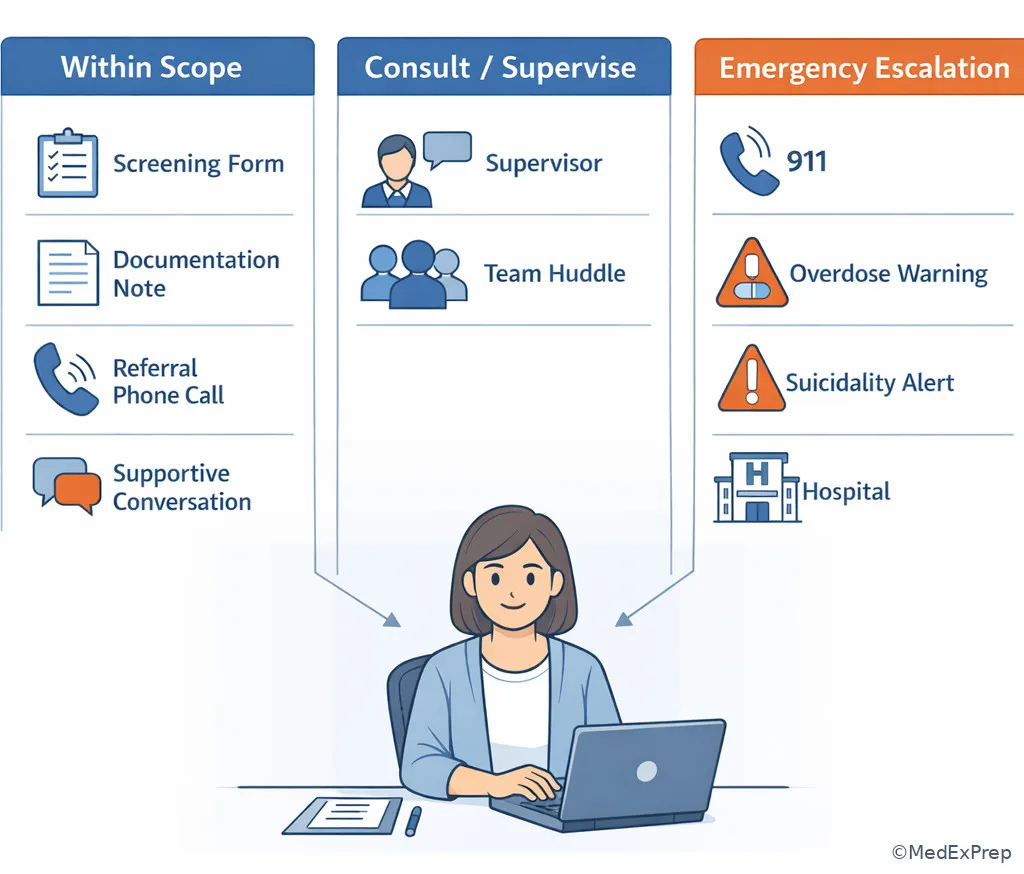
Exam takeaway: A visual boundary line helps separate supportive actions from decisions reserved for licensed or emergency responders.
Core content
1.1.1.1 Foundational boundary rule: support versus determine
A. Explanation
The first boundary question on CPSUD stems is: Am I being asked to support a process, or to determine an outcome that exceeds my role? Support tasks include screening, structured information gathering, psychoeducation consistent with policy, documenting observations, helping the client name goals, coordinating services, and monitoring for warning signs. Determination tasks usually belong to a licensed clinician, medical provider, court, or agency process: diagnosing, prescribing, clearing someone medically, deciding detox orders, declaring someone safe based on your own authority, or guaranteeing legal and social outcomes.
WHY THIS IS TESTED: exam writers often make an out-of-role choice sound compassionate, efficient, or decisive. The correct response is frequently the option that stays engaged and respects scope. Choose support, reject unauthorized determination.
A simple rule: if the action requires independent clinical judgment beyond observation and structured support, or creates a legal/medical decision, it is likely out of role. See Fig 1.
Key rule: The CPSUD candidate gathers, supports, documents, consults, refers, and escalates. The CPSUD candidate does not independently diagnose, prescribe, medically clear, or make binding legal determinations.
Recall: This is the first topic in the course, so there is no prior lesson to retrieve yet. Build the baseline here: every later “best next step” item will depend on this support-versus-determine distinction.
B. Worked example
A 34-year-old client in an outpatient intake says, “I know I have bipolar disorder and opioid addiction. Tell the court I’m stable and write that I need methadone.” He has hypertension, chronic back pain, and recent job loss. He appears tired but conversational. A urine cup from urgent care is mentioned in the chart, and the client adds that his cousin says your program “always signs off fast.”
Identify the task: The stem is not asking you to sympathize with the client’s urgency. It asks what you can appropriately do now.
Extract key facts: The client requests a diagnosis confirmation, a legal statement to the court, and a medication recommendation. Those are the tempting clues. None falls squarely within routine CPSUD scope. No immediate emergency signs are given.
Apply the rule: You can acknowledge the request, explain your role, gather structured information, document his statements, and connect him to the appropriate clinician or prescriber pathway.
Eliminate distractors: Reject “confirm his diagnosis,” “promise the court letter,” and “recommend methadone.” Even if these seem helpful, they exceed role. Also reject “do nothing until he calms down” because engagement and coordination are in scope.
Verify: Best next step: provide role-appropriate support, document objectively, and refer/consult for diagnostic, medication, and legal documentation needs.
C. Exam trap
Common wrong answer: “Use your clinical experience to tell the client the most likely diagnosis and preferred medication while waiting for the prescriber.”
WHY IT IS TEMPTING: It sounds efficient and client-centered because it seems to reduce delay.
SINGLE CLUE THAT ELIMINATES IT: The stem asks for diagnosis and medication direction, both of which are outside the role described for CPSUD support practice.
D. Checkpoint
Question: A client asks the CPSUD professional to “decide whether I need detox or just outpatient.” What is the most appropriate next step?
- A. Explain that you can gather information and promptly connect the client to the appropriate clinician or program for level-of-care determination.
- B. Decide based on your interview whether detox is necessary and schedule accordingly.
- C. Reassure the client that outpatient is usually enough unless there are seizures.
- D. Decline to discuss any options until a full diagnosis is made.
Answer: A
- A: Tempting because it may feel less decisive than the others, but it is right because it stays within scope while still moving care forward.
- B: Tempting because decisiveness can look competent, but it is wrong because independent level-of-care determination may exceed role and requires proper clinical pathway.
- C: Tempting because it uses a familiar severe-withdrawal clue, but it is wrong because it gives unauthorized clinical guidance and oversimplifies risk.
- D: Tempting because it avoids overreach, but it is wrong because the role still includes engagement, structured information gathering, and referral coordination.
If you missed this: Review 1.1.1.1 Foundational boundary rule: support versus determine - focus on the support-versus-determine distinction.
1.1.1.2 Safety changes the boundary: routine help versus urgent escalation
A. Explanation
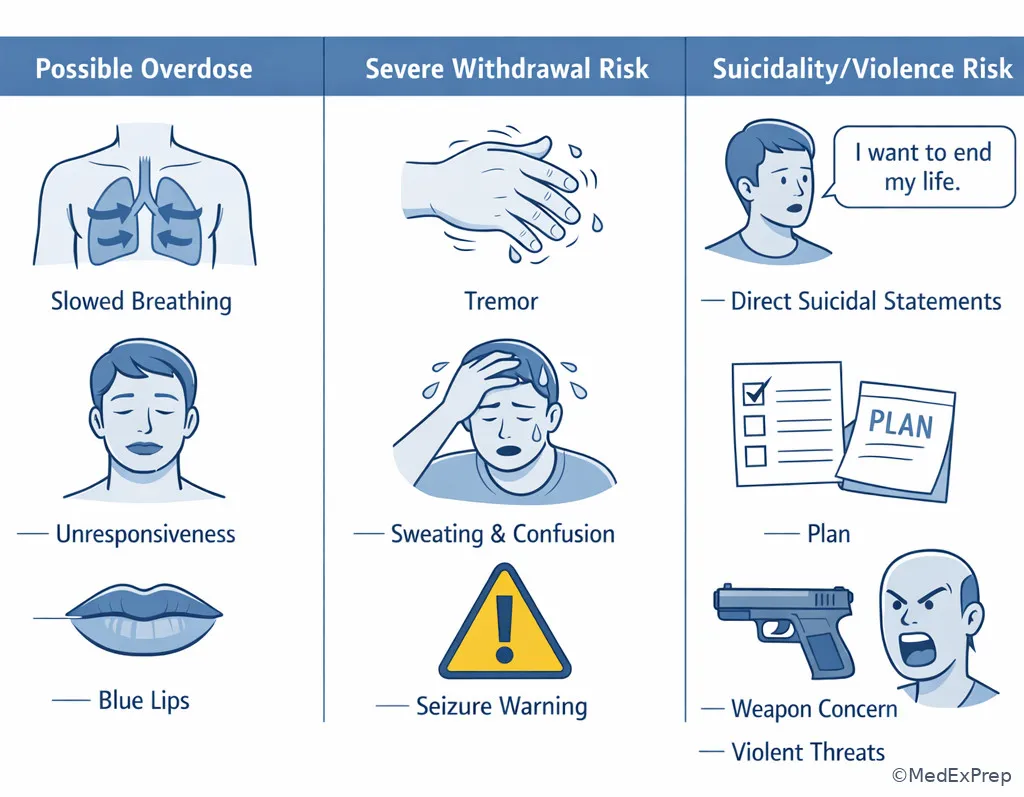
Role boundaries are not just about avoiding overreach. They also define when routine support is no longer enough. A common exam conflict is choosing between continued conversation and immediate escalation. The single rule that resolves it: when the stem includes possible overdose, severe withdrawal, active suicidal or homicidal risk, abuse or neglect concerns, marked medical instability, or acute psychiatric decompensation, your role shifts from routine support to first-response safety action and urgent notification.
This does not mean you become the emergency clinician. It means you recognize the danger, use program protocol, notify the appropriate supervisor or clinician, and activate emergency procedures when indicated. On the exam, “stay with the client, notify supervisor, call emergency services per protocol, document observations and actions” is often stronger than a counseling-heavy answer.
WHY THIS IS TESTED: candidates sometimes confuse empathy with delay. The exam rewards safety-first judgment within scope. See Fig 2.
Key rule: Once imminent danger or acute instability appears, the correct answer moves from supportive counseling to emergency or urgent escalation consistent with policy.
High-Yield Connection: This concept is tested alongside Suicidality Warning Signs and Overdose Recognition And Response. Know both the red flags and the role-bounded response; exam stems often pair them.
B. Worked example
A 49-year-old client arrives for a recovery-support appointment with diabetes and depression. He says he “just needs to talk through a rough night.” While speaking, he is sweating, tremulous, and intermittently confused. His sister reports he stopped drinking two days ago after years of daily heavy use. He also mentions a pending utility shutoff, which is emotionally compelling but not the main issue.
Identify the task: Best next step within CPSUD scope.
Extract key facts: Tremor, sweating, confusion, and abrupt alcohol cessation create concern for severe withdrawal risk. Housing/utility stress is the noise detail.
Apply the rule: This is not the moment for routine motivational conversation or detailed support planning. Acute risk requires urgent escalation according to protocol.
Eliminate distractors: Reject options focused on coping skills, scheduling next week, or trying to personally judge whether symptoms are “serious enough.” Also reject any answer suggesting the candidate independently manage detox.
Verify: Best answer: ensure immediate safety, notify the appropriate supervisor/clinician, and activate emergency or urgent medical response as required by protocol.
C. Exam trap
Common wrong answer: “Use grounding and supportive interviewing first, then reassess in 30 minutes.”
WHY IT IS TEMPTING: Trauma-informed and calming responses are usually good practice.
SINGLE CLUE THAT ELIMINATES IT: Confusion plus possible severe alcohol withdrawal signs means routine counseling should not delay urgent escalation.
D. Checkpoint
Question: Which situation most clearly requires immediate escalation rather than routine support planning?
- A. A client misses two appointments and asks for a new referral list.
- B. A client reports family conflict and requests help prioritizing recovery goals.
- C. A client is drowsy, breathing slowly, and difficult to wake during intake.
- D. A client says transportation is the main barrier to treatment attendance.
Answer: C
- A: Tempting because missed appointments can signal deterioration, but it is wrong because the stem does not show immediate danger.
- B: Tempting because family conflict can worsen risk, but it is wrong because it still fits routine engagement and planning unless imminent danger emerges.
- C: Tempting because someone might want to “observe first,” but it is right because slow breathing and reduced responsiveness suggest overdose or medical instability.
- D: Tempting because barriers to care matter, but it is wrong because it is a coordination issue, not an acute emergency cue.
If you missed this: Review 1.1.1.2 Safety changes the boundary: routine help versus urgent escalation - focus on the clue that acute instability overrides routine support.
- The most common safer response to a possible overdose stem is immediate emergency escalation, not prolonged interviewing.
- True or False: A CPSUD candidate should independently decide detox orders when alcohol withdrawal seems likely. False.
- Name 3 red flags that move a case out of routine support: overdose signs, severe withdrawal signs, active suicidality/homicidal risk.
Exam takeaway: Acute danger converts a routine support encounter into an escalation scenario.
flowchart TD
A[Client interaction begins] --> B{Any acute danger signs?}
B -- No --> C[Continue screening, support plan, referral]
B -- Yes --> D{Overdose, severe withdrawal, suicidality, violence, medical instability?}
D -- Yes --> E[Activate emergency or urgent protocol]
E --> F[Notify supervisor or clinician]
F --> G[Document observations, actions, and notifications]
D -- Unclear --> H[Consult immediately; do not delay with routine counseling]
Exam takeaway: Rapid visual recognition of overdose, withdrawal, and suicidality cues supports best-next-step decisions.
1.1.1.3 Communication boundaries: empathy without promising, pressuring, or shaming
A. Explanation
Another boundary domain is how you communicate. The exam often contrasts a technically correct content choice with a poor interpersonal approach. Within scope, the CPSUD professional uses trauma-informed, collaborative, person-centered language. That means avoiding labels, avoiding coercive threats, not arguing the client into change, and not making promises you cannot control. The decision conflict is often: Do I push for compliance, or do I guide with honesty and respect?
The single rule that resolves many items: choose the response that preserves dignity, clarifies your role, and supports the client’s next safe step without exaggerating certainty. For example, “I can help connect you with services and stay with you through the process” is appropriate. “If you don’t do this now, you’re failing treatment” is not. “I can keep everything you say totally secret” is also unsafe because confidentiality has limits. “I know exactly what will happen in court/child welfare/housing” crosses boundaries because you do not control those systems.
WHY THIS IS TESTED: boundary problems are not always dramatic. They often appear as subtle overpromising, shaming, rescuing, or blurred roles.
Memory anchor: HELP = Honest limits, Empathic tone, Link to services, Protect safety. If a response lacks one of these, reconsider it.
Forward link: The next lesson, Allowed Versus Disallowed Actions, will turn these broad boundaries into a sharper checklist of actions you may take versus those you must reject or clarify.
B. Worked example
A 27-year-old client with anxiety and probation involvement says, “If I tell you I used yesterday, you can’t tell anyone, right? And can you write that I’m definitely doing great so I don’t get sanctioned?” He is visibly tense, recently homeless, and mentions a cousin in recovery told him to “say whatever gets you through.” He denies current suicidal thoughts and is medically stable.
Identify the task: The stem tests communication and confidentiality boundaries.
Extract key facts: The client seeks total secrecy and a favorable outcome statement. He is anxious and fearful, which can tempt overreassurance.
Apply the rule: Respond with empathy and accurate limits: explain confidentiality in role-appropriate terms, note that some disclosures may require action depending on safety or policy, and avoid guaranteeing external outcomes. Offer to discuss options and next steps honestly.
Eliminate distractors: Reject “promise total secrecy,” “warn him that dishonesty will ruin everything,” and “agree to write a strongly positive summary to preserve rapport.”
Verify: Best response preserves rapport without false promises and keeps documentation truthful.
C. Exam trap
Common wrong answer: “Promise confidentiality first so the client will open up, then decide later what to disclose.”
WHY IT IS TEMPTING: Rapport matters, and reassurance often feels relationship-building.
SINGLE CLUE THAT ELIMINATES IT: Ethical communication requires accurate limits up front; you cannot promise absolute secrecy regardless of safety or legal exceptions.
D. Checkpoint
Question: Which statement best reflects a boundary-safe response?
- A. “Tell me everything; I can keep anything you say fully confidential no matter what.”
- B. “If you used substances, I need to tell every involved system immediately.”
- C. “I want to understand what happened, and I’ll explain the limits of confidentiality so we can plan the safest next step together.”
- D. “If you relapse again, there is nothing more this program can do for you.”
Answer: C
- A: Tempting because it seems warm and reassuring, but it is wrong because it promises more than confidentiality rules allow.
- B: Tempting because it sounds strict and compliant, but it is wrong because it overstates disclosure and ignores minimum-necessary, policy-based practice.
- C: Tempting because it may feel less dramatic, but it is right because it combines empathy, honesty, and collaborative planning.
- D: Tempting because relapse can frustrate helpers, but it is wrong because it is punitive and not recovery-oriented.
If you missed this: Review 1.1.1.3 Communication boundaries: empathy without promising, pressuring, or shaming - focus on honest limits plus empathic tone.
1.1.1.4 Documentation boundaries: record facts, not unsupported conclusions
A. Explanation
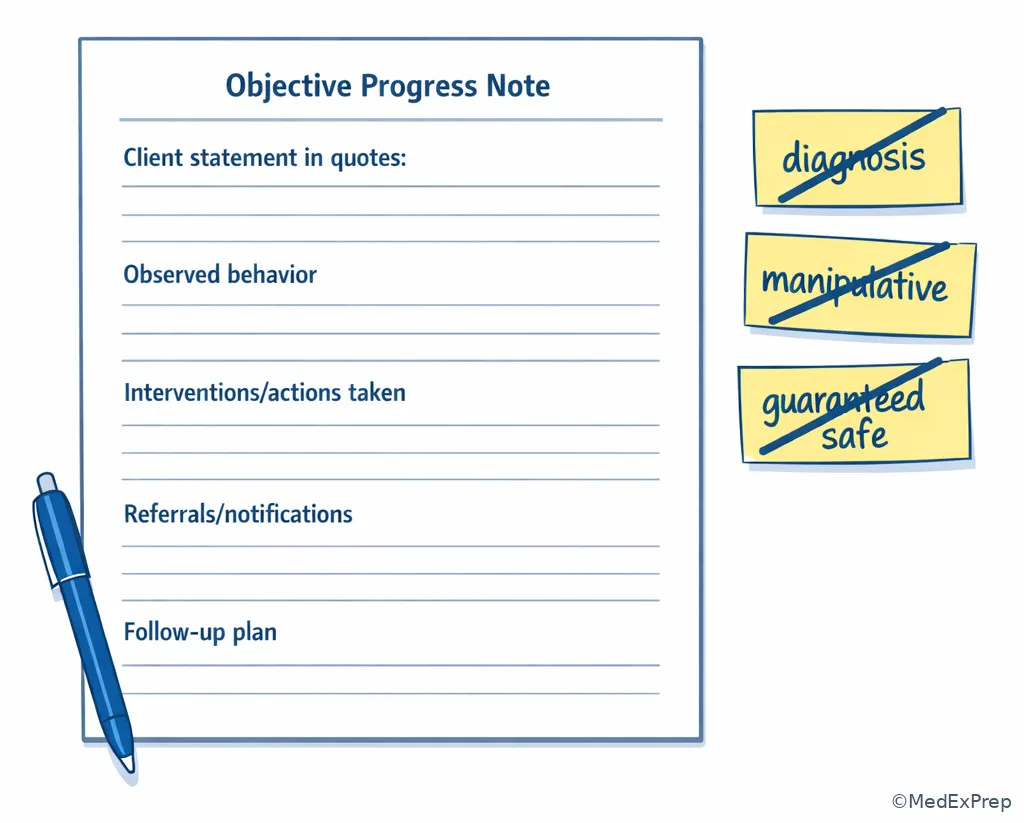
Documentation boundary errors are highly testable because they often sound professional. The decision conflict is: Do I write an interpretation that sounds clinically impressive, or do I document the observable facts and my actions? Choose facts. Within CPSUD scope, documentation should include client statements in quotes when useful, observed behavior, screening results if used, actions taken, referrals made, who was notified, time-sensitive safety steps, and follow-up plans. Reject unsupported labels such as “client is manipulative,” “obviously intoxicated from opioids,” “safe to return home,” or “does not have withdrawal.”
The single resolving rule: if you did not directly observe it, are not authorized to determine it, or cannot support it objectively, do not document it as a conclusion. You may document behavior and context instead: “speech slurred,” “stumbled when standing,” “client stated, ‘I took something earlier,’” “supervisor notified at 3:20 PM.” See Fig 3.
WHY THIS IS TESTED: objective records protect the client, the team, and the practitioner. Overinterpretation creates risk and often hides poor role judgment.
Key rule: Document observations, direct statements, actions taken, and notifications. Avoid diagnostic labels, motive attributions, and legal conclusions unless your role explicitly authorizes them.
High-Yield Connection: This overlaps strongly with Objective Documentation Basics and Incident And Critical Event Notes. On exam day, a good boundary answer often becomes a good documentation answer.
B. Worked example
A 41-year-old client with hepatitis C history and generalized anxiety arrives late for a support visit. He smells strongly of alcohol, speaks slowly, and says, “I had a few drinks at lunch.” He also reports poor sleep and a recent breakup. The wrong-answer lure is to write a polished but unsupported clinical summary.
Identify the task: Choose the best documentation approach.
Extract key facts: Observable signs include odor of alcohol and slowed speech; the client self-reports drinking. There is no authority here to diagnose intoxication severity or declare him safe/unsafe without protocol.
Apply the rule: Document the observed facts, the client quote, your response, any safety steps, and who was notified if needed.
Eliminate distractors: Reject “client intoxicated and manipulative,” “client safe to drive home,” and “client relapsed because of breakup stress.” Each goes beyond direct observation.
Verify: Best note uses objective wording and records role-appropriate actions.
C. Exam trap
Common wrong answer: “Document the likely diagnosis because it helps the team understand the seriousness.”
WHY IT IS TEMPTING: It sounds clinically sophisticated and efficient.
SINGLE CLUE THAT ELIMINATES IT: The candidate role emphasizes objective documentation and referral/escalation, not independent diagnosis.
D. Checkpoint
Question: Which note excerpt is the best example of boundary-safe documentation?
- A. “Client was clearly abusing alcohol again and was manipulative about it.”
- B. “Client smelled of alcohol, had slowed speech, stated ‘I had a few drinks at lunch,’ and supervisor was notified per protocol.”
- C. “Client has alcohol intoxication and is unsafe, but agreed to calm down.”
- D. “Client relapsed due to relationship trauma and poor motivation.”
Answer: B
- A: Tempting because it sounds direct, but it is wrong because it uses stigmatizing and motive-based language.
- B: Tempting because it may feel too plain, but it is right because it documents observable facts and an action taken.
- C: Tempting because safety matters, but it is wrong because it states a diagnosis and broad safety conclusion without showing objective basis or role authority.
- D: Tempting because context can matter, but it is wrong because it infers causation and motivation beyond what was objectively documented.
If you missed this: Review 1.1.1.4 Documentation boundaries: record facts, not unsupported conclusions - focus on replacing conclusions with observable details.
- Fill in the blank: A documentation note should emphasize observed facts, client statements, actions taken, and notifications/follow-up.
- True or False: “Manipulative” is objective documentation. False.
- Name 3 note elements after a safety concern: what was observed, what was done, who was notified.
Exam takeaway: Convert interpretations into observable facts, actions, and notifications.
flowchart LR
A[Thought: client is intoxicated] --> B[Observed facts]
B --> C[Odor of alcohol]
B --> D[Slowed speech]
B --> E[Client quote]
E --> F["I had a few drinks at lunch"]
B --> G[Action taken]
G --> H[Supervisor notified per protocol]
H --> I[Objective note completed]
Exam takeaway: Seeing facts, quotes, and action fields side by side reinforces what belongs in a role-appropriate note.
1.1.1.5 Relationship boundaries: helpfulness versus dual roles and overinvolvement
A. Explanation
Foundational boundary questions often involve a practitioner wanting to be extra helpful. The exam conflict is: Does this action support recovery, or does it create a dual relationship, favoritism, dependence, or exploitation risk? Relationship boundaries protect both client welfare and professional judgment. Common hazards include lending money, using personal social media, socializing outside professional purpose, sharing too much personal information, using the client for errands or favors, and taking on roles you cannot ethically sustain.
The single rule: if the action blurs the professional relationship or shifts benefit toward the helper, reject it. Appropriate alternatives usually include using approved communication channels, connecting the client with formal resources, involving the team, and documenting significant interactions. Boundary-safe care can still be warm and genuine; it is not cold detachment. It is consistent, fair, and structured.
WHY THIS IS TESTED: overinvolvement often masquerades as compassion. Exam writers use emotionally difficult scenarios to see whether you can remain supportive without crossing a line.
Memory anchor: SAFE = Structured contact, Approved channels, Fairness to all clients, Exploit-none. If an action breaks SAFE, it is likely a boundary problem.
B. Worked example
A 52-year-old client in early recovery, with COPD and a history of depression, says he has no ride to an evening support group and asks the CPSUD professional to “just take me this once.” He also says, “You’re the only one who gets me,” and offers homemade food in thanks. He is not in immediate danger, and the transport issue is real. The tempting wrong answer is to give a personal ride because it seems kind and efficient.
Identify the task: Decide whether personal help is appropriate.
Extract key facts: Transportation need is legitimate, but the request introduces personal access and gratitude exchange. The client’s statement about exclusivity is a boundary warning.
Apply the rule: Decline the personal ride if it violates policy or creates boundary risk; instead, explore approved transportation options, community resources, tele-support alternatives if available, or supervisor-guided solutions.
Eliminate distractors: Reject “drive him yourself,” “accept the gift to preserve trust,” and “ignore the issue because transportation is not treatment.”
Verify: Best answer uses formal supports and preserves a consistent professional relationship.
C. Exam trap
Common wrong answer: “Make a one-time exception because the client’s need is genuine and recovery is the priority.”
WHY IT IS TEMPTING: One-time exceptions sound humane and practical.
SINGLE CLUE THAT ELIMINATES IT: Personal transportation and special favors blur the professional relationship and bypass structured, fair processes.
D. Checkpoint
Question: Which response best maintains relationship boundaries while still helping?
- A. Give the client your personal phone number so he can contact you anytime he feels lonely.
- B. Use approved program contact methods, explore transportation resources, and consult policy if additional support is needed.
- C. Accept a small personal gift because refusing may damage rapport.
- D. Become friends on social media to encourage recovery accountability.
Answer: B
- A: Tempting because availability can feel supportive, but it is wrong because it blurs roles and bypasses structured channels.
- B: Tempting because it may feel less emotionally gratifying, but it is right because it helps through approved, fair, and documentable means.
- C: Tempting because gift refusal can feel awkward, but it is wrong because personal gifts may create obligation or favoritism concerns.
- D: Tempting because connection may seem motivating, but it is wrong because social media dual relationships create privacy and boundary problems.
If you missed this: Review 1.1.1.5 Relationship boundaries: helpfulness versus dual roles and overinvolvement - focus on rejecting personal-resource solutions when formal supports exist.
1.1.1.6 Integration: the best-next-step boundary framework
A. Explanation
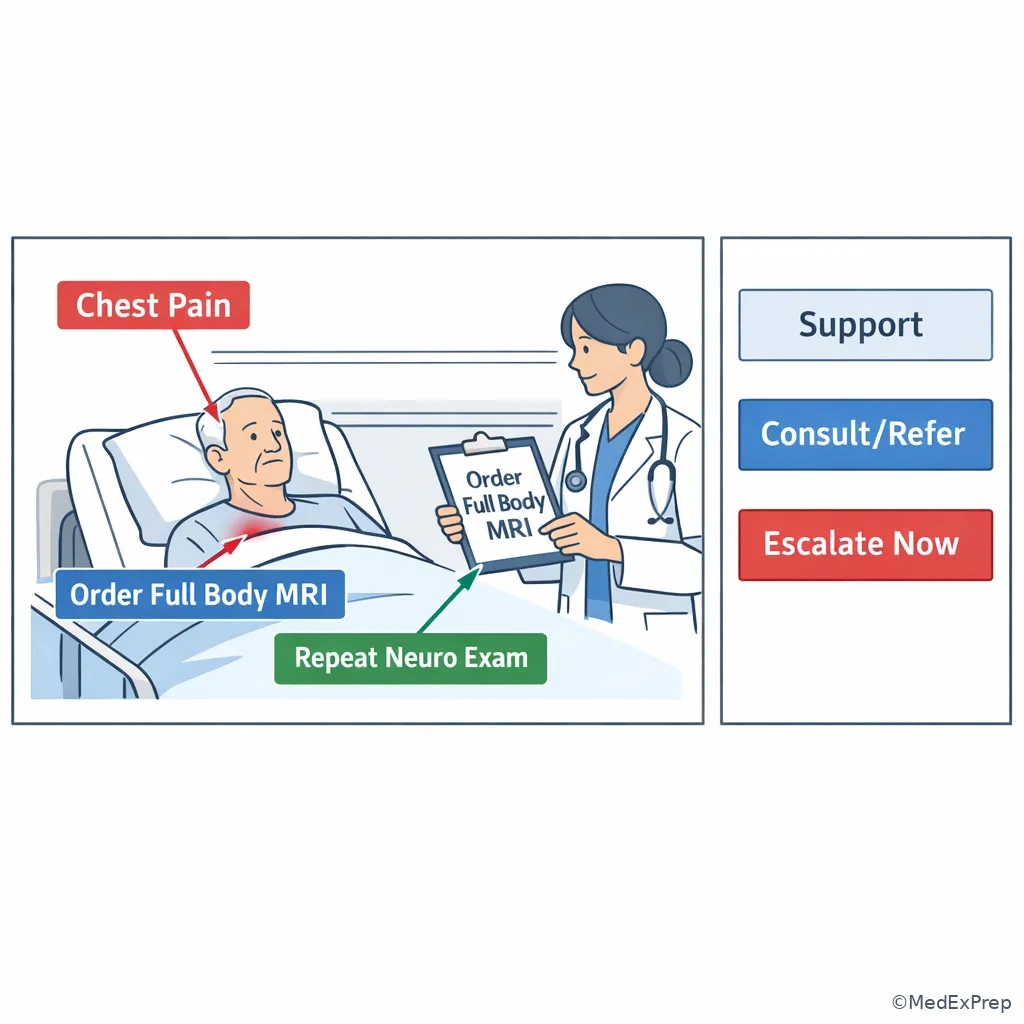
When a stem feels messy, combine everything into one sequence: identify the task - extract key facts - apply the governing boundary rule - choose the in-scope action - verify safety, documentation, and collaboration. This is the course-wide reasoning framework and will reappear across later lessons. See Fig 4 and Fig 5.
Ask five questions in order:
- Is this routine support, service coordination, or an urgent safety issue?
- Is the answer choice asking me to diagnose, prescribe, legally determine, or guarantee something?
- What action can I take right now within scope?
- Who needs to be consulted, referred, or notified?
- What must be documented objectively?
WHY THIS IS TESTED: integration items mix communication, safety, ethics, and documentation. The right answer is usually the one that is both practical and role-bounded.
Key rule: The best answer is rarely the most extreme or the most passive. It is the most appropriate next step within scope that protects safety, maintains professionalism, and moves care forward.
B. Worked example
A 38-year-old client with PTSD symptoms, asthma, and recent stimulant use says during intake, “I just need you to tell me exactly what diagnosis to put on my disability forms, and if my ex calls, don’t tell them anything. Also, I have not slept for three days and sometimes think everyone would be better off without me.” He appears agitated but cooperative. He also spends several minutes discussing an argument with a landlord.
Identify the task: This is an integration item, not a pure communication item.
Extract key facts: Requests for diagnosis and confidentiality limits are present, but the most important clue is possible suicidal thinking plus severe sleep disruption and agitation. The landlord argument is noise.
Apply the rule: Safety outranks routine intake. Do not diagnose; do not give blanket confidentiality promises. Address immediate risk through protocol, notify the appropriate supervisor/clinician, and document the client’s statements and your actions.
Eliminate distractors: Reject “complete the forms first,” “assure absolute privacy,” and “finish the standard intake before reporting concerns.”
Verify: Best next step prioritizes safety escalation while maintaining role honesty and objective documentation.
C. Exam trap
Common wrong answer: “Continue the intake so you can gather a full picture before involving anyone else.”
WHY IT IS TEMPTING: Comprehensive information gathering is usually encouraged.
SINGLE CLUE THAT ELIMINATES IT: The statement that others would be better off without him is a potential suicidality cue that changes the urgency.
D. Checkpoint
Question: Which answer best reflects the integrated boundary framework?
- A. Provide the likely diagnosis, complete the paperwork, and then discuss safety if time allows.
- B. Explain confidentiality limits, address the possible safety concern immediately per protocol, and notify the appropriate supervisor or clinician.
- C. Promise to keep the conversation private to build trust before exploring suicidal statements.
- D. Focus first on the housing dispute because practical stressors are often the root cause of substance use.
Answer: B
- A: Tempting because forms and diagnosis requests are concrete, but it is wrong because it oversteps scope and delays response to a safety cue.
- B: Tempting because it may feel procedural, but it is right because it balances honesty, safety, and collaboration.
- C: Tempting because trust matters, but it is wrong because false secrecy promises are unethical and unsafe.
- D: Tempting because social stressors are important, but it is wrong because the stem contains a higher-priority potential self-harm clue.
If you missed this: Review 1.1.1.6 Integration: the best-next-step boundary framework - focus on prioritizing the highest-risk clue before routine tasks.
- Fill in the blank: In messy stems, the highest-priority discriminator is usually the safety clue.
- True or False: A role-bound answer can still be active, empathic, and practical. True.
- Name the 5 steps: task, facts, boundary rule, action, verify.
Exam takeaway: In mixed stems, prioritize safety, reject out-of-role actions, then choose support, consultation, referral, or escalation.
flowchart TD
A[Read stem] --> B[Identify what is being asked]
B --> C{Any acute safety clue?}
C -- Yes --> D[Immediate protocol and notification]
C -- No --> E{Does option ask for diagnosis, medication, legal determination, or guarantee?}
E -- Yes --> F[Reject as out of role]
E -- No --> G[Choose in-scope action]
G --> H[Support, document, refer, coordinate]
D --> I[Document observations, actions, notifications]
Exam takeaway: Sorting stem clues into safety, scope, and next-step buckets prevents overreach and missed escalation.
Exam Traps & Differentiators
Common traps & distractors: Boundary questions rarely use blatantly absurd options. The wrong answer usually sounds caring, efficient, or strict. Eliminate options that diagnose, prescribe, guarantee outcomes, promise absolute secrecy, use personal resources, or delay urgent safety action.
Most common wrong answer and why
Most common wrong answer: an answer that sounds “more helpful” because it goes beyond scope. Examples include declaring a diagnosis, telling the client which medication or detox path they need, promising total confidentiality, personally solving a transportation or housing problem through private means, or continuing supportive counseling when urgent escalation is required.
Why it is tempting: test-takers often reward decisiveness and emotional rescue. The exam rewards appropriate action, not maximal action.
Looks similar but isn't
| Looks similar | Actually in scope | Actually out of scope | Single discriminator |
|---|---|---|---|
| Screening versus diagnosis | Use structured questions to identify concern and need for referral | Label the client with a disorder independently | Screening identifies risk; diagnosis determines condition |
| Support planning versus treatment ordering | Help identify goals, barriers, and referrals | Order detox, prescribe medication, or set clinical treatment independently | Planning supports engagement; ordering directs medical/clinical care |
| Objective note versus interpretation | Record quotes, observations, actions, notifications | State motives, diagnoses, or legal conclusions | Facts are observable; conclusions require authority/evidence |
| Empathy versus overpromising | Explain limits honestly and offer next steps | Guarantee secrecy or outcomes | Empathy is truthful; overpromising creates risk |
| Helpful flexibility versus dual relationship | Use approved channels and formal resources | Give rides, lend money, use personal social media | Formal support protects fairness and boundaries |
| Calming response versus dangerous delay | Provide immediate safety action and notify appropriate personnel | Continue routine conversation despite acute red flags | Imminent or acute risk changes the priority |
If the stem says ___, think ___
- If the stem says “Tell me my diagnosis”, think gather information and refer/consult rather than diagnose.
- If the stem says “Can you guarantee this won’t be shared?”, think explain confidentiality limits honestly.
- If the stem says “Breathing slowly,” “hard to wake,” “confused after stopping alcohol,” or “I’d be better off dead”, think urgent escalation.
- If the stem says “Just this once, use your personal phone/car/account”, think dual-role risk; use approved channels.
- If the stem says “Write that I’m stable for court/job/housing”, think document facts and refer for authorized determinations.
| Trap pair | Tempting wrong answer | Why tempting | Clue that rules it out |
|---|---|---|---|
| Empathy vs secrecy promise | “I will never tell anyone.” | Feels trust-building | Confidentiality has limits for safety and other required exceptions |
| Helpfulness vs overreach | Recommend medication or detox level | Feels efficient | Medication and medical treatment decisions exceed scope |
| Calming vs delaying | Use counseling first in overdose/withdrawal danger | Supportive techniques are usually good | Acute instability requires protocol-based escalation now |
| Professional note vs polished conclusion | Write a diagnosis-like summary | Sounds sophisticated | Objective notes require observed facts and actions |
| Compassion vs dual relationship | Offer personal ride or personal contact access | Feels humane | Uses personal resources and blurs role boundaries |
Related future traps appear in Allowed Versus Disallowed Actions and Supervision And Escalation Thresholds. Those topics will sharpen confusable pairs like consult versus escalate and screen versus assess without repeating the full boundary framework.
Review connection: The traps above test role-bounded best-next-step judgment. If any felt unfamiliar, revisit 1.1.1.6 Integration: the best-next-step boundary framework before attempting the Self-check quiz.
Tables
| Boundary domain | Within scope | Not within scope | Best exam response |
|---|---|---|---|
| Screening/intake | Structured questions, risk recognition, information gathering | Independent diagnosis | Screen, document, refer/consult as needed |
| Medication issues | Educate on available services and connect to prescriber | Prescribe, adjust, or direct regimens | Clarify role and connect to appropriate clinician |
| Safety event | Recognize red flags, initiate protocol, notify appropriate personnel | Provide independent emergency medical management beyond first-response role | Escalate immediately and document |
| Documentation | Observed facts, client statements, actions, contacts | Unsupported conclusions, motives, legal declarations | Use objective language |
| Legal/social outcomes | Referral, support, factual records | Guarantee court, housing, employment, or custody outcomes | Avoid promises; explain role limits |
| Professional relationship | Approved channels, formal boundaries | Dual relationships, financial/social/sexual exploitation | Use SAFE rule and consult policy |
| Scenario type | Choose | Reject |
|---|---|---|
| Client asks “What do I have?” | Explain role, gather information, connect to proper assessment | Provide independent diagnosis |
| Client asks for medication advice | Refer to prescriber/clinician and support engagement | Recommend a medication or dose |
| Client discloses relapse without acute danger | Respond nonjudgmentally, assess immediate safety cues, support next steps | Threaten, shame, or guarantee secrecy |
| Client is hard to wake | Activate emergency protocol | Continue counseling interview |
| Client requests ride or personal favor | Use approved resources and policy-guided options | Offer personal transport or private favors |
| Need to chart the encounter | Record quotes, observations, actions, notifications | Write motives, labels, or unsupported safety declarations |
| Differential classification | Routine support | Consult/referral needed | Urgent escalation needed |
|---|---|---|---|
| Main issue | Barriers, motivation, attendance, goal setting | Diagnostic, medication, legal, specialized service need | Overdose, severe withdrawal, suicidality, violence, medical instability |
| Primary action | Engage, screen, plan, educate, document | Consult supervisor/clinician; arrange referral | Use emergency/urgent protocol immediately |
| Communication style | Collaborative and supportive | Clear role limits and next steps | Calm, direct, safety-focused |
| Documentation emphasis | Goals, barriers, support plan | Request, referral, coordination actions | Observed risk signs, exact statements, times, notifications, actions |
| Typical exam stem clue | “Needs help getting into services” | “Wants you to decide/declare/order” | “Hard to wake,” “confused after stopping alcohol,” “better off dead” |
Exam takeaway: Seeing the three action lanes side by side makes close-call stems easier to sort.
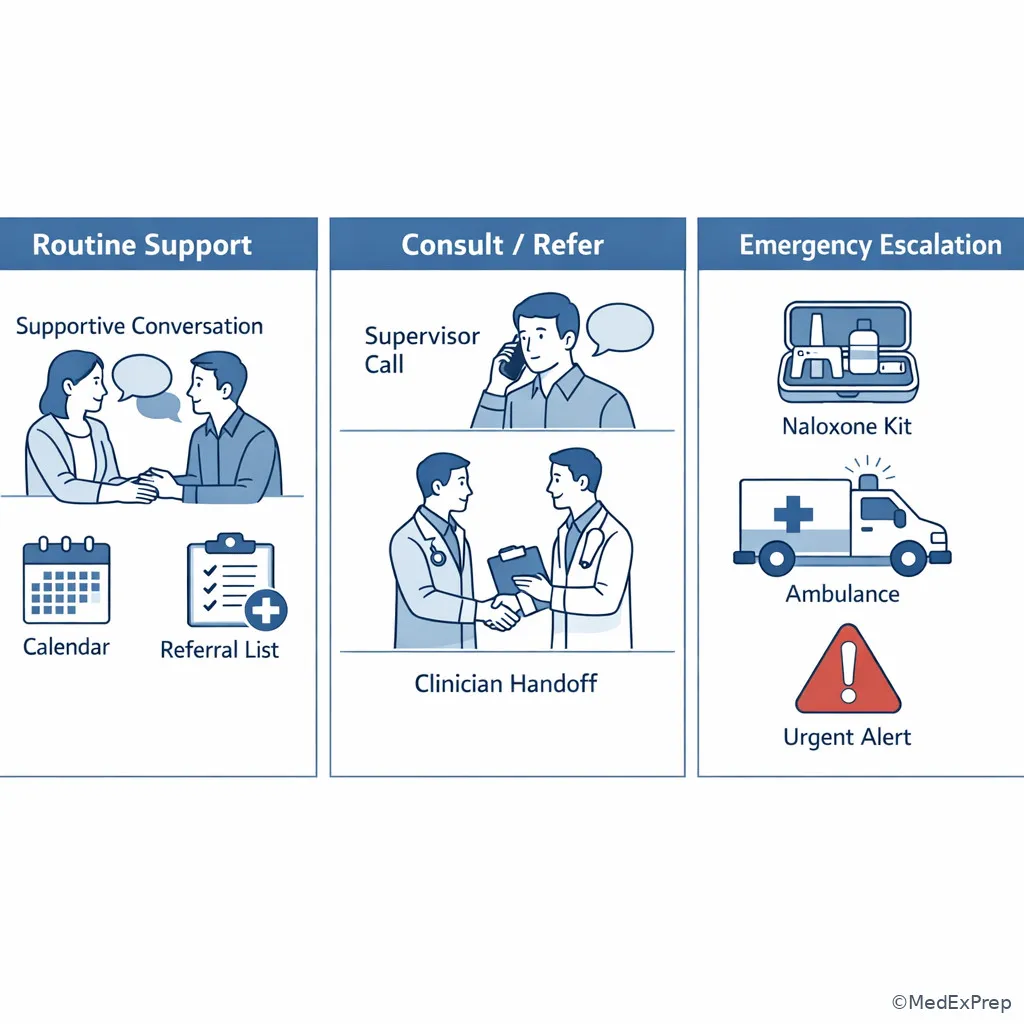
Algorithm / Approach
Exam takeaway: Use this sequence to choose the safest in-scope next step under exam pressure.
When stuck between two plausible answers, prefer the one that is:
- more safety-aware,
- more clearly within role,
- more collaborative with supervision or referral pathways, and
- more objectively documentable.
Rapid Review
- Screening -> identifies concern; does not establish diagnosis.
- Support plan -> organizes goals and barriers; does not order treatment.
- Best boundary answer -> active but role-bounded; not passive, not overreaching.
- Safety cue -> outranks rapport-building conversation.
- Confidentiality -> explain limits honestly; never promise absolute secrecy.
- Documentation -> quote, observe, act, notify; avoid labels and motives.
- Helpful impulse -> check for dual-role risk before acting.
- Medication request -> connect to prescriber/clinician; do not recommend regimen.
- Court or housing request -> provide factual records or referral; do not guarantee outcomes.
- Severe withdrawal clue -> urgent escalation, not routine follow-up.
- Overdose clue -> emergency protocol, not extended assessment interview.
- “Just this once” exception -> common setup for a boundary violation.
- Strongest close-call answer -> clarifies limits and offers the next concrete in-scope step.
Self-check quiz
1. During intake, a client asks the CPSUD professional to confirm whether he “definitely has an addiction diagnosis” before talking further. What is the most appropriate next step?
- A. Confirm the likely diagnosis based on the client’s history so rapport is not lost.
- B. Explain your role, continue structured information gathering, and connect the client to the appropriate clinician or process for diagnosis if needed.
- C. End the interview because no discussion can occur without a diagnosis.
- D. Tell the client to choose the diagnosis that seems most accurate to him.
2. A client says, “Before I tell you anything, promise you will never share this with anyone.” Which response is best?
- A. “I promise total secrecy so you can feel safe talking.”
- B. “Anything you say must be reported to all involved agencies.”
- C. “I want to be honest about the limits of confidentiality so we can talk safely and plan next steps together.”
- D. “I cannot discuss confidentiality until the session is over.”
3. A 46-year-old client with hypertension and alcohol use history presents for a routine support visit. He stopped drinking 36 hours ago, is sweating, shaking, and intermittently confused. He also wants help with a missed rent payment. What is the most appropriate next step?
- A. Complete a housing resource worksheet first because stabilizing housing reduces relapse risk.
- B. Encourage hydration and arrange a follow-up visit tomorrow if symptoms persist.
- C. Initiate urgent escalation per protocol and notify the appropriate supervisor or clinician immediately.
- D. Ask detailed questions about the client’s childhood trauma before deciding what to do.
4. A 29-year-old client with anxiety and probation involvement asks the CPSUD professional to write, “Client is fully stable and no longer using,” for court the same day. The client appears anxious but medically stable and says he missed his bus fare home. What is the most appropriate next step?
- A. Write the statement to support the client because court pressure can worsen relapse risk.
- B. Explain role limits, document the request objectively, and direct the client to the appropriate authorized evaluation or documentation process.
- C. Refuse to speak further because legal issues are never relevant in SUD work.
- D. Write that the client is “probably stable” so the statement is less absolute.
5. A 40-year-old client with depression and chronic pain arrives smelling strongly of alcohol and says, “I only had two drinks.” Which documentation entry is most appropriate?
- A. “Client intoxicated and minimizing, likely relapsed due to poor coping.”
- B. “Client smelled of alcohol, had slowed speech, stated ‘I only had two drinks,’ and was informed of next steps per protocol.”
- C. “Client abusing alcohol again and unsafe to leave.”
- D. “Client manipulative and resistant to treatment.”
6. A 33-year-old client with opioid use history, hepatitis C, and recent job loss says, “I took some pills but I’m fine.” He is very drowsy, breathing slowly, and difficult to arouse. His partner asks you to keep this private because the client could lose housing. What is the most appropriate next step?
- A. Respect privacy, monitor him briefly, and continue the interview if he awakens more fully.
- B. Explain that confidentiality has limits, activate emergency protocol immediately, and notify the appropriate supervisor or emergency system per policy.
- C. Ask the partner what medication he probably took so you can document the diagnosis accurately first.
- D. Provide a lengthy motivational discussion about overdose risk before involving anyone else.
7. A 55-year-old client in early recovery with COPD and major depression asks for a ride to group because he trusts only you. He offers cash for gas and says he will stop attending if you decline. No acute danger is present. What is the most appropriate next step?
- A. Accept the gas money and provide a one-time ride because treatment attendance is clinically important.
- B. Decline the personal ride, use approved program channels to explore transportation options, and document the coordination efforts.
- C. Accept the ride request but refuse the money so the boundary is preserved.
- D. Tell the client transportation is not your problem and end the conversation.
8. A 37-year-old client with PTSD symptoms, recent stimulant use, and insomnia says during intake, “Sometimes everyone would be better off without me, but first I need you to tell me what diagnosis to put on my disability paperwork.” He is agitated, has not slept for three days, and is preoccupied with an argument with his landlord. What is the most appropriate next step?
- A. Complete the paperwork section first so the client feels helped, then revisit the statement later.
- B. Clarify the suicidal statement immediately within protocol, notify the appropriate supervisor or clinician, and avoid providing an independent diagnosis.
- C. Reassure the client that sleep loss often causes dramatic statements and continue standard intake.
- D. Suggest the most likely diagnosis so the paperwork can be started while waiting for supervision.
Answer key
1. Correct answer: B
- A: Tempting because quick diagnostic labeling may seem rapport-building; incorrect because independent diagnosis exceeds the candidate’s role. Single clue: the client asks for confirmation of a diagnosis, which should trigger role-limit thinking.
- B: Tempting because it can feel less definitive; correct because it preserves engagement while staying within scope through information gathering and referral/consultation. Single clue: structured information gathering is allowed, diagnosis is not.
- C: Tempting because it avoids overreach; incorrect because the role still includes supportive engagement and screening even before formal diagnosis.
- D: Tempting because it centers client voice; incorrect because self-selection of diagnosis is not a substitute for proper evaluation and is not role-safe guidance.
If you missed this: Review 1.1.1.1 Foundational boundary rule: support versus determine - focus on gathering information versus making a diagnosis.
2. Correct answer: C
- A: Tempting because reassurance can feel empathic; incorrect because it promises more confidentiality than can ethically or legally be guaranteed. Single clue: “never share this with anyone” tests confidentiality limits.
- B: Tempting because it sounds compliance-oriented; incorrect because it overstates disclosure and does not reflect minimum-necessary, policy-based practice.
- C: Tempting because it may seem less immediately comforting; correct because it combines transparency, empathy, and collaboration.
- D: Tempting because it avoids giving inaccurate information; incorrect because confidentiality explanation should happen before sensitive disclosure, not after.
If you missed this: Review 1.1.1.3 Communication boundaries: empathy without promising, pressuring, or shaming - focus on honest limits of confidentiality.
3. Correct answer: C
- A: Tempting because housing instability matters in recovery; incorrect because the stem includes tremor, sweating, and confusion after alcohol cessation, which is a higher-priority safety issue. Single clue: intermittent confusion after stopping alcohol.
- B: Tempting because hydration and observation sound practical; incorrect because severe withdrawal risk should not be managed casually within this role.
- C: Tempting because it may seem more urgent than some candidates expect; correct because possible severe alcohol withdrawal requires prompt escalation per protocol.
- D: Tempting because trauma history can be clinically relevant; incorrect because it delays response to acute risk.
If you missed this: Review 1.1.1.2 Safety changes the boundary: routine help versus urgent escalation - focus on confusion plus alcohol cessation as an escalation cue.
4. Correct answer: B
- A: Tempting because court pressure is real and helping feels compassionate; incorrect because the statement requested is an unauthorized determination. Single clue: “write fully stable and no longer using” asks for an evaluative declaration.
- B: Tempting because it may seem bureaucratic; correct because it documents the request and channels the client to an authorized process while maintaining support.
- C: Tempting because legal decisions are not yours; incorrect because refusing all discussion is too passive and abandons coordination responsibilities.
- D: Tempting because softer wording sounds safer; incorrect because even a hedged clinical declaration can exceed role and create documentation risk.
If you missed this: Review 1.1.1.1 Foundational boundary rule: support versus determine - focus on factual support versus authorized legal/clinical statements.
5. Correct answer: B
- A: Tempting because it synthesizes the situation; incorrect because it adds diagnosis-like interpretation, motive, and causation unsupported by objective observation. Single clue: phrases like “minimizing” and “poor coping” are interpretive.
- B: Tempting because it may seem plain; correct because it records observable facts, a direct quote, and an action taken.
- C: Tempting because safety is important; incorrect because it states a broad conclusion without showing objective basis or role authority.
- D: Tempting because difficult encounters can feel frustrating; incorrect because it uses stigmatizing and subjective language.
If you missed this: Review 1.1.1.4 Documentation boundaries: record facts, not unsupported conclusions - focus on observable wording and direct quotes.
6. Correct answer: B
- A: Tempting because privacy and observation can feel less disruptive; incorrect because slow breathing and decreased arousal suggest a possible overdose requiring immediate emergency action. Single clue: difficult to arouse plus slow breathing.
- B: Tempting because it overrides the partner’s request, which may feel uncomfortable; correct because confidentiality does not block emergency response to acute medical risk.
- C: Tempting because documentation matters; incorrect because accurate diagnosis is not the immediate task and should not delay emergency steps.
- D: Tempting because overdose education is valuable; incorrect because motivational discussion cannot replace emergency action during an acute event.
If you missed this: Review 1.1.1.2 Safety changes the boundary: routine help versus urgent escalation - focus on respiratory depression as a protocol-triggering clue.
7. Correct answer: B
- A: Tempting because attendance matters and the money can make it seem like a fair exchange; incorrect because accepting payment for a personal ride creates dual-role and exploitation concerns. Single clue: personal ride plus cash offer.
- B: Tempting because it may feel less relationally satisfying; correct because it addresses the barrier through formal, fair, and documentable channels.
- C: Tempting because refusing money may seem to solve the ethics issue; incorrect because the boundary problem is the personal transport itself, not only payment.
- D: Tempting because it strongly protects boundaries; incorrect because it abandons role-appropriate service coordination and is not client-centered.
If you missed this: Review 1.1.1.5 Relationship boundaries: helpfulness versus dual roles and overinvolvement - focus on formal resources versus personal-resource solutions.
8. Correct answer: B
- A: Tempting because helping with paperwork may preserve rapport; incorrect because it delays response to a potential suicidal statement and asks for out-of-scope diagnosis support. Single clue: “everyone would be better off without me.”
- B: Tempting because it may feel procedural under emotional pressure; correct because it prioritizes safety, uses protocol, and avoids diagnostic overreach.
- C: Tempting because insomnia can amplify distress; incorrect because apparent explanation should not dismiss a potential self-harm cue.
- D: Tempting because it seems like a partial solution while waiting; incorrect because independent diagnosis remains out of role and distracts from urgent risk assessment/escalation needs.
If you missed this: Review 1.1.1.6 Integration: the best-next-step boundary framework - focus on prioritizing safety over paperwork and rejecting diagnostic overreach.